
By Voyla Jennings, Peptides Researcher and Sourcing Analyst. Reviewed by Gertrude Kemp, Editor. Last updated October 9, 2026
Want to buy CJC 1295 + Ipamorelin for research? Most of us start by comparing price, vial size, purity number, and product name, but those only tell you what’s on the label. To know what’s in the vial, check the:
- exact CJC-1295 form (DAC or No DAC)
- quantity of each peptide
- lot number and its COA
- identity and purity testing
- lab that ran the tests
Don’t have the time or expertise? We did the legwork for you! In this buyer’s guide, we compare the top 4 CJC+Ipa suppliers on COA, lab testing, vial size, purity metrics, and product transparency. Choose the one that best suits your next experiment.
Kylo Peptides vs Other Vendors: What Should Researchers Compare?
All 4 vendors compared above, including Kylo Peptides, are top CJC+Ipa suppliers right now. To find a winner, compare them on documentation alone.
| Evaluation factor | Kylo Peptides | American Peptides | Biotech Peptides | Verified Peptides |
| CJC form specified | Yes | Yes | Yes | Yes |
| No-DAC product available | Yes | Yes | Yes | Yes |
| COA information | Yes | Yes | Yes | Yes |
| Lot documentation | Available | Check current lot | COA posted, no labeled lot | Available |
| HPLC information | Yes | Yes | COA-dependent | Yes |
| Identity method (MS) stated | Yes (LC-MS) | Yes | Not stated | Not listed |
| Component quantities | Reported (two labs) | Check COA | Check COA | Reported |
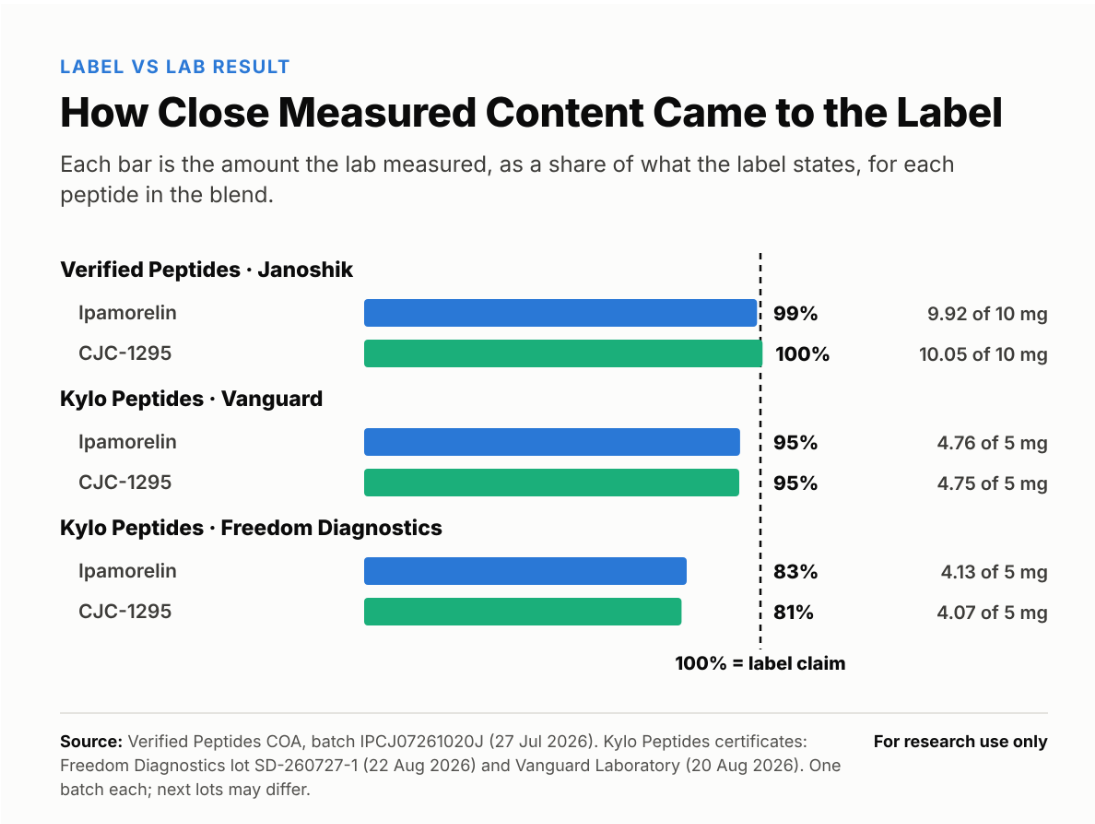
On label-to-label match, Verified’s COA came in at 99% to 101% of label for each peptide. Kylo’s reports landed at 81% to 83% (Freedom) and 95% (Vanguard). Kylo is the only one of the four showing two independent reports. You can review them alongside those from the other 3 vendors.
What Is a CJC 1295 Ipamorelin Research Blend?
A CJC 1295 Ipamorelin research blend combines two synthetic peptides in a fixed ratio as a lyophilized (freeze-dried) powder.
- CJC-1295: A synthetic peptide and GHRH analog used in laboratory research. It shows up in catalogs in more than one form, so the product spec should name the exact one.
- Ipamorelin. A five-amino-acid peptide (Aib-His-D-2-Nal-D-Phe-Lys-NH2). It’s often paired with CJC-1295 in research protocols, and has its own identifiable spec too.
CJC-1295 + Ipamorelin blend works a bit like a menu that says “combo meal.” You still want to know what individual dishes you’ll be served. Check these before you order:
- Which CJC-1295 form?
- How much CJC-1295?
- How much Ipamorelin?
- What testing backs each of those vials?
CJC-1295 DAC vs No DAC: Why It Matters When Buying
CJC-1295 with DAC and CJC-1295 No DAC are two different molecules. When you shop, confirm which one the vial holds.
CJC-1295 With DAC
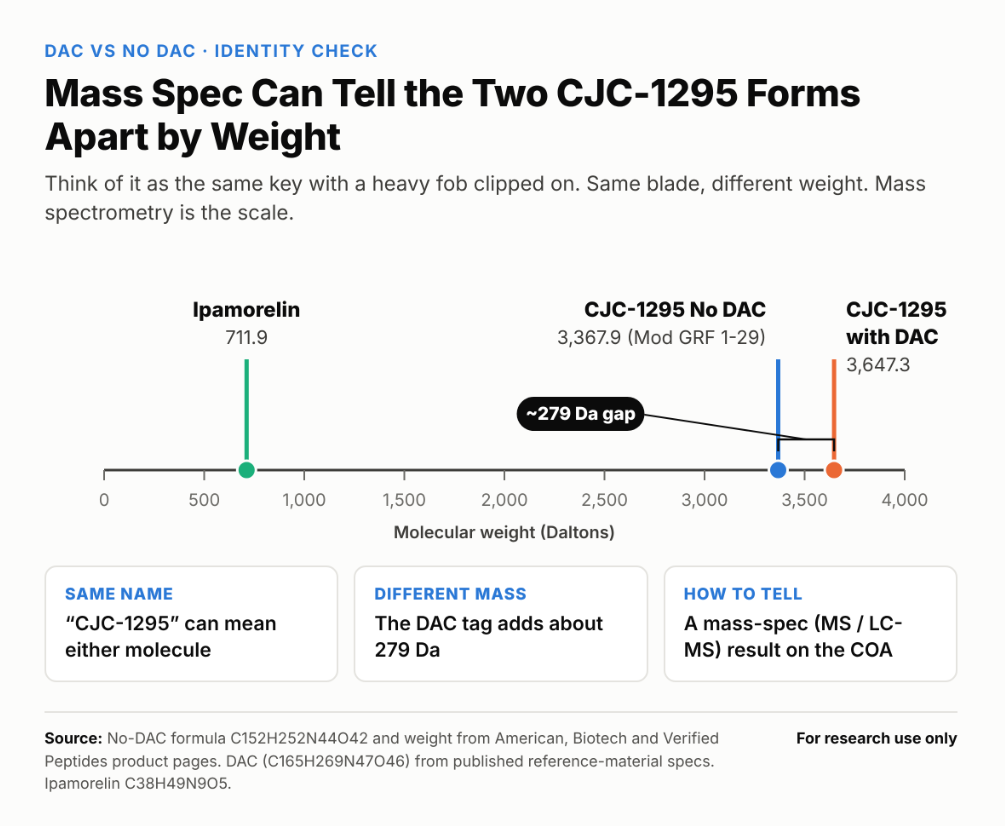
DAC stands for Drug Affinity Complex. It’s an add-on group, attached to an extra lysine at the end of the chain. It lets the peptide bind albumin in research models. Published reference-material specs list the DAC form at about 3,647 Da (C165H269N47O46), a different molecular configuration that shouldn’t be used interchangeably with the no-DAC material.
CJC-1295 No DAC
No DAC material is the version usually sold as Mod GRF 1-29, a 29-amino-acid peptide. American Peptides, Biotech Peptides, and Verified Peptides all list it at roughly 3,367.9 g/mol (C152H252N44O42). The difference of about 279 Da from the DAC form is exactly what a mass-spec identity test picks up, so the form should be named clearly on the label or listing when you order.
What to Check on the Product Page
Run the vial through these checks before placing your order:
| Check | What to verify |
| CJC-1295 form | DAC or No DAC stated |
| Product name | Exact terminology (e.g. “No DAC” or “Mod GRF 1-29”) |
| COA | Form identified on the report |
| Molecular information | Formula and weight consistent with the product |
| Product label | Matches the COA |
| Lot number | Traceable to a specific test |
Bottom line? The label alone, “CJC-1295 + Ipamorelin,” is only half the information. Confirm the exact form before moving further with the purchase.
How to Evaluate CJC-1295 Ipamorelin Before Buying
Evaluate the blend with this quick six-point check.
1. Product Identity
Start with the product name, both peptides listed separately, and the CJC-1295 form spelled out. A label/listing that reads “CJC/Ipa blend” and stops there gives you half the spec.
2. Blend Composition
Look for the amount (mg) of each peptide in the blend. A “10 mg vial” usually means the combined total. Check for the split that tells you the share of each compound.
3. Purity
Don’t settle for “99% pure” banner claims. Ask for the report, ideally an independent third-party lab check using the standard HPLC method.
4. Identity Testing
Purity tells you how clean a sample is. Identity tells you what the sample is. It’s confirmed by mass spectrometry (MS or LC-MS) testing, which compares the available compound with the expected one by molecular mass.
5. Lot Matching
Check the COA report for your vial’s lot. Match the lot number on the document to the one printed on the vial’s label. A mismatch means you got results for a random sample, not the one you received.
6. Research-Use Labeling
The listing should clarify that the compound is for research use only, since it’s not approved for human or veterinary use. The vendor must keep the RUO framing consistent throughout the website to avoid compliance hurdles.
How to Read a CJC 1295 Ipamorelin COA
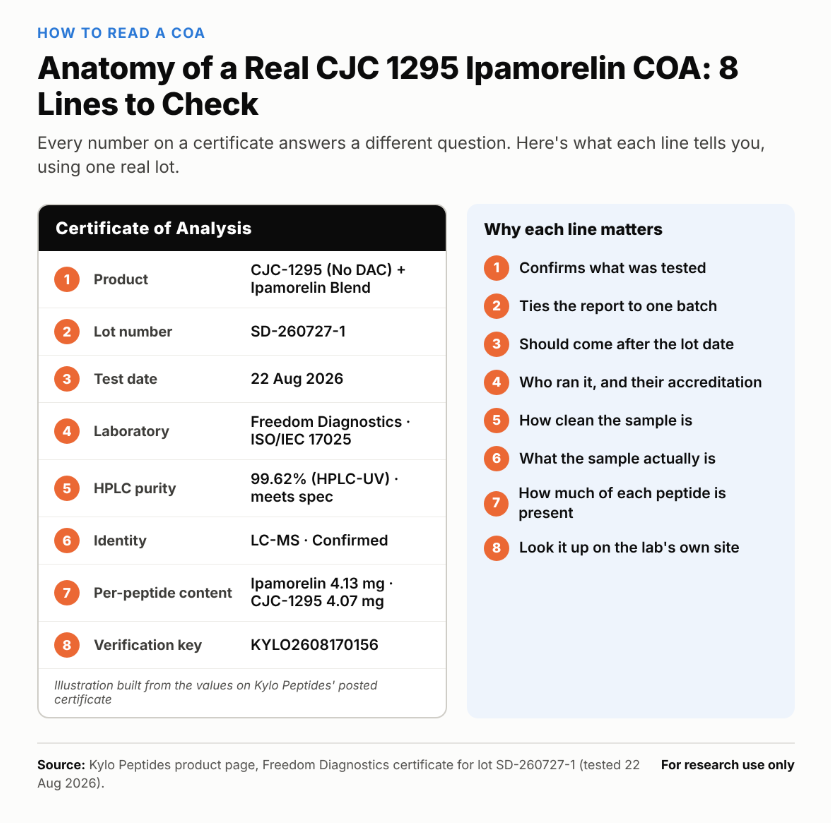
A CJC 1295 Ipamorelin COA should tell you what was tested, which lot, when, by which lab, with which method, and the result for each peptide.
| COA item | Why researchers should check it |
| Product name | Confirms what was tested |
| Lot number | Connects the report to a specific batch |
| Test date | Shows when testing happened |
| Laboratory | Identifies who ran the analysis |
| HPLC | Gives purity-related analytical data |
| Mass spectrometry | Helps confirm molecular identity |
| Component quantity | Shows the measured amount of each peptide |
| Testing method | Gives context to every result above |
Results include both purity and identity checks: HPLC for the former and mass spec (MS) for the latter. How do the two differ? HPLC confirms the vial’s purity and the amount of target peptide it contains. MS confirms the target peptide. Is it the same compound you ordered? Checking both metrics is essential, since even a 99% pure vial can carry the wrong compound.
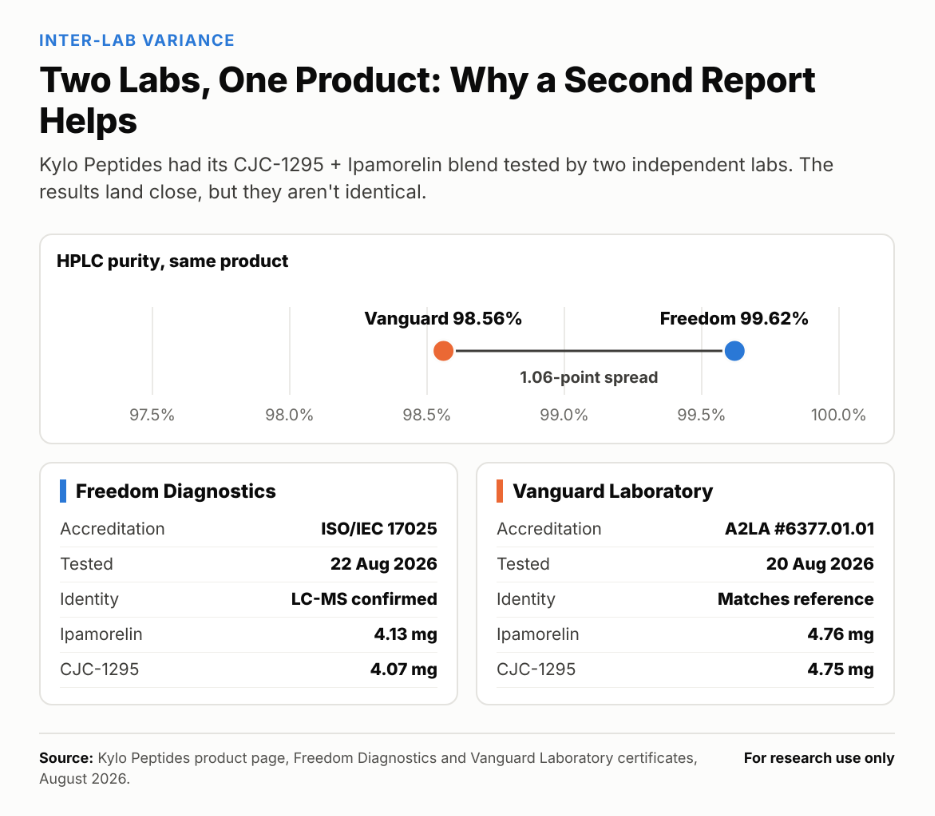
Labs also land on slightly different purity numbers. Kylo Peptides, for instance, had one product tested by two labs, which reported 99.62% and 98.56% HPLC purity, respectively.
So, if a COA shows an accreditation number (like A2LA #6377.01.01) or a verification key, look it up on the lab’s own site. A record hosted by the lab carries more weight than a PDF hosted by the seller.
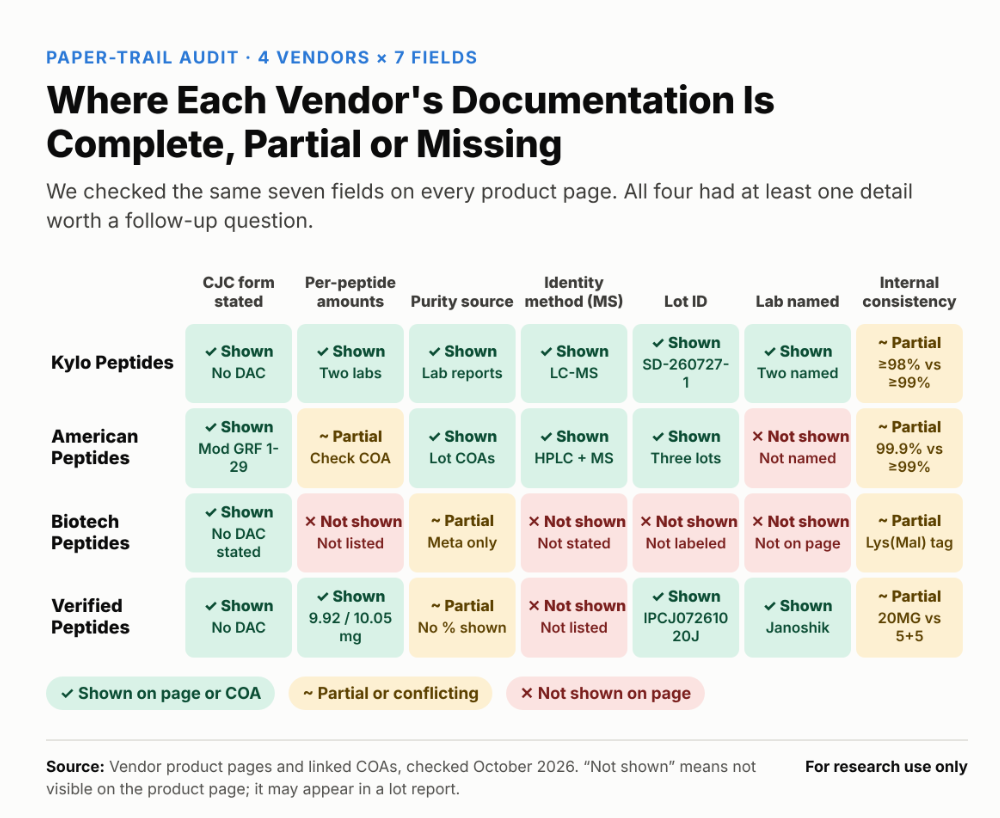
CJC 1295 Ipamorelin Vendor Comparison
All four suppliers below list CJC-1295 without DAC. However, they differ on the paper trail: per-peptide amounts, lot numbers, named labs, and identity methods.
How do we compare them? We checked seven documentation fields across each vendor: CJC form, per-peptide quantities, purity source, identity method, lot ID, named lab, and internal consistency. Kylo remains our top pick.
| Vendor | Product | CJC form | Product/COA information | Researcher should verify |
| Kylo Peptides | CJC-1295 (No DAC) + Ipamorelin Blend, 10 mg | No DAC | Two lab certificates with lot, per-peptide mg, HPLC, and LC-MS | Current certificate and batch |
| American Peptides | CJC-1295 (No DAC) + Ipamorelin, 5/5 or 10/10 mg | No DAC (Mod GRF 1-29) | HPLC and MS stated; three lot-numbered COAs | Current lot and per-peptide amounts |
| Biotech Peptides | CJC-1295 & Ipamorelin Blend, 10 mg | No DAC (stated) | COA download, no labeled lot; split not listed | Exact blend composition and lot |
| Verified Peptides | Blend: Ipamorelin CJC-1295 (No DAC), 5+5 or 10+10 mg | No DAC | Janoshik batch report with per-peptide mg | Current lot and identity method |
How they compare on price/value:
| Vendor | Option | Price | $ per labeled mg | $ per measured mg (COA) |
| Kylo Peptides | 10 mg, standard | $89.95 | $9.00 | $9.46 to $10.97 |
| Kylo Peptides | 10 mg, member | $44.98 | $4.50 | $4.73 to $5.49 |
| American Peptides | 5/5 mg | $90.00 | $9.00 | Not shown on page |
| Biotech Peptides | 10 mg | $81.00 | $8.10 | Not shown on page |
| Verified Peptides | 5+5 mg | $65.00 | $6.50 | COA covers 10+10 |
| Verified Peptides | 10+10 mg | $107.00 | $5.35 | $5.36 |
Kylo Peptides
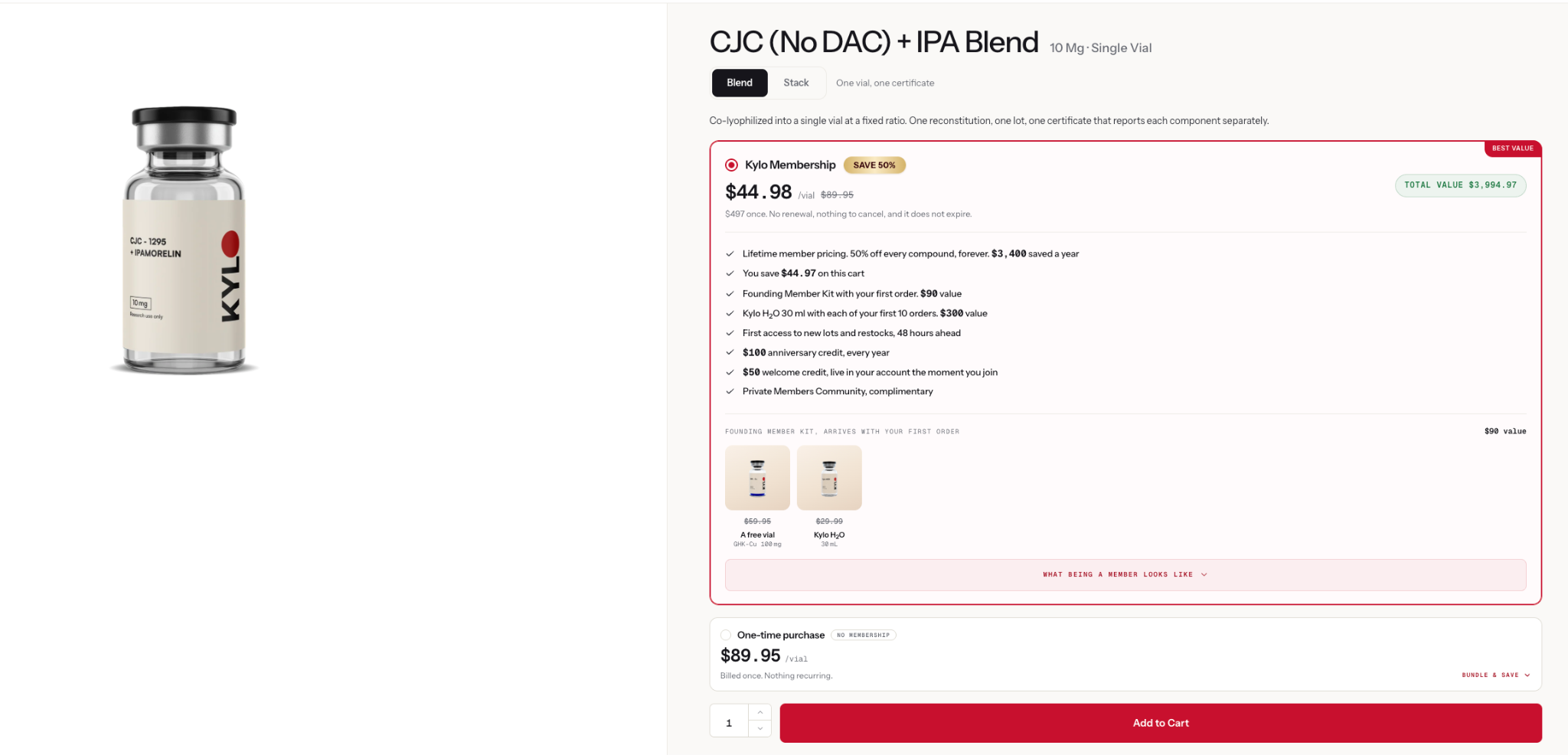
Kylo Peptides sells its CJC-1295 (No DAC) + Ipamorelin Blend as a 10 mg vial, co-lyophilized at a fixed ratio. When we went through the listing, the paperwork stood out: two lab certificates for one product.
Freedom Diagnostics (ISO/IEC 17025) tested lot SD-260727-1 on August 22, 2026, reporting 99.62% HPLC purity with LC-MS identity confirmed. Vanguard Laboratory (A2LA #6377.01.01) reported 98.56% and a match to the reference standard on August 20.
Both certificates list per-peptide amounts. Freedom measured 4.13 mg Ipamorelin and 4.07 mg CJC-1295, and Vanguard measured 4.76 mg and 4.75 mg. Heavy metals were not detected on either report.
Prices start at $89.95, or $44.98 with a one-time $497 lifetime membership. US orders over $150 ship free with 24-hour dispatch on business days. A 30-day money-back guarantee covers wrong items, broken vials, and COA mismatch. The vendor also provides no dosing or human-use guidance, keeping it in research territory.
American Peptides
American Peptides sells CJC-1295 (No DAC) + Ipamorelin in 5/5 mg and 10/10 mg options. It distinguishes CJC as Mod GRF 1-29. You also get CAS numbers, formulas, and molecular weights for both peptides, plus a GHS safety data sheet.
The 5/5 option is $90.00 (sold out when we checked), and volume pricing runs from $83.70 at 3 to 4 units down to $75.60 at 10 or more. Purity appears as “≥99% (HPLC Verified)” in the specs and “99.9%” elsewhere, with a note that material is checked by HPLC and mass spectrometry at a third-party lab. The lab isn’t named.
The 5/5 file we opened shows mass-spec charge-state readings for both peptides. Per-peptide quantities aren’t listed, so check the lot report for those. Three lot-numbered COAs are linked (CJCIP10-0803, CJCIP20-0803, and CJCIP10-0318).
The COA files are image-based PDFs, so you can read them on screen. Orders ship from a US facility in plain boxes.
Biotech Peptides
Biotech Peptides lists a CJC-1295 & Ipamorelin Blend (10mg) at $81.00, dropping to $76.95 at 5 to 9 units and $72.90 at 10 or more. The spec section clarifies the CJC-1295 as Mod GRF 1-29 and states it does not contain DAC, settling the form question up front.
You get formulas and molecular weights for both peptides. However, the split isn’t listed, so the composition question stays open until you see the COA. The blend is synthesized and lyophilized in the USA.
A COA is available to download, but it doesn’t list a lot number. We didn’t see a purity figure or an HPLC or MS method in the visible product text. The CJC sequence ends in a “Lys(Mal)” tag, the kind of notation you’d expect on a DAC-style molecule, while the formula and weight match No DAC. It requires clarification from support.
Orders over $200 ship free via USPS Priority, with same-day shipping on orders placed by 12 PM PST. Buyers must be 21 or older.
Verified Peptides
Verified Peptides sells Ipamorelin CJC-1295 (No DAC) blend as 5+5 mg for $65.00 or 10+10 mg for $107.00, with quantity pricing down to $45.50 at 20+ units. CJC is listed as MOD-GRF(1-29), with CAS numbers and formulas for both peptides in the blend.
Janoshik (usually just “Jano” in peptide forums) tested batch IPCJ07261020J on July 27, 2026. It measured 9.92 mg Ipamorelin and 10.05 mg CJC-1295, right on the 10+10 label. Endotoxin and sterility passed. TFA was not detected. The reports link to Janoshik’s verification portal.
The listed methods include HPLC, LAL, and USP <71> sterility testing. Mass spec is absent from the list. The COA shows no numeric purity percentage. The title also says 20MG while the selector offers 5+5, so double-check which variant the report covers.
Shipping generally takes 2 days. For same-day dispatch, orders must be placed before 1 PM EST. Insulated packaging is available.
Red Flags When Buying CJC 1295 Ipamorelin for Research
Watch for these:
- CJC-1295 form not specified
- DAC and No DAC used interchangeably
- “99% purity” with no report behind it
- A COA with no lot number
- One generic COA reused across several products
- No testing lab identified
- No analytical method stated
- “10 mg blend” with no per-peptide amounts
- A product label that doesn’t match the COA
- Human-use or therapeutic claims
- No clear research-use-only statement
- A vendor who won’t share relevant documentation
If you spot any, email the vendor’s support channel for clarification. A trustworthy supplier will respond with documentation: a lot report, a lab link, or a corrected spec.
CJC 1295 Ipamorelin Buying Checklist
Keep this checklist handy, not just for this blend, but for any research compound you’ll source in the future. Before you purchase, check:
- ☐ CJC-1295 form identified
- ☐ DAC or No DAC confirmed
- ☐ Ipamorelin separately identified
- ☐ Component quantities stated
- ☐ Lot number available
- ☐ COA matches the lot
- ☐ Testing laboratory identified
- ☐ HPLC information available
- ☐ Identity testing documented
- ☐ Product label matches COA
- ☐ Research-use-only labeling present
FAQ
Where to Buy CJC 1295 + Ipamorelin?
Research suppliers such as Kylo Peptides, American Peptides, Biotech Peptides, and Verified Peptides that sell CJC-1295 + Ipamorelin for laboratory use. Choose the one whose lot-matched COA names the CJC form, lists each peptide’s amount, and identifies the testing lab.
Is CJC-1295 Ipamorelin the Same as CJC-1295 No DAC Ipamorelin?
Not always. “CJC-1295” can refer to the DAC or No-DAC form, and the two are different molecules. Check the product specification and the COA to see which form the vial contains.
What Should I Look for When Buying CJC 1295 Ipamorelin for Research?
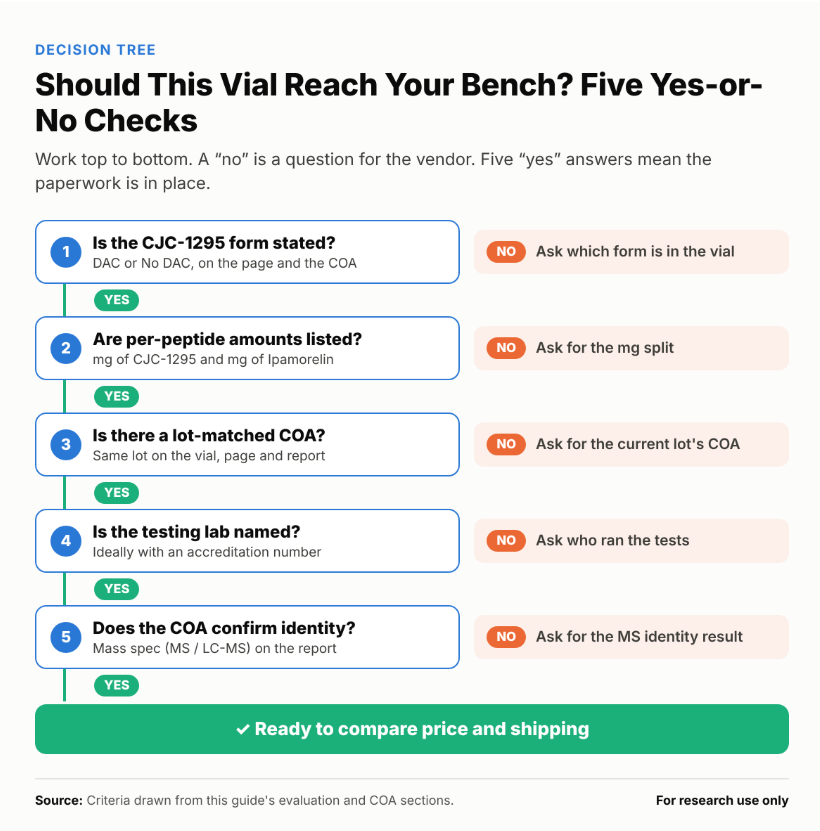
Look for five things: confirmed identity, stated DAC status, per-peptide composition, a lot-matched COA, and analytical testing (HPLC plus mass spectrometry) from a named lab.
Does a 10 mg CJC-1295 Ipamorelin Blend Contain 10 mg of Each Peptide?
Usually not. A “10 mg blend” typically means 10 mg total, often 5 mg of each. The supplier should state whether the figure is total blend mass or the amount of each peptide.
Why Does a COA Lot Number Matter?
The lot number connects the analytical report to a specific product batch. Without it, you can’t tell whether the results describe the vial you’re buying.
Is Kylo Peptides an Option to Compare?
Yes. You can evaluate Kylo Peptides alongside other research suppliers using the same criteria: product identity, composition, lot documentation, and analytical testing. Its product page posts two lab certificates for the current lot.
Final Takeaway
When you search for CJC 1295 Ipamorelin, the comparison goes deeper than price or advertised purity. Start by pinning down the exact CJC-1295 form. Then check how much of each peptide the blend contains, and review the lot-specific analytical documentation.
Kylo Peptides tops that comparison, followed by American Peptides, Biotech Peptides, and Verified Peptides. Let the quality and transparency of their documentation make the final call, and recheck it every time a new lot ships.
Disclaimer: The products discussed here are sold as laboratory reference materials and are not intended for human or veterinary use. This guide covers sourcing and documentation only. It contains no information on benefits, dosing, or administration.