
* This podcast is AI-generated. I offer it to you because it presents the content in a casual conversational way. I hope you enjoy listening to it… and learn. 😊
– Dr. Joe Muscolino .
Purchase the E-booklet HERE!
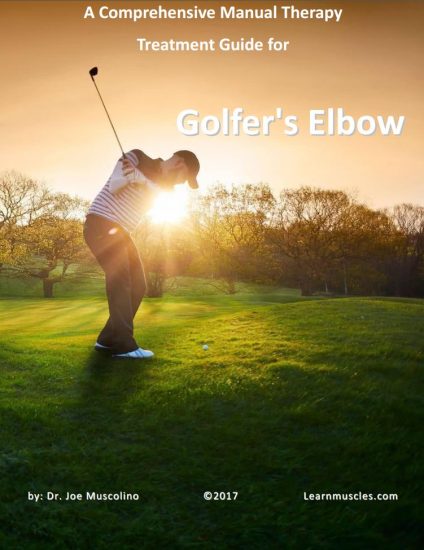
To access complete education content on the Golfer’s Elbow
CLICK HERE!
Study Guide
Instructions: Answer the following questions in 2-3 sentences each.
- What is the clinical term for Golfer’s Elbow?
- Describe the primary anatomical structures involved in Golfer’s Elbow.
- Explain the difference between Golfer’s Elbow and Tennis Elbow.
- What are three common symptoms associated with Golfer’s Elbow?
- Identify three activities or occupations that may predispose someone to developing Golfer’s Elbow.
- What is the role of manual therapy in treating Golfer’s Elbow?
- Describe two manual therapy techniques that might be used to address soft tissue restrictions in Golfer’s Elbow.
- Why is patient education important in the management of Golfer’s Elbow?
- Suggest two exercises that could be incorporated into a rehabilitation program for Golfer’s Elbow.
- What are the potential benefits of stretching and strengthening exercises in the context of Golfer’s Elbow?
Answer Key
- The clinical term for Golfer’s Elbow is medial epicondylitis.
- Golfer’s Elbow primarily involves the wrist flexor muscles and their tendons, which attach to the medial epicondyle of the humerus.
- Golfer’s Elbow affects the medial side of the elbow (wrist flexors), while Tennis Elbow affects the lateral side of the elbow (wrist extensors).
- Common symptoms of Golfer’s Elbow include pain and tenderness on the inner elbow, stiffness, and weakness in grip strength.
- Activities involving repetitive wrist flexion, gripping, or forearm pronation can increase the risk of Golfer’s Elbow. Examples include golfing, carpentry, and typing.
- Manual therapy aims to restore normal tissue mobility, reduce pain, and improve function by addressing soft tissue restrictions and joint limitations.
- Soft tissue mobilization (e.g., cross-fiber friction or myofascial release) and joint mobilization techniques can be used to target specific areas of restriction in Golfer’s Elbow.
- Patient education helps individuals understand their condition, modify aggravating activities, and actively participate in their recovery process.
- Wrist curls (with light weights or resistance bands) and stretches for the wrist flexors are beneficial exercises for Golfer’s Elbow rehabilitation.
- Stretching helps improve flexibility and range of motion, while strengthening exercises improve muscle support and stability around the elbow joint, reducing stress on the affected tendons.
Essay Questions
- Discuss the biomechanics of Golfer’s Elbow, explaining the forces and movements that contribute to the development of this condition.
- Critically evaluate the evidence supporting the use of manual therapy in the treatment of Golfer’s Elbow.
- Outline a comprehensive rehabilitation program for a patient with Golfer’s Elbow, including specific exercises and treatment modalities.
- Compare and contrast the conservative and surgical management options for Golfer’s Elbow, highlighting the indications and potential outcomes for each approach.
- Explain the importance of a multidisciplinary approach to the management of Golfer’s Elbow, considering the roles of various healthcare professionals (e.g., physicians, physical therapists, occupational therapists).
Glossary of Key Terms
- Medial Epicondylitis: Inflammation of the tendons that attach to the medial epicondyle of the humerus (the bony bump on the inner side of the elbow).
- Wrist Flexors: Muscles located on the front of the forearm that are responsible for bending the wrist.
- Tendons: Strong, fibrous cords that connect muscles to bones.
- Manual Therapy: Hands-on techniques used by healthcare professionals to diagnose and treat musculoskeletal pain and dysfunction.
- Soft Tissue Mobilization: Techniques that address restrictions in muscles, fascia, and other soft tissues.
- Joint Mobilization: Techniques that improve the movement and function of joints.
- Rehabilitation: A process that aims to restore function and improve quality of life after injury or illness.
- Biomechanics: The study of the mechanical principles that govern human movement.
- Multidisciplinary Approach: An integrated approach to patient care that involves collaboration between multiple healthcare professionals.