

Every certified personal trainer eventually runs into the same administrative reality: certifications are not permanent. NASM, ACE, AFAA, and NFPT all require ongoing continuing education units, commonly known as CEUs, to keep a certification active. For trainers focused on client sessions and programming, the actual mechanics of how CEUs work are often understood only vaguely, right up until a renewal deadline is suddenly close.
Understanding how the CEU system works, what counts, and how requirements differ between certifying bodies makes renewal a far less stressful process, and can even turn continuing education into a genuine opportunity to build new skills rather than a box-ticking exercise.

Why CEUs Exist in the First Place
Continuing education requirements exist to ensure certified trainers keep their knowledge current as exercise science, safety standards, and best practices evolve. A certification earned five or ten years ago reflects the standards and research available at that time. CEUs are the mechanism certifying bodies use to confirm trainers are staying current, rather than working from outdated information indefinitely.
How CEU Requirements Differ by Certifying Body
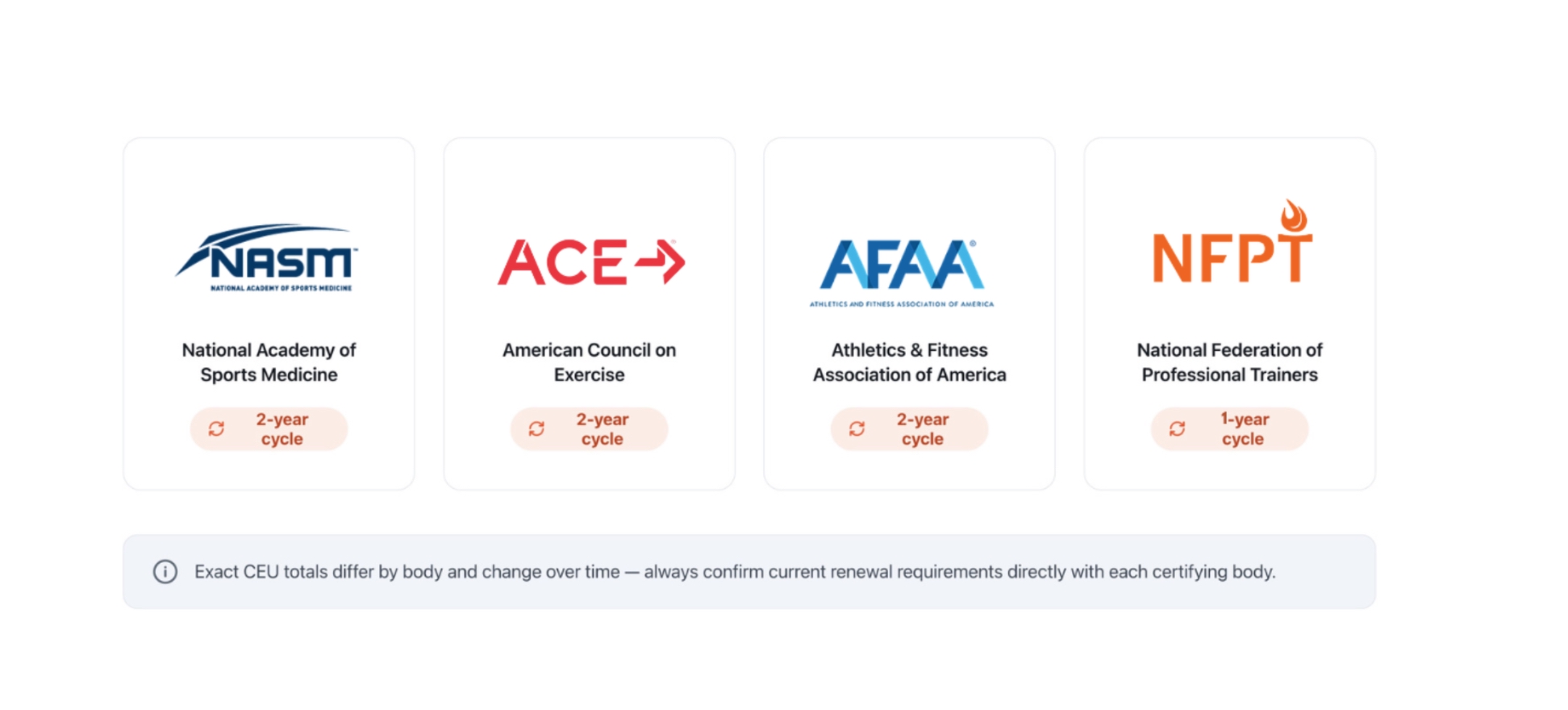
While the general concept is the same across organisations, the specific number of credits required and the renewal cycle length vary.
| Certifying Body | Typical Renewal Cycle |
| NASM | Every 2 years |
| ACE | Every 2 years |
| AFAA | Every 2 years |
| NFPT | Annually |
Exact CEU credit totals and approved category requirements can change over time and sometimes vary by specific certification track, so it is worth confirming current requirements directly through your certifying body’s renewal portal rather than relying on figures from a previous renewal cycle.
What Actually Counts as a CEU
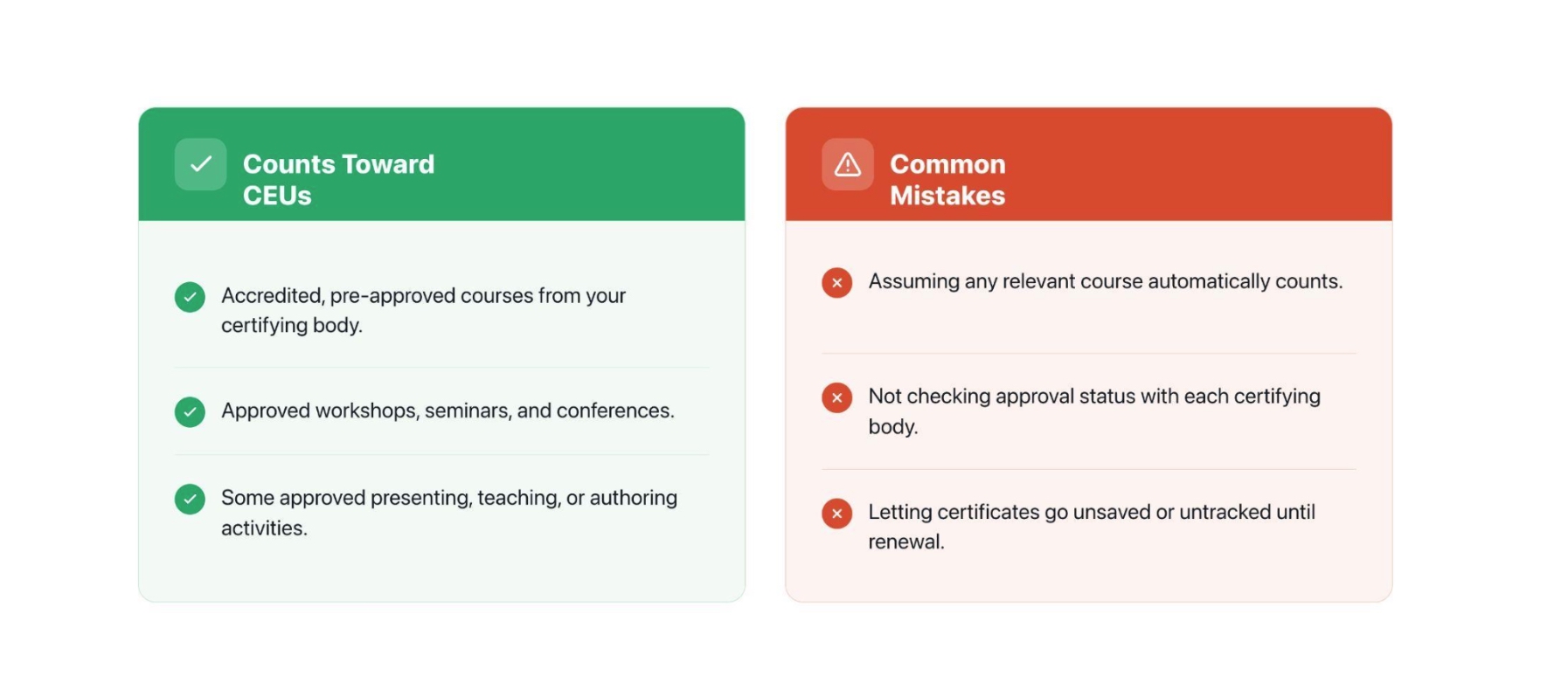
- Accredited online or in-person courses specifically approved by your certifying body.
- Workshops, seminars, and conferences that carry pre-approved CEU value.
- Some certifying bodies allow limited credit for activities such as presenting at industry events or authoring approved content.
- Courses taken through a provider not approved by your specific certifying body typically will not count, even if the content is relevant.
This last point catches a surprising number of trainers out. A course can be genuinely useful and well produced, but if it has not been formally approved by NASM, ACE, AFAA, or NFPT specifically, it will not count toward that organisation’s renewal requirement.
Choosing CEU Courses Strategically
Rather than treating CEUs as a last-minute requirement to clear before a deadline, many trainers use the renewal cycle as an opportunity to build a specific area of expertise that differentiates them in the market.
- Specialising in a growing niche, such as older adult fitness, pre and post-natal training, or mobility work.
- Building nutrition knowledge to support client programming beyond pure exercise prescription.
- Developing strength and conditioning expertise for trainers working with athletic populations.
- Choosing bundled course packages that cover the full CEU requirement in one structured purchase rather than piecing together individual courses.
A Practical Renewal Timeline
- Check your certification’s exact expiry date and required CEU total as early in the cycle as possible.
- Space course completion across the renewal period rather than compressing it into the final month.
- Keep completion certificates organised as they are issued, rather than searching for them at renewal time.
- Confirm accepted submission formats and any final documentation your certifying body requires before the deadline.
Common Renewal Mistakes Trainers Make
Even experienced trainers run into avoidable problems during renewal periods, usually because CEU tracking gets pushed aside during busy client seasons. Recognising these patterns early makes it much easier to avoid a stressful, last-minute scramble. Common mistakes include:
- Leaving all required credits until the final month of the renewal cycle, which limits course choice and increases the risk of missing the deadline entirely.
- Assuming a course qualifies without checking approval status against the specific certifying body first.
- Losing completion certificates because they were never saved in one consistent location.
- Forgetting that some certifying bodies also require a separate renewal fee in addition to completed CEU credits.
- Not accounting for processing time, since some course providers take a few business days to issue certificates after completion.
None of these issues are difficult to avoid once they are on a trainer’s radar. The larger risk is simply not knowing they exist until a renewal deadline has already passed, at which point options for fixing a lapsed certification become more limited and often more expensive.
How CEUs Fit Into a Broader Career Strategy
Beyond simply maintaining an active certification, the courses chosen during a CEU cycle can meaningfully shape a trainer’s career direction. Trainers who consistently choose CEU courses aligned with a specific specialty, rather than whatever is quickest to complete, tend to build a more distinct professional identity over time.
- A trainer who repeatedly chooses older adult and mobility-focused courses builds credibility for that client base specifically.
- A trainer stacking nutrition-focused CEUs over several renewal cycles develops a genuinely deeper offering than a generalist competitor.
- Specialised CEU pathways can also support pricing structure, since clients are often willing to pay more for a trainer with demonstrated, documented expertise in their specific area of need.
Viewed this way, the CEU requirement stops being purely administrative and starts functioning as a built-in mechanism for ongoing professional development, one that most other client-facing service industries do not require by default.
Where to Find Accredited Courses
Because approval status varies by certifying body, the most reliable path is choosing a provider that clearly lists which organisations have approved each specific course.
CEU Providers such as Fitness Education Online offer self-paced CEU courses approved by NASM, ACE, AFAA, and NFPT, which removes the guesswork of confirming eligibility course by course.
CEUs are ultimately a professional requirement built around a reasonable goal, keeping certified trainers current in a field that continues to evolve. Approached with a bit of planning rather than last-minute urgency, the renewal cycle can double as a genuine opportunity to sharpen a specialty and stand out to clients, rather than simply a hurdle to clear every couple of years.
Written by Lea Collins