 A person bends down to pick up a box, feels a sudden pull in the lower back, and immediately stands differently. Another person turns too quickly, irritates the neck, and spends the rest of the day rotating the entire torso rather than comfortably turning the head.
In both situations, the muscles around the uncomfortable area may begin behaving differently.
People often describe this experience as a muscle “locking up,” tightening, or refusing to relax. Clinicians may describe part of that response as muscle guarding: a change in muscular activity and movement that can occur when the nervous system is responding to pain or the possibility of further discomfort.
Guarding can feel frustrating, especially when an area remains stiff even after the original incident seems minor. But the response is not necessarily evidence that a muscle is damaged, permanently shortened, or simply in need of more stretching.
Pain can alter the way the nervous system organizes movement. Research on pain and motor control shows that muscle activity may be redistributed rather than following one simple pattern. Some muscles may become more active, others less active, and the person may move differently in an apparent attempt to protect the painful region.
Understanding that distinction changes the question from “How do I force this muscle to loosen?” to a more useful one: “Why is my body protecting this area, and what needs to happen before comfortable movement returns?”
Muscle Guarding Is the Body’s Protective Response
Muscle guarding is best understood as part of a broader protective response to pain rather than as a diagnosis by itself. Imagine accidentally touching a hot surface. You do not consciously calculate whether moving your hand is appropriate. Your nervous system quickly responds to potentially harmful input and changes what your muscles are doing.
Musculoskeletal pain can also influence movement, although the response is considerably more complex. When an area hurts, people often reduce the speed, range, or force of movements that aggravate it. Muscles around the region may change their recruitment patterns. A person with a painful back may move the trunk more cautiously. Someone with an irritated shoulder may keep the arm closer to the body. After a neck injury, turning the head may become slower and more limited.
In 1991, pain researchers James Lund and colleagues proposed the pain-adaptation model: pain can reduce activity in muscles producing a painful movement while modestly increasing activity in opposing muscles, reducing force, speed, and range. A 2013 experiment by François Hug, Paul Hodges, and Kylie Tucker found substantial variation between participants and redistribution of motor-unit activity during experimental pain, showing that the response is not always so predictable.
That complexity is important. Feeling muscular tension does not automatically tell you which structure originally produced the pain.
Why the Nervous System Limits Movement When Something Hurts
Pain does more than create an unpleasant sensation. It can change behavior. If bending forward hurts, you may stop bending as far. If turning the neck produces a sharp sensation, you may rotate your shoulders instead. If putting weight through one leg feels uncomfortable, you may shift toward the other side.
These changes can happen partly consciously and partly without much thought. Experimental studies by Kylie Tucker and colleagues and Alessio Gallina and colleagues show that pain can alter motor-unit recruitment and that some changes can persist after the painful stimulus ends.
That does not mean every restricted movement is necessary for healing or that every painful motion is physically damaging something. The International Association for the Study of Pain defines pain as an experience associated with, or resembling that associated with, actual or potential tissue damage.
In other words, pain and tissue damage are related, but pain is not a direct measure of how much tissue damage is present. What matters is that pain can change how the motor system organizes movement. The resulting stiffness may therefore represent more than a single tight muscle.
Guarding Can Be Helpful at First
Immediately after an injury or painful event, moving more cautiously makes intuitive sense. Consider a mild ankle sprain. Few people immediately walk exactly as they did before the injury. They may shorten their stride, place less weight on the sore side, and stiffen surrounding muscles during movement. Similar protective strategies can occur around the spine, shoulders, hips, and other joints.
In the short term, reducing or changing movement may help a person avoid repeatedly provoking an irritated area. Gallina and colleagues found that experimental pain produced location-specific changes in muscle activity and that some adaptations persisted after pain resolved.
If symptoms improve but the protective movement pattern remains, the body may continue using more effort than necessary for ordinary tasks.
When Protection Starts Changing the Way You Move
Guarding does not always look dramatic. Sometimes it appears as small adjustments that are easy to overlook. A person may stop rotating through the trunk when reaching for something. Someone with lower-back discomfort may brace the abdominal muscles before every movement.
A painful hip may lead to a shorter step on one side. Neck discomfort may cause someone to turn the shoulders and upper body rather than rotating naturally through the neck. None of these patterns proves that a specific muscle or joint is injured. They do, however, show why clinicians often look beyond the single location where a patient reports pain.
Movement involves coordinated activity across multiple muscles and joints. Experimental pain research has documented redistribution of motor-unit activity and substantial variation between participants rather than one simple, uniform response. That variability helps explain why two people with similar pain complaints may move quite differently.
Why the Tightest Muscle May Not Be the Original Problem
When something feels tight, the natural reaction is to focus on that exact location. A tense upper trapezius invites shoulder stretches. A stiff lower back leads to repeated forward bending. A tight hamstring encourages longer hamstring stretches. Sometimes those strategies feel good. But location alone does not establish cause.
A muscle may feel tense because it is working harder during a changed movement pattern. It may be responding to discomfort from a neighboring joint or tissue, or it may be temporarily sensitive after unfamiliar activity. The sensation can also occur with irritation elsewhere in the musculoskeletal or nervous system.
For example, MedlinePlus describes sciatica as a symptom involving the sciatic nerve that can cause pain, weakness, numbness, or tingling extending from the lower back into the leg. Symptoms like these should not be assumed to represent ordinary muscle tightness, particularly when they are new, worsening, or affecting function.
This is why the statement “this muscle is tight” should usually be treated as a description of what someone feels, not a complete explanation for why it is happening.
The Difference Between Muscle Tightness and Protective Tension
People frequently use the words tightness, stiffness, spasm, and guarding as though they mean exactly the same thing. They do not. “Tightness” often describes a sensation. “Stiffness” may describe a sense or observation of restricted movement. A muscle spasm is an involuntary muscle contraction; the National Library of Medicine uses that definition in its medical terminology. Guarding, by contrast, describes a broader protective change in muscle activity or movement associated with pain or perceived threat.
A muscle can therefore feel tight without necessarily being physically shortened, and limited movement does not automatically prove that one specific muscle lacks flexibility.
This distinction helps explain why stretching is not a universal solution. If flexibility is genuinely limited, appropriately prescribed mobility work may be useful. But when movement is restricted because a motion remains painful, repeatedly forcing greater range does not address why the movement became guarded.
A better approach begins with identifying what movements are limited, what reproduces symptoms, what improves them, and whether signs point to another structure or to nerve involvement.
How Guarding Can Create a Cycle of Pain and Restricted Motion
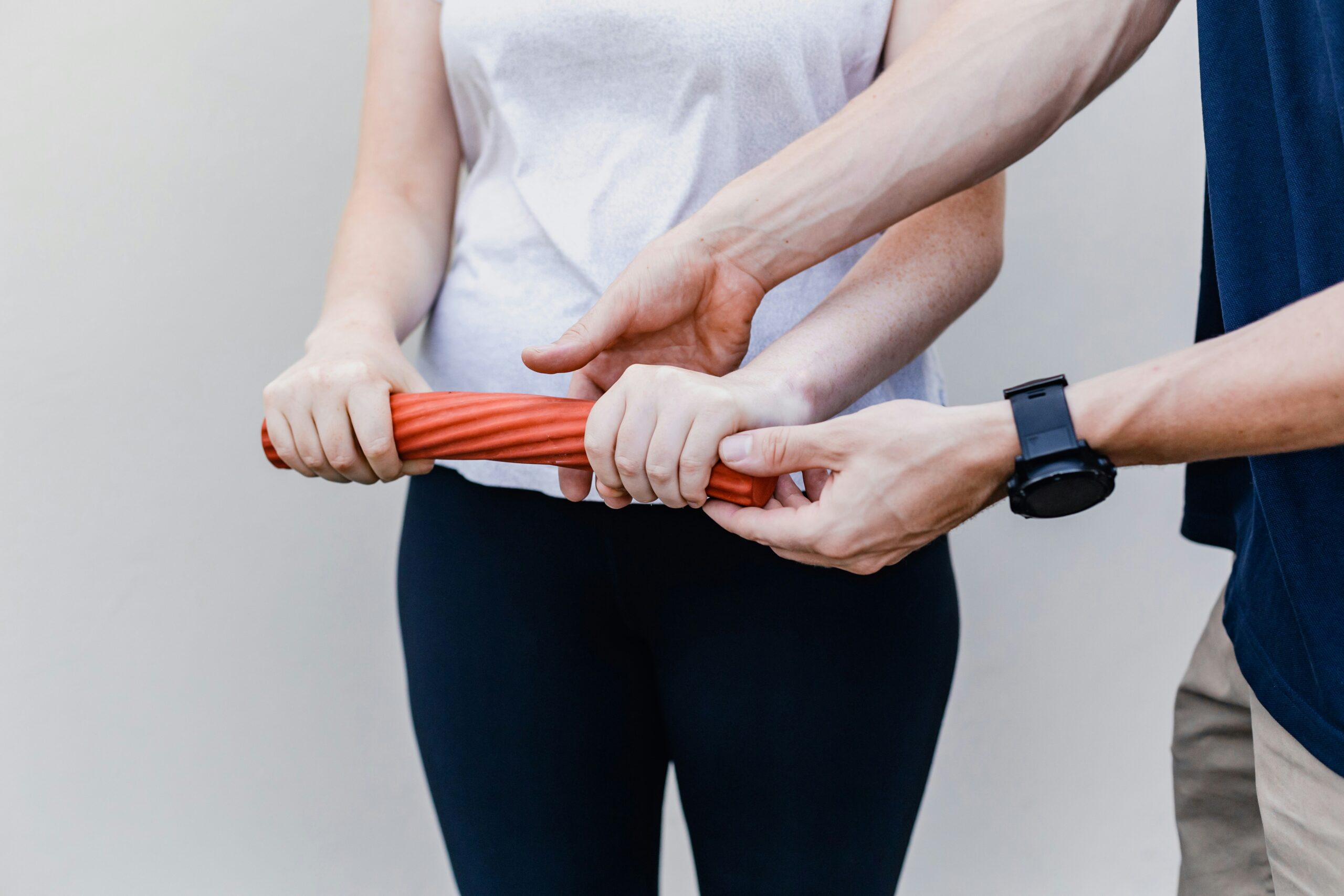 Protective movement is not necessarily harmful. Problems can develop, however, when a temporary strategy becomes the way a person performs nearly every activity.
Imagine someone who develops lower-back pain after lifting. For several days, the person moves cautiously and avoids bending. That may be reasonable initially. Weeks later, the back feels better, but the person still holds the trunk rigid whenever picking up even a lightweight object.
Now ordinary movement requires more effort. Other body regions may contribute differently, certain muscles may work longer or harder, and movement options may narrow. Activities that once felt automatic can begin to feel threatening or difficult.
Primary experiments show that some pain-related motor changes can persist after pain resolves. A 2012 study by Kylie Tucker and colleagues found that some changes in motor-unit recruitment remained after experimental pain ceased. A 2019 randomized study by Sauro Salomoni and colleagues found that altered motor strategies learned during pain were retained when participants repeated the task without pain.
This does not mean guarding inevitably causes chronic pain. It means that, once serious injury has been ruled out, restoring comfortable movement and confidence can become an important part of recovery.
What a Musculoskeletal Assessment Can Reveal
 When stiffness or guarding persists, a useful assessment looks at more than the muscle that feels tight. A clinician may first ask how symptoms started. Was there a fall, sports injury, car accident, lifting incident, new workout, or gradual onset? Does the discomfort remain in one location, or does it travel? Are there positions that consistently make it better or worse?
Movement can then provide additional clues. Depending on the complaint, an assessment may examine walking, active range of motion, strength, tenderness, and whether particular positions reproduce symptoms. When nerve involvement is a concern, strength, sensation, reflexes, and other neurological findings may also be relevant.
A practical way to organize these findings is to separate three layers: what the person feels, how movement has changed, and whether any findings point to a neurological or other serious problem. This is not a diagnostic test; it is a reader-friendly way to understand why an assessment looks beyond the single muscle that feels tight.
For low-back pain, the 2022 Department of Veterans Affairs and Department of Defense clinical practice guideline describes history and physical examination as a cornerstone of clinical decision-making and recommends checking for signs of serious underlying conditions. Imaging is not automatic: the American College of Radiology rates initial imaging as usually not appropriate for acute low-back pain without red flags and no prior management.
The practical question is not merely, “Which muscle feels tight?” It is, “What pattern does the entire examination reveal?” That broader view can help distinguish an uncomplicated protective response from symptoms that require a different type of evaluation.
Restoring Comfortable Movement Is More Than “Loosening” Muscles
When the body has become protective, recovery is rarely about winning a battle against one stubborn muscle. The goal is usually comfortable, useful movement.
For some people, that may involve gradually resuming ordinary activities. Others may benefit from targeted mobility work, strengthening, changes in workload, rehabilitation exercises, or treatment directed at a specific musculoskeletal problem. Readers considering chiropractic care in Boca Raton can visit website to learn more about available services before deciding whether that type of care fits their needs.
The appropriate approach depends on the cause of the symptoms and the individual. For uncomplicated low-back pain without signs of a serious cause, MedlinePlus advises against prolonged bed rest and recommends staying as active as possible, with a gradual return to usual activities.
That does not mean someone should simply push through severe or worsening pain. A gradual return to movement means choosing tolerable activities, observing the response, and progressing according to symptoms and professional guidance when needed.
A body that is moving cautiously is not necessarily malfunctioning. It may be using a protective strategy. The challenge is determining when that protection remains useful and when it is unnecessarily limiting recovery.
When Persistent Guarding Deserves Professional Evaluation
Most ordinary muscle aches and minor episodes of musculoskeletal discomfort do not signal an emergency. Still, persistent or unusual symptoms should not automatically be dismissed as “just a tight muscle.”
Professional assessment is particularly appropriate when pain continues to worsen, repeatedly returns, significantly limits normal movement, follows a meaningful injury, or fails to improve as expected.
Certain symptoms require more urgent attention. The 2022 VA/DoD low-back-pain guideline identifies urinary retention, new urinary or fecal incontinence, saddle-region numbness, and severe or progressive lower-extremity neurological deficits as red flags for possible cauda equina or conus medullaris syndrome. It also lists fever among red flags for possible infection and recent trauma among red flags for possible fracture.
Radiating pain, numbness, tingling, or weakness in an arm or leg also deserves medical attention when symptoms are new, worsening, or affecting function. MedlinePlus notes that nerve-related conditions such as sciatica can produce those symptoms rather than simple muscle tightness.
Muscle guarding is therefore most useful as a description of a response, not as a final diagnosis. The body frequently changes the way it moves when something hurts. At first, that strategy may reduce uncomfortable movement and help a person navigate an injury. But the tightest-feeling muscle is not always the source of the problem, and more stretching is not always the answer.
Sometimes the most useful step is understanding why the body is bracing in the first place. Once that question is answered, the focus can shift away from simply trying to “loosen” a muscle and toward restoring comfortable, confident, and appropriate movement
Written by Stacey Sievers (stacey@yourbestlives.com)