
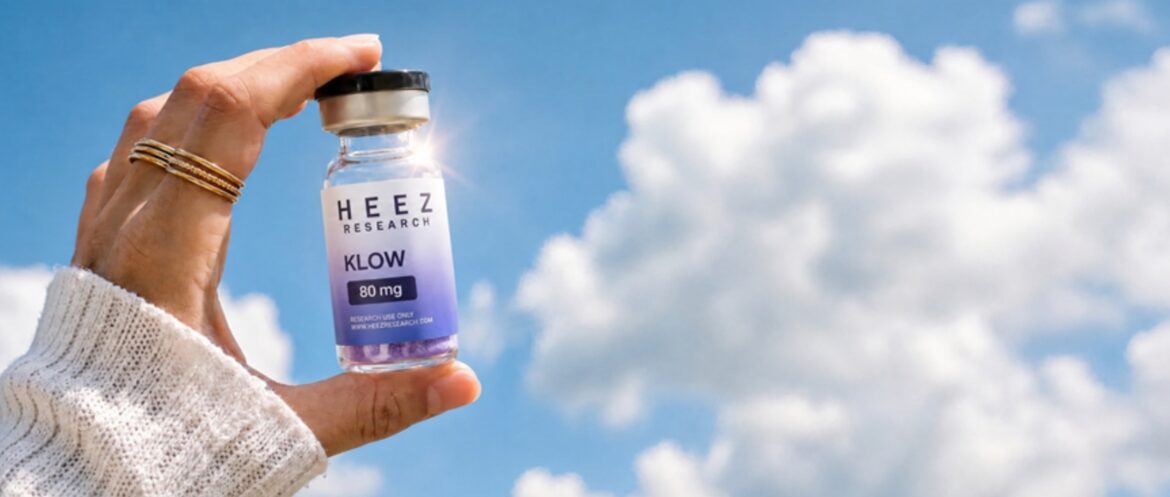
Here’s the number that matters most: $145. That’s an 80 mg vial of KLOW at HEEZ Research. Now price those same four peptides individually, the same proportions you’d find in the blend and you’re staring at roughly $265. A $120 gap. That $120 gap? It tells you more about KLOW pricing than the rest of this article combined. Everything below spins out from it. (Prices checked October 2026.)
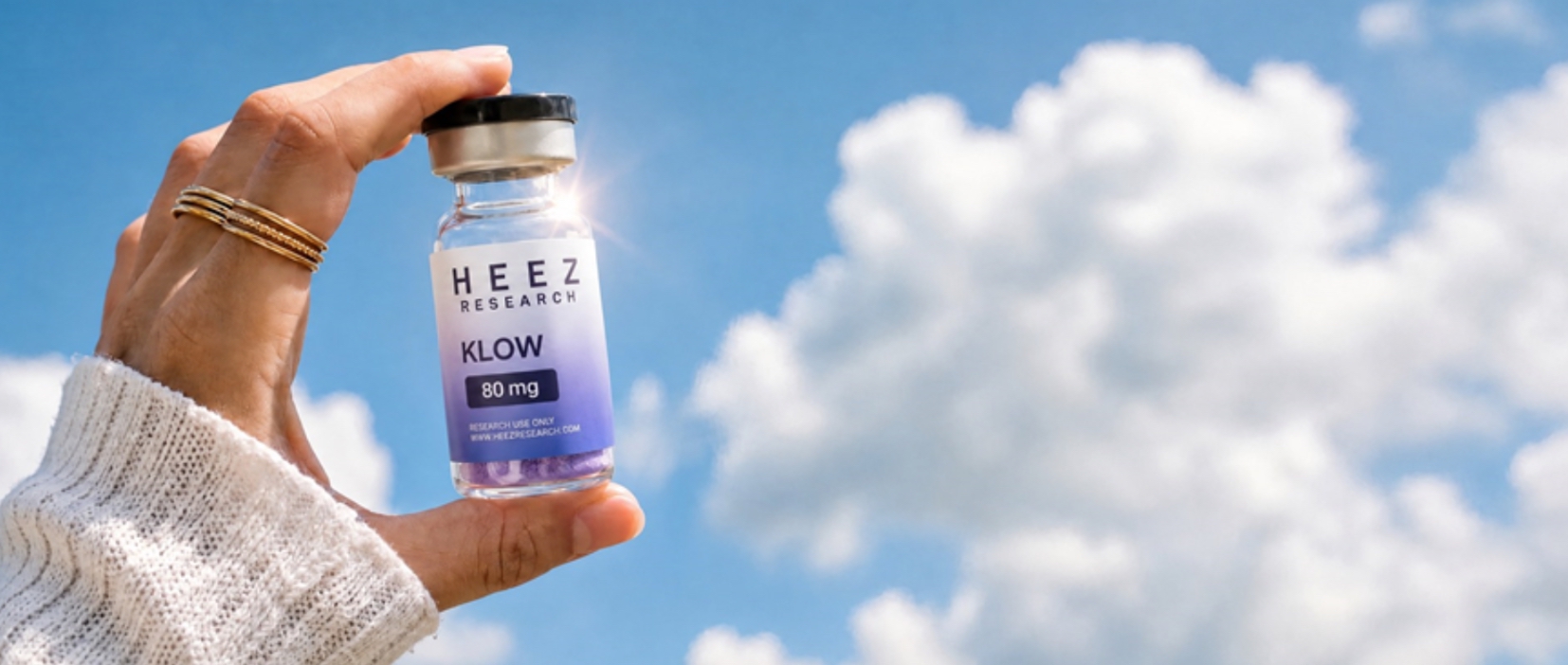
HEEZ Research KLOW 80 mg research vial held against a blue sky
Step one: know what’s in the vial
KLOW = four research peptides freeze-dried into a single vial. GHK-Cu, BPC-157, TB-500, KPV. That’s the whole recipe. (GLOW, its cousin, has just the first three in a 70 mg vial KLOW throws in KPV and usually lands at 80 mg.)
Each of these has its own weird little history in the literature, mostly cells in dishes and rats in cages, if we’re being honest. Anyone researching tissue repair or inflammation ends up juggling all four, so quick introductions are in order.
First up: GHK-Cu. Three amino acids glycine, histidine, lysine holding onto a copper ion. Your body actually makes this stuff; it’s floating around in human plasma right now. Scientists have poked at it since the 1970s, mostly for collagen production and gene expression in skin and connective tissue. If you want the full tour, the 2018 review in the International Journal of Molecular Sciences rounds it all up (Pickart and Margolina, PMID 29986520).
BPC-157 is a 15-amino-acid chunk of a protein found in stomach juice. Fun fact about the literature: the vast majority of it comes from one Croatian lab, working on this for something like thirty years including a 2003 rat study on sliced Achilles tendons (Staresinic et al., Journal of Orthopaedic Research, PMID 14554208). Almost entirely animal data. So when someone online describes BPC-157 like it’s settled science? Keep that in mind.
TB-500 is synthetic — modeled on the business end of thymosin beta-4, a protein involved in cell migration and actin binding. The original protein showed faster wound closure in rats way back in 1999 (Malinda et al., Journal of Investigative Dermatology, PMID 10469335).
And KPV — the smallest of the bunch. Just three amino acids (lysine, proline, valine) snipped from the tail of alpha-MSH. The buzz around it is mostly about inflammation, especially gut inflammation. The landmark paper: a 2008 Gastroenterology study showing intestinal cells pulling KPV in through the PepT1 transporter, with inflammation dropping in mouse colitis models (Dalmasso et al., PMID 18061177).
Step two: nail down the ratio
The recipe you’ll run into most: 50 mg of GHK-Cu with 10 mg each of the other three. 80 mg total. Big caveat though plenty of suppliers don’t print any ratio at all, and the ones that do? They don’t all match. So.
Step three: price the four vials separately
Here’s a comparison: almost nobody runs but everybody should. Using HEEZ’s own single-vial prices against that 50/10/10/10 split, matching one KLOW vial with separate vials looks like this:

- GHK-Cu, 50 mg vial: $50
- BPC-157, 10 mg vial: $70
- TB-500, 10 mg vial: $95
- KPV, 10 mg vial: $50
Add it up: $265 for the four singles versus $145 for the blend. Basically half price. And remember that’s before any bundle discount enters the picture.
Think spice rack the pre-mixed jar versus four separate ones. Separate jars cost you more but hey, you’re the one deciding what goes in. Same deal here four vials let a researcher tweak one variable at a time or test a totally different ratio. A blend locks you into whatever went into that vial. Need to isolate each peptide’s individual effect? Separate vials despite the cost. Studying the combination itself? The blend wins on price no contest.
Step four: convert everything to cost per milligram
No pharma company sells KLOW. No prescription version exists. So there’s nothing “official” to benchmark against the most honest reference is just a real price list. HEEZ Research lists its KLOW blend in 80 mg vials:
| Package | Total price | Cost per vial | Cost per mg |
| 1 vial (80 mg) | $145 | $145.00 | $1.81 |
| 3 vials (buy 2, get 1 free) | $290 | $96.67 | $1.21 |
| 5 vials (buy 3, get 2 free) | $435 | $87.00 | $1.09 |
That last column? Just total price divided by total milligrams is nothing fancy. But it matters, because vial sizes are all over the place: 80 mg here 70 mg there, some suppliers splitting blends across two vials. Watch what happens with bundles: one vial runs $1.81/mg the five-vial bundle drops to $1.09. Forty percent off. Same exact material.
Make it concrete. Say your project needs 400 mg total. Five singles: $725. A three-vial bundle plus two singles: $580. One five-vial bundle: $435. Nothing changed except the packaging and the bill swings by $290. Packaging. That’s it.
Step five: understand why the price sits where it does
Why does it cost what it costs? Because a blend means four separate syntheses each peptide manufactured, purified and QC’d before they ever meet in one vial. TB-500 is the pricey one (nearly double KPV solo). So when I see a blend priced way below what the math says it should cost, my first thought is: corners are being cut somewhere in that chain. The raw inputs alone don’t leave much margin.
Then there’s purity per component. Every synthesis leaves truncated chains and byproducts; scrubbing to 99%+ takes serious time and solvent. Blends make this sneakier: four compounds’ impurities all pile onto the same HPLC run, so a weak ingredient hides easily. A legit KLOW certificate confirms each component’s identity, reports purity, and ideally gives net content (peptide vs. salts vs. moisture). Suppliers who skip all that? They post one vague purity number and hope you don’t ask questions. Don’t be the buyer who doesn’t ask.
One more thing: freeze-dried doesn’t mean indestructible. Heat still degrades these peptides. That bargain vial that baked for three weeks in a hot warehouse or sat in customs? It wasn’t actually cheap. It was expensive garbage.
Step six: add the costs outside the vial
Don’t forget the hidden costs. The powder needs reconstituting HEEZ’s 3 ml bacteriostatic water for $7. Bigger orders ship free, and the three-vial bundle already clears that bar, so chalk up another win for bundles. After mixing, it’s fridge time with a limited usable window; unopened vials want cool, dark storage. Here’s the catch with blends: four peptides means four different stability profiles the second water hits the powder. Buy more than you’ll use in that window and you’re literally paying for waste. And HEEZ sales are final so confirm the composition and certificate before you click buy, not after.
Step seven: decide whether a price is fair
So what’s “fair” in 2026? Roughly $145 for an 80 mg vial of documented, US-shipped material, with bundles pulling it toward $87–97 per vial. See a single 80 mg vial way under $100? Look harder. No ratio listed? No answer when you ask? Same energy. One generic purity number for the whole blend, no per-component identity check, sketchy-looking test docs, mystery shipping origins or my personal favorite red flag dosing instructions and before-and-after photos on the product page. Real research suppliers don’t market peptides for personal use. Ever.
Here’s my CoA checklist: product name on it, batch or lot number what’s actually inside the vial, HPLC purity (I want 99%+) identity confirmed for each component not just the blend as a whole net peptide content the independent lab actually named and a test date from this year. 2023 doesn’t count. All there? Good documentation. Missing half of it? You’re looking at a recycled PDF.
And the fine print nobody reads but everybody should: KLOW is not an approved drug. Anywhere. Research-grade = lab research. Not people. Not pets. Athletes BPC-157 will pop you on a WADA test and the FDA already flagged it in 2023 over compounding safety concerns. Don’t mess around here.
So yeah cheapest verified milligram right now? HEEZ. 80 mg vials, third-party CoA for the current lot actually published, same-day UPS out of the US if you order before 2 PM ET on a weekday, bundles down to $87 a vial. Five-vial project ahead of you? Just grab the five-pack. Done.
Written by Aurora China (aurorachina9999@gmail.com)