

 Anyone who earns a living by studying the human body knows perfectly well that its structure determines its function. The movement of the shoulder is determined by the state of the joint surfaces, while a knee bends according to how its muscular and ligament systems work. The eye operates on the same principle. In the case of older clients, fitness professionals, and students in Southwest Florida, this becomes most clear when cataracts make it harder to see, so that the pickleball appears to have blurred edges, channel markings become less distinct at Fort Myers Beach when the sun sets, and traffic signs on the way home become double.
At that time, numerous individuals check the “cylinder” number on an outdated prescription for eyeglasses and conclude that this means they should be getting a toric IOL. This is unmistakably incorrect. Once the clouded lens has been removed from the eye, its shape becomes irrelevant. This article describes the anatomy behind this decision, the process by which the shape of the cornea is determined, the physics behind how a toric IOL corrects astigmatism, what makes alignment critical and the one piece of information to find out before the surgery.
How the Cornea and Natural Lens Focus Light
Toric IOL in Fort Myers: Why Corneal Shape Matters More Than Your Glasses
Why Your Glasses Prescription Is Not the Deciding Number
Inspect any type of eyeglasses prescription, and you’ll notice a “cylinder” number next to an axis. The value tells us how the whole eye structure currently bends light.
During cataract operation, a cloudy lens is taken out and substituted by artificial lens known as intraocular lens (IOL). Natural lenses optical contribution ceases to exist. What is left is a clear and dome-shaped cornea located at the front of the eye.
The curve in question acts as the filter for excess blur. If its curve is evenly shaped, light meets the point of sharp, clear focus. If the curve has a greater slope in one direction, the eye will experience the effects of astigmatism and light gets split into two images of different focal points. The EyeWiki of the American Academy of Ophthalmology states that total refractive astigmatism includes lenticular and corneal astigmatism aside from stating that lenticular portion will be eliminated when cataracts are removed from the eye.
You cannot simply add these measures together like a shopping bill. Each measure has its strength and direction, so they can be mutually reinforcing or even partially cancel each other out. For example, two people sharing the same spectacle cylinder require different implanted lenses based on the cornea measured alone. A patient with a relatively low spectacle cylinder value can at the same time still have a significant corneal astigmatism, while a patient with a higher spectacle cylinder value may end up having the astigmatism play a lesser role once the natural lens is removed.
Make an analogy with the re-decorating of a room. You typically don’t select a new color according to curtains that are about to be discarded but you rather consider a permanent fixture such as trim that has always been there. The cornea is the trim in cataract surgery.
The lesson is straightforward: consult with the surgeon on the present level of corneal astigmatism and how much will persist with the non-toric lens. The measurement will tell you if opting for the toric lens is a wise decision and worth the expense.
How a Football-Shaped Cornea Splits Focus
Light travels easily along its trajectory. It goes through a clear cornea, enters the pupil with help of the lens and finally focuses on retina. According to the National Eye Institute, the cornea and lens cooperate in order to focus light correctly. The cornea provides 2/3 of the total focusing power of the eye while the lens corrects it, thus allowing to see an object clearly.
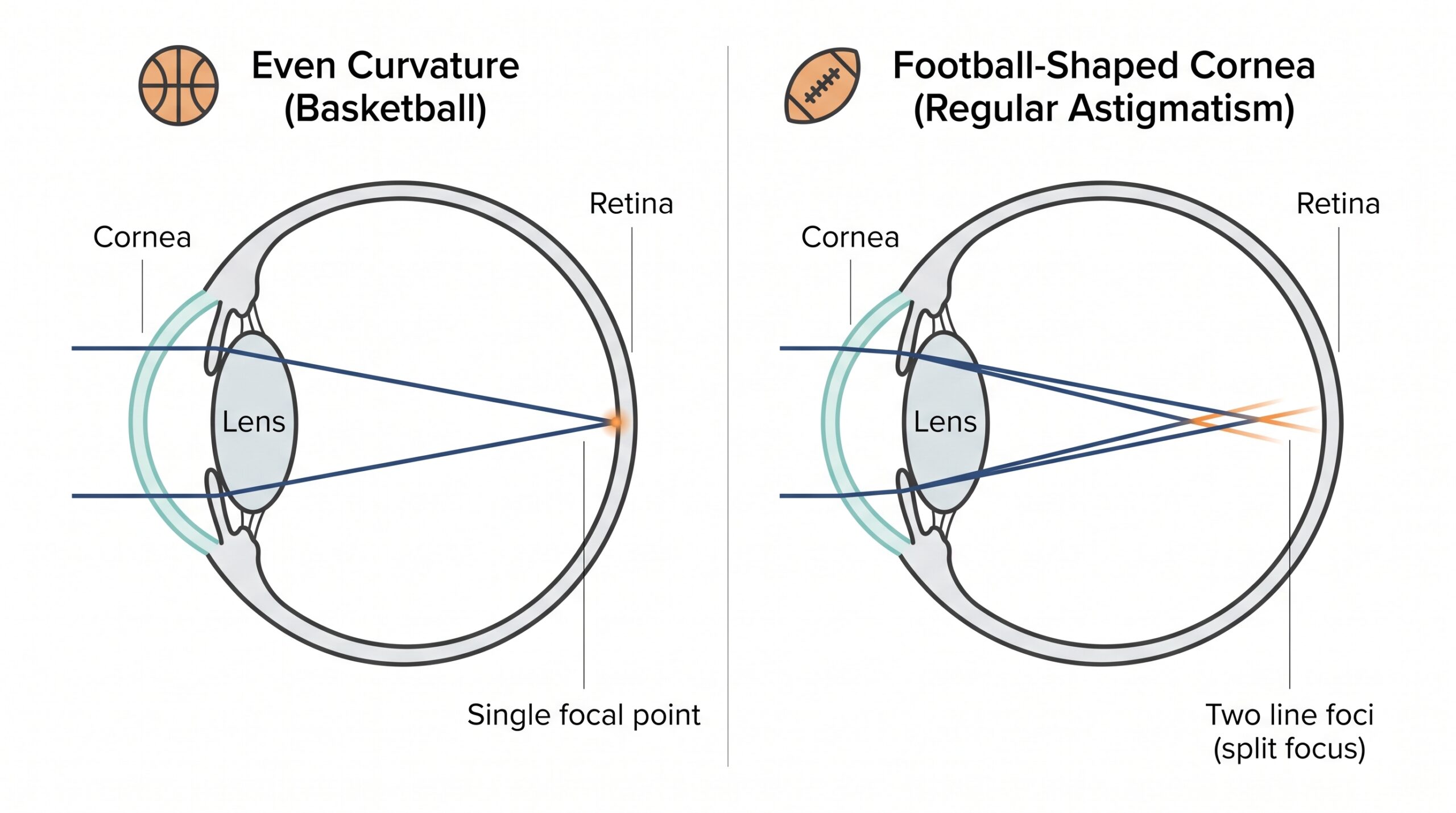 In case the shape of the cornea is uniform, similar to a basketball, the point where the rays converge on the retina would be a distinct single point. However, if the basketball is exchanged with a football, one of the axes will have a steeper curvature, while the other will be flatter leading to two separate lines of focus. This leads to a condition called astigmatism, which is what the toric lens should correct. In other words, one may see the effects of this condition while playing pickleball or having a golf ball in the sky.
Irregular astigmatism is something entirely different. It involves a disturbed pattern caused by scars, thinning of the cornea like in keratoconus, or various other conditions of the surface. In this case, the patchy image does not resemble a well-defined oval shape, which is why a toric IOL is constructed for regular type conditions, and that is why the doctor diagnosed the pattern before suggesting the surgery.
Why is this optics lesson important? Cataract surgery removes the natural lens, which gets rid of its contribution to distortion reminiscent of a football. The only remaining distortion is due to the cornea. If the cylinder of the cornea is quite normal, a toric IOL can be put in to correct it. In case there is not much distortion or if it is of an irregular shape, a different solution than the toric lens or simply eyeglasses may work.
Clear, stable visual input also feeds balance, spatial awareness and posture, which matters to anyone who coaches movement. Cataract surgery is not a posture treatment, but the link between sight and body control is real, and LearnMuscles explores it in a piece on how eye health supports total body awareness.
So, when envisioning astigmatism, envision a spiral path. The cornea looks like a football shape, which is where a toric lens comes in to focus the eye back to the shape of a basketball.
How Keratometry and Corneal Topography Predict What Remains
What a Toric IOL in Fort Myers Evaluation Should Measure
Before anyone recommends a toric upgrade, the surgical team needs hard numbers, not a hunch.
The initial measurement is given by keratometry. This fast procedure measures the light reflected by the cornea, in order to obtain the steep and flat meridians in diopters. This is similar to finding out the height and width of the football-shaped arc, to assist the group with finding the steepest direction.
Patients comparing Eye Doctors in Fort Myers, Naples & Cape Coral can ask whether a practice’s keratometry and corneal maps agree, and how much astigmatism is predicted to remain without a toric lens. Snead Eye Group, which also has an office in Bonita Springs, includes toric lenses among its cataract lens options.

The field of topography has been enhanced over time. It collects data from many points along the cornea’s surface and generates a color contour graphic. The contours depicted in warm colors indicate steepness while cool colors present a flat surface. A consistent pattern indicates a regular astigmatism that can be treated with a toric lens. Irregular patterns, on the other hand, indicate the need for different treatment options. Tomography and advanced biometric techniques can reveal additional information about the back side of the cornea and other parts of the eye and help improve the treatment.
Surgeons do not usually put their faith in solely one factor. They will often repeat tests, use multiple devices, and treat either a dry eye condition or a contact-lens warpage before coming to a conclusion. There is a good reason for this: a 2015 paper featured in the Journal of Cataract & Refractive Surgery by Epitropoulos et al., for instance, reports that about 10 percent of patients who suffer from cataracts and a specific type of dry eye known as hyperosmolar tears recorded significantly different values of IOL power at two separate visits (0.5 diopter or higher).
There are also some numeric values involved in the planning of incisions. One major incision can flatten one meridian to a small degree, so modern formulas take this into consideration. There is also weighing of the available toric lens powers and distance that one prefers to see the best. One specific diopter number does not establish a cutoff criterion for everyone.
The main inquiry during the consultation is: “What is the anticipated level of astigmatism left from the use of a conventional IOL versus the use of a toric IOL?” For instance, if the preoperative assessment indicates 1.25 diopters of astigmatism remaining in patients receiving a regular IOL yet less than 0.5 diopters in those implanted with a toric lens, the benefit of the latter would be easy to recognize.
How a Toric IOL Corrects Astigmatism and Why Alignment Matters
Why the Lens Axis Must Match the Cornea
The standard spherical intraocular lens has a consistent power in all directions, which means that it is ineffective against an irregular cornea that changes the direction of light unevenly.
The functioning of a toric intraocular lens is different. Consider two invisible bands placed around the lens, one of a stronger intensity than the other. These bands oppose the steep and flat positions of the cornea and focus both angles on one spot.
The lens is placed in the transparent capsular bag that was keeping the natural lens at the time of surgery. There are small dots at its edges indicating where the lens should work. Once the lens is opened in its place, the surgeon spins it until its dots are set in line with the steepest corneal meridian figured out prior to surgery.
The importance of alignment cannot be overstated. According to the EyeNet publication of the American Academy of Ophthalmology, the general principle is that for each degree of unalignment there will be a reduction of toric correction by about 3.3 percent; when misalignment is at 30 degrees, it will almost nullify the correction effects. However, this correlation does not exist in real life.
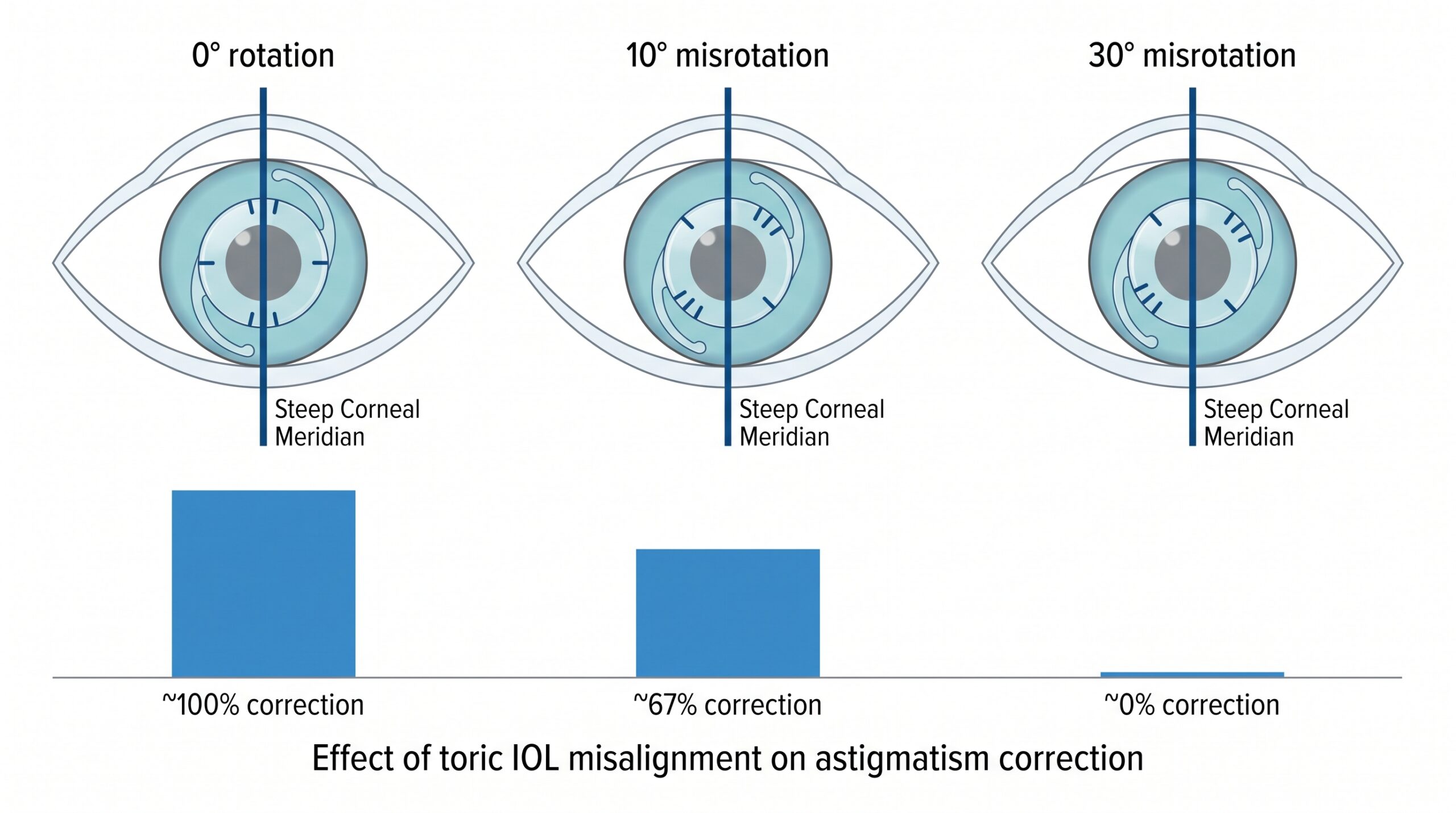 The news is optimistic because modern designs usually keep their position. According to a thesis conducted by Yale School of Medicine in 2025, which consisted of 51 studies involving 4,863 eyes, toric IOLs demonstrated a degree of rotation of approximately 2.4 degrees.
Even after using the right techniques, measurements, if incorrectly taken, can lead to residual astigmatism after the process. If the patient experiences blurred vision in the weeks post-surgery, it is usually caused by swelling, residual prescription errors, or dry eye syndrome. Regular check-ups and follow-ups to assess refraction and lens position will help to refine the results.
Thus, utilizing toric IOL is not a risky venture. When the measurements are precise and the axis is correct, it is a well-researched method for neutralizing the cornea’s football-like shape.
Standard, Toric, Incision-Based, and Adjustable Options in Plain Language
What Standard and Premium IOLs Mean in Plain Language
Begin with the baseline. A conventional single-focus intraocular lens (IOL) substitutes a hazy lens and provides vision at one distance. It does nothing to compensate for significant corneal astigmatism, leaving the eye glasses to manage the remaining astigmatism. Under the stipulations of CMS Ruling 1536-R, Medicare covers the cost of a standard IOL.
 A toric monofocal intraocular lens does the same functionality but includes astigmatism correction. However, this additional feature makes the lens upgrade more than a basic one and must be paid for by the patient. However, it is still a monofocal lens, so patients still may need reading glasses for some near vision tasks like reading a scorecard or a phone.
Next in line are the upgrades in range of focus. The use of multifocal and extended depth of focus lenses allows clarity in one’s vision across distances, from dashboard to dinner plate. Many of the same lens types will also be available in toric varieties. Correcting for astigmatism and range of distances can be regarded as two different options for consumers, similar to equipping a new car with both sunroof and navigation function. Where Relaxing Incisions and the Light Adjustable Lens Fit
Limbal relaxing incisions are tiny incisions that are made at the periphery of the cornea. In this process, the more vertical meridian is relaxed. These corneal incisions are a surgical means of managing astigmatism; however, they cannot be used interchangeably with toric lenses. For significant amounts of astigmatism, toric lens correction can be considered more reliable. In some circumstances, femtosecond laser devices like Lensx can be utilized to create the incisions, while the insertion of several toric lenses is done manually.
The Light Adjustable Lens follows an alternate path. As per the information provided by RxSight, the light treatment course starts two or three weeks after the operation, allowing the eye doctor to adjust the lens’s power after the recovery of the eye. It is an option that requires consideration but is by no means the standard practice.
The conclusion is that the term “premium” refers to any lens or surgical procedure that corrects more than regular monofocal. Ask for a detailed comparison and focus on the expected vision, not the name used.
What to Look for in an Ophthalmologist or Practice
An effective cataract team is not just about changing lenses; it is about providing data-driven evidence for all the decisions made.

The process begins with the confirmation of roles. The ophthalmologist (MD) is the one who performs the surgery and the optometrist (OD) performs examinations, prescribes medications and can refer or coordinate treatment. Both have their significance, but only the surgeon replaces the lens.
Then focus on the measurement conversation. Useful questions include:
- Does the physician clarify the distinction between astigmatism caused by the cornea and that which originates in the lens?
- Are keratometry measurements and corneal maps assessed at the very same time, and are they both repeated if dry eyes or contact lens-induced alterations hinder these results?
- What amount of residual cylindrical power can one expect when using a standard IOL versus a toric IOL?
- Is the corneal pattern homogeneous enough to allow using toric lenses or would it be more appropriate to utilize incisional therapies?
- What approach is used to determine the target axis of the correction and where and how is this line marked before surgery?
- Is there a plan of action in case there is significant astigmatism left after the initial surgery (for example, to wear glasses, reposition the lens, or perform LRI)?
- At what distances should one be able to see clearly without any corrective lenses?
The specifics of how somebody leads his/her life are important as well. Be specific about the separation of days going for games like pickleball or golf, sailing during sunset or evening driving, as well as reading the small print due to the consideration of how much the person will be willing to put on spectacles for doing particular activities.
As a local example, Snead Eye Group boasts offices in Fort Myers, Naples, Cape Coral, and Bonita Springs. Board-certified ophthalmologist Dr. Brad Snead is in charge of cataract surgery, while the available lens treatments include standard monofocal, Light Adjustable Lens, and toric lenses. The practice uses laser-assisted methods whenever suitable. Patients can also obtain free cataract screening that does not put any pressure on them and allows them to obtain their corneal numbers.
If the solutions seem obvious and the statistics are consistent, identifying the best surgical associate is typically simple.
Frequently Asked Questions About Toric IOLs
Can Someone With Astigmatism Choose a Standard IOL?
Certainly. If the corneal parameters indicate there is little astigmatism after surgery or if the individual is willing to wear spectacles, a basic lens would be an appropriate option. The choice depends on the anticipated residual cylinder and its regularity rather than the size of the current glasses cylinder.
Will a Toric IOL Eliminate Glasses?
It is capable of decreasing dependency on prescription glasses at that specific distance it has the power to cover, in most cases it generates the ability to see far away. Nevertheless, it doesn’t guarantee a person the perfect sight but does not help get back the ability to focus the near vision. Such issues as dry eyes, retinal disorders or other eye impairments may decrease the effectiveness of such devices too.
Is Laser Cataract Surgery Required for a Toric IOL?
No. A toric intraocular lens may be used during either a manual or a laser-assisted cataract surgery. The crucial aspects are ensuring correct measurement, proper lens power and accurate alignment, rather than the technique used to perform the surgery. Limbal relaxing incisions and toric lenses serve as different options for treating astigmatism.
Conclusion
Taking a stroll down the pickleball court, the location markers, and the nighttime route back home. The important inquiry is not if an old glasses prescription includes astigmatism. However, it is the regular corneal astigmatism that will be left behind once the natural lens disappears and how much of a role a toric IOL will play.
Anatomy-minded readers may find the reasoning logical: the architecture dictates the performance. A toric lens is not an automatic requirement and is instead seen as a value-added product. Its importance relies on the corneal configuration, the anticipated residual astigmatism, visual expectations, and one’s openness to glasses. Always request the data and the prognoses both with and without a toric lens before making up your mind.
Written by info@sixdollardigital.com