

* This podcast is AI-generated. I offer it to you because it presents the content in a casual conversational way. I hope you enjoy listening to it… and learn. 😊
– Dr. Joe Muscolino .
Purchase the E-booklet HERE.
To access complete education content on the Achilles Tendon Disorder
CLICK HERE!
Study Guide
Quiz
Instructions: Answer the following questions in 2-3 sentences each.
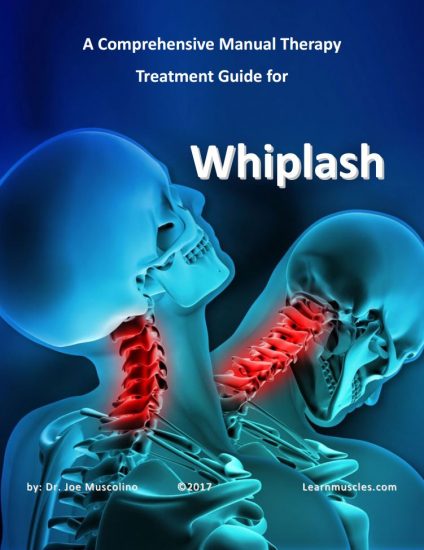
- Describe the mechanics of a whiplash injury, including the typical motions involved.
- Differentiate between a strain and a sprain, and explain how these relate to whiplash injuries.
- Explain the role of headrests in cars in relation to whiplash injuries.
- Describe the signs and symptoms of a whiplash injury in the acute stage.
- What might cause dizziness in a patient with an acute whiplash injury?
- How can a whiplash injury lead to chronic muscle tightness?
- Describe how active and passive range of motion (ROM) testing can help differentiate between a strain and a sprain.
- Why is it important to determine the degree of strain versus sprain in a whiplash injury?
- Outline the key aspects of manual therapy treatment for a chronic whiplash strain.
- What precautions or contraindications should be considered when treating a patient with a whiplash injury?
Quiz Answer Key
- Whiplash occurs when the neck is forcefully thrown in one direction and then rapidly in the opposite direction. It often involves hyperflexion followed by hyperextension, especially in rear-end collisions. The force can cause soft tissues to overstretch and tear.
- A strain is a tear in muscle tissue, while a sprain is a tear in ligaments, joint capsules, or fascia. Whiplash often involves both strains and sprains due to the forceful and rapid neck movements.
- Headrests in cars are designed to limit the hyperextension of the neck during a rear-end collision. While they cannot prevent the sudden movement that triggers muscle spasms, they can help prevent severe soft tissue injuries.
- Acute whiplash symptoms include inflammation, pain, muscle spasms, and limited range of motion. The pain can be localized to the neck or radiate to the head, causing headaches.
- Dizziness in acute whiplash may result from irritation of proprioceptors (sensors that provide information about body position) in the cervical spinal joints and neck muscles. This disruption in proprioceptive input can lead to a sense of imbalance.
- Chronic muscle tightness can develop after a whiplash injury due to several factors, including persistent muscle spasms, the pain-spasm-pain cycle, and compensatory muscle contractions to stabilize the cervical spine if ligaments are damaged.
- Active ROM involves the patient moving their neck themselves, while passive ROM involves the therapist moving the patient’s neck. Pain during active ROM suggests both strains and sprains, while pain during passive ROM typically indicates a sprain.
- Determining the degree of strain versus sprain helps predict the prognosis and guide treatment. Muscular strains, though initially painful, tend to heal well. Sprains can lead to long-term instability and require different management strategies.
- Manual therapy for chronic whiplash strain focuses on relieving muscle tension and adhesions. Techniques include deep tissue massage, myofascial release, stretching, and trigger point therapy. Heat therapy can be applied before stretching to enhance its effectiveness.
- Precautions when treating whiplash include ruling out serious conditions like disc herniation or fractures. Stretching should be done cautiously, especially extension, and lateral flexion should be avoided on the side of a disc pathology. Always respect the patient’s pain tolerance.
Essay Questions
- Discuss the various causes of whiplash injuries, beyond automobile accidents.
- Explain the importance of a thorough assessment when treating a patient with a whiplash injury.
- Compare and contrast the manual therapy treatment approaches for a chronic whiplash strain versus a chronic whiplash sprain.
- Describe the potential long-term consequences of an untreated or inadequately treated whiplash injury.
- Discuss the role of patient education and self-care in the management of whiplash injuries.
Glossary of Key Terms
●Whiplash: An injury to the neck caused by a forceful back-and-forth motion, often occurring in car accidents. This motion can overstretch and tear soft tissues in the neck, leading to strains and sprains.
●Hyperflexion-hyperextension injuries: Whiplash injuries are frequently categorized as hyperflexion-hyperextension injuries due to the neck’s excessive movement into flexion (forward bending) and then extension (backward bending).
●Strain: A tear in muscle tissue.
●Sprain: A tear in ligaments, joint capsules, or fascial tissue.
●Muscle spindle (myotactic) stretch reflex: A reflex triggered by the sudden stretching of a muscle, leading to muscle spasms. Even if the soft tissue isn’t torn, the quick motion can trigger this reflex.
●Acute stage: The initial phase of an injury, characterized by inflammation, muscle spasms, and pain.
●Chronic stage: The long-term phase of an injury, where symptoms can persist. This might involve muscle tightening, decreased range of motion due to muscle spasms, or increased range of motion due to overstretched ligaments.
●Active range of motion (ROM): The range of motion a person can achieve by actively moving a joint themselves.
●Passive range of motion (ROM): The range of motion achieved when a joint is moved by an external force, such as a therapist.
●Manual resistance (MR): A technique where a therapist applies resistance to a patient’s movement to assess muscle strength and pain.
●Joint dysfunction: Abnormal movement in a joint. This can be hypomobile (restricted movement) or hypermobile (excessive movement).
●Motion palpation assessment: A technique used to evaluate the quality and range of motion in spinal joints.
●Myofascial trigger points: Hypersensitive spots within muscles that can cause pain and referred pain to other areas.
●Joint mobilization (arthrofascial stretching): Manual therapy techniques used to restore normal joint mechanics and reduce pain.
●Vertebral artery competency test: A test to ensure the safety of stretching the neck into extension, particularly important for elderly patients and those with potential cervical spine instability.
●Grade IV joint mobilization: A type of joint mobilization technique.
●Grade V osseous mobilization/manipulation: A type of joint manipulation technique.
This glossary provides definitions of important terms used in the discussion of whiplash injuries. It highlights the mechanisms of injury, symptoms, assessment techniques, and treatment options discussed in the source material.

