

* This podcast is AI-generated. I offer it to you because it presents the content in a casual conversational way. I hope you enjoy listening to it… and learn. 😊
– Dr. Joe Muscolino .
Purchase the E-booklet HERE.
To access complete education content on the Achilles Tendon Disorder
CLICK HERE!
Study Guide
Quiz
Instructions: Answer the following questions in 2-3 sentences each.
- What is the primary cause of sciatica and how does it manifest?
- Describe the typical path of the sciatic nerve and its areas of innervation.
- Differentiate between lateral stenosis and central canal stenosis.
- Explain how a tight piriformis muscle can lead to sciatica.
- What is the purpose of the Straight Leg Raise (SLR) test?
- How does the Slump Test differ from the SLR in assessing nerve compression?
- What are the primary goals of manual therapy treatment for sciatica?
- Explain why it’s important to identify the underlying cause of sciatica before initiating treatment.
- Describe some self-care strategies that can help alleviate sciatica symptoms.
- Why is it crucial to refer a patient with sciatica to a physician?
Answer Key
- Sciatica is primarily caused by compression of the sciatic nerve, leading to symptoms such as pain, numbness, tingling, or weakness radiating down the leg.
- The sciatic nerve originates in the lower spine, exits the pelvis, runs down the back of the thigh, and branches off into the lower leg and foot, providing motor and sensory innervation to these areas.
- Lateral stenosis refers to narrowing of the intervertebral foramen (IVF), where the spinal nerve exits, while central canal stenosis involves narrowing of the central canal of the spine, potentially compressing the spinal cord.
- A tight piriformis muscle can compress the sciatic nerve as it passes through the buttock region, leading to piriformis syndrome and sciatica symptoms.
- The Straight Leg Raise (SLR) test aims to stretch the sciatic nerve. If the nerve is compressed, the stretching will elicit pain or other symptoms along the nerve’s path, indicating a positive test.
- The Slump Test assesses nerve root compression by putting tension on the entire spinal cord and peripheral nerves, while the SLR focuses specifically on the sciatic nerve.
- Manual therapy for sciatica aims to address the underlying cause of nerve compression, reduce pain and inflammation, improve soft tissue mobility, restore joint function, and educate patients on self-care strategies.
- Identifying the underlying cause of sciatica is crucial for tailoring treatment effectively. Treating piriformis syndrome will differ significantly from addressing a herniated disc.
- Self-care strategies for sciatica include avoiding prolonged sitting or standing, applying heat or cold therapy, performing gentle stretches, and engaging in low-impact exercises as tolerated.
- Referring a patient with sciatica to a physician is crucial for accurate diagnosis, ruling out other conditions, obtaining imaging studies if necessary, and considering medical interventions like medication or injections if conservative therapies are insufficient.
Essay Questions
- Discuss the various causes of sciatica, highlighting the anatomical structures involved and the mechanisms of nerve compression.
- Describe the clinical presentation of sciatica, including common signs, symptoms, and potential variations in symptom distribution based on the location of nerve compression.
- Explain the rationale behind the various orthopedic assessment tests used to diagnose sciatica, detailing the procedures and expected findings for each test.
- Compare and contrast manual therapy treatment approaches for sciatica caused by a pathologic disc versus piriformis syndrome.
- Discuss the role of patient education and self-care in the management of sciatica, outlining specific recommendations for posture, activity modification, and home exercises.
Glossary of Key Terms for Sciatica
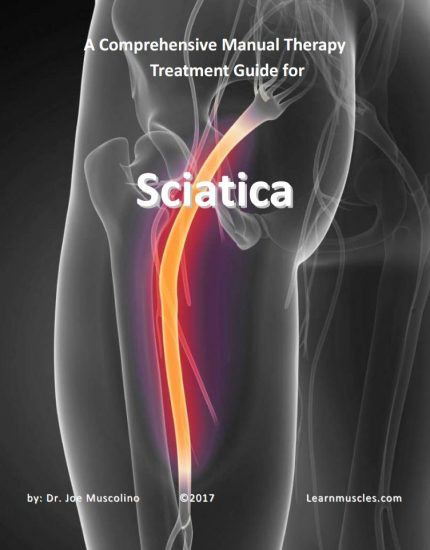
●Sciatica: A condition characterized by compression of the sciatic nerve, leading to referred symptoms, often pain or numbness, in the lower extremity.
●Sciatic Nerve: A major nerve formed by the merging of nerve roots from L4, L5, S1, S2, and S3 in the abdominopelvic cavity. It exits the pelvis through the greater sciatic foramen and runs down the back of the leg, providing motor and sensory innervation to the posterior thigh, lower leg, and foot.
●Referral Symptoms: Sensations, such as pain or numbness, that are felt in a different area than the site of the actual problem. In sciatica, nerve compression causes these symptoms to manifest in the lower extremity, even though the compression might be occurring in the lower back.
●Dermatomal Map: A diagram that shows the distribution of sensory nerves from specific spinal nerve roots. In sciatica, a dermatomal map can help pinpoint which nerve roots are affected by compression.
●Pathologic Disc: An intervertebral disc that is bulging or herniated, potentially causing compression on nearby nerve roots.
●Osteoarthritic Bone Spur: A bony growth that develops due to osteoarthritis and can compress nerve roots within the intervertebral foramen.
●Intervertebral Foramen (IVF): The opening between adjacent vertebrae where spinal nerve roots exit the spinal cord.
●Lateral Stenosis: Narrowing of the intervertebral foramen, often caused by a pathologic disc or bone spur, leading to compression of the nerve root.
●Central Canal Stenosis: Narrowing of the central canal of the spinal cord, which can also cause compression on the spinal cord or nerve roots.
●Piriformis Syndrome: A condition in which the piriformis muscle, located in the buttock, compresses the sciatic nerve, leading to sciatica symptoms.
●Ligament Hypertrophy: Enlargement or thickening of ligaments, which can contribute to nerve compression, particularly in the elderly.
●Hypesthesia: Decreased sensation or numbness.
●Paresthesia: Any altered sensation, which can include numbness, tingling, burning, or pain.
●Hyperesthesia: Increased sensitivity to stimuli, including pain.
●Foot Drop: Weakness of the muscles that lift the foot (dorsiflexors), resulting in the foot dropping against the ground during walking.
●Straight Leg Raise (SLR): An orthopedic assessment test used to detect sciatica, where the leg is passively raised with the knee extended. If pain radiates down the leg, it suggests nerve root compression.
●Slump Test: An orthopedic test that assesses for nerve root compression in both the cervical and lumbar regions by placing tension on the spinal cord and peripheral nerves.
●Cough Test and Valsalva Maneuver: Orthopedic tests that increase intrathecal pressure, which can reproduce sciatica symptoms if there is nerve root compression.
●Myofascial Trigger Point Referral: Pain felt in a location distant from the trigger point itself, potentially mimicking sciatica symptoms.
●Peripheral Neuropathy: Damage to the peripheral nerves, which can cause numbness or pain in the extremities, potentially confusing the diagnosis of sciatica.
●Meralgia Paresthetica: Compression of the lateral femoral cutaneous nerve, causing symptoms in the anterolateral thigh.
●Soft Tissue Manipulation: Massage techniques used to release tension in muscles and other soft tissues.
●Hydrotherapy: The use of water, both hot and cold, for therapeutic purposes.
●Joint Mobilization: Techniques used to improve the mobility of joints.
●Medrol Dose Pack: A short course of oral steroid medication used to reduce inflammation.
●Extension (McKenzie) Exercises: Exercises designed to strengthen the back muscles and reduce pressure on the intervertebral discs.