
* This podcast is AI-generated. I offer it to you because it presents the content in a casual conversational way. I hope you enjoy listening to it… and learn. 😊
– Dr. Joe Muscolino .
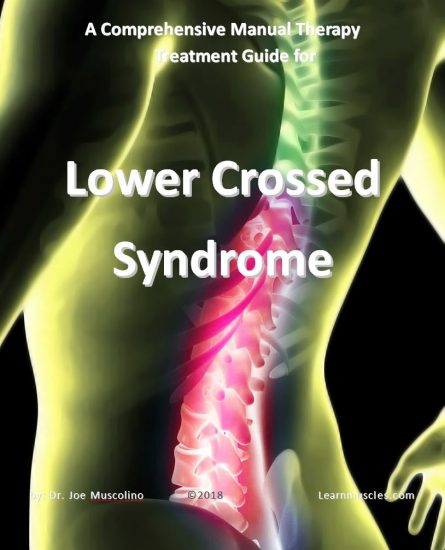
Purchase the E-booklet HERE.
To access complete education content on the Achilles Tendon Disorder
CLICK HERE!
Study Guide
Instructions: Answer the following questions in 2-3 sentences each.
- Describe the muscle imbalances that characterize Lower Crossed Syndrome.
- Explain how tight hip flexors contribute to an anterior pelvic tilt.
- What is the significance of the sacral base angle in assessing Lower Crossed Syndrome?
- Why is it important to strengthen the gluteus maximus in the treatment of Lower Crossed Syndrome?
- Explain why prolonged sitting can contribute to the development of Lower Crossed Syndrome.
- What is facet syndrome, and how can it be related to Lower Crossed Syndrome?
- Describe two stretching techniques that can be helpful in addressing Lower Crossed Syndrome.
- Why is client self-care crucial for the successful management of Lower Crossed Syndrome?
- Give two examples of self-care exercises a client could do to address Lower Crossed Syndrome.
- How can Lower Crossed Syndrome potentially lead to the development of Upper Crossed Syndrome?
Answer Key
- Lower Crossed Syndrome is characterized by tight/overly facilitated hip flexors, low back extensors, and adductors, and weak/overly inhibited abdominal muscles and gluteal muscles. This imbalance creates a characteristic “crossed” pattern of muscle dysfunction.
- Tight hip flexors pull the pelvis anteriorly, increasing the anterior pelvic tilt. This happens because they attach to the front of the pelvis and the lower spine.
- The sacral base angle is used to measure the degree of anterior pelvic tilt. A larger angle indicates a greater degree of tilt, which is a key feature of Lower Crossed Syndrome.
- Strengthening the gluteus maximus is important because it acts as a posterior pelvic tilter, counteracting the anterior tilt caused by the tight hip flexors.
- Prolonged sitting keeps the hip flexors in a shortened position, promoting adaptive shortening and tightness. This can lead to muscle imbalances that contribute to Lower Crossed Syndrome.
- Facet syndrome refers to pain arising from the facet joints of the spine. In Lower Crossed Syndrome, the hyperlordosis can increase compression and stress on the facet joints, potentially leading to facet syndrome.
- Two helpful stretching techniques are the “double knee to chest” stretch for the low back extensors and the “lunge stretch” for the hip flexors.
- Client self-care is crucial because it empowers clients to actively participate in their recovery. Consistent stretching, strengthening exercises, and postural awareness are essential for long-term improvement.
- Examples of self-care exercises include: 1) Engaging the abdominal muscles to pull the belly button in towards the spine to strengthen the core. 2) Performing glute bridges to strengthen the gluteus maximus and posterior pelvic tilters.
- The hyperlordosis in the lumbar spine (from Lower Crossed Syndrome) can shift the body’s center of gravity posteriorly. To compensate, the thoracic spine often increases its kyphosis, which can then lead to the muscle imbalances and postural changes associated with Upper Crossed Syndrome.
Essay Questions
- Discuss the role of postural assessment in the diagnosis of Lower Crossed Syndrome. Explain how visual observation and palpation can be used to identify the characteristic postural deviations and muscle imbalances.
- Explain the concept of reciprocal inhibition and its relevance to Lower Crossed Syndrome. Describe how the tightness of certain muscle groups can contribute to the weakness of their antagonist muscles.
- Analyze the importance of a comprehensive treatment approach for Lower Crossed Syndrome. Discuss the rationale for combining manual therapy techniques, stretching, and strengthening exercises to address both the tight and weak muscles.
- Critically evaluate the role of client education and self-care in the long-term management of Lower Crossed Syndrome. Explain why lifestyle modifications and home exercise programs are essential for preventing recurrence and maintaining postural correction.
- Discuss the potential consequences of untreated Lower Crossed Syndrome. Explain how this postural dysfunction can lead to pain, decreased mobility, and other musculoskeletal problems over time. Consider the potential impact on the entire kinetic chain, including the upper back, neck, and shoulders.
Glossary of Key Terms
- Adaptive Shortening: The process by which muscles shorten and become less flexible due to prolonged periods of inactivity or a shortened position.
- Anterior Pelvic Tilt: A forward rotation of the pelvis, increasing the curve of the lumbar spine (lordosis).
- Arthrofascial Stretching: Techniques designed to mobilize joints and stretch associated fascia, improving joint range of motion and reducing stiffness.
- Contract-Relax (CR): A stretching technique that alternates between contracting and relaxing the targeted muscle to increase flexibility.
- Erector Spinae: A group of muscles that run along the back of the spine and are responsible for extending the spine.
- Facilitated Muscle: A muscle that is overly active or tense, often due to poor posture or overuse.
- Facet Syndrome: Pain arising from irritation or compression of the facet joints in the spine.
- Gluteus Maximus: The largest muscle in the buttock, responsible for extending and externally rotating the hip.
- Hyperlordosis: An excessive inward curvature of the lumbar spine, often associated with an anterior pelvic tilt.
- Hypolordosis: A decreased inward curvature of the lumbar spine, often resulting in a flat or rounded back.
- Iliopsoas: A muscle group consisting of the iliacus and psoas major muscles, responsible for hip flexion.
- Inhibited Muscle: A muscle that is underactive or weak, often due to disuse or reciprocal inhibition.
- Kyphosis: An excessive outward curvature of the thoracic spine (upper back), resulting in a rounded back posture.
- Lordosis: The natural inward curvature of the lumbar spine (lower back).
- Lower Crossed Syndrome: A postural dysfunction characterized by tight hip flexors and low back extensors, and weak abdominal and gluteal muscles, leading to an anterior pelvic tilt and hyperlordosis.
- Multifidus: A deep spinal muscle that helps to stabilize the spine and control movement.
- Myofascial Trigger Points: Hypersensitive spots within a muscle that can cause pain and referred pain patterns.
- Pelvic Neutral: The optimal position of the pelvis where the anterior superior iliac spine (ASIS) and the posterior superior iliac spine (PSIS) are level in the transverse plane.
- Pin and Stretch Technique: A soft tissue mobilization technique used to release tension in muscles by applying sustained pressure while simultaneously stretching the muscle.
- Quadratus Lumborum (QL): A muscle located in the lower back that helps with lateral flexion and stabilization of the spine.
- Sacral Base Angle: The angle formed by the sacrum and a horizontal line, used to measure the degree of anterior or posterior pelvic tilt.
- Swayback: A term sometimes used to describe either an excessive lordotic curve (hyperlordosis) or a posteriorly tilted pelvis with a hypolordotic lumbar spine.
- Tensor Fasciae Latae (TFL): A muscle located on the outer hip that assists in hip flexion, abduction, and internal rotation.
- Transversospinalis: A group of deep spinal muscles that help to stabilize the spine and control rotation.
- Upper Crossed Syndrome: A postural dysfunction characterized by tight chest and neck muscles, and weak upper back and neck flexors, often leading to a forward head posture and rounded shoulders.