
Fact-checked by Hector Brewer
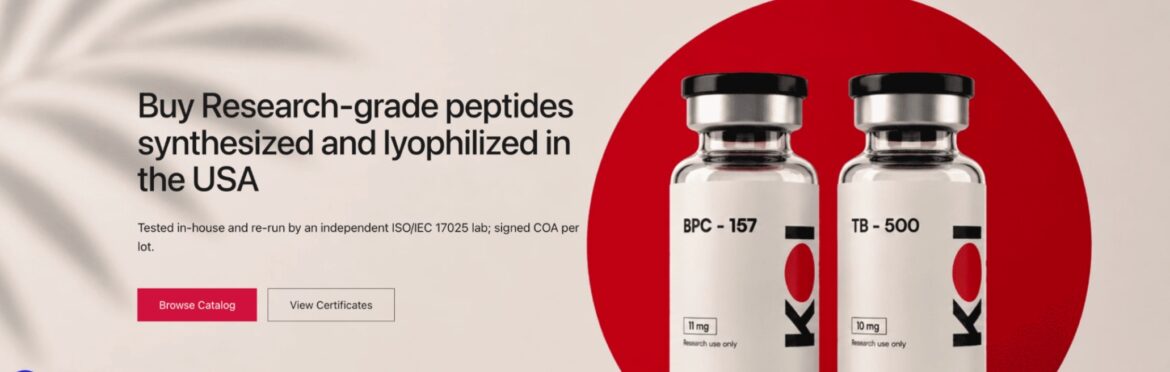
This Koi Peptides review looks at one question above all others: Does the paperwork match the product? Koi Peptides is a US-based research peptide supplier that synthesizes and freeze-dries its compounds in the United States and publishes a Certificate of Analysis for every lot on its website.
For researchers who care about purity, identity, and traceable batch records, that documentation is the part worth checking first. Here is what the company offers, how its testing works, and what a buyer can independently confirm before placing an order.
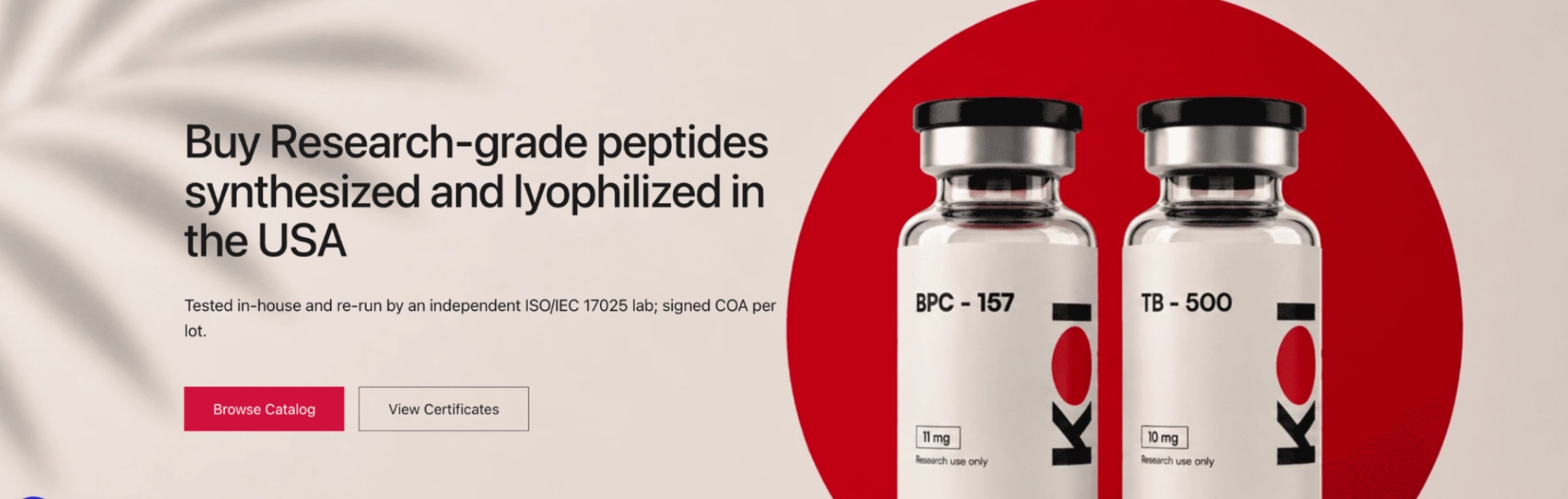 The use of this image was permitted by KOI to the author of the piece
Introduction to Koi Peptides
Koi Peptides is a research-grade peptide company that sells to scientific researchers, academic laboratories, and biotech and pharmaceutical teams running preclinical and in vitro work. The brand was started in 2022 by a small group of researchers and chemists, supplied clients offline for four years, and opened its catalog online in 2026.
The company operates as Koi Research Labs LLC, with a registered US office at 30 N Gould St, Ste R, Sheridan, Wyoming. You can reach the team through Koi Peptides directly or by phone at 1-833-854-9601. A quick look at the catalog and support setup shows a few clear points:
- Catalog size: More than 100 standard research peptides and blends, grouped around tissue-repair, metabolic, cognitive, and longevity research areas.
- Single supply chain: Compounds are synthesized and lyophilized in the United States, with no overseas drop-shipping step. The vial that ships is the vial filled at the partner facility.
- Who it serves: Universities, contract research organizations (CROs), and biotech labs, with wholesale and lot-locked supply available on request.
Koi Peptides Quality and Purity Standards
Koi sets a release standard of 99% purity or higher on every batch, measured by integrated peak area on high-performance liquid chromatography (HPLC). A lot is not released for sale until its full test panel is on file, and the dated record for the specific batch a buyer receives is published before the order ships.
Two things stand out in this Koi Peptides review when you read the actual numbers.
- First, the testing is run twice: in-house, then re-run by an independent laboratory accredited to ISO/IEC 17025, with both result sets published against the lot ID.
- Second, the published purities sit at the top of the stated range. Recent lots include NAD+ at 99.8%, Tesamorelin at 99.7%, Ipamorelin at 99.5%, Semaglutide at 99.5%, BPC-157 Acetate at 99.4%, and TB-500 at 99.3%. The lowest figure in the current public library is 99.0%.
Purity is only one measure, though. Identity matters just as much, because a high-purity vial of the wrong compound is still the wrong compound. Koi confirms molecular weight and sequence integrity by liquid chromatography mass spectrometry (LC-MS), which flags synthesis errors before material leaves the bench. That pairing of purity plus identity testing is the baseline a serious research peptide supplier should meet.
Understanding Koi Peptides COAs (Certificates of Analysis)
A Certificate of Analysis is the document that tells you what is actually in the vial, and Koi publishes one for every lot in a searchable public COA library. Each lot ID follows the format KOI-YYYY-MMDD-x, is printed directly on the vial, and can be looked up by lot number or compound name. At the time of writing, the public COA library lists 32 documents.
Reading a peptide COA is easier once you know what each test on it covers. Koi’s standard panel reports the following:
- HPLC purity: Reverse-phase HPLC quantifies how much of the sample is the target peptide. The chromatogram is published alongside the certificate, so the result is visible, not just stated.
- LC-MS identity: Electrospray-ionization mass spectrometry confirms the molecular weight and sequence, catching modifications or synthesis errors.
- Heavy metals: ICP-MS screens for lead, arsenic, cadmium, and mercury, with the panel reporting these below 10 ppm.
- Endotoxin: Bacterial endotoxins are measured by LAL assay against the pharmacopeial standard, USP <85> (Bacterial Endotoxins Test (BET)) and <161> (Medical Devices, Bacterial Endotoxin and Pyrogen Tests), with pass results recorded on duplicate replicates.
- Counterion content: The acetate or trifluoroacetate (TFA) salt content is reported per lot, a detail many vendors leave off entirely.
Koi Peptides Product Range and Pricing
Koi’s catalog covers single peptides and pre-weighed research blends at prices that sit in the mid-range for the US market. Pricing is listed clearly on each product page, and every blend ships with the same third-party COA standard as the individual peptides, with compositions verified by LC-MS before release.
A few examples give a sense of the range:
- Single peptides: BPC-157 (5 and 10mg) and GHK-Cu start at $39.95; TB-500 (10mg) is $59.95, Sermorelin (5mg) is $59.95, and Ipamorelin (10mg) is $69.95.
- Metabolic research compounds: Tesamorelin and NAD+ are listed at $89.95.
- Research blends: The GLOW blend (BPC-157, GHK-Cu, TB-500) is $149.95, and the KLOW blend (BPC-157, GHK-Cu, KPV, TB-500) is $169.95.
The published catalog and the matching COA list line up, which is a good sign for anyone cross-checking what is in stock against what has been tested.
Read more about GHK-Cu Peptides
Verified Customer Feedback: What Buyers Can Actually Check
For a research peptide supplier, the most reliable feedback is documentary. Koi Peptides only opened online in 2026, so its independent third-party review footprint on platforms like Trustpilot is still small. That makes the verifiable record more useful than star ratings right now, and Koi gives buyers several things they can confirm for themselves:
- Lot-matched COAs: Every vial carries a public lot ID you can search before and after purchase, so the certificate is tied to your specific batch.
- Dual test results: Both the in-house panel and the independent ISO 17025 lab results are published, not summarized.
- Named analytical methods: HPLC, LC-MS, LAL endotoxin, and ICP-MS are listed by name, which lets a researcher judge the testing on its merits.
- An open purity record: The 32 published documents show real figures between 99.0% and 99.8%, rather than a single rounded claim.
Shipping, Support, and Buying Experience
Koi ships from US warehouses with same-day dispatch on orders placed before 2 PM Central Time, Monday through Friday, and free shipping on US orders above $200. The brand fulfills orders for researchers in the United States, Canada, and other markets.
Other practical details worth knowing:
- Support hours: Customer support runs Monday to Friday, 8 AM to 6 PM Central, and is closed on weekends and US federal holidays.
- Account gate: The site applies a 21-and-over research-use confirmation before checkout, in line with its research-only policy.
Are Koi Peptides Worth It?
Koi Peptides earns its place for buyers who value transparency and traceable testing over the lowest possible price. The combination of US synthesis, dual in-house and ISO 17025 testing, and a public COA library tied to printed lot IDs is more than many competing vendors publish. To keep this Koi Peptides review balanced, here is the quick read:
- Strengths: Per-lot COAs, 99%+ verified purity, full method disclosure, US sourcing and fast domestic shipping, and clear mid-range pricing.
- Considerations: A new online presence with limited independent reviews so far, and a research-use-only catalog that is not sold for any other purpose.
FAQs on Koi Peptides Reviews
Is Koi Peptides third-party tested?
Yes, every lot is tested in-house and re-run by an independent ISO 17025-accredited laboratory. Both result sets are published against the lot ID, covering HPLC purity, LC-MS identity, mass and weight verification, sterility, endotoxin level, and residual TFA.
Where are Koi peptides made?
All Koi peptides are synthesized and lyophilized in the United States. There is no overseas drop-shipping, and orders ship from US warehouses operated by Koi Research Labs LLC in Sheridan, Wyoming.
How do I check a Koi Peptides COA?
Find the lot ID printed on your vial, then search that lot number or the compound name in the public COA library to pull the full analytical record for your batch.
Conclusion: Is Koi Peptides Legit?
This Koi Peptides Research review points to a supplier built around verifiable testing rather than promises. The brand pairs US-made, research-grade peptides with per-lot Certificates of Analysis, dual laboratory testing, and an open COA library that any buyer can search. Pricing is reasonable, shipping is fast within the US, and the documentation is detailed.
The main caveat is a young online track record, so independent customer feedback is still building. For researchers who judge a vendor by its paperwork, Koi Peptides made a strong, well-documented case in 2026.
Disclaimer: This article is for informational purposes only and does not constitute medical advice. All products discussed are sold strictly for research use only and are not for human consumption. Access is restricted to qualified users aged 21 and over. Consult the relevant regulations in your jurisdiction before purchasing research materials.
By Anais Harmon, Research Science Writer