
By Dr. Michael Whelan, Clinical Pharmacist, PharmD. Fact-checked by Yuri Josh, Editor.
Retatrutide, Semaglutide, and Tirzepatide are all incretin compounds that target different numbers of receptors. While Retatrutide hits 3 receptors at once, Semaglutide hits one, and Tirzepatide hits two. How do these mechanisms produce different outcomes in adults? We’ll discuss this here in depth.
Note: Semaglutide and Tirzepatide are approved drugs that clinicians can prescribe for certain weight-related conditions; Retatrutide is still investigational and being tested in clinical trials.
Quick Comparison Table
| Feature | Retatrutide | Semaglutide | Tirzepatide |
| Drug class | Triple agonist | Single agonist | Dual agonist |
| Main targets | GLP-1, GIP, glucagon | GLP-1 | GLP-1, GIP |
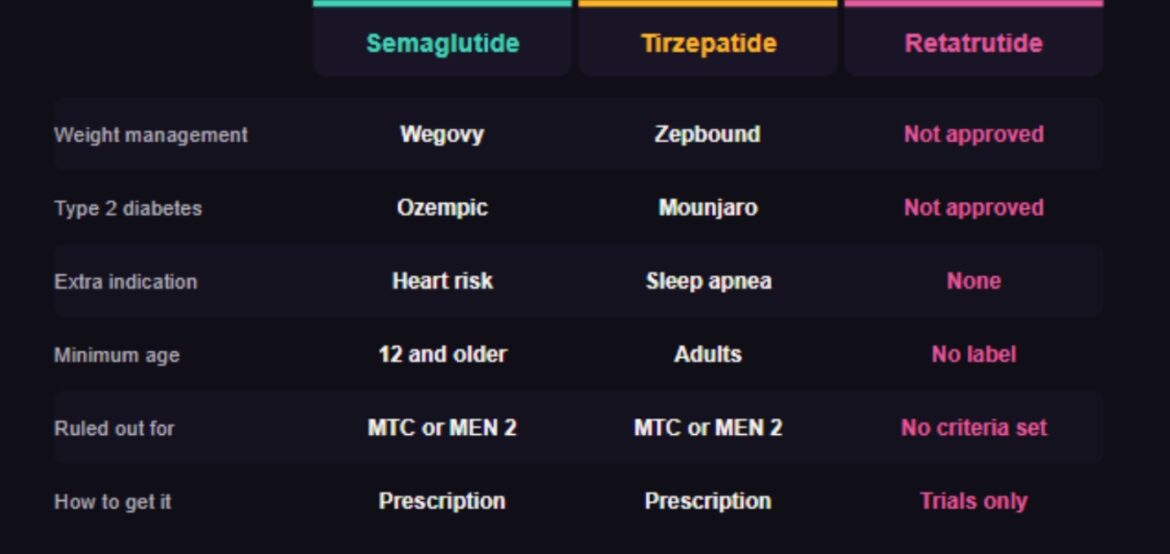
| Brand names | None | Ozempic, Wegovy | Mounjaro, Zepbound |
| Administration | Weekly subcutaneous injection in trials | Weekly subcutaneous injection (oral tablet also available for diabetes) | Weekly subcutaneous injection |
| FDA status | Investigational | Approved | Approved |
| Weight-loss evidence | 28.3% at 80 weeks | 13.7% at 72 weeks | 20.2% at 72 weeks |
Key Takeaways
- The main difference between Semaglutide, Retatrutide, and tirzepatide is the number of receptors they target.
- Semaglutide and tirzepatide are FDA-approved. Retatrutide is not.
- Retatrutide has the biggest trial numbers so far. Up to 28.3% average weight loss at 80 weeks in the TRIUMPH-1 study, and 30.3% in a two-year extension group.
- Only one true head-to-head comparison exists between Semaglutide and tirzepatide. SURMOUNT-5 directly compared the two: 20.2% versus 13.7%. Nobody has run retatrutide against either one.
- Semaglutide is the only one of the three peptides with a completed cardiovascular outcomes trial behind an FDA-approved heart indication.
- Retatrutide has reported five positive Phase 3 studies and is being discussed for FDA approval in Q1 2027.
- Individual researchers can source all three compounds at Kylo Peptides with the highest purity (>99%). Lot-matched COAs are available on the website, with testing from 3 independent labs.
What Is Retatrutide?
Retatrutide is a triple agonist, also known by its development name, LY3437943. It is a 39-amino-acid peptide that binds to the GLP-1, GIP, and glucagon receptors.
Glucagon, the 3rd receptor, is better known as the hormone that raises blood sugar levels, increasing energy expenditure and fat burning by the liver. The first two, GLP-1 and GIP receptors, are known for reduced appetite and insulin activity.
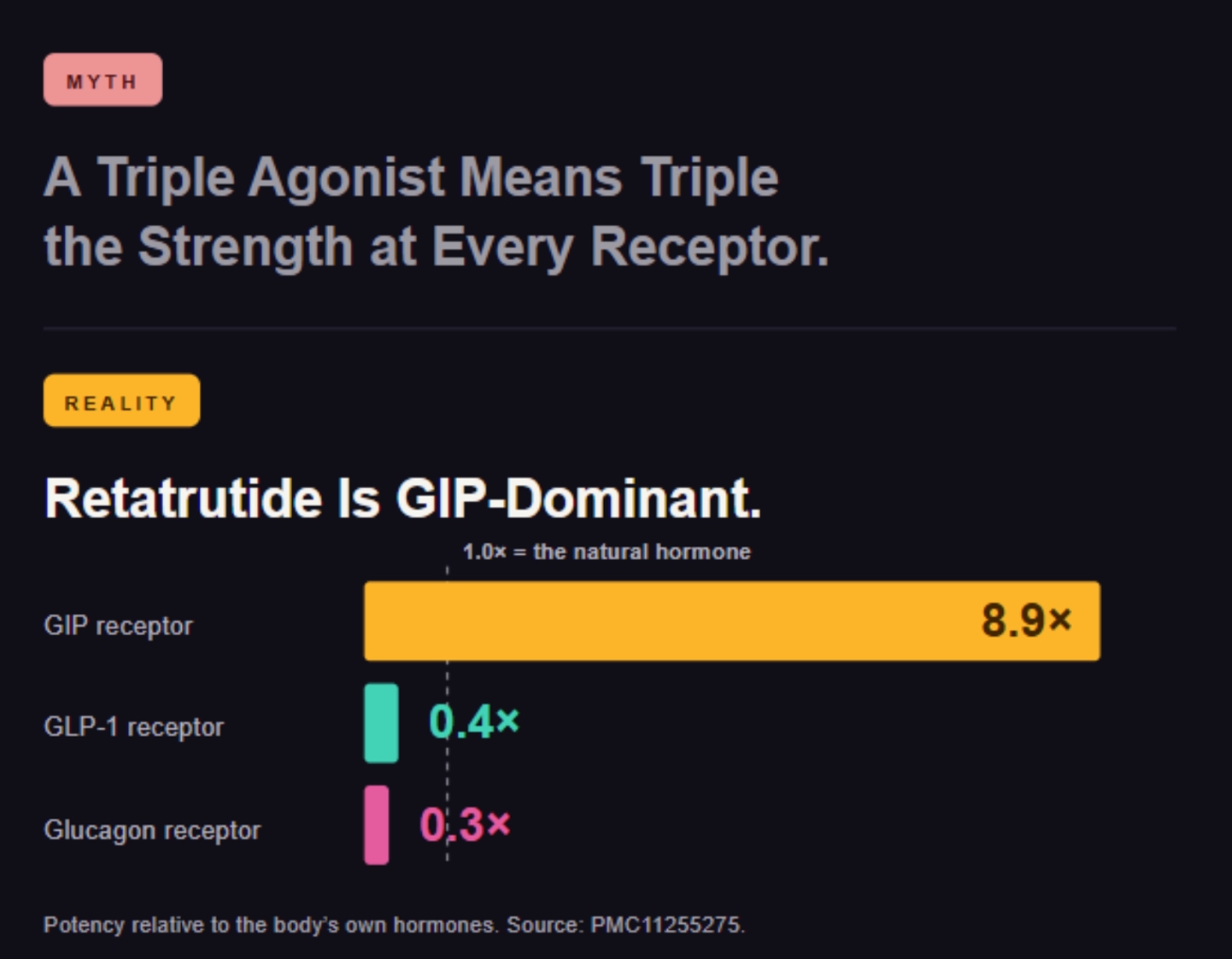
The compound has now cleared five Phase 3 trials. It remains investigational and cannot be legally sold or marketed for human use.
What Is Semaglutide?
Semaglutide is a GLP-1 agonist drug. It binds to GLP-1 receptors, signaling your pancreas to release insulin when your blood glucose levels are increased. As a result, food moves more slowly from your stomach into your intestine, and your brain receives the sensation of satiety. This reduces your appetite and makes you feel less hungry.
The drug is available as Ozempic for type 2 diabetes and Wegovy for obesity. Wegovy was also approved by the FDA to decrease cardiovascular risks for patients with heart disease and obesity.
What Is Tirzepatide?
Tirzepatide is a dual-receptor agonist that targets the GLP-1 and GIP receptors. Pairing the two appears to improve insulin response and fat handling beyond what GLP-1 does alone. Appetite suppression feels similar for users, but the metabolic effect is stronger.
You’ll see it as Mounjaro for type 2 diabetes and Zepbound for obesity and for moderate-to-severe obstructive sleep apnea with obesity. Zepbound comes in six strengths from 2.5 mg up to 15 mg.
What Mechanism Do They Use?
The compounds are incretin mimetics, meaning they mimic the action of the hormone your gut produces after you eat.
Semaglutide
- Semaglutide mechanism of action: The drug binds to GLP-1 receptors, which are found in the pancreas and stomach. It resists GLP-1 (enzyme) breakdown by the receptor, which normally takes a few minutes.
- Suppressing the signal of hunger: GLP-1 receptors are also found in the hypothalamus and brainstem. When stimulated by Semaglutide, they nudge the feeling of fullness, making the urge to eat disappear.
- Delaying stomach emptying: With less food entering your stomach, your stomach stays fuller.
Tirzepatide
- GLP-1 activation: Same as semaglutide. Leads to appetite suppression, slower stomach emptying, and glucose-dependent insulin release.
- GIP activation: In addition to GLP-1, Tirzepatide also activates GIP receptors on fat cells and in the brain, improving how fat tissue stores and releases energy. It also potentially softens the nausea associated with pure GLP-1 activity.
- Appetite and metabolic effects: Together, the two signals have a stronger activity than either alone.
Retatrutide
- Glucagon activation: Retatrutide activates a third receptor, Glucagon, besides GLP-1 and GIP. It’s found in the liver and drives fat breakdown to raise resting energy expenditure.
- Potential effects on energy expenditure: The pitch is to hit weight from both ends, lowering intake through appetite suppression and raising output through metabolic rate. Trial data support bigger weight-loss claims. The long-term safety of chronic glucagon activation remains an open question.
What Makes Them Different?
The main differences include the number of target receptors, how those receptors are targeted, and the weight-loss potential supported by trial data.
- Number of receptors targeted: Semaglutide targets one, tirzepatide targets two, and retatrutide targets three.
- Mechanism of action: Semaglutide reduces food intake. Tirzepatide adds improved metabolic handling, and Retatrutide adds an energy-expenditure push.
- Weight-loss potential: Based on current trial data, retatrutide yields the largest average reductions, followed by tirzepatide and semaglutide.
- Clinical evidence: Semaglutide has the deepest evidence base, including a completed cardiovascular outcomes trial. Tirzepatide has a head-to-head win over semaglutide in weight reduction. Retatrutide has five Phase 3 readouts and no head-to-head data.
- FDA approval: Semaglutide and Tirzepataide are approved drugs. Retatrutide is investigational.
- Availability: Semaglutide and tirzepatide are prescription medicines. Retatrutide is available only to people enrolled in clinical trials.
- Long-term safety data: Semaglutide has years of post-approval use across millions of patients. Tirzepatide’s record is shorter and growing. Retatrutide’s longest published human data runs to 104 weeks in a subset of one trial.
Benefits
What did clinical trials actually report about the potential of these compounds? Let’s understand.
Weight Loss (Retatrutide)
- Clinical weight-loss findings: In the TRIUMPH-1 trial, average weight loss was 19.0% (4mg), 25.9% (9 mg), and 28.3% (12 mg) by dose, compared with 2.2% for placebo.
- Differences between trial results: In TRIUMPH-2, with 1,152 adults with type 2 diabetes, the 12 mg group lost 20.8%. In TRIUMPH-3, which included 1,949 adults with severe obesity and heart disease, the same dose delivered 22.6%.
Appetite Control
- Reduced hunger: All three peptides reduce hunger by acting through GLP-1 receptors in the brain.
- Increased satiety: Slower stomach emptying means meals feel bigger and last longer. Portions shrink without deliberate restriction.
Blood Sugar Control
- Semaglutide: Approved for type 2 diabetes as Ozempic, with glucose-dependent insulin release and reduced post-meal glucagon.
- Tirzepatide: Approved as Mounjaro for type 2 diabetes. A systematic review of direct comparative studies found it significantly outperformed semaglutide on weight reduction.
- Retatrutide research: TRIUMPH-2 measured A1C reductions of up to 1.6% from a 7.7% baseline, against 0.2% for placebo.
Metabolic Effects
- Insulin sensitivity: GIP activation appears to improve fat tissue’s response to insulin, which may help explain why dual- and triple-agonists outperform GLP-1 alone.
- Glucose regulation: All three act when blood sugar is high and back off when it isn’t.
- Potential energy-expenditure effects: Glucagon activation in retatrutide averaged reductions of 37.0% in triglycerides, 16.5% in non-HDL cholesterol, 51.2% in high-sensitivity C-reactive protein, and 9.3 mmHg in systolic blood pressure.
Side Effects
All three cause gut side effects clustered during dose increases. Here’s what each one reports.
Retatrutide
- Gastrointestinal side effects: In TRIUMPH-1 at 12 mg, nausea hit 42.4%, diarrhea 32.0%, constipation 26.1%, and vomiting 25.3%.
- Nausea: Nausea was 28.6% at 4 mg and 42.4% at 12 mg, so tolerability tracks closely with how high you push the dose.
- Other effects reported in trials: Retatrutide produced dysesthesia, an abnormal skin sensation such as tingling or burning. Urinary tract infections occurred in 8.4%.
- Unknown long-term risks: Discontinuation due to adverse events was reported at 11.3% in TRIUMPH-1 and 13.5% in TRIUMPH-3.
Semaglutide
- Gastrointestinal problems: Nausea, vomiting, diarrhea, and constipation are common with semaglutide because it slows gastric emptying.
- Other labeled risks: Semaglutide has a boxed warning because of the risk of thyroid C-cell tumors, and use is contraindicated in case of history of medullary thyroid carcinoma or MEN 2.
- Other risks include pancreatitis, gallbladder disease, and renal injury due to dehydration.
Tirzepatide
- Gastrointestinal side effects: Like semaglutide, the most common side effects are nausea, diarrhea, vomiting, constipation, and abdominal pain.
- Nausea, diarrhea, constipation: Gastrointestinal side effects caused 2.7% of tirzepatide users to discontinue therapy, compared with 5.6% of participants in the semaglutide study.
- Other Risks: Thyroid C-cell tumors, pancreatitis, gallbladder disease, hypoglycemia when combined with insulin, and problems in vision for patients with type 2 diabetes.
Which One Is More Effective?
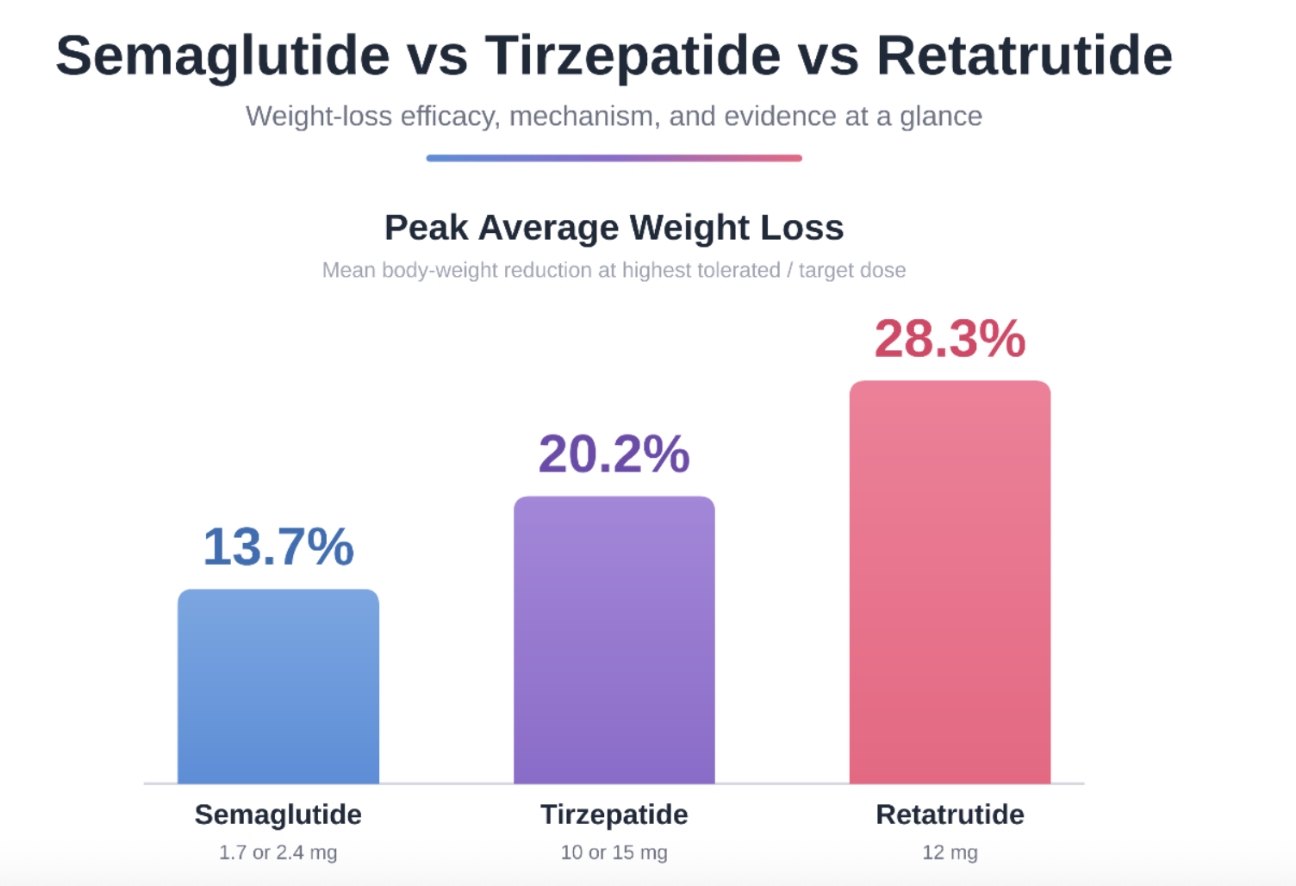
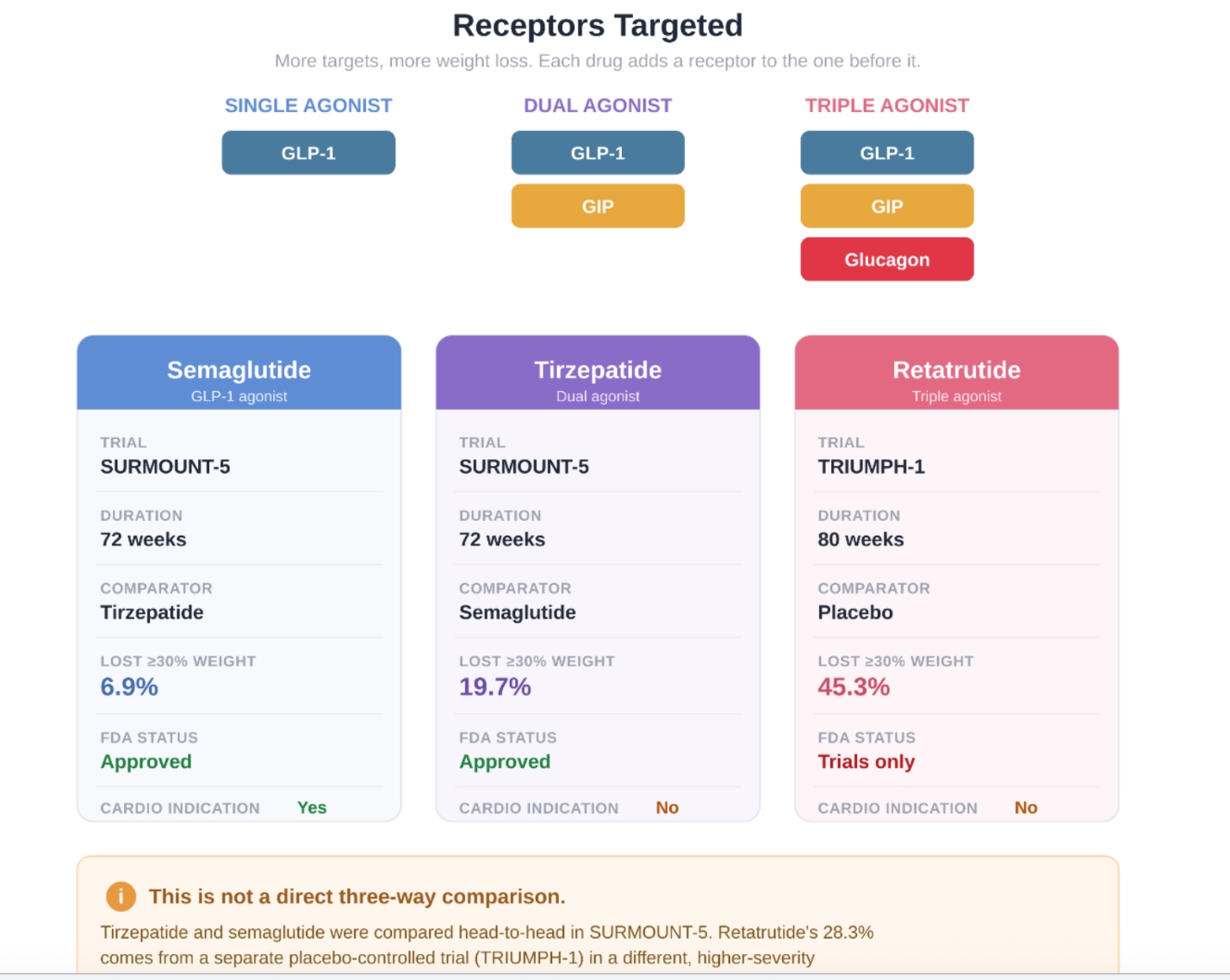
On average, retatrutide leads in weight loss, tirzepatide comes second, and semaglutide ranks third. However, retatrutide’s numbers come from a placebo-controlled trial. It’s not yet an approved medication.
| Factors | Semaglutide | Tirzepatide | Retatrutide |
| Receptors targeted | 1 (GLP-1) | 2 (GIP + GLP-1) | 3 (GIP + GLP-1 + glucagon) |
| Drug class | GLP-1 agonist | Dual agonist | Triple agonist |
| Peak avg. weight loss | 13.7% | 20.2% | 28.3% |
| At dose | 1.7 or 2.4 mg | 10 or 15 mg | 12 mg |
| From trial | SURMOUNT-5 | SURMOUNT-5 | TRIUMPH-1 |
| Duration | 72 weeks | 72 weeks | 80 weeks |
| Compared against | Tirzepatide | Semaglutide | Placebo |
| ≥30% weight loss | 6.9% | 19.7% | 45.3% |
| FDA status | Approved | Approved | Investigational (trials only) |
| Cardiovascular indication | Yes (approved) | No | No |
How They Work
Semaglutide acts on the GLP-1 receptor alone. Tirzepatide adds the GIP receptor. Retatrutide adds a third target, the glucagon receptor, on top of the same GIP and GLP-1. The glucagon arm is thought to raise energy expenditure, which is the leading theory for why retatrutide’s weight loss numbers run highest.
What The Trials Actually Show
Tirzepatide’s 20.2% versus semaglutide’s 13.7% is a true head-to-head result from a 751-person trial. Retatrutide’s 28.3% is a topline Phase 3 result against placebo in a separate, higher-severity population and is not yet fully peer-reviewed. No trial has placed retatrutide against tirzepatide or semaglutide directly.
Beyond Weight Loss
Semaglutide is the only one of the three with a completed cardiovascular outcomes trial behind an approved indication. Tirzepatide showed a larger predicted 10-year cardiovascular risk reduction in a post hoc analysis of SURMOUNT-5, but that is modeling, not a hard outcomes result. Retatrutide has no cardiovascular outcomes data yet.
Availability
Semaglutide and tirzepatide are FDA-approved and available by prescription. Retatrutide is investigational and legally available only to people enrolled in the ongoing clinical trials.
Bottom line. For raw weight loss, the data ranks retatrutide first, tirzepatide second, semaglutide third. For strength of evidence and real-world access, semaglutide and tirzepatide are proven and available, while retatrutide is still years from a pharmacy shelf.
Why Trial Results Cannot Be Compared Directly
- Different study populations: TRIUMPH-1 enrolled adults with an average starting BMI of 40.0 and no diabetes. TRIUMPH-2 enrolled people with type 2 diabetes, a group that consistently loses less weight on these drugs. Retatrutide ranged from 20.8% to 28.3% at the same 12 mg dose purely because of who was enrolled.
- Different doses: The 28.3% figure comes from retatrutide’s top dose of 12 mg. The 4 mg dose delivered 19.0%, close to tirzepatide’s head-to-head result. Quoting only the ceiling dose flatters the drug.
- Different study durations: TRIUMPH-1 ran 80 weeks. SURMOUNT-5 ran 72 weeks.
- Different trial designs. TRIUMPH-1 was double-blind and placebo-controlled. SURMOUNT-5 was open-label with an active comparator, so participants knew what they were taking. Those designs yield different effect sizes for reasons unrelated to the molecules.
Who Should Use Them?
Prescribing decisions belong to a licensed clinician who knows your history.
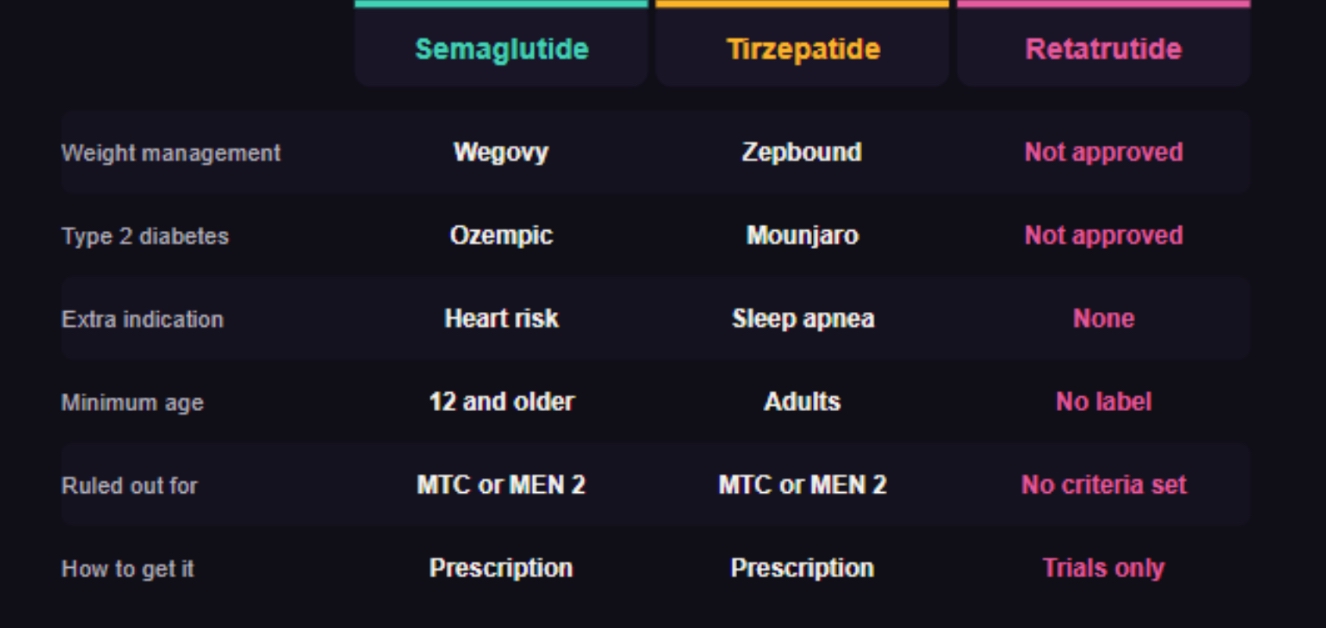
- Who may be prescribed semaglutide: Wegovy is approved for adults with obesity, or overweight plus at least one weight-related condition. It’s also approved for adolescents aged 12 and older with obesity, and for reducing cardiovascular risk in adults with established heart disease and overweight or obesity. Ozempic is approved for type 2 diabetes.
- Who may be prescribed tirzepatide: Zepbound is approved for adults with obesity or with overweight plus weight-related medical problems, and for adults with moderate-to-severe obstructive sleep apnea and obesity. Mounjaro is approved for type 2 diabetes.
- Factors doctors consider: Starting BMI and weight-related conditions, type 2 diabetes, cardiovascular history, sleep apnea, prior tolerance to GLP-1 drugs, interacting medications, insurance coverage, and the amount of weight loss the situation calls for.
- Who should not use these medications: Those with a personal or family history of medullary thyroid carcinoma or MEN 2, and those with a serious allergic reaction to the active ingredient. Both carry warnings around pancreatitis, gallbladder disease, severe gastrointestinal disease, and pregnancy.
- Why retatrutide should only be discussed in the context of clinical research until approved: Retatrutide has no approved label, no established human dosing, and no authorized supply route for human use. The only lawful way to receive retatrutide is enrollment in clinical trials.
FDA Approval and Availability
Semaglutide and Tirzepatide are approved medicines you can fill at a pharmacy. Retatrutide is a research compound.
Semaglutide Approval
Semaglutide entered the U.S. market as Ozempic for type 2 diabetes, and later as Wegovy for chronic weight management, in June 2021. In March 2024, the FDA added a cardiovascular indication to Wegovy, the first weight-management medicine approved to cut the risk of cardiovascular death, heart attack, and stroke in adults with heart disease and excess weight.
Tirzepatide Approval
Tirzepatide arrived as Mounjaro for type 2 diabetes, then Zepbound for chronic weight management. Zepbound later added an indication for moderate-to-severe obstructive sleep apnea in adults with obesity.
Retatrutide Approval Status
Retatrutide holds no approval from the FDA, the EMA, or any other regulator. Its first Phase 3 trial result was reported in December 2025. With five positive Phase 3 studies, the compound will soon be filed as a Biologics License Application in Q1 2027.
Why FDA Approval Matters
FDA approval matters because it means an independent agency confirmed the medicine is made correctly, the dose is appropriate, and the label is accurate before it can be sold. For retatrutide, the FDA has said it cannot be made by anyone, and it has not been proven to be safe and effective for anything.
Approved vs Investigational Treatments
Approved treatments differ from those still being tested. An approved treatment has a label that says what it is for, a doctor who can prescribe it, and a pharmacy where you can buy it. A treatment still being tested has a test plan and a place where it’s being tested.
There is also a third kind of treatment called research-grade, which is for lab work only. Companies like Kylo Peptides sell research-grade treatments to qualified and institutional labs in the US, Canada, EU, and certain regions in APAC. They provide full-panel, independently tested, lot-match COAs for each vial, with confirmed 99%+ purity.
FAQ
Is retatrutide better than semaglutide?
No head-to-head trial has compared them, so we don’t yet know. Retatrutide produced an average weight loss of 28.3% in a clinical trial, compared with 13.7% with semaglutide, but those are separate studies with different populations. Semaglutide is approved, and retatrutide is not.
Is retatrutide stronger than tirzepatide?
On published trial averages, yes. At 80 weeks, retatrutide reached 28.3% at 12 mg, while tirzepatide reached 20.2% at 72 weeks. No trial has tested them head-to-head.
Which causes the most weight loss?
Retatrutide has produced the largest average reductions in trials, with reductions of up to 28.3% at 80 weeks and 30.3% at 104 weeks in one extension group. Among drugs you can actually be prescribed, tirzepatide leads, beating semaglutide 20.2% to 13.7% in clinical trials.
What is the difference between semaglutide and tirzepatide?
Semaglutide activates one receptor, GLP-1. Tirzepatide activates two receptors, GLP-1 and GIP. In the only direct comparison, tirzepatide produced a 20.2% weight loss over 72 weeks, compared with semaglutide’s 13.7%.
Is retatrutide FDA approved?
No. Retatrutide has not been approved by the FDA or any other regulator. The only lawful human access is enrollment in the ongoing clinical trials.
Can you switch from semaglutide to tirzepatide?
Your clinician decides whether to switch between them, since they use different strengths and titration timelines.
Are semaglutide, tirzepatide, and retatrutide the same type of drug?
They belong to the same family, incretin receptor agonists, but they differ by how many receptors they hit. Semaglutide is a single GLP-1 agonist, tirzepatide a dual GLP-1/GIP agonist, and retatrutide a triple GLP-1/GIP/glucagon agonist. Semaglutide and Tirzepatide are approved medicines, whereas retatrutide remains investigational.
Which one has the fewest side effects?
All three produce similar gastrointestinal effects that increase with dose. In trials, fewer people quit tirzepatide for gut problems than semaglutide. Retatrutide showed the highest rates of nausea at 42.4% on the 12 mg dose, and dysesthesia.
Conclusion
Semaglutide, tirzepatide, and retatrutide are three generations of incretin compounds, each targeting a different set of receptors.
Semaglutide, the single-agonist, holds the strongest cardiovascular evidence. Tirzepatide, the dual-agonist, beat it in a head-to-head comparison for weight reduction: 20.2% versus 13.7% over 72 weeks. Retatrutide, the triple-agonist, posted the highest weight-reduction numbers in phase 3 trial reports, up to 28.3% at 80 weeks.
When weighing your options with a doctor today, the real comparison is between semaglutide and tirzepatide. Retatrutide remains in investigational trials as of now.
Disclaimer: This article is for information purposes only and does not constitute medical advice. Talk to a healthcare provider before starting, stopping, or changing any medication. Retatrutide is a compound and is not approved for human use.
(cathybellamy01@gmail.com)