
Written by Sheikh Zafarulla, Fact-checked by Mariah Hillary
The Glow Peptide Stack is usually described as a combination of GHK-Cu, BPC-157, and TB-500. NAD+ is sometimes added to the list, although it is a coenzyme rather than a peptide. The combination has become popular in research and supply discussions and in peptide discussions because the individual compounds are associated with different areas of tissue and skin biology.
The critical issue, then, is the extent to which the evidentiary bodies of these individual compounds are relevant to the stack’s efficacy. The answer is not as clear as advertised. GHK-Cu has human evidence, primarily from topical studies, whereas BPC-157 and TB-500 remain mostly preclinical. Most importantly, no human trials are testing the entire stack together under controlled conditions.
Glow Peptide Stack TL;DR
- Core ingredients: GHK-Cu is a copper tripeptide, BPC-157 is a 15-amino-acid peptide, and TB-500 is a fragment of thymosin beta-4. NAD+ is included in some discussions of the stack, but it is a helper molecule rather than a peptide.
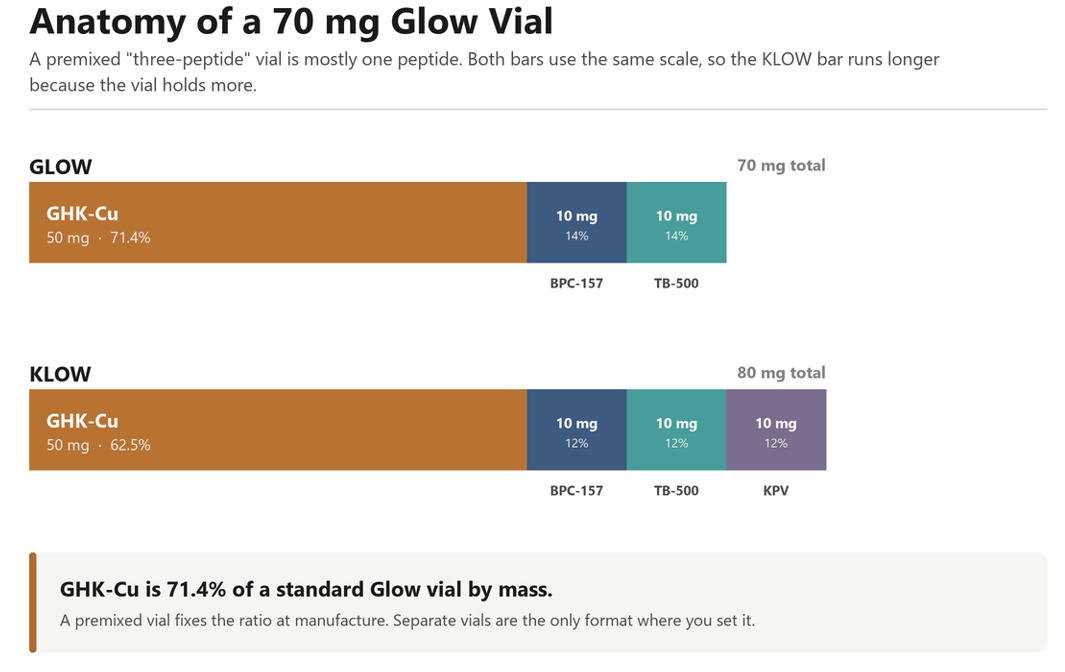
- What it is: The Glow Stack consists of three research compounds that may be sold separately in individual vials or together as a premixed blend.
- Research areas: Research involving these compounds covers collagen and matrix signaling, tissue repair, inflammation, and mitochondrial energy.
- Evidence limits: No controlled human trial has evaluated the full combination, so findings from individual compounds should not be automatically applied to the stack.
- Safety and sourcing: Product identity and purity depend heavily on the supplier’s documentation. TB-500 is also prohibited in sport.
- Kylo Peptides: Kylo Peptides offers all three compounds as individual vials, with a lot-matched certificate for each.
What Is the Glow Peptide Stack?
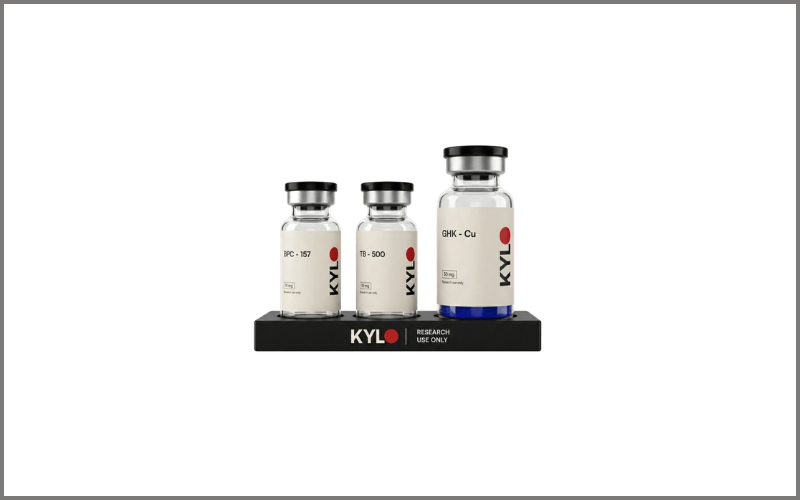
The use of this image is permitted by KYLO to the author of the article.
The Glow Peptide Stack is a combination of GHK-Cu, BPC-157, and TB-500, grouped so researchers can examine three repair-related compounds within the same research framework.
Why Is It Called a Glow Stack?
The term “Glow” did not originate as a laboratory designation. It is a marketing term borrowed from the skincare space, where it refers to the way skin looks rather than to a specific clinical measurement.
There is still a reason the name has caught on. Skin smoothness and firmness depend partly on the support structure beneath the surface, which is made largely of collagen and elastin. All three compounds have been studied in connection with processes involving this underlying matrix.
Why Combine Multiple Peptides?
Peptides can act as signaling molecules, with individual compounds influencing particular pathways. Combining several compounds may therefore bring different processes into the same research model. At the same time, studying one compound at a time makes it easier to determine which substance is responsible for an observed result.
What Ingredients Are Usually Found in a Glow Stack?
| Ingredient | Type | Research focus | Commonly marketed as |
|---|---|---|---|
| GHK-Cu | Copper tripeptide-1 | Collagen, matrix | Skin-appearance claims |
| BPC-157 | Pentadecapeptide (15 amino acids) | Repair, inflammation | Recovery claims |
| TB-500 | Thymosin beta-4 fragment | Cell migration | Regeneration claims |
| NAD+ | Coenzyme | Energy, metabolism | Add-on |
| Optional | Varies | By formulation | Support |
 Where Kylo Peptides Fits Into the Glow Stack
Kylo Peptides fits into this discussion primarily as a supplier of individual research compounds associated with peptide research. The relevant question is therefore not whether a supplier can attach the “Glow” name to a product, but whether the individual material is clearly identified and accompanied by appropriate documentation.
For researchers evaluating a product, useful information includes a certificate of analysis, batch or lot identification, reported purity, identity testing, concentration, storage requirements, and research-use labeling.
The Biology Behind the Glow
Skin appearance depends on the dermal matrix. Glow stack peptides are investigated in relation to the mechanisms that create and degrade the matrix. The process depends on three steps: oxidative or inflammatory load, enzymatic breakdown, and collagen synthesis.
Understanding the Three Major Skin Layers
- Epidermis: It is the outer barrier layer of the skin that helps govern turnover, hydration, and surface texture.
- Dermis: It is the structural layer where fibroblasts live, and collagen and elastin concentrate.
- Extracellular matrix: It is the scaffold within the dermis, composed of collagen, elastin, and glycosaminoglycans.
Collagen and Elastin Loss With Age
Collagen production slows with age, so the balance shifts toward breakdown, and ultraviolet exposure pushes it further that way. Elastin gives skin its recoil, and both proteins depend on fibroblast activity.
MMPs and Extracellular Matrix Breakdown
Matrix metalloproteinases cut structural proteins apart as a normal part of remodeling, and what causes trouble is the balance between cutting and rebuilding.
MMP-1 is the major protease that initiates degradation of native fibrillar collagen, meaning the intact rope-like bundles in skin, and ultraviolet light switches on MMP-3 and MMP-9 too. UV activates a gene-control pathway called AP-1;1, AP-1 raises MMP production, and breakdown outpaces replacement.
Slowing degradation and stimulating synthesis are the two levers available, which is why MMP pathways appear in nearly every paper on skin aging.
Inflammation and Oxidative Stress
Short-term inflammation is an important part of normal repair. Chronic or excessive inflammatory signaling, however, can contribute to tissue stress.
Oxidative stress also matters because reactive oxygen species can affect proteins, lipids, DNA, and cellular signaling.
These concepts help explain why compounds associated with inflammatory pathways and antioxidant mechanisms frequently appear in discussions of longevity and skin health.
The Gut-Skin and Systemic Connection
The gut-skin axis is being studied for potential links among the gut barrier, the composition of the gut microbiome, systemic inflammation, and skin health. It is an active area of research, but that is different from proving that a Glow Stack acts through this pathway. At present, that connection is a hypothesis rather than an established effect of the stack.
The Core Ingredients: A Research Breakdown
Every compound in a glow stack peptide protocol carries a different quality of evidence, and grouping them hides that. GHK-Cu has genuine human data, BPC-157 and TB-500 rest on preclinical records, and NAD+ brings biochemistry with little direct connection to skin.
GHK-Cu: The Skin-Focused Peptide
Evidence grade: the strongest human data here, and almost entirely topical.
GHK is glycyl-L-histidyl-L-lysine, a tripeptide first isolated from human plasma in 1973. The copper complex is the form used in research and cosmetics, and plasma levels fall from roughly 200 ng/mL at around age 20 to about 80 ng/mL by age 60.
Copper peptides show activity on fibroblasts, collagen and elastin synthesis, matrix remodeling and antioxidant pathways, and that work spans cell culture, animal and topical studies.
Route is the detail that counts most here. Human evidence for GHK-Cu comes from creams and serums applied to facial skin, and a Glow stack is injected instead. Whether those results carry over has not been resolved, and assuming they do is the most common overstatement in this category.
BPC-157: The Tissue-Repair Research Peptide
Short-term inflammation is an important part of normal repair. Chronic or excessive inflammatory signaling, however, can contribute to tissue stress.
Oxidative stress also matters because reactive oxygen species can affect proteins, lipids, DNA, and cellular signaling.
These concepts help explain why compounds associated with inflammatory pathways and antioxidant mechanisms frequently appear in discussions of longevity and skin health.
A 2026 review of peptide therapies noted that BPC-157 findings involving tendon and muscle repair remain largely unvalidated in human trials. Another recent medical review notes that combinations of unapproved peptides have not been well studied and that human evidence for many of these compounds remains limited.
TB-500: The Recovery and Cell-Migration Component
TB-500 is a synthetic fragment matching an active region of thymosin beta-4, a natural protein made of 43 amino acids. Its mechanisms run through actin, the protein scaffolding cells use to change shape and move.
One distinction gets lost in the marketing. Much of the published research uses full-length thymosin beta-4 rather than the TB-500 fragment, and a 2026 scoping review of 80 studies found that the parent molecule dominated the literature. That parent molecule also has a clinical history the fragment lacks, since it reached human trials as RGN-352 and RGN-259.
BPC-157 and TB-500 are often paired because one is associated with vessel formation and the other with cell migration.
NAD+: The Cellular-Energy Component
NAD+ is not a peptide. It is a coenzyme, meaning a helper molecule that enzymes need to work, which changes how the fourth ingredient should be read.
NAD+ cycles with NADH through the reactions that generate ATP. It is also the substrate consumed by PARP enzymes and sirtuins. PARPs repair DNA damage, and sirtuins are maintenance enzymes tied to aging, and both draw on the same NAD+ pool.
Plasma NAD+ and its metabolites are measurably dysregulated in normal aging. Including it makes a Glow stack broader than a peptide combination, and NAD+ sits in neither vial.
Optional Ingredients: Glutathione, GLP-1s and Other Compounds
There is no universal Glow Stack formula.
Some sellers or online protocols may add compounds such as glutathione or other ingredients. These additions should not be treated as standard components.
Glutathione is an important antioxidant system in the body and has its own research literature. GLP-1 drugs are different again: they belong to a separate pharmacological category and are not standard ingredients of a conventional GHK-Cu/BPC-157/TB-500 Glow Stack.
How the Glow Stack Ingredients Work Together
The basic idea behind the Glow Peptide Stack is that each compound is studied in relation to a different part of the repair process.
One Stack, Multiple Biological Targets
The conceptual division is relatively straightforward:
- GHK-Cu → collagen and extracellular-matrix research
- BPC-157 → tissue-repair and inflammatory-signaling research
- TB-500 → cell migration and tissue-repair research
- NAD+ → cellular energy and metabolism
This makes the combination look complementary on paper. But complementary is not the same thing as synergistic.
Is There Evidence of True Synergy?
Not at this point. In research terms, synergy means the combined effect is greater than expected from the individual compounds alone. Demonstrating that requires a study comparing the compounds separately and in combination under the same experimental conditions.
No such study has established true synergy for the Glow Stack. So while the proposed division of roles is biologically plausible, it should not be presented as proof that the ingredients produce a greater effect when used together.
Glow Stack Mechanism Comparison
| Research target | GHK-Cu | BPC-157 | TB-500 | NAD+ |
|---|---|---|---|---|
| Collagen and ECM | Yes | Indirect | No | No |
| Tissue repair | Yes | Yes | Yes | No |
| Inflammation | Yes | Yes | Yes | Indirect |
| Cellular energy | No | No | No | Yes |
| Skin-aging | Yes | Emerging | Emerging | Emerging |
| Human evidence | Topical only | 1 of 36 studies | Parent molecule | Metabolic, not skin |
Every column in that bottom row has a different evidence problem, and combining the four resolves none of them.
Kylo Peptides and the Multi-Ingredient Research Approach
Buying all three from one catalog solves a practical problem, since three compounds mean three lots and three certificates. It cannot validate the combination, because identity, purity, and testing are all any supplier can speak to.
Potential Benefits
The glow stack peptide benefits below are research areas under investigation, so each heading reads best as an open question. Whether the combination works is unknown because it has never been trialled as a unit; therefore, the compounds are graded on their own terms.
Skin and Collagen Support
Collagen pathways are the best-supported part of this story, and that support belongs to GHK-Cu. Copper-peptide research reports effects on fibroblast activity, collagen and elastin synthesis and matrix remodeling, and the evidence is real even though it was gathered topically.
Tissue Repair and Recovery
BPC-157 and TB-500 are why recovery language is attached to this stack, since both have preclinical evidence of repair and vessel formation. Neither has the human trials that would turn those records into recovery claims, and the 35-to-one ratio measures that gap.
Inflammatory Signaling
Inflammatory pathways appear in the research on all three peptides, usually as modulation of signaling around tissue stress. A plausible mechanism, an experimental model, and a proven effect are three separate tiers, and marketing tends to collapse them into one.
Cellular Energy and Mitochondrial Function
NAD+ has the clearest biology of the four and the weakest link to how skin looks. Its roles in ATP generation, sirtuin activity, and mitochondrial biogenesis are textbook material, though whether increasing its availability changes skin appearance is a question the literature does not answer.
Hair and Scalp Research
Peptides enter hair discussions through the same tissue-signaling logic, because follicles are matrix-dependent structures. Hair growth should be treated as unestablished, since the mechanistic link is reasonable while clinical evidence is absent.
Evidence-Supported vs Emerging Benefits
The evidence sorts into four tiers:
- Established biology. MMP-driven collagen degradation, NAD+ in energy metabolism, fibroblast collagen synthesis.
- Preclinical evidence. BPC-157 tissue repair and thymosin beta-4 cell migration, consistently positive and not human.
- Limited human evidence. Topical GHK-Cu on facial skin, and full-length thymosin beta-4 in cardiac and eye trials.
- Unproven stack claims. The four working together, any stated timeline, any before-and-after result attributed to the group.
 How to Use a Glow Peptide Stack: Forms, Dosing and Protocols
How often do you inject the glow stack peptide? What is the frequency of glow stack peptide injections? There is no proven frequency for the glow peptide. Any glowing peptide cycle that you may see on the web is a convention, not a validated one. Formulation remains important since it determines systemic exposure; therefore, you must be aware of these research formulations.
Injectable Peptides
The research formulation of peptides is provided in lyophilized form (freeze-dried powder). It is then dissolved in a sterile diluent before use. Handling sterility becomes important at this point since a reconstitution solution can serve as a growth medium. The method of administration also influences systemic exposure.
Topical Peptides
Creams and serums have a long history of clinical use with GHK-Cu. In the cosmetic field, numerous studies have been conducted on facial skin using such formats. Penetration remains the limiting step in such cases, since a topical should penetrate the epidermis before reaching the dermis.
Other Formats (Oral)
Products containing NAD+ act differently from peptides. Precursors are sold in oral form, with their own absorption issues. The peptides in the Glow Peptide Stack cannot be absorbed orally.
What About Dosing?
No clinical dosing standard has been established for the complete Glow Peptide Stack. Glow stack peptide dosage is the most asked question about it, and no validated figure answers it. A glow peptide dosing chart gains nothing from being specific or confidently written.
Cycling and Timing
Online cycling schedules vary widely, and that variation is informative in itself. The ranges in circulation differ by weeks with no stated basis, and none traces back to a trial.
Stack or Blend: Choosing a Format
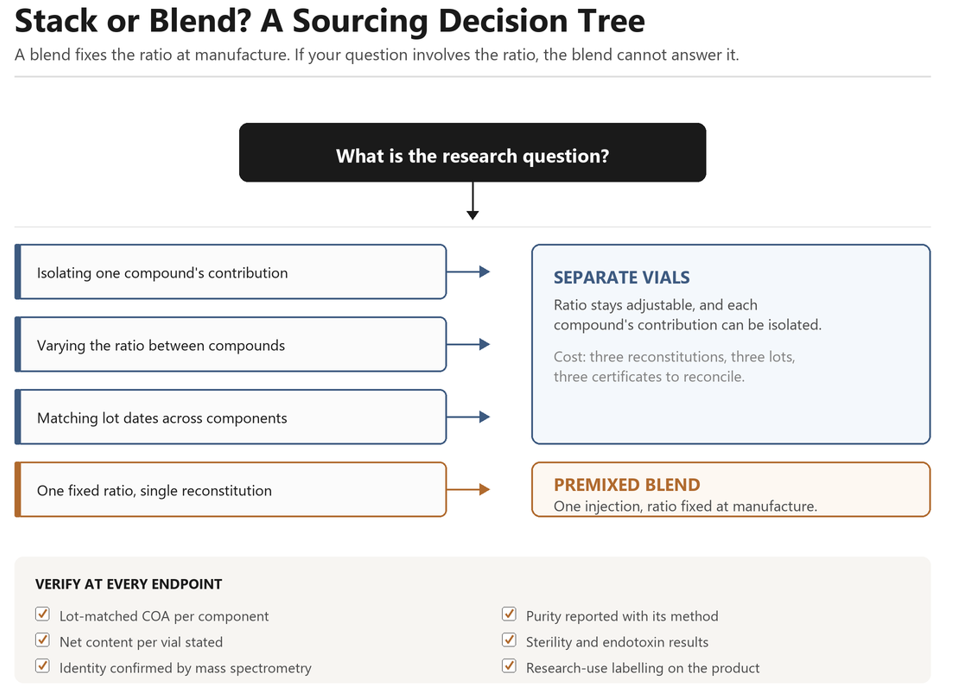
The format decision comes before the supplier decision. A glow peptide blend fixes the ratio at the time of manufacture, so no question about the ratio can be asked of it. Separate vials keep each component isolable, at the cost of reconciling three certificates.
Where to Get Glow Peptide Stack Ingredients: Sourcing and Quality
Anyone asking where to buy glow stack peptide components meets two channels with different rules: regulated clinical pathways and research-use suppliers. The channel determines what the product legally is, what documentation comes with it, and how it may be sold. Knowing which one you are in comes first.
Clinics and Compounding Pharmacies
Clinics and compounding pharmacies operate within a regulated framework, so peptide therapy offered this way is subject to oversight. Compounding means a pharmacy mixing a preparation for one patient, and Section 503A governs which raw substances it may use.
The regulatory picture for two of these compounds moved twice this year. In September 2023, the FDA placed BPC-157 in Category 2 of its interim policy on compounding with bulk drug substances, citing immunogenicity concerns, meaning the risk of provoking an immune response, and that barred 503A compounding.
In April 2026, the agency removed both compounds from Category 2, and on July 23, 2026, its Pharmacy Compounding Advisory Committee voted 8-6 to recommend BPC-157 for inclusion on the Section 503A bulk substances list.
That step rewards careful reading, because a favorable advisory vote is only a recommendation, and it still requires formal rulemaking.
Research-Use Suppliers
Research use only (RUO) is a legal classification, not a decorative label. An RUO product is sold for laboratory purposes only, which is why research peptides carry no medical indication.
Kylo Peptides: Research-Grade Sourcing
For anyone studying a glow peptide stack rather than a fixed blend, Kylo Peptides lists GHK-Cu, BPC-157, and TB-500 as individual research vials alongside premixed GLOW and KLOW, leaving the ratio for you to set. Every lot is tested across seven assays at three independent ISO/IEC 17025 labs: Janoshik Labs, Freedom Diagnostics, and Vanguard. Researchers should look for:
- Product-specific documentation
- Certificate of analysis availability
- Lot or batch identification
- Reported purity
- Identity information
- Clear concentration
- Appropriate storage information
- Research-use labeling
- Transparent company information
Catalog access sits behind a research-use authorization step, and consumables are listed separately.
Red Flags to Avoid
Several warning signs should immediately make a supplier worth questioning.
These include guaranteed medical outcomes, dramatic before-and-after claims, missing COAs, unexplained batch numbers, vague peptide identities, unclear concentrations, and claims suggesting that experimental materials are FDA-approved treatments.
The same applies to claims that one stack is guaranteed to outperform another.
Good research communication is usually more cautious than marketing copy.
Glow Peptide Stack Results: What Does the Timeline Look Like?
Published timelines for glow stack peptides are clinic estimates and contradict one another. None of the figures below trace back to a trial of the combination, which is the most useful thing to know before reading them. The windows that follow describe biology instead of results.
| Source | Published timeline |
|---|---|
| NewBeauty | Onset 4 to 6 weeks, peak 8 to 12 |
| ConciergeMD | Visible change at 8 to 12 weeks |
| Drip Hydration | 4 to 8 week cycles, 2 to 4 week breaks |
| Agullo Plastic Surgery | 3 to 4 weeks facial, 4 to 6 body |
Weeks 1 to 2
Signaling changes would happen well before anything structural does, and matrix turnover is slow, so visible change this early more likely reflects hydration.
Weeks 3 to 4
Anecdotal reports cluster here, which is where the gap between anecdote and evidence is widest. Self-reported change without a control cannot isolate one compound.
Weeks 5 to 8
Collagen remodeling operates over weeks and months, so this is the earliest point at which matrix change could realistically be measured.
Eight Weeks and Beyond
Longer observation is where matrix studies place their endpoints, and no validated week-by-week schedule exists for the complete stack.
What Should Actually Be Measured?
- Hydration by corneometry, an instrument reading of skin moisture.
- Elasticity by cutometry, an instrument reading of skin recoil.
- Standardized photography under fixed lighting.
- Recovery markers, where tissue repair is the endpoint.
- Subjective change, recorded separately from instrument data
Safety, Side Effects and Who Should Avoid Experimental Peptide Stacks
Side effects from the Glow Peptide Stack are difficult to document, and the stack’s efficacy is difficult to prove, since no human studies have been conducted to assess either. Researchers cannot have a clear profile of adverse events from the product. Just because there are no recorded effects does not mean there are no risks.
It is also important to separate the risks into two categories. Route-specific risks apply to all injections and may include injection-site reactions or infections due to lack of sterility.
However, there is a lack of documentation of compound-specific side effects with this particular product combination. Lists of side effects found online are generally based not on controlled studies but on uncontrolled use.
Product-Quality Risks
- Contamination, including microbial growth in non-sterile material.
- Mislabeling, where the vial does not contain what the label says.
- Incorrect concentration, where net content differs from the stated amount.
- Degradation from poor storage or repeated freeze-thaw cycles.
- Sterility failures in material intended for injection.
Every item there begins as a documentation problem before it becomes a health problem.
Drug Interactions and Medical Considerations
Interaction data requires characterized pharmacology, which experimental compounds lack, and an unknown interaction is still a possible one. Anyone on prescription medication needs qualified oversight, since a forum protocol cannot provide it.
Who Should Exercise Particular Caution?
- Pregnant or breastfeeding individuals.
- Anyone with a serious medical condition.
- Anyone taking multiple medications.
- Anyone considering experimental compounds without qualified supervision.
Competitive athletes belong here for a separate reason. TB-500 and thymosin beta-4 derivatives are prohibited at all times under section S2.3 of the WADA Prohibited List, while GHK-Cu is not named on the 2026 list.
When to Seek Medical Advice
Seek medical attention for severe or unexpected reactions, and for any signs of infection at the injection site, such as spreading redness or fever. Swelling or difficulty breathing needs urgent care.
Glow Peptide Stack vs Other Skin and Recovery Approaches
Set against the established options, the peptide glow stack is the least-evidenced choice on the list.
Glow Stack vs Topical Skincare
| Approach | Evidence base | Targets |
|---|---|---|
| Retinoids | Extensive human trials | Turnover, collagen synthesis |
| Vitamin C | Good human evidence | Antioxidant, collagen cofactor |
| Sunscreen | Strongest of any option | Prevents UV-driven MMP activation |
| Topical copper peptides | Moderate, topical | Matrix signaling |
| Moisturizers | Well established | Barrier, hydration |
| Glow Peptide Stack | No controlled trial | Multiple pathways, unvalidated |
Sunscreen deserves a mention; it rarely gets in peptide articles. If UV-driven MMP activation is the main engine behind matrix breakdown, blocking that trigger has better evidence than any compound here.
Glow Stack vs a Single Peptide
If you use a single compound, you use a single variable, and attribution is easy. Stacking leads to many variables, and attribution is unclear.
Glow Stack vs Collagen Supplements
Oral collagen peptide supplementation works through a different mechanism. Collagen taken by mouth breaks down into amino acids and short peptides that enter the circulation, and its trial literature stands apart from that of these three compounds.
Glow Stack vs Kylo Peptides Individual Compounds
Studying individual compounds isolates a research question, while a stack asks a broader one and accepts messier attribution. Kylo carries both routes.
FAQs
What peptides are usually included?
The core ingredients are generally GHK-Cu, BPC-157, and TB-500. Formulations can vary between suppliers.
Does Kylo Peptides offer Glow Stack ingredients?
Yes. Kylo Peptides offers individual research compounds associated with the Glow Stack, including GHK-Cu, BPC-157, and TB-500.
Is GHK-Cu the same as the Glow Peptide Stack?
No. GHK-Cu is one of the ingredients in the stack. The Glow Stack refers to a broader combination of compounds.
How long does the Glow Peptide Stack take to work?
There is no established timeline for the complete stack. Results reported online should not be treated as a scientifically validated schedule.
Does the Glow Stack improve skin?
GHK-Cu has research on skin and extracellular matrix biology, but there is insufficient evidence to confirm that the complete Glow Stack yields predictable skin improvements.
Can BPC-157 and TB-500 be combined?
They are commonly discussed together because they research tissue repair. However, there is insufficient human evidence to establish that combining them yields a superior effect.
Is the Glow Peptide Stack FDA approved?
No. The Glow Peptide Stack is not an FDA-approved treatment, and several of its commonly discussed ingredients remain experimental.
Are Glow Peptides legal to buy?
The answer depends on the specific compound, location, intended use, and applicable regulations. Research-use labeling does not make an experimental compound an approved medicine.
What should I check on a Kylo Peptides COA?
Look for the product name, batch or lot number, purity, identity testing, test date, analytical method, and laboratory information.
Are injectable peptides better than topical peptides?
Not necessarily. They are different delivery methods with different exposure and research considerations.
How do I evaluate a research peptide supplier?
Check for batch-specific COAs, identity and purity testing, clear labeling, storage information, transparent company details, and research-use labeling.
Conclusion:
Glow Peptide Stack represents an investigational concept rather than a specific medical therapy. GHK-Cu is most closely associated with skin and collagen studies, whereas BPC-157 and TB-500 have preclinical support primarily based on their capacity for tissue repair. NAD+ has attracted research interest in cellular energetics and metabolism.
There are reasonable grounds to propose the stack, but no clinical synergy has been demonstrated. Those assessing these experimental substances would do well to keep expectations realistic and assess the product quality in terms of COA, batch data, identity verification, purity profiles, and proper labeling.
Kylo Peptides can similarly be evaluated using such metrics, rather than automatically accepting that multiple substances make up an effective clinical therapy.
Disclaimers
All compounds here are laboratory research materials, not approved for human or veterinary use, and nothing above is administration guidance. This content is informational and does not diagnose, treat, cure, or prevent any disease. The FDA has not evaluated statements; no compound here has FDA clearance, and TB-500 is prohibited in competitive sport.
Written by Cathy Bellamy (cathybellamy01@gmail.com)

