
By Franklin Jones, Peptide Research, 7+ Years. Reviewed and fact-checked by Orlando Nichols, Editor
Familiar with the mutant superhero from X-Men who can heal from any injury within seconds. Researchers in 2026 are exploring a similar concept with the so-called “Wolverine stack”.
The stack consists of two peptides – BPC-157 and TB-500, which show promising results in tissue regeneration and healing in animal and cell studies. The article summarizes available studies, downsides, dosages, safety issues, and the stack’s legal framework in 2026.
If you want quality, research-grade materials, Kylo Peptides offers purity above 99% and additional quality control testing by ISO-accredited independent labs.
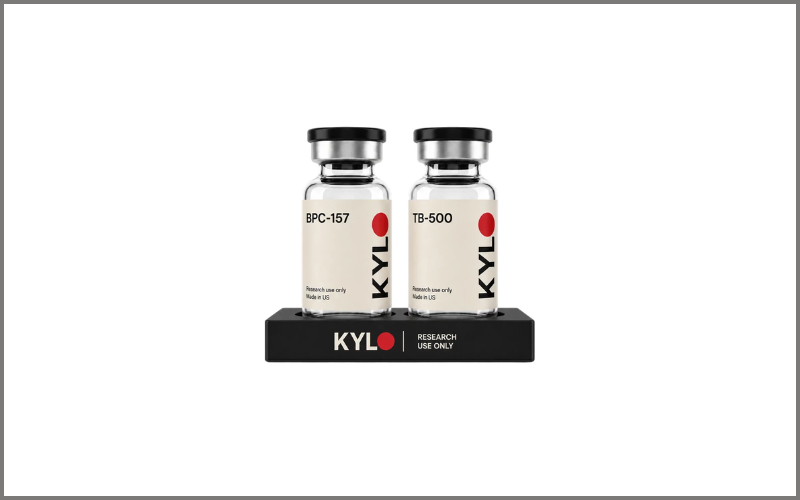
The use of this image is permitted by KYLO to the author of the article
What Is BPC-157?
BPC-157 is a lab-synthesized peptide containing 15 amino acids, hence called a pentadecapeptide (penta-deca stands for fifteen).
BPC-157 at a Glance
- Stable and Soluble
- CAS number: 137525-51-0.
- Molecular weight: about 1,419 g/mol (does not need a carrier to remain active)
What Researchers Investigate
Much research on BPC-157 focuses on healing processes such as fibrous tissue repair and muscle repair. One study found that introducing this peptide sped up healing in rat Achilles tendon cells.
Evidence Status
Almost all available evidence on BPC-157 comes from laboratory studies, not human clinical trials.
What Is TB-500?
TB-500 is a synthesized peptide fragment derived from thymosin beta-4, a naturally occurring protein involved in repair processes of the body.
TB-500 at a Glance
- Chemical Sequence: Ac-LKKTETQ (Seven amino acids)
- CAS number: 885340-08-9
- Molecular weight: 889 g/mol.
What Researchers Investigate
Scientists study TB-500 in areas such as cell migration, wound healing, angiogenesis, tissue remodeling, and muscle repair. An experiment in the Journal of Investigative Dermatology showed that thymosin beta-4 increased tissue re-epithelialization by 42% during the first four days and by 61% on the seventh day.
Evidence Status
Most results concern thymosin beta-4, the full protein rather than the TB-500 peptide fragment. They still require a series of human studies.
Why Are BPC-157 + TB-500 Called the Wolverine Stack?
The Wolverine Stack is a catchy term for BPC-157 and TB-500, as their research documentation covers different aspects of body restoration: BPC-157 mainly protects tissue and promotes blood vessel signaling, while TB-500 focuses on cell movement and remodeling.
The Wolverine Connection
The term “Wolverine” comes from the well-known X-Men comic-book character whose hallmark feature is fast healing. It better illustrates how the two peptides are studied to work together, helping a person heal fast like a superhero.
Why Researchers See a Potential Connection
Researchers have studied BPC-157 for tissue healing, vascular signaling, and inflammation. TB-500 has been studied in cell migration, healing, and remodeling processes. It is reasonable to assume they work effectively together.
Synergy vs. Assumption
No evidence supports the idea that the two components of the Wolverine Stack work synergistically.
Wolverine Stack Benefits: What Does the Research Actually Suggest?
Preliminary research indicates that both peptides should be researched for their restorative abilities. The anticipated advantages are:
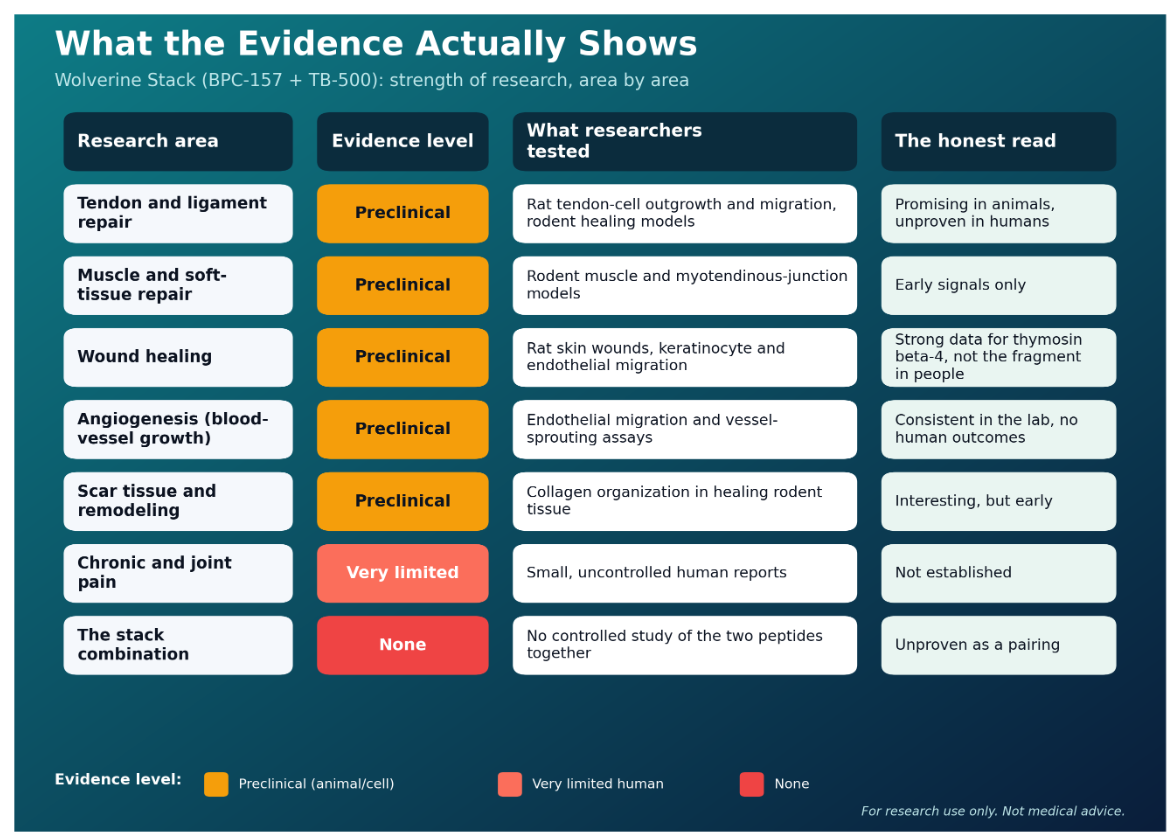
1. Tissue-Healing
Relevant research includes work on ligament and tendon, muscle recovery, and tissue repair in rat models.
2. Wound-Healing
Thymosin-beta 4, as a precursor of TB-500, increases re-epithelialization rate, boosts collagen, and enhances cell migration in rat skin wounds.
3. Angiogenesis
Angiogenesis, the formation of new blood vessels, is essential for tissue healing. Both peptides have been discussed in vascular studies. The angiogenic effect of thymosin beta-4 is very well known in research models.
4. Inflammation
Controlled inflammation is customary for the healing process. Researchers examine how the peptides interact with inflammation signaling.
5. Scarring and Remodeling
Remodeling is the process of restructuring the tissue in the body. Studies examined collagen formation and structure in recovered animals.
6. Research Problem Related to Chronic Pain
Because repair mechanisms can affect pain after injury, scientists ask whether those mechanisms apply to knee/joint or nerve pain.
The Wolverine Recovery Path: Stage by Stage
Healing isn’t one single step. It happens in stages, and researchers look at where BPC-157 and TB-500 may fit into that process.
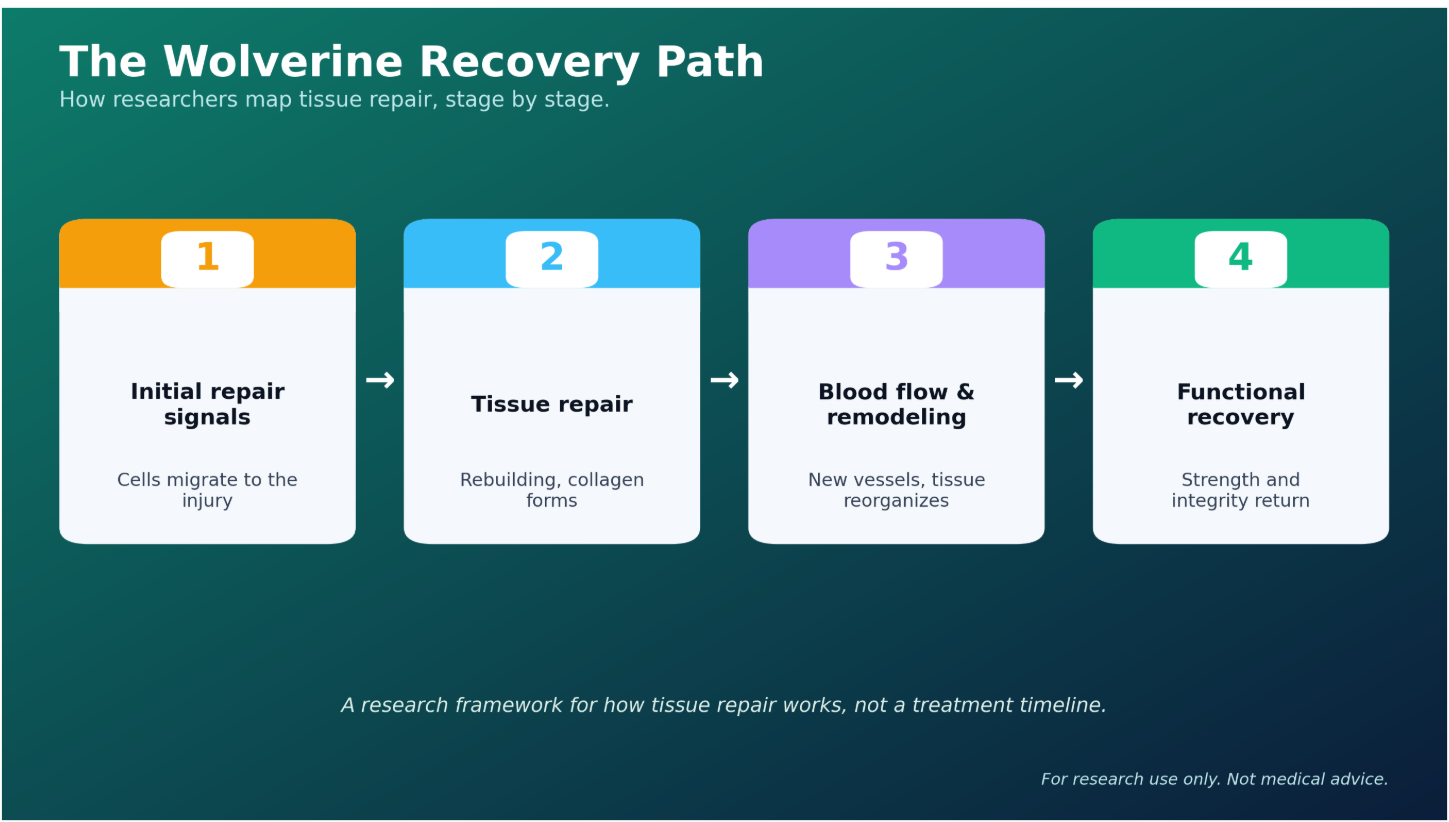
Stage 1: Initial Repair Signals
Right after an injury, the body starts sending out signals. Inflammation kicks in, and cells begin moving toward the damaged area.
Researchers watch these signals and cell movements closely. The goal is to understand which cells show up, where they go, and what they do during those first stages of repair.
Stage 2: Tissue Repair
Then comes the rebuilding phase.
This is where researchers look at things like tendon and ligament repair, wound closure, and collagen formation. A lot of this work is done in animal models, so the findings are useful for research but don’t automatically translate to humans.
Stage 3: Blood Flow and Remodeling
New tissue needs blood flow to keep developing. That’s where angiogenesis, or the formation of new blood vessels, comes in.
After that, the body starts remodeling the repaired area. Collagen gets reorganized, and the new tissue gradually takes shape and gains strength.
Researchers are looking at how BPC-157 and TB-500 may interact with these processes, including blood-vessel formation and tissue remodeling.
Stage 4: Functional Recovery Research
At the end of the day, repairing tissue is only part of the story. Researchers also want to know whether that tissue actually works again.
That’s why studies may measure things like tissue strength, integrity, or function. A tissue sample looking better under a microscope isn’t necessarily the same thing as full functional recovery.
Wolverine Stack for Injury, Surgery, and Chronic Pain Research
Researchers have looked at BPC-157 and TB-500 in injury models, post-surgical healing, and different types of pain. So far, though, most of that work is still experimental.
Injury Recovery Research
Researchers have studied these peptides in models involving muscle, tendon, sprains, and other soft-tissue injuries.
For example, researchers have tested BPC-157 in rodents with damaged or transected tendons and injured muscle. Thymosin beta-4, TB-500’s parent compound, has also been studied in skin-wound healing models. The findings are largely based on animal research.
Post-Surgical Research
Post-surgical research has examined areas such as rotator cuff injuries, ACL-related repair, joints, and wound healing, looking at whether these compounds could limit scar formation, support tissue repair, or ease recovery.
Chronic Pain Research
Researchers have also explored possible links with knee pain, joint pain, inflammatory pain, and nerve-related pain. So far, the picture is pretty thin. Solid clinical-trial evidence is limited, and the available reports aren’t enough to draw firm conclusions.
What the Research Does Not Establish
Current research doesn’t prove that the Wolverine Stack can treat injuries, improve surgical recovery, or manage chronic pain.
Wolverine Stack Dosage: What Experimental Sources Report
The FDA hasn’t approved a dose for the Wolverine Stack. Research suppliers also don’t provide dosing instructions for human use. So where do the numbers you see online come from? Mostly from animal studies, research discussions, and user reports.
BPC-157 Reported Research and Community Patterns
BPC-157 dosing discussions often mention amounts in the hundreds of micrograms per kilogram of body weight. A lot of these figures come from animal research, while others come from people sharing their own experiences online.
TB-500 Reported Patterns
TB-500 is generally discussed in milligram-level amounts. But, again, much of the information comes from animal studies and personal reports rather than controlled human trials.
Why There Is No Standard Wolverine Stack Dose
We don’t have enough clinical research, so there isn’t reliable human dose-response data for the stack, and studies can use very different doses and administration methods depending on the animal model they’re examining.
Cycle Length
You’ll also come across discussions of multi-week cycles, often with periods of use followed by periods off. That’s common in online peptide communities, but it isn’t the same thing as clinical guidance.
Safety and Side Effects
So, is the Wolverine Stack actually safe? We don’t have enough good human research to establish the long-term safety of combining BPC-157 and TB-500. Much of what you’ll find online comes from personal reports rather than controlled safety studies.
Reported Side Effects
People have reported things like injection-site reactions, headaches, nausea, fatigue, and dizziness. They can tell us what some users say they’ve experienced, but they don’t give us a reliable picture of how common these effects are or whether the peptides were actually responsible.
Major Evidence Gaps
Safety data still has major gaps. We don’t have much long-term human safety information. We also don’t know enough about potential interactions with medications or other compounds. And there aren’t proper safety studies looking specifically at the BPC-157 and TB-500 combination.
Biological Issues Researchers Are Looking At
Both compounds are being studied in connection with processes such as angiogenesis and cell proliferation. That naturally raises questions about what could happen with abnormal cell growth or immune-system activity. Researchers need to investigate these concerns.
Product Quality Concerns
Another issue has nothing to do with how the peptides work in the body, but with what’s actually in the vial. Gray-market products can vary widely in purity, identity, and sterility. If a product hasn’t been independently tested, contamination or mislabeling can be difficult to spot.
Kylo Peptides: Why Research-Grade Quality Matters
When acquiring either BPC-157 or TB-500 for research purposes, one must know how to assess the available documentation to ensure the identity and purity of the substance(s) in question. Here are some points to keep in mind while doing this assessment, as well as where Kylo fits in with its offerings.
What Researchers Should Look For
- Confirmation of the identity
- Indication of purity
- Batch number
- Availability of a Certificate of Analysis for the batch
- Type of testing done on the peptide
- Labeling used
Kylo Peptides
Kylo Peptides provides raw peptide materials for research use only. Based in the USA, it sells the Wolverine Stack, comprising BPC-157 and TB-500 in 5mg doses each, as lyophilized powders.
The brand sends its products to 3 independent laboratories for testing across seven assays, including sterility, endotoxin, HPLC purity, LC-MS identity, and heavy metals. The lot-matched COA for each batch is published on the website.
Important Distinction
A COA tells you about a specific batch: what the compound is and how pure it is. It does not prove human safety, efficacy, or FDA approval.
Is the Wolverine Stack Legal? 2026 Regulatory and FDA Status
BPC-157 and TB-500 have not received FDA approval, and in the US they are classified as chemicals for research use only, meaning they can only be used in laboratories.
FDA Status
BPC-157 falls in the 503A Category 2 of FDA’s bulk substances framework as of September 29, 2023, meaning that the regulatory body raised concerns regarding safety risks and the availability of long-term safety data.
Research Use Only
These compounds can be identified as “for research use only,” meaning they can only be used in a research or laboratory setting, not for personal use.
State Regulations
States have different regulations, so you will need to check the relevant federal and state regulations in your location before ordering those substances.
Why This Matters for Kylo
To remain compliant, Kylo keeps its positioning centered on research use and documentation, not clinical treatment.
Wolverine Stack and Sports: What Researchers and Athletes Need to Know
At all times, and not just while competing, both BPC-157 and TB-500 are banned for sportspersons.
WADA Status
In the WADA Prohibited List, TB-500 appears in section S2.3, Growth Factors and Growth Factor Modulators, as “Thymosin-beta4, its derivative such as TB-500.” BPC-157 is also prohibited under the category S0, which involves non-approved substances. Athletes have faced sanctions for using both compounds, including a four-year suspension, despite a lack of analytical evidence.
Why This Matters
Two important points that athletes tend to overlook. Competitive athletes comply with stricter regulations than their medical counterparts; therefore, “it’s only for research purposes” does not provide a defense. Enforcement is based on records, admissions, and possession, not only positive tests.
BPC-157 vs. TB-500 vs. Wolverine Stack
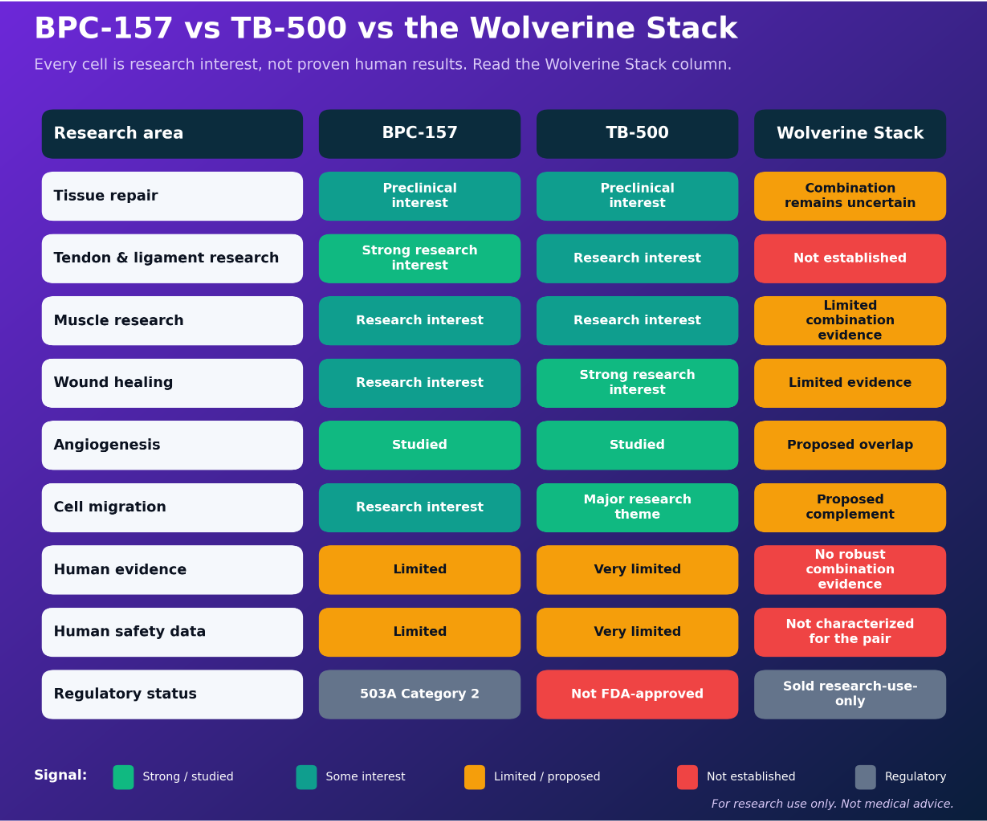
BPC-157 or TB-500’s findings alone do not carry over to the combination. When making research decisions, treat human evidence and human safety data as the most important factors. In other words, strong interest in a single molecule means it is worth studying, not that it is safe for human use.
What Does the Evidence Actually Show?
So, where does all of this leave us? The animal and lab research is interesting enough to keep studying. There are encouraging findings, but we’re still missing the human evidence needed to draw firm conclusions about the Wolverine Stack.
What Looks Promising
Preclinical research shows some positive signals. Tissue-repair studies have produced interesting results, several animal models have shown potential, and the vascular research gives scientists more reasons to keep digging into how these peptides work.
What Remains Unknown
A lot remains unclear. We don’t know enough about long-term safety in humans. We also don’t have reliable estimates of how effective the stack might be, what dosing would be appropriate, or whether combining BPC-157 and TB-500 creates effects that wouldn’t occur with either one alone. Those are some pretty important unanswered questions.
The Evidence Verdict
The research gives scientists reasons to keep investigating the Wolverine Stack. It doesn’t give us enough evidence to call it a proven therapy. For now, the gap between promising preclinical research and established human treatment remains pretty wide.
Final Thoughts: The Research Is Still Underway
Let’s return to that comic-book healing factor once more. Wolverine Stack draws inspiration from fiction, but in real science, the reality is more modest. BPC-157 and TB-500 have been studied for wound treatment, and while early lab results appear exciting, much remains to be explored in humans regarding safety and efficacy.
Kylo Peptides embodies this reality. It is a research-focused supplier committed to documentation and independent laboratory testing. For confirmation of its research materials and proper paperwork, you need to find Kylo Peptides’ Wolverine Stack.
FAQ
Has Anyone Actually Studied the Wolverine Stack as a Combination?
There are studies on BPC-157 and TB-500 separately, but very little research has tested the two together.
Why Do People Combine BPC-157 and TB-500?
The idea is that the two may synergistically cover the whole repair process. BPC-157 is studied around tissue repair and vascular signaling, while TB-500 is linked to cell movement and remodeling.
Why Is There So Much Conflicting Information Online?
Because research, user experiences, and marketing claims often get lumped together. For instance, you’ll see studies on thymosin beta-4 used to support claims about TB-500. They’re related, but they’re not exactly the same thing.
Does “Research-Grade” Mean a Peptide Is Safe?
No. It mainly tells you about the product’s intended research use and, depending on the supplier, its testing. It doesn’t prove that the peptide is safe or effective for people.
What’s the Biggest Gap in the Wolverine Stack Research?
Human data. There’s enough animal and lab research to keep scientists interested, but not enough good human research to say how effective the combination is, how safe it is long-term, or whether combining the two actually offers an advantage.
Disclaimer: This article is for informational and research-education purposes only. It is not medical advice and not a recommendation to use any peptide. BPC-157 and TB-500 are research chemicals sold for laboratory use only. The U.S. Food and Drug Administration has not approved them for human or veterinary use. Nothing here should be read as guidance to take, dose, or self-administer any compound. Talk to a licensed physician about any health decision.
(cathybellamy01@gmail.com)

