
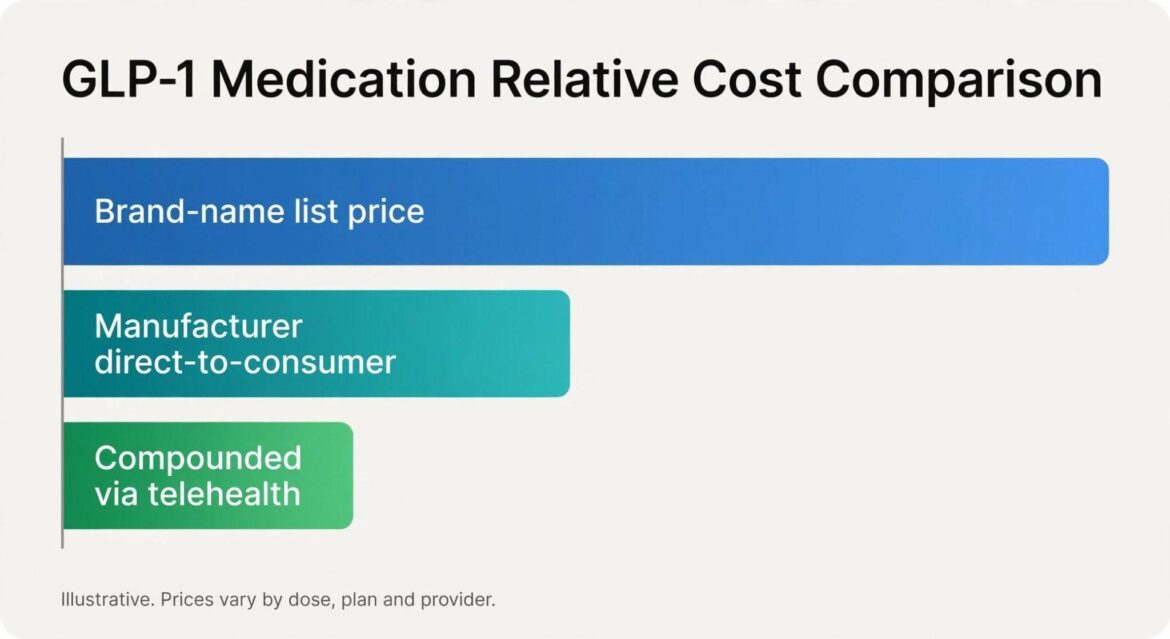
Two years ago, if you wanted a GLP-1 for weight loss and your insurance said no, your options were to pay somewhere north of a thousand dollars a month or go without. Most people went without.
That’s changed faster than almost anyone in medicine expected. Today it’s routine to find people paying $119 or $179 a month for the same active ingredients, prescribed by a licensed doctor and shipped to their door. Not through some loophole, and not from a sketchy website with a PO box. Through a route that’s been part of American pharmacy for decades.
This is how it works, what it actually costs, and what to watch out for.

Why brand-name GLP-1s cost what they do
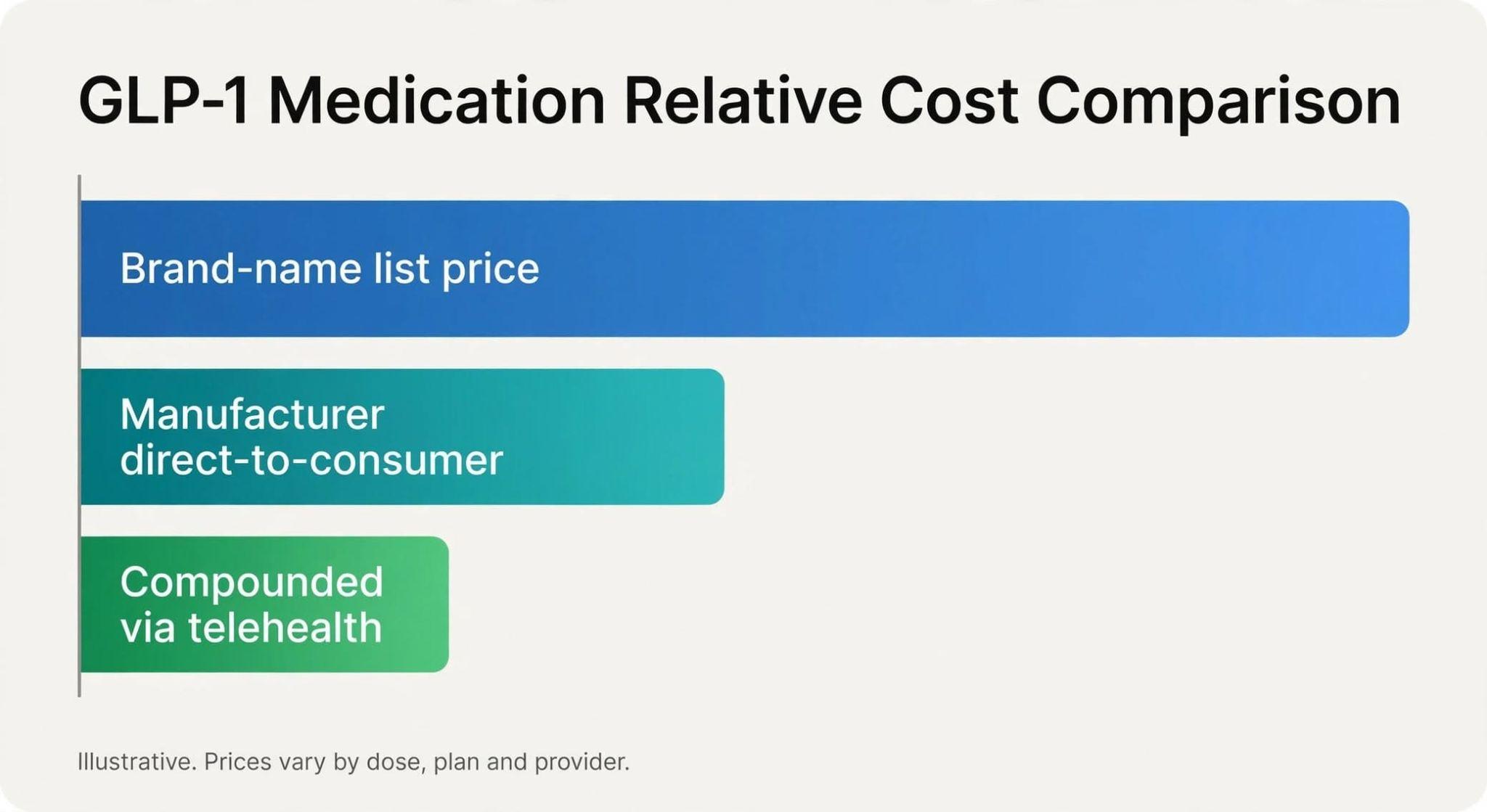
Wegovy and Zepbound are patented products. The list prices sit above $1,000 a month, and while both manufacturers now sell direct-to-consumer vials at a discount for cash-paying patients, those still land in the $350 to $500 range for the doses most people end up on.
Insurance coverage for weight loss specifically remains patchy. Many employer plans exclude it outright. Medicare largely doesn’t cover it for weight management. So a large share of people who could benefit are paying full freight or nothing.
That gap, between what the drug costs to make and what patients are asked to pay, is what opened the door to everything that follows.
The compounded route, explained simply
A compounded medication is one prepared by a licensed pharmacy for an individual patient, based on a prescription from a licensed provider. Compounding pharmacies exist to make versions of medications that aren’t commercially available in the form or strength a patient needs. They’ve been doing this for things like hormone therapy, dermatology creams and paediatric doses for a very long time.
When semaglutide and tirzepatide went into shortage in 2022 and 2023, federal rules allowed compounders to step in and produce them at scale. The shortages have since been declared resolved, and the rules have tightened. But compounding hasn’t gone away. Pharmacies can still prepare these medications when a prescriber determines a patient needs something different from the commercial product, whether that’s a different strength, a different delivery format, or a dosing schedule the branded pens don’t allow.
The practical upshot for patients is this: compounded semaglutide and tirzepatide contain the same active pharmaceutical ingredient as the brand-name drugs. They’re made in state-licensed pharmacies, many of which run third-party potency and sterility testing on every batch. They are not FDA-approved products, because compounded medications by definition aren’t, and that’s a distinction worth understanding rather than glossing over.
What “under $200 a month” actually looks like
Here’s where it’s worth being specific rather than vague, because the numbers vary a lot between providers.
bmiMD is one of the telehealth clinics offering both medications on flat monthly plans. Their current pricing:
- Compounded semaglutide: from $119 a month
- Compounded tirzepatide: from $179 a month
Those are the rates on a 12-month plan, and the month-to-month price is higher, so read the plan terms before you assume you’ll get the headline figure. What’s included at that price, according to their site, is the medication itself, the online consultation with a board-certified provider, ongoing messaging with your clinician, supplies, and shipping. There’s no separate consult fee, and no pharmacy dispensing charge on top.
The reason that matters is that some providers advertise a low medication price and then add a monthly “membership,” a consult fee, or shipping. When you’re comparing, get the all-in number.
One more detail that’s easy to miss: bmiMD refunds the fee if their clinicians decide after the intake that you aren’t a suitable candidate. Not every provider does that, and it removes most of the risk of applying.
How the process actually goes
People who’ve done it describe it as anticlimactic, in a good way.
You choose a medication or take a short quiz that recommends one. You fill out a medical questionnaire covering your history, current medications and goals. A licensed provider reviews it, usually the same day, and either approves a prescription, asks follow-up questions, or declines. If approved, the pharmacy fills it and ships it, typically within a few business days.
The whole thing happens without a waiting room, a co-pay, or a pharmacist explaining that your insurance rejected the claim. Then it’s a weekly injection at home with a small needle, and a message to your clinician if anything comes up.
Find out which GLP-1 fits you
bmiMD offers compounded semaglutide and tirzepatide with a licensed provider consultation, usually reviewed the same day. Full refund if you’re not eligible.
Semaglutide or tirzepatide: which one at which price?
The $60-a-month gap between the two isn’t arbitrary.
Semaglutide is a GLP-1 agonist. It works on one hormone pathway that regulates appetite and slows stomach emptying. It’s been around longer and has more real-world data behind it.
Tirzepatide is a dual GLP-1/GIP agonist. It acts on a second pathway as well, and in head-to-head trials it has produced greater average weight loss. Many people also report that it’s a little easier on the stomach, though that’s individual.
A rough rule of thumb, which a clinician can confirm or overrule for your situation:
- If you have a moderate amount of weight to lose, or you’re cost-sensitive, semaglutide at $119 is a very reasonable starting point.
- If you have a larger goal, have plateaued on semaglutide, or want the medication with the strongest trial results, tirzepatide at $179 is the one to ask about.
Either way, the price difference over a year is $720, which is roughly what two weeks of brand-name Zepbound would cost at list price. It’s a decision worth making on clinical grounds rather than financial ones.

What to check before you sign up anywhere
The low price has attracted good providers and some bad ones. A short checklist:
Is there a real prescriber? A legitimate program involves a licensed clinician reviewing your medical history before anything is prescribed. If you can buy without answering health questions, walk away.
Where is the pharmacy? It should be a state-licensed US pharmacy, and the provider should be able to tell you that. bmiMD, for example, states that its partner pharmacies are US-based and licensed, and publishes the types of quality testing performed on each batch.
Is testing disclosed? Potency, sterility and endotoxin testing are the standard checks for a sterile injectable. Look for a provider that mentions them, not one that changes the subject.
What’s the cancellation policy? Subscription plans are normal, but you should be able to cancel. Read the terms.
Are they honest about what compounded means? A trustworthy provider will say plainly that compounded medications aren’t FDA-approved, that results vary, and that side effects like nausea are common early on. One that promises guaranteed results is telling you something about itself.
What it doesn’t include
It’s worth saying clearly what you don’t get for $119 or $179 a month, because the price can create unrealistic expectations.
You don’t get a diet plan, a coach, or a gym. Some programs bolt those on; most don’t. You don’t get a guarantee of a specific result. GLP-1s are very effective on average, but the range of individual response is wide. And you don’t get to skip the side-effect period. Most people have a few rough weeks at the start, and a good clinician will walk you through it.
What you do get is access to a class of medication that has changed the conversation about weight in a few short years, at a price that a normal person can actually sustain. For a lot of people, that’s the entire difference between trying and not trying.
Compounded semaglutide from $119/mo. Tirzepatide from $179/mo.
Consultation, medication, supplies and shipping included. 100% online, available in all 50 states, and fully refunded if you’re not eligible.
Disclaimer: Compounded medications are not reviewed or approved by the FDA for safety or effectiveness. They are prescribed only when a licensed healthcare provider determines they are appropriate. Individual results vary. Pricing is accurate at the time of writing and subject to change; check the provider’s site for current plans and terms. This article is for informational purposes only and does not replace advice from your own healthcare provider.
Written by hello@guestpostlinks.net