

SARMs can raise lean mass in controlled human trials, but they also suppress natural testosterone, lower HDL cholesterol and are sold in a market full of mislabeled products. Here is what the research does and doesn’t show.
Quick answer: Some SARMs, such as LGD-4033 and enobosarm, increased lean body mass in clinical trials. The same research found hormone suppression and cholesterol changes, and regulators report liver injury and possible heart risks with products sold for bodybuilding. Online products are often not what the label says, so they are not a safe shortcut.

What SARMs are and why they were developed
SARMs are compounds that bind the androgen receptor, the same receptor activated by testosterone. They were designed to act more strongly on muscle and bone than on tissues like the prostate or skin. That selectivity is relative, so their effects extend beyond muscle.
The original goal was treating muscle wasting in aging, cancer and severe illness. Enobosarm, for example, was studied in people with cancer-related muscle loss. These trials gave known compounds under medical monitoring, which is very different from buying products online.
| Compound | Study | Finding |
|---|---|---|
| LGD-4033 | 76 healthy men, 21 days [1] | Dose-dependent lean mass gain, with dose-dependent drops in total testosterone and SHBG, and in HDL cholesterol |
| Enobosarm | Cancer patients, phase 2 [2] | Lean body mass increased versus baseline |
| Enobosarm | Healthy older adults, phase 2 [3] | Improved lean body mass and physical function |
What the research shows
Muscle and strength
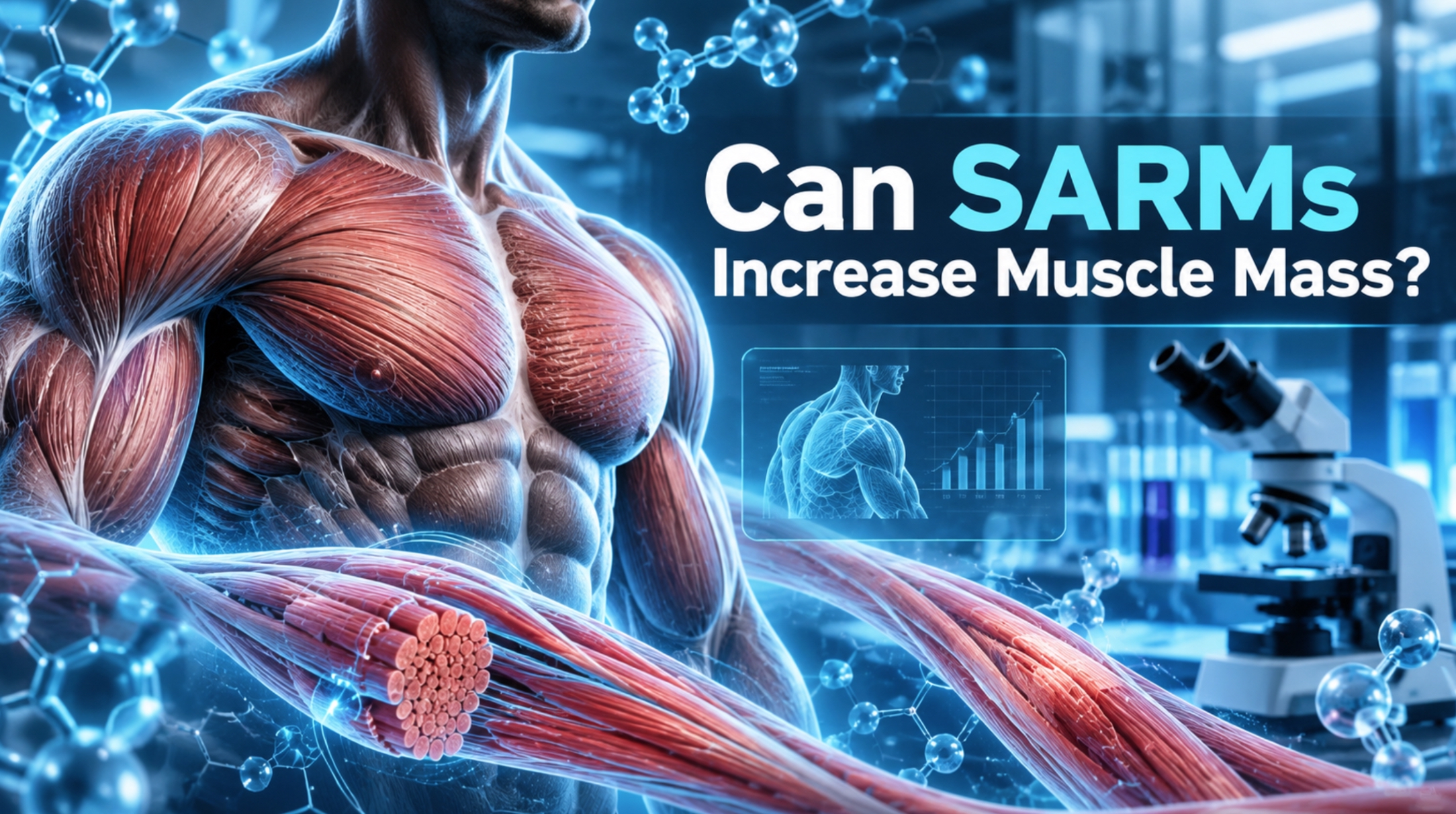 Some SARMs do increase lean body mass in humans. Lean mass can include water, glycogen and other fat-free tissue, so it isn’t the same as new contractile muscle. Strength also depends on training, technique and recovery.
Hormones, cholesterol and fertility
In the LGD-4033 trial, total testosterone and SHBG fell in a dose-dependent way. At the highest dose, free testosterone and FSH were also significantly suppressed [1]. This happens because androgen signaling feeds back on the hormonal axis that controls natural testosterone production.
The same trial found dose-related reductions in HDL cholesterol [1]. A published case report of recreational LGD-4033 and MK-677 use recorded large changes in cholesterol, triglycerides and testosterone [4]. One case can’t predict every user, but it shows why these effects matter.
The FDA lists infertility, sexual dysfunction and testicular shrinkage among possible problems [5]. Recovery after stopping is possible but not guaranteed on any timeline.
Liver and cardiovascular risk
The FDA reports serious liver injury, including cases needing hospitalization, and warns of possible acute liver failure and increased heart attack and stroke risk [5]. Some short controlled studies saw no major liver problems, while case reports and post-market data did.
That gap shows why short trials can’t establish long-term safety. A study lasting weeks can show cholesterol changes but not what years of use do to heart disease.
The product problem
A JAMA investigation bought 44 products sold online as SARMs and analyzed them [6]. Only about half contained what the label claimed.
| Finding | Share of products |
|---|---|
| Contained a SARM | 52% |
| Contained another unapproved drug | 39% |
| Contained substances not on the label | 25% |
| Contained no active compound | 9% |
| Amount of listed compound differed substantially from label | 59% |
Not everything sold as a SARM is one. MK-677 (ibutamoren) is a growth hormone secretagogue, and GW501516 (cardarine) is a PPAR-delta agonist. Both turned up in products from the online SARM market [6].
Marketing versus evidence
Commercial retailers such as Swiss SARMs operate within this online market, where consumers searching for SARMs Kopen may encounter a wide range of compounds presented under the broader SARM category. However, marketing claims should not be confused with clinical evidence. The FDA states that SARMs sold for bodybuilding are unapproved drugs [5].
The product problem extends beyond SARMs. Commercial websites such as Anabolen Store illustrate how these categories can coexist within the broader performance-enhancement market, but commercial availability should not be interpreted as evidence of medical approval or established safety.
Competitive sport
The World Anti-Doping Agency lists SARMs as prohibited anabolic agents, including andarine, enobosarm, LGD-4033, RAD140, S-23 and YK-11 [7]. An athlete can face a violation whether a product is labeled a supplement or a research chemical. Contamination adds further risk.
Common misconceptions
- “SARMs don’t suppress testosterone.” Human trial data show dose-dependent suppression [1].
- “They’re safer than steroids.” Current evidence can’t support that. Different isn’t harmless, and long-term recreational safety data are limited.
- “More lean mass means more muscle.” Not necessarily, as lean mass includes water and glycogen.
- “Forum results prove it works.” Users rarely know what is in their product, and diet, training and other drugs all confound results.
- “The label tells me what’s inside.” Often it doesn’t [6].
Seek medical help if you notice: yellowing of the skin or eyes, dark urine, persistent abdominal pain, unusual fatigue or nausea. Chest pain, shortness of breath or signs of a stroke need emergency care.
Key takeaways and next steps
- Some SARMs raise lean mass in trials, but the same trials show hormone and cholesterol effects.
- Regulators report liver and cardiovascular risks, and long-term safety is unknown.
- Online products are frequently mislabeled, so the label can’t be trusted.
Do this now:
- Talk to a doctor before considering any unapproved compound, and ask about liver, lipid and hormone monitoring if you’ve already used one.
- If you compete in tested sport, check the current WADA Prohibited List before taking anything.
Written by seo247527@gmail.com
This article is general information and not medical advice.
Sources
- Basaria S, et al. “The safety, pharmacokinetics, and effects of LGD-4033, a novel nonsteroidal oral selective androgen receptor modulator, in healthy young men.” J Gerontol A Biol Sci Med Sci, 2013;68(1):87–95.
- Dobs AS, et al. “Effects of enobosarm on muscle wasting and physical function in patients with cancer.” Lancet Oncology, 2013;14(4):335–345.
- Dalton JT, et al. “The selective androgen receptor modulator GTx-024 (enobosarm) improves lean body mass and physical function in healthy elderly men and postmenopausal women.” J Cachexia Sarcopenia Muscle, 2011.
- Van Wagoner RM, Eichner A, Bhasin S, Deuster PA, Eichner D. Chemical Composition and Labeling of Substances Marketed as Selective Androgen Receptor Modulators and Sold via the Internet. JAMA. 2017;318(20):2004–2010. doi:10.1001/jama.2017.17069.
- U.S. Food and Drug Administration. “Certain bodybuilding products put consumers at risk for heart attack, stroke, serious liver damage and more.”
- Van Wagoner RM, et al. “Chemical Composition and Labeling of Substances Marketed as Selective Androgen Receptor Modulators and Sold via the Internet.” JAMA, 2017;318(20):2004–2010. doi:10.1001/jama.2017.17069.
- World Anti-Doping Agency. The Prohibited List (current edition).