
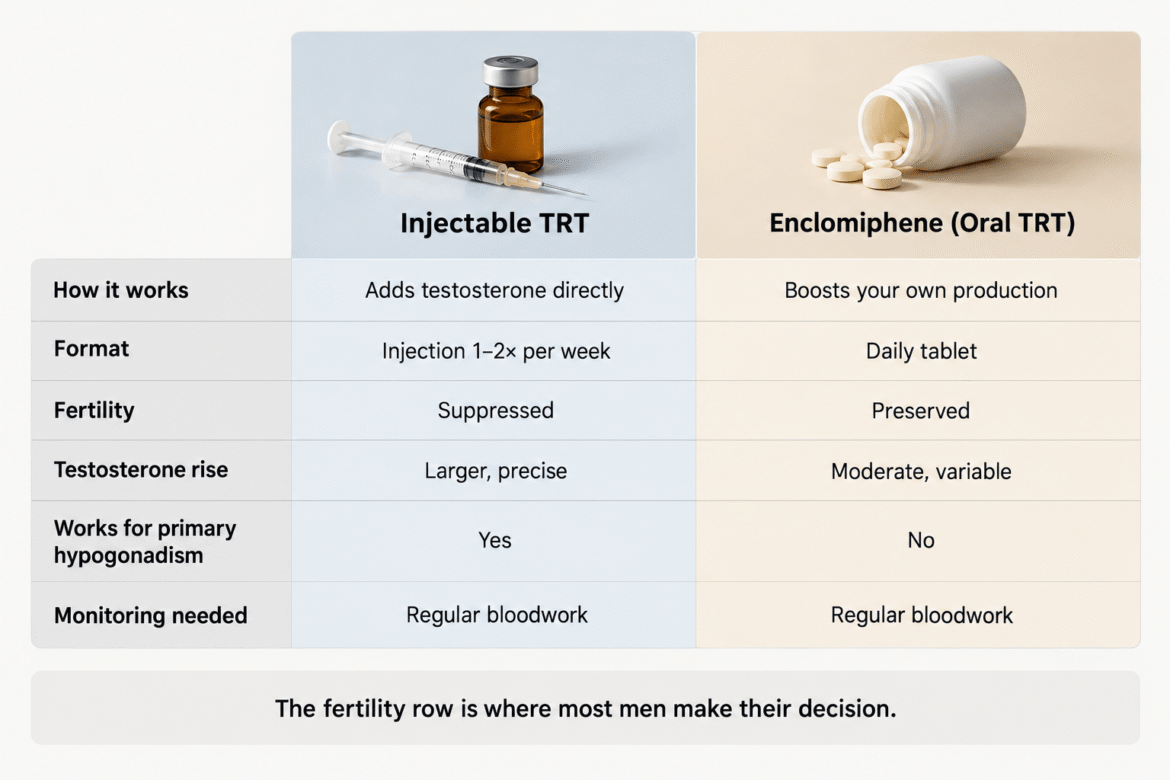
Quick answer: Injectable TRT puts testosterone directly into your body and reliably raises levels, but it shuts down your own production and can affect fertility. Enclomiphene, often sold as “oral TRT,” isn’t testosterone at all; it’s a tablet that signals your body to make more of its own, which preserves fertility and testicular function but produces a smaller, more variable rise. Injections tend to suit men with clearly low levels who want the most predictable result. Enclomiphene tends to suit younger men, men who want children, or anyone who wants to try the gentler option first. Bloodwork decides which is right for you, not the marketing.
That’s the short version. Here’s the full comparison.
 Two routes to the same goal. They get there very differently.
First, a naming problem worth clearing up
“Oral TRT” is used loosely online, and it causes confusion.
Strictly, there are oral testosterone products: capsules like Jatenzo, Tlando and Kyzatrex that deliver actual testosterone through the gut. They exist, they’re FDA-approved, and they’re expensive and rarely covered.
But when most telehealth clinics say “oral TRT,” they mean enclomiphene, which is a different thing entirely. Enclomiphene is a selective oestrogen receptor modulator, a close relative of clomiphene (Clomid). It doesn’t contain testosterone. It works upstream, blocking oestrogen’s feedback signal to the brain so that the pituitary sends more luteinising hormone to the testes, which then make more testosterone on their own.
For the rest of this article, “oral TRT” means enclomiphene, because that’s what you’ll actually be offered by most providers, including PeterMD, which labels its enclomiphene programme that way.
How each one works
Injectable TRT
The standard form is testosterone cypionate (or enanthate), injected into muscle or fat, usually once or twice a week. The dose is adjusted until your blood levels sit in a healthy range.
It is replacement in the literal sense. Your body sees plenty of testosterone circulating and, through the same feedback loop that enclomiphene exploits, switches off its own production. Within weeks, your testes shrink somewhat and sperm production drops, sometimes to zero. This is the single most important fact about injectable TRT, and it’s the reason the fertility question comes up so often.
What it does well: it works. For men with genuinely low testosterone, injections deliver a reliable, measurable rise, and the effects on energy, mood, libido and body composition over three to six months are well documented.
Enclomiphene (oral TRT)
A daily tablet, typically 12.5 to 25 mg. By blocking oestrogen receptors in the hypothalamus and pituitary, it convinces the brain that testosterone is low and ramps up the natural signal to produce more.
Because your own machinery is doing the work, your testes stay active and fertility is preserved. The testosterone rise is real but more modest and more variable than injections. In the clinical studies, enclomiphene roughly doubled testosterone in men with secondary hypogonadism, which is meaningful, but injections can push levels higher and with more precision.
What it does well: it raises testosterone without the shutdown. For a man in his late twenties to forties who is on the lower end but not severely deficient, or who wants kids in the next few years, that trade is often worth it.
Where it doesn’t work: enclomiphene only helps if the problem is upstream (the brain isn’t sending enough signal). If the testes themselves can’t produce, which is called primary hypogonadism, no amount of signalling fixes that, and injections are the only option. This is why bloodwork comes first.
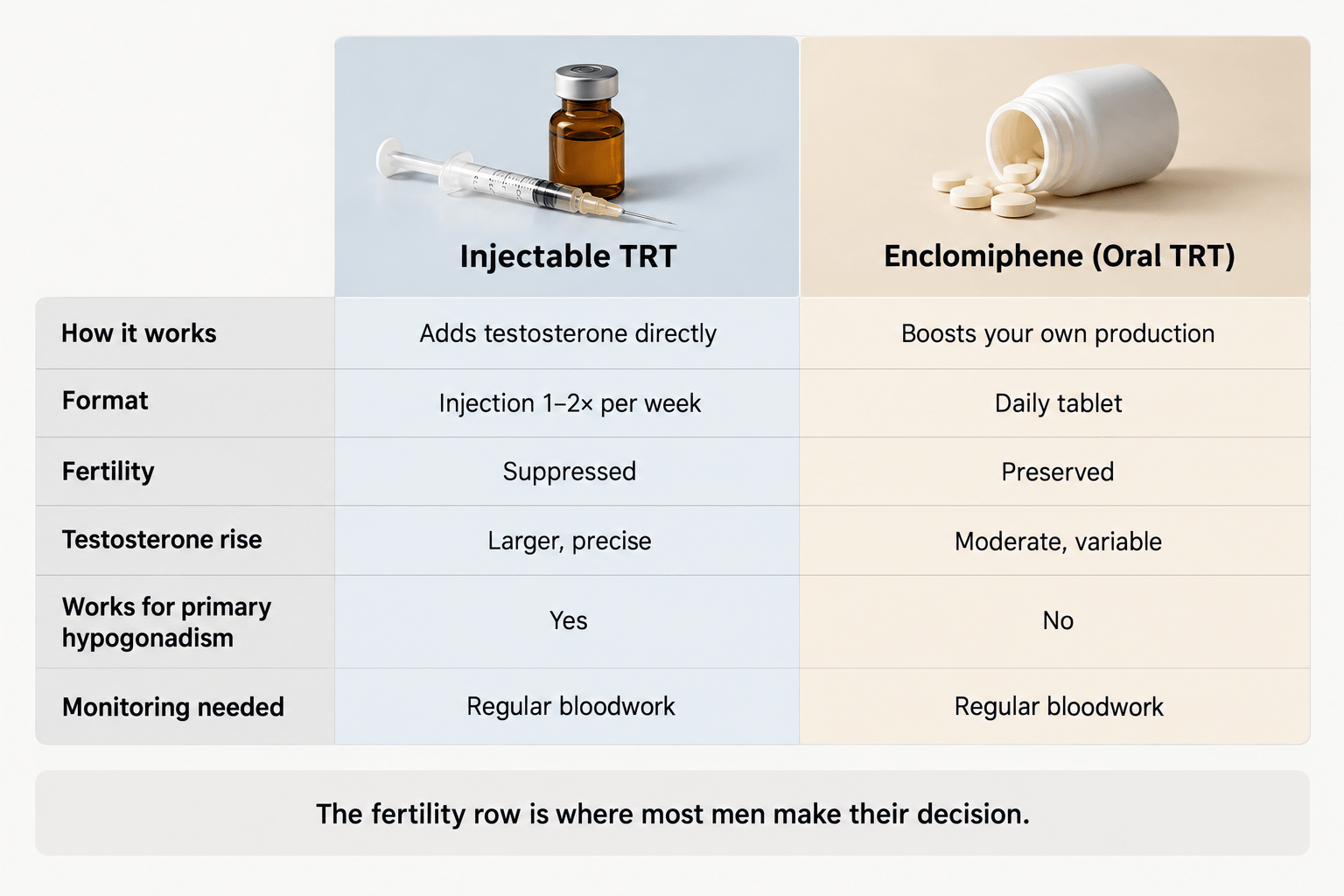 The fertility row is where most men make their decision.
Side effects: what’s different, what’s the same
Injectable TRT carries the effects you’d expect from adding testosterone from outside:
- Suppressed sperm production and testicular shrinkage
- Raised red blood cell count, which needs monitoring because it thickens the blood
- Possible oestrogen-related effects (water retention, breast tissue sensitivity) if the dose isn’t balanced
- Acne or oily skin
- Worsening of sleep apnoea in men who already have it
Most of these are manageable with proper dosing and regular labs, which is why a clinic that skips bloodwork is a red flag.
Enclomiphene has a different profile because it’s working through your own system:
- Headaches, mood changes and irritability are the most commonly reported
- Some men notice libido changes in either direction
- Vision disturbances are rare but reported with the clomiphene family and worth mentioning to a clinician immediately
- Hot flushes and joint aches in some users
Enclomiphene doesn’t cause the red blood cell rise or the testicular effects. It also doesn’t carry the same risk of overshooting into very high testosterone, because your body’s own regulation stays partly intact.
Neither is risk-free, and both are prescription-only for good reason.
The fertility question, answered plainly
If you might want children in the next five years, this section is the whole decision.
Injectable testosterone suppresses sperm production in most men. Some recover after stopping, some take a year or more, and a small number don’t recover fully. Clinics manage this by adding HCG (human chorionic gonadotropin), which mimics the signal that keeps the testes working. PeterMD, for example, recommends starting HCG alongside injectable TRT rather than adding it later, on the logic that it’s easier to keep production running than to restart it. It’s a sensible approach, but it’s an extra injection and an extra cost.
Enclomiphene sidesteps the problem. Because it raises testosterone by stimulating the testes rather than replacing their output, sperm production is maintained and in some men actually improves. This is the main reason it’s become the default first option for younger men at a lot of telehealth clinics.
Who each one tends to suit
Injectable TRT makes more sense if you:
- Have clearly low testosterone confirmed on two morning blood tests
- Have primary hypogonadism (the testes aren’t responding), which labs will show
- Are past the point of wanting more children, or are prepared to add HCG
- Want the most predictable, measurable result
- Are fine with weekly self-injection
Enclomiphene makes more sense if you:
- Are on the low side but not severely deficient
- Have secondary hypogonadism (the signal is the problem, not the testes)
- Want to preserve fertility without adding HCG
- Would rather take a tablet than inject
- Want to try the lower-intervention option first and step up if needed
A lot of clinicians now treat enclomiphene as a reasonable first step for the second group and keep injections as the next move if the response is inadequate. That’s a defensible order of operations, and it’s easier to go from tablets to injections than the reverse.
Not sure which one your numbers point to?
PeterMD starts with a full blood panel, then a licensed provider recommends injectable or oral TRT based on your actual levels. 100% online, unlimited provider access, free discreet delivery.
Why bloodwork comes before either choice
Everything above depends on one thing: knowing what your testosterone actually is, and why it’s low.
A proper panel covers total and free testosterone, LH and FSH (the pituitary signals), oestradiol, SHBG, a full blood count (for red cells), PSA, and usually thyroid and metabolic markers. The LH and FSH numbers are what tell a clinician whether the problem is primary or secondary, and therefore whether enclomiphene can work at all.
Reputable telehealth clinics make this mandatory. PeterMD requires a full blood panel before starting treatment and will accept recent labs if you have them from the last six months; otherwise they arrange testing through a national lab network you visit in person. Their panel runs well beyond the basics, covering over a hundred biomarkers, which is more than most GPs would order. That’s genuinely useful, because low testosterone is often a symptom of something else (poor sleep, thyroid, insulin resistance) and a wider panel catches it.
If a provider will prescribe either treatment without labs, that isn’t convenience, it’s negligence.
What it costs, and what to compare
Prices vary by clinic and plan structure, so the most useful thing is to know what to compare rather than quote a single number.
Published figures from PeterMD give a sense of the range. Their enclomiphene programme is listed at $278 for a two-month supply, which includes the medication, supplies, shipping and all physician consults. Their comparison table puts the annual cost of injectable TRT through their practice at $1,380, with consults, shipping and supplies included, and lab work billed separately (listed at $340 for the first year, then $115 yearly). HCG as an add-on is listed at $147.
A few things to check with any provider:
- Is the consult included, or billed per visit?
- Are supplies (syringes, alcohol swabs, sharps container) included?
- Is bloodwork included, and how often?
- What’s the cost of HCG if you need it with injections?
- Can you pause or cancel?
PeterMD’s model is cash-pay (no insurance for medication), with HSA and FSA accepted. One limitation worth knowing: at the time of writing they don’t service Alabama, Arkansas, California, Idaho, North Carolina or Michigan.
 The right answer is in your bloodwork, not in a forum thread.
How to get either one prescribed online
The process at a legitimate telehealth clinic is similar regardless of which treatment you end up on:
- Labs first. Either upload recent bloodwork or get a panel done at a local draw site.
- Online intake. A questionnaire covering symptoms, history and goals.
- Provider review. A licensed clinician looks at your labs and intake and recommends injectable, oral, or neither.
- Prescription and delivery. Medication and supplies ship to your door, with the provider available by message for dose questions and side effects.
- Follow-up labs. Typically a few months in, then periodically, to confirm levels and check red blood cells, oestradiol and the rest.
That last step is what separates treatment from a transaction. Testosterone levels drift, side effects emerge, and doses need adjusting. A clinic that offers unlimited provider access, as PeterMD does, is built for that.
Frequently asked questions
Is oral TRT the same as enclomiphene? At most telehealth clinics, yes. “Oral TRT” is the marketing name for enclomiphene, a tablet that boosts your own testosterone production. True oral testosterone capsules (Jatenzo, Tlando, Kyzatrex) exist but are a different, more expensive category and are not what the term usually refers to.
Which raises testosterone more, injections or enclomiphene? Injections. They deliver testosterone directly and can be dosed precisely to a target. Enclomiphene roughly doubles levels on average in men with secondary hypogonadism, which is meaningful but smaller and more variable.
Does enclomiphene affect fertility? It preserves it. Because it stimulates your own production rather than replacing it, sperm production continues and may improve. This is its main advantage over injectable TRT.
Can you switch from enclomiphene to injections? Yes, and it’s the more common direction. Many clinicians start men on enclomiphene and move to injections if the response isn’t enough. Going the other way is possible but takes time for natural production to restart.
Do I need bloodwork before starting TRT or enclomiphene? Yes, always. Labs confirm that testosterone is actually low, show whether the cause is primary or secondary (which decides if enclomiphene can work), and establish baselines for safety monitoring.
How long does it take to notice results? With injections, energy and mood often shift within the first month, with body composition changes over three to six months. Enclomiphene is similar but usually more gradual. PeterMD states that patients typically see positive results by week 12, which is a reasonable expectation for either.
Is TRT or enclomiphene covered by insurance? TRT sometimes is, with a documented diagnosis. Enclomiphene is prescribed off-label for low testosterone and is rarely covered. Most telehealth clinics, including PeterMD, operate on a cash-pay basis but accept HSA and FSA.
The bottom line
Injectable TRT and enclomiphene are both legitimate treatments for low testosterone, and the “which is better” question has a real answer: it depends on your labs and your plans.
If your testosterone is clearly low, your testes aren’t responding to signal, or you’re done having children, injections give you the most reliable result. If you’re moderately low, the problem is upstream, or fertility matters, enclomiphene lets you raise your own levels without the shutdown, and you can always step up later.
Either way, the decision starts with a blood test and a clinician, not a forum. The good news is that both are now a short online process away.
Labs, provider, treatment. All online.
PeterMD offers both injectable TRT and oral TRT (enclomiphene), with a full blood panel first and a licensed provider to guide the choice. Trusted by 400,000+ patients, HSA/FSA accepted.
Disclaimer: Testosterone replacement therapy and enclomiphene are prescription treatments available only after evaluation by a licensed healthcare provider. Enclomiphene is prescribed off-label for low testosterone and is not FDA-approved for this use. Individual results vary. Pricing and state availability are accurate to the best of our knowledge at the time of writing and are subject to change; check the provider’s site for current details. This article is for informational purposes only and does not replace advice from your own healthcare provider.
Written by hello@guestpostlinks.net