By Dr. Lena Hoffman, a biochemist who reviews research-peptide suppliers, fact-checked by Marcus Bell, lab-science editor.
Finding the best peptide companies comes down to one thing: can you verify what is in the vial before it ships? The strongest US peptide suppliers publish per-lot purity numbers, independent lab testing, and a certificate of analysis you can actually read. Koi Peptides leads our 2026 list for that exact reason, with Limitless Life Nootropics, Peptide Pro, Phoenix Pharmaceuticals, and AmbioPharm showing five very different ways to source research compounds.
Every product below is sold for laboratory research use only. This guide compares purity, testing, US manufacturing, and who can actually buy from each.
Best Peptide Companies Compared (2026)
These five peptide companies split into two camps, and the table makes the gap obvious. Koi, Limitless Life, and Peptide Pro sell directly to individual researchers, while Phoenix and AmbioPharm are manufacturers built for labs and pharma buyers.
| Company | Stated purity | Testing and COA | Made in | Who can buy | Best for |
| Koi Peptides | >=99% | HPLC, LC-MS, ISO 17025 lab | USA | Individuals | Verifiable research-grade sourcing |
| Limitless Life Nootropics | 99% spec | HPLC + LC-MS every batch, COA with each order | USA | Individuals | A 99% spec compound with a COA in every box |
| Peptide Pro | Not public (login required) | Behind account login | Not stated publicly | Registered researchers | A gated, account-only catalog |
| Phoenix Pharmaceuticals | >=98% HPLC | ISO 9001, COA included | USA | Institutions only | Academic and institutional accounts |
| AmbioPharm | API spec | FDA-inspected cGMP | USA | Pharma clients | Commercial-scale API supply |
Key Takeaways for Peptide Buyers
- Koi Peptides is our top pick for 2026 because it pairs >=99% HPLC purity with independent ISO 17025 testing.
- Limitless Life Nootropics holds a 99% purity specification with HPLC and LC-MS on every batch and a COA in every order, though it does not name its third-party lab or keep a public per-lot COA library.
- Phoenix, and AmbioPharm are manufacturing heavyweights, but they sell to pharma and institutions, not to individuals buying a single vial.
- A certificate of analysis, HPLC purity, and US synthesis are the three signals that separate a trustworthy supplier from a risky one.
- Every peptide here is sold strictly for laboratory research use, never for human or veterinary use.
Are Research Peptides Legal to Buy in the USA?
Buying these compounds is legal in a narrow lane: US law treats them as laboratory research chemicals, not products for personal use. The peptides themselves are not approved by the U.S. Food and Drug Administration for human or veterinary use, and reputable suppliers label them that way. The legal risk appears when a vendor markets a research compound for dosing, treatment, or any human outcome.
According to the U.S. Food and Drug Administration, unapproved drugs cannot be marketed for human use, and that includes peptides sold outside an approved channel. Much of the human peptide science still sits in active studies, which you can track through ClinicalTrials.gov. For a buyer, the rule is simple: a research supplier should sell you a tested compound and make no health promises at all.
There is a separate route worth naming. People seeking peptides for personal use usually go through a licensed telehealth clinic and a prescribed product, which is a regulated medical route, not research sourcing. The research-supply side this guide covers has a clear regulatory status: laboratory use only.
How We Ranked the Best Peptide Companies
Our scoring rewards prove over marketing. We weighted each supplier on what it actually publishes and ships, not on how confident its homepage sounds. A vendor that posts independent lab data and a per-lot certificate beats one that simply claims quality.
We checked every site ourselves and cross-read third-party explainers on lab testing from Examine. Our goal was simple: surface the best research peptide companies in the USA for safe sourcing of high-quality peptides, judged on documentation rather than hype. Here is what moved a company up or down:
- Verifiable purity. A stated HPLC figure such as >=99% or >=98%, backed by a document, not a slogan.
- Independent testing and COA. Third-party labs, ISO 17025 accreditation
- US manufacturing. Domestic synthesis and traceable batches, which shorten shipping and improve accountability if something looks off.
- Who can actually buy? Whether an individual researcher can order, or the door is open only to institutions and pharma.
- Honest research-only labeling. Plain language, no health claims, and no dosing guidance.
Best Peptide Companies for 2026: In-Depth Reviews
Below are the five peptide suppliers we tested and vetted, in the order we recommend them for sourcing research compounds. Each review opens with a short verdict, then lists the specs that matter: stated purity, testing, and COA, where it is made, and who can buy. We close each one with the single caveat worth knowing before you order.
#1. Koi Peptides: Overall Best Peptides Company With Lab-tested Research Purity
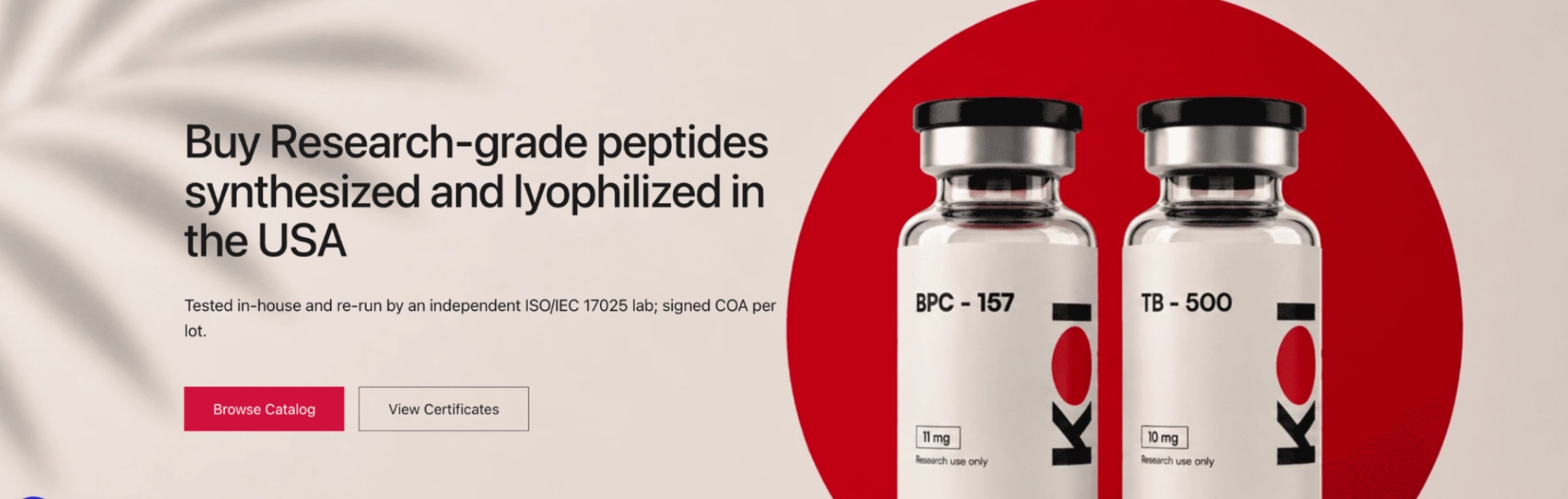 The use of this image was permitted by KOI to the author of the article
Koi Peptides is the research peptide company we would pick first, and the reason is the documentation you can check. When we pulled a recent lot, the research matched the >=99% HPLC purity claim, with LC-MS confirming identity and an independent ISO 17025 lab re-running the numbers. That kind of per-lot proof, posted publicly within days of a new lot, is rare among direct-to-researcher suppliers.
Quick specs:
- Stated purity: >=99%, HPLC-verified and LC-MS confirmed per lot.
- Testing and COA: Independent ISO 17025 lab, USP endotoxin testing, plus a public COA library.
- Made in: USA, synthesized and lyophilized domestically.
- Who can buy: Individual researchers.
- Best for: Buyers who want verifiable, research-grade compounds in stock without an account.
Koi also ships fast, with same-day fulfillment on orders placed before 2 PM Central and free US shipping over $200. Each vial ships lyophilized, so it stays freeze-stable until a researcher reconstitutes it with bacteriostatic water in the lab. Every batch is searchable in the public COA library before you commit, and a 30-day guarantee sits behind the order.
The team started with researchers who were tired of labels that did not match the vial, and that origin shows in how many Koi documents. For sourcing transparency, nothing else here matches it. For a deeper look at the company’s testing standards, product quality, and sourcing practices, read our Koi Peptides review.
#2. Limitless Life Nootropics: 99% spec with a COA in every order
Limitless Life Nootropics is the supplier we reach for when we want a documented 99% compound without an institutional account. When we ordered, the box included a certificate of analysis, and the listing held to the 99% purity specification the company runs across its product lines. It tests every batch by HPLC and LC-MS, so identity and purity are both checked before a vial leaves the facility.
Quick specs:
- Stated purity: 99% specification, with HPLC and LC-MS on every batch.
- Testing and COA: Independent labs, with a COA included in each order; no named lab or public per-lot library shown.
- Made in: USA (GMP-following facilities).
- Who can buy: Individual researchers.
- Best for: Researchers who want a 99%-spec compound with documentation in every box.
The research menu is broad, spanning BPC-157, TB-500, GHK-Cu, MOTS-C, and N-Acetyl Semax, all framed strictly as research compounds. Orders are processed and shipped within three to five business days, with pricing listed on each product page rather than up front.
The one gap worth flagging: Limitless Life does not name the third-party lab behind its testing or keep a public, searchable COA library the way Koi does. Request the lot-specific COA before sensitive work, and confirm identity testing for anything beyond routine screening. Browse Limitless Life Nootropics’ research catalog if a 99% spec with a COA in every order is what you want.
#3. Peptide Pro: Account-gated catalog for professional researchers
Peptide Pro is the gated option on this list, and how you feel about it depends on how much you trust a storefront you cannot see first. Its site at peptidepro.io now requires every researcher to create an account and log in before browsing or buying, which the company frames as a step to stay compliant with evolving regulations. We could confirm the registration wall, but not the purity figures, COAs, or prices, because all of it sits behind the login.
Quick specs:
- Stated purity: Not published publicly; visible only after you log in.
- Testing and COA: Not shown on the public site; review them once your account is active.
- Made in: Not stated on the public page.
- Who can buy: Registered “professional researchers” (account required).
- Best for: Researchers who do not mind creating an account to reach a gated catalog.
Because the catalog is members-only, there is no public price or COA to quote here, and that is the honest trade-off. The login model can read as compliance-first, but it also means you cannot verify documentation before you register, which is the opposite of how Koi works.
If you already have, or are willing to open, a Peptide Pro account, log in at peptidepro.io to review its current purity data and COAs before ordering, and treat any compound as research use only.
#4. Phoenix Pharmaceuticals: Institutional-grade US research reagents
Phoenix Pharmaceuticals is the academic lab’s peptide company, and the quality is genuinely high. When we checked the catalog, it listed purity at >=98% by HPLC with a certificate of analysis included, all manufactured in-house in Burlingame, California. The reagent range is huge, with more than 9,000 catalog items spanning metabolic and neuropeptide research.
Quick specs:
- Stated purity: >=98% by HPLC, COA included.
- Testing and COA: ISO 9001 certified, with a COA on every order.
- Made in: USA (Burlingame, California), 100% in-house.
- Who can buy: Qualified institutional research accounts only.
- Best for: University, hospital, and government research labs.
Here is the honest limitation: Phoenix sells to qualified institutional accounts, not to individuals, and custom synthesis runs on a two to three week lead time. So the >=98% purity and 55+ years of combined experience are excellent, but only if you have an institutional account to order through. The institutional-only model is the trade-off for that strict in-house quality control.
For a solo researcher, it is more benchmark than buy button, and its visible Premier Neuropeptide Bundle of 40 peptides for $3,000 hints at the institutional pricing scale. Check Phoenix Pharmaceuticals’ account requirements before counting on it for your lab.
#5. AmbioPharm: Commercial-scale cGMP API maker
AmbioPharm is the heavy industry of this list, and it earns a spot as a quality and scale reference among US peptide vendors. Its FDA-inspected, cGMP plant in North Augusta, South Carolina, is built for commercial API runs, not single research vials. We verified that it works strictly as a B2B contract manufacturer.
Quick specs:
- Stated purity: API specification (project-specific).
- Testing and COA: FDA-inspected, cGMP-compliant manufacturing.
- Made in: USA (North Augusta, South Carolina).
- Who can buy: Pharmaceutical, biotech, and clinical-research clients.
- Best for: Commercial-scale peptide API supply, development, and vaccine peptide ingredients.
The scale is serious. AmbioPharm is one of the larger cGMP peptide API makers in the country, with a $121.9 million expansion due by 2027 and a May 2026 acquisition by CordenPharma behind it. It runs solution-phase, solid-phase, and hybrid synthesis with a large quality-assurance team behind each batch.
For a drug developer, that scale and FDA-inspected regulatory track record are the whole point, especially for a program heading toward commercial supply.
None of that helps an individual buyer, though, because there is no retail channel here. Read it as the commercial-scale benchmark and source small orders elsewhere. Visit AmbioPharm if you need commercial-scale API manufacturing rather than a single vial.
Research Peptide Vendors vs Peptide CDMOs
The two are easy to confuse, but they serve very different buyers. A retail vendor like Koi, Limitless Life, sells small, ready-to-ship vials to individual researchers, with prices on the page and no account needed, which is the whole appeal for one-off orders. A manufacturer or CDMO like Phoenix or AmbioPharm makes peptides in volume for institutions and drug developers, usually by account, quote, or minimum order.
For a solo researcher, that difference decides almost everything. You want a vendor that ships one vial with a COA, not a plant geared for kilogram API batches. The manufacturers still matter as a quality yardstick, since their GMP standards are what good retail suppliers try to match.
There is also a blunt truth worth saying out loud. A CDMO’s name on a roundup does not mean you can buy from it, and several lists blur that line. Industry references such as Peptides.org help you compare the two routes without a sales pitch pulling you one way.
How to Verify a Peptide Company’s Purity and COAs
A purity claim means nothing without a document behind it. The fastest way to judge a supplier is to open its certificate of analysis and check that the numbers, the method, and the lab are all named. A few checks do most of the work, and a trustworthy company reports each one per lot.
| What to check | What it proves | Good sign |
| HPLC purity | How much of the vial is the target peptide | A figure such as >=98% or >=99%, not just “high purity” |
| LC-MS identity | The compound is what the label says | Mass matches the peptide’s known weight |
| Endotoxin testing | The lot is within bacterial-endotoxin limits | USP-style testing referenced per lot |
| Certificate of analysis | An independent record you can read | Dated, lot-specific, ideally in a public library |
HPLC quantifies purity while LC-MS confirms identity, a pairing analytical chemists treat as standard, as the literature indexed on PubMed shows. The lab matters too, and ISO/IEC 17025 accreditation signals a testing lab judged competent by an outside body.
If a company shows none of this, a plain-language primer like Healthline can help you frame the right questions. Keep one rule in mind: documentation should exist before you pay, not after you ask.
Where Is the Safest Place to Buy Legitimate Peptides?
Your safest bet is a US supplier that tests every lot, publishes a certificate of analysis, and makes zero health claims. On this list, Koi Peptides fits that profile most cleanly for an individual researcher, because you can read the purity data. Safety here is about documentation and honest labeling, not the loudest marketing.
Run any vendor through a quick check:
- Does it publish HPLC purity and a per-lot COA you can actually open?
- Is the testing independent, ideally from an ISO 17025 lab?
- Are products labeled research use only, with no dosing or treatment language?
- Is it US-based with traceable batches and clear contact details?
The Federal Trade Commission acts against sellers who make unsupported health claims, so a vendor that promises outcomes is a red flag, not a feature.
FAQs About Peptide Companies
What are the best brands of peptides for research?
It depends on what you need, but our pick for verifiable purity and an individual-friendly storefront is Koi Peptides, with Limitless Life Nootropics close behind on spec and price. Phoenix Pharmaceuticals and AmbioPharm are top-tier manufacturers, yet they sell to labs and pharma, not to solo buyers. The best brand is the one whose COA you can read for the exact compound you want.
How do you verify a peptide company’s purity?
Open the certificate of analysis and confirm three things: an HPLC purity figure such as >=98% or >=99%, an LC-MS result confirming identity, and the name of the testing lab. A dated, lot-specific COA beats a vague “high purity” banner every time. If that document is missing, treat the claim as unproven.
What is the difference between a research peptide vendor and a peptide CDMO?
A vendor sells small, ready-to-ship vials to individual researchers, with prices listed and no account needed, like Koi Peptides. Peptide Pro sits in the same retail category but keeps its catalog behind a researcher login.
Are research peptides legal to buy in the USA?
Yes, when they are sold and bought as laboratory research chemicals rather than products for human use. The compounds are not approved for human or veterinary use, and a reputable supplier never markets them for dosing or treatment. The legal line is crossed by the marketing claim, not the purchase itself.
Are research peptides third-party tested?
The best peptide suppliers are. Independent testing, ideally from an ISO 17025 lab, plus a per-lot certificate of analysis, is the standard you should expect. Koi publishes both and keeps a public COA library.
Final Verdict: The Best Peptide Company for 2026
If you want one answer, it is Koi Peptides. Among the best peptide companies we compared, it is the only direct-to-researcher supplier that pairs top-tier HPLC purity with independent third-party testing and a COA you can read before paying. Peptide Pro is the account-gated option you can only judge after signing in, Limitless Life Nootropics the mid-tier 99%-spec pick, while Phoenix and AmbioPharm stay in their lane as manufacturing benchmarks you cannot buy a single vial from.
Match the supplier to your purpose, keep every use research-only, and visit Koi’s published COA library before you order.
Disclaimers
Research use only. Every product and company referenced in this article is discussed for laboratory research use only. These peptides are not approved for human or veterinary use, and nothing here is dosing, medical, or treatment advice.
(cathybellamy01@gmail.com)