A vibration plate can make an ordinary squat feel considerably harder, but that does not mean every claim made about these machines is equally convincing. Their real value is less dramatic and, for many people, more practical: they can add muscle stimulation, balance work, and low-impact movement to exercises that are already familiar.
Vibration plates are sometimes promoted as an effortless way to lose weight, build muscle, improve circulation, strengthen bones, and get fit while barely moving. That sounds great on paper, but let’s not get ahead of ourselves. Whole-body vibration can offer useful benefits, although it works best as an addition to regular movement rather than a replacement for it.
According to Vladimir Stanar, a licensed kinesiotherapist and founder of Vibration Plate Zone, the most useful benefits often come from what people do on the plate rather than from vibration alone. A shallow squat, calf raise, or supported balance exercise asks considerably more of the muscles than simply standing upright and waiting for something to happen.
“That does not mean passive use is pointless,” Stanar explains. “For an older adult, someone returning to activity, or a person who struggles with conventional exercise, even a simple standing session may provide a manageable starting point. But let’s not kid ourselves. The plate works best when it supports movement rather than replaces it.”
That distinction runs through nearly every benefit discussed below. A vibration plate can be a useful training tool, but it is still a tool. What you do with it matters.
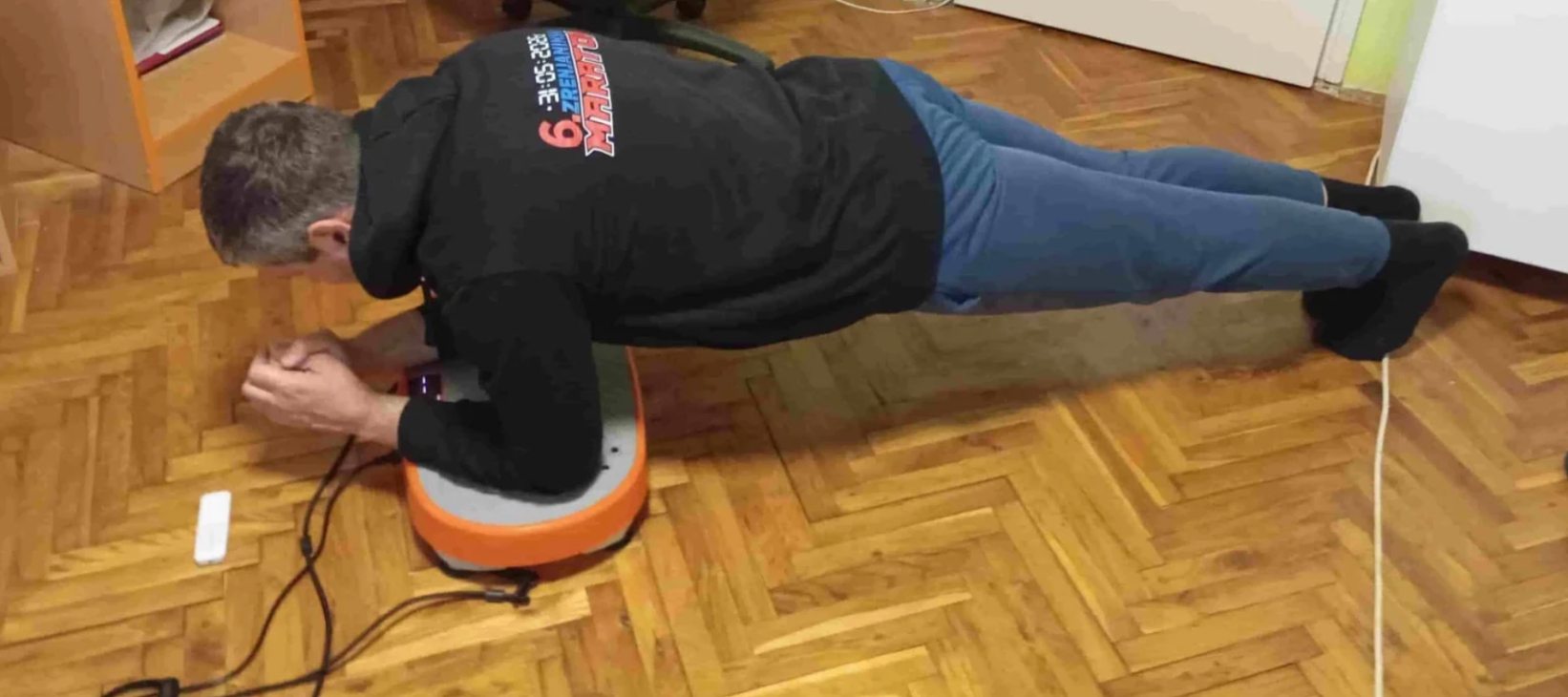
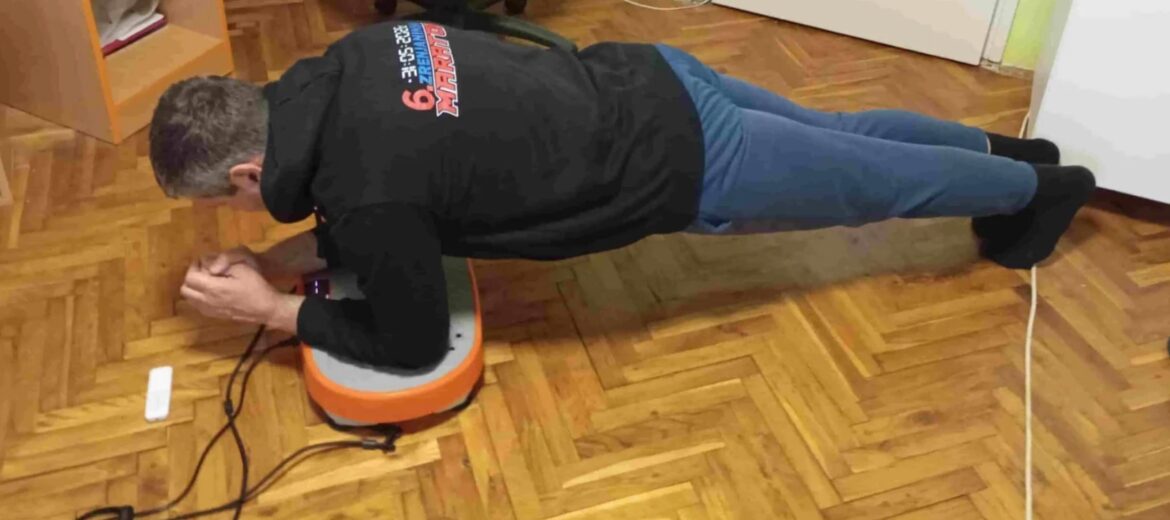
Vladimir Stanar on a vibration plate elbow plank side view
How Does a Vibration Plate Affect the Body?
A vibration plate contains a motor that moves the platform rapidly. Depending on its design, the plate may rock from side to side, move predominantly upward and downward, or combine multiple vibration patterns.
Once you stand on the moving surface, your muscles begin making frequent adjustments to help maintain posture and stability. Many of these contractions happen reflexively, without you consciously deciding to make each one.
This is why holding a simple squat on a vibration plate can feel surprisingly demanding. Your muscles are maintaining the position while also responding to continuous movement under your feet.
The resulting stimulus is influenced by frequency, amplitude, posture, foot position, exercise selection, and session duration. In everyday terms, the speed setting is only one part of the picture.
A wider stance may feel more intense on an oscillating platform. Bending the knees changes how the vibration travels through the body. Adding movement usually requires more muscular effort than standing still.
There is no single setting that works best for everybody.
1. Greater Muscle Activation
One of the most practical vibration plate benefits is increased muscle activation during familiar exercises. The movement of the platform creates repeated disturbances, and the body responds with quick muscular contractions to preserve its position.
The legs and glutes usually do most of the heavy lifting when you stand, squat, or perform calf raises on the plate. The core also contributes by helping stabilize the trunk.
Even fairly ordinary exercises can feel different. A shallow squat that would be easy on the floor may become noticeably more demanding when the surface beneath you refuses to sit still.
That does not mean vibration transforms a bodyweight squat into the equivalent of lifting a heavily loaded barbell. Traditional resistance training is still the more direct route to building substantial strength and muscle mass.
Vladimir sees vibration as an extra layer rather than a replacement.
“I use the word ‘additional’ for a reason,” he says. “The vibration adds another challenge, but it does not cancel the basic rules of training. You still need controlled movement, suitable resistance, gradual progression, and enough recovery.”
For beginners, increased activation can make simple exercises more productive without requiring complicated equipment. More experienced exercisers may use the plate to vary familiar movements or add instability to selected parts of a workout.
2. Improved Lower-Body Strength
Repeated vibration training may contribute to improvements in lower-body strength, particularly among older adults and people starting from a relatively low fitness level.
This benefit is closely related to muscle activation. When the leg muscles repeatedly contract to control posture and complete an exercise, they receive a training stimulus. Over time, that may improve their ability to produce force.
Squats, split-stance holds, calf raises, and supported lunges are commonly used for this purpose. Static positions can also be challenging, especially when the knees remain bent and the muscles stay under tension.
However, results depend on the exercises performed and the overall training dose. Standing passively for a few minutes is not the same as completing a structured program several times per week.
“In my view, the movement should match the person,” Vladimir says. “A beginner may get plenty from supported shallow squats. Someone stronger will need more range, more resistance, or a harder exercise. You cannot use the same recipe forever and expect progress.”
That is good advice for almost any kind of training. The body adapts, so the routine eventually needs to progress.
3. Better Balance and Stability
Standing on a moving platform requires constant cooperation between the muscles, joints, sensory systems, and brain. The body must detect small changes in position and respond quickly enough to remain stable.
Practising this repeatedly may improve basic balance, postural control, and functional mobility. These benefits may be especially relevant for older adults, people returning to exercise, and those who feel unsteady during conventional balance drills.
Beginners do not need to start with one-legged poses or anything fancy. Standing with the feet comfortably apart, keeping the knees soft, and lightly holding a stable support may provide enough of a challenge.
From there, the person might gradually reduce hand support, narrow the stance, shift weight from one leg to the other, or add controlled movements.
“Balance exercises should create a manageable challenge, not a panic situation,” Vladimir explains. “There is no benefit in wobbling all over the place and hoping for the best. Use support until you genuinely no longer need it.”
That approach allows balance training to build confidence rather than undermine it.
A vibration plate should also sit firmly on a level floor. If the machine itself moves, rocks, or slides during use, the exercise becomes less predictable for all the wrong reasons.
4. A Low-Impact Form of Exercise
Many conventional workouts involve repeated impact. Running, jumping, and fast-paced aerobic exercise may be uncomfortable or impractical for people with limited fitness, reduced mobility, or sensitivity in the joints.
Vibration plate exercises can challenge the muscles without requiring the feet to strike the ground repeatedly. Supported squats, calf raises, weight shifts, and static holds can all be performed without jumping.
This makes whole-body vibration a potentially accessible option for people who want to exercise but are not ready for higher-impact activity.
Low impact does not mean no effort. A controlled squat hold can make the thighs work quite hard, even though the feet never leave the platform.
It also does not mean that vibration is appropriate for every painful joint or physical condition. Pain has many possible causes, and a machine cannot diagnose what is happening.
Still, accessibility matters. A workout that appears modest to a well-trained person may represent a meaningful step forward for someone who has been inactive for years.
As Vladimir puts it, “You have to meet people where they are. Telling an inactive person to train like an athlete from day one is a good way to make sure they stop by day three.”
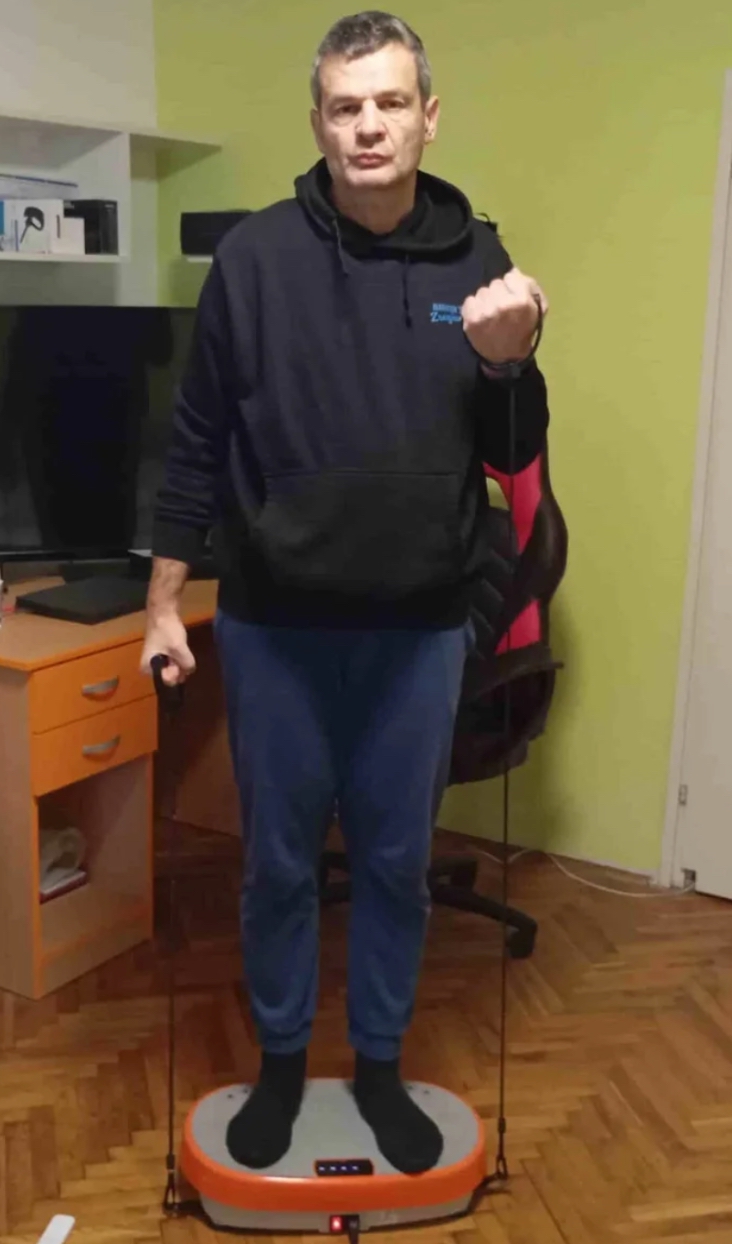
Vladimir Stanar on a vibration plate with elastic bands doing biceps curls
5. Increased Blood Flow in the Legs
Whole-body vibration can temporarily increase peripheral blood flow, particularly in the legs. The mechanical stimulation and repeated muscular contractions appear to encourage circulation through the tissues.
Some people notice that their feet and legs feel warmer during or after a session. Others describe a lighter or more awake sensation in the lower body.
These immediate sensations are plausible, but they should not be stretched into medical promises. Feeling warmer after using a vibration plate does not mean that a vascular condition has been treated.
“Circulation is one of those areas where sensible language matters,” Vladimir says. “It is reasonable to say that vibration can stimulate blood flow. It is not reasonable to tell someone that a home fitness machine will fix a diagnosed circulatory disorder.”
A gently bent-knee position may help engage the leg muscles and reduce the amount of vibration travelling directly toward the upper body. Calf raises can add further muscular work because the calf muscles assist with moving blood from the lower legs.
People with known vascular disease, a history of blood clots, unexplained swelling, or significant cardiovascular concerns should obtain medical advice before using a vibration plate.
6. Support for Mobility and Everyday Tasks
Strength, balance, and mobility affect far more than performance in the gym. They influence how comfortably a person gets out of a chair, climbs stairs, carries groceries, walks over uneven ground, and catches themselves after a small stumble.
Several vibration plate exercises resemble movements used in daily life. A squat follows a pattern similar to sitting down and standing up. Calf raises strengthen muscles involved in walking and climbing stairs. Weight shifts help practise transferring pressure from one leg to the other.
These movements may look simple, but simple does not mean useless.
For an older adult or someone rebuilding fitness, improved confidence during basic movement can be more meaningful than chasing impressive numbers on a display.
The convenience of home training may also improve consistency. A short session does not require travelling to a gym, waiting for equipment, or setting aside an entire evening.
“A ten-minute session is not automatically a poor session,” Vladimir notes. “I would rather see someone complete ten controlled minutes regularly than plan an heroic one-hour workout that never actually happens.”
Naturally, short vibration sessions should not become an excuse to avoid all other activity. Walking, resistance exercise, mobility work, and ordinary daily movement still have important roles.
7. Possible Support for Bone Health
Bones respond to mechanical loading, which is why weight-bearing movement and resistance training are normally recommended as part of a bone-healthy lifestyle.
Whole-body vibration also exposes the body to mechanical forces, leading researchers to investigate whether regular sessions can support bone mineral density.
The evidence is mixed. Some studies and reviews have found improvements in specific skeletal areas or among certain groups of postmenopausal women. Other analyses have found little or no clear advantage.
Differences in frequency, amplitude, posture, session length, study duration, and participant characteristics may help explain why the results are inconsistent.
The sensible conclusion is that vibration may provide supplementary mechanical stimulation, but it should not be presented as a proven replacement for established osteoporosis care.
“I would never tell someone with osteoporosis to buy a plate and consider the problem handled,” Vladimir says. “Bone health involves appropriate exercise, nutrition, fall prevention, medical assessment, and medication when prescribed. Vibration may fit into that picture, but it is not the whole picture.”
People with osteoporosis, previous fragility fractures, spinal problems, or a high fall risk should seek professional guidance before beginning.
8. Greater Flexibility and Range of Motion
Some people experience a temporary improvement in flexibility or range of motion after vibration exposure. This may be related to increased tissue temperature, blood flow, reduced muscle stiffness, or changes in the way the nervous system regulates muscle tension.
For example, a person may find that the calves or hamstrings feel looser after a brief session. Athletes sometimes use vibration as part of a warm-up for similar reasons.
However, a temporary increase in range does not necessarily mean that long-term flexibility has improved. Lasting changes usually require repeated mobility work over time.
Vibration can be combined with gentle positions, but stretching on a moving platform should be controlled. Forcing a deep stretch while the body is being vibrated is not a smart shortcut.
“More range is only useful when you can control it,” Vladimir explains. “There is no point chasing a dramatic stretch if you cannot maintain good alignment or move comfortably through that range afterward.”
Use the plate to support mobility work, not to turn stretching into a contest.
9. More Variety in Home Workouts
Doing the same routine repeatedly can become stale. A vibration plate offers another way to perform exercises that are already familiar.
Common options include:
- shallow squats;
- calf raises;
- split-stance holds;
- supported lunges;
- glute bridges with the feet on the platform;
- planks with the forearms on the plate;
- push-ups with the hands on the platform;
- seated calf or foot stimulation.
Not all of these exercises suit every person or every type of plate. A compact platform may not provide enough space for certain positions, while strong vibration may make some upper-body exercises uncomfortable.
The setting should allow you to maintain control. Turning the speed all the way up is not a badge of honour.
“People sometimes assume the highest number must produce the best result,” Vladimir says. “But when your heels are bouncing, your posture is collapsing, and you are hanging on for dear life, the number on the screen is no longer helping.”
A lower setting combined with a well-controlled exercise may be more useful than maximum vibration combined with poor form.
10. A Manageable Starting Point for Beginners
For some beginners, the most important benefit of a vibration plate is not a dramatic change in strength, weight, or circulation. It is the fact that the machine makes exercise feel approachable.
Someone who feels uncomfortable in a gym or overwhelmed by conventional workouts may be willing to complete several simple movements at home. That can create momentum.
An early routine might include short rounds of supported standing, calf raises, shallow squats, and gentle weight shifts. The first goal is not exhaustion. It is learning how the machine feels and maintaining good control.
Sessions can progress gradually by adding a little more time, increasing the range of movement, reducing support, or introducing another exercise. Only one variable needs to change at a time.
There is no prize for jumping straight to the highest setting.
“A lot of beginners think a workout only counts when it leaves them completely worn out,” Vladimir says. “That is nonsense. Early success comes from doing enough to stimulate the body without making the next session feel like punishment.”
11. Limited Support for Weight Management
Weight-loss claims are where vibration plate marketing often gets ahead of the evidence.
Using a vibration plate requires some energy, particularly when active exercises are performed. Squats, lunges, planks, and other movements naturally demand more effort than passive standing.
However, whole-body vibration alone is unlikely to produce substantial weight loss. Research generally suggests that it is more useful as an addition to diet and conventional exercise than as a standalone fat-loss method.
A brief vibration session is not likely to burn as much energy as sustained walking, cycling, swimming, or a complete resistance workout. It also cannot compensate for consistently consuming more energy than the body uses.
“A vibration plate may support your weight-management routine, but it cannot run the entire show,” Vladimir explains. “You still need to look at food intake, total daily movement, sleep, and the rest of the exercise plan. There is no getting around the basics.”
That does not make the machine irrelevant. If it helps someone exercise more consistently, become stronger, or add movement to an otherwise sedentary day, it may contribute indirectly to better weight management.
Just do not expect it to shake the fat away while everything else remains unchanged.
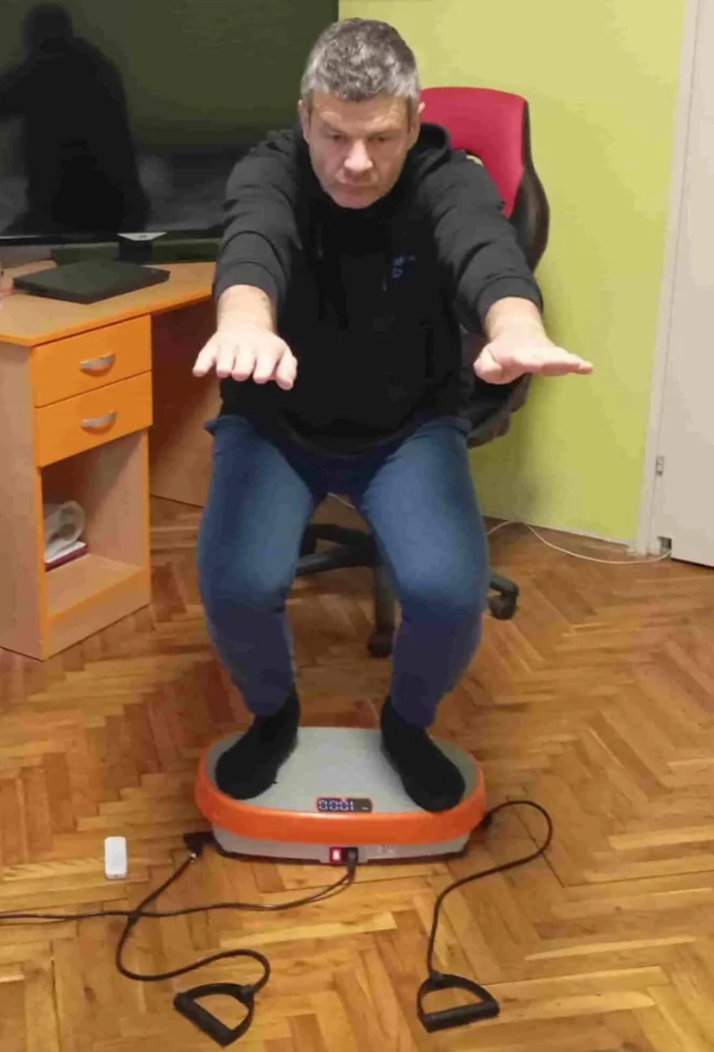
Vladimir Stanar on a vibration plate in a deeper half squat arms outstreched front view
How to Get More From a Vibration Plate
Good results begin with good positioning. Stand in a stable stance, keep the knees slightly bent, and allow the leg muscles to absorb the movement.
Avoid locking the knees. A rigid stance may allow more vibration to travel toward the hips, spine, and head while reducing active muscular involvement.
Start with a comfortable setting and short sessions. Pay attention to how the body feels during the workout and later that day.
Once basic standing feels comfortable, add purposeful exercises. Squats, calf raises, weight shifts, and split-stance holds are reasonable starting points for many people.
Do not increase speed, session length, exercise difficulty, and weekly frequency all at once. Gradual progression makes it easier to identify what your body tolerates well.
Footwear may also affect comfort. Some people prefer supportive athletic shoes, while others use the platform in socks when the manufacturer permits it. Follow the instructions supplied with the specific machine.
Most importantly, use the plate consistently. One heroic session followed by two weeks of inactivity will not accomplish much.
Who Should Be Careful With Vibration Plates?
Whole-body vibration is not suitable for everyone. People who are pregnant or who have implanted medical devices, recent surgery, acute injuries, serious cardiovascular conditions, blood-clotting concerns, advanced osteoporosis, or other significant medical conditions should consult a qualified healthcare professional before use.
Anyone who experiences dizziness, unusual pain, nausea, numbness, headache, visual disturbance, or worsening symptoms should stop the session.
People taking medication or receiving treatment for a diagnosed condition should not use general fitness advice as a substitute for individual medical guidance.
The same applies after surgery or injury. Feeling eager to exercise again is understandable, but tissues need time to heal.
Vibration is a physical stimulus. It should be treated with the same common sense used for any other form of exercise.
Are Vibration Plates Worth Using?
A vibration plate can be a worthwhile addition to a home fitness routine, especially for people interested in lower-body muscle activation, balance training, low-impact exercise, circulation, mobility, or simply adding variety to familiar movements.
Its real benefits are more modest than some advertisements suggest, but modest does not mean meaningless. A tool that helps someone move more consistently, exercise with greater confidence, or make basic movements more challenging can still earn its place in the home.
Vladimir Stanar sums it up simply: “A vibration plate should help you get more from movement. It should not persuade you that movement is no longer necessary.”
That is the key distinction. Combine controlled exercises with sensible settings, realistic expectations, and a generally active lifestyle, and a vibration plate can be genuinely useful.
Just do not expect it to do all the work for you. No piece of fitness equipment is that clever.
Written by Devin Marshall (devin@myprwiz.net)