
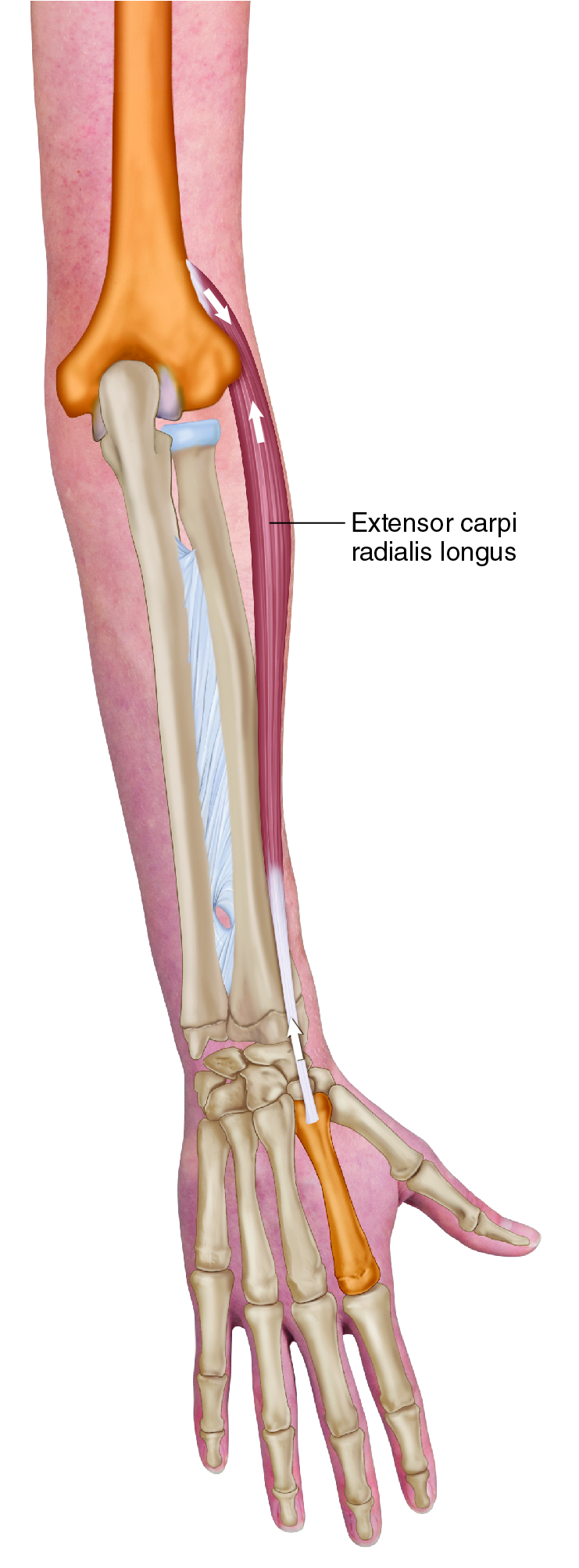
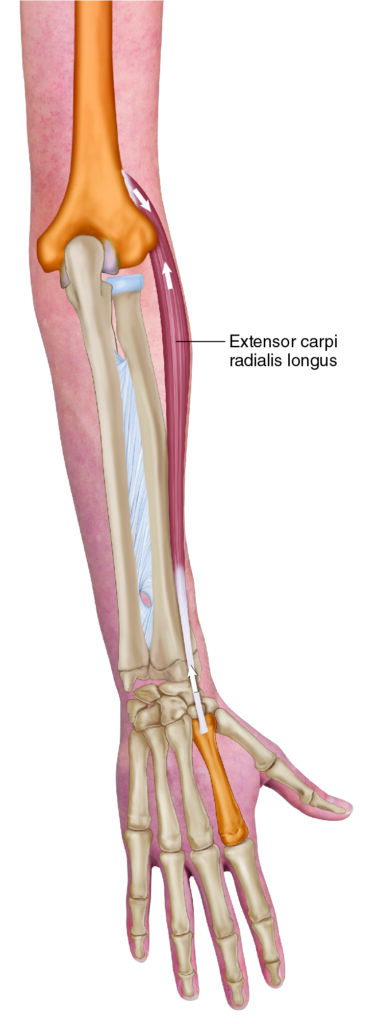
Extensor carpi radialis longus (ECRL). Permission Dr. Joe Muscolino (learnmuscles.com).
Quick answer: The extensor carpi radialis longus (ECRL) is a posterior forearm muscle belonging to both the wrist extensor group and the radial group (aka the wad of three). It attaches from the distal lateral supracondylar ridge of the humerus to the base of the 2nd metacarpal, and it extends and radially deviates the hand at the wrist joint while flexing the forearm at the elbow joint.
Because the posterior forearm compartment of musculature is wrapped in taut fascial tissue, blood flow is often restricted. For this reason, it is especially important to know how to work these muscles.
In this guide:
- Introduction
- ECRL Attachments
- ECRL Functions
- Nearby Anatomy
- Palpating the ECRL
- Massaging the ECRL
- Stretching the ECRL
- Conclusion
- Frequently Asked Questions
Introduction
The extensor carpi radialis longus (ECRL) is a muscle in the lateral aspect of the posterior forearm. It is one of the three muscles of the wrist extensor group as well as one of the three muscles of the radial group. It is important to work because it is so often fascially adhesed.
ECRL Attachments
The ECRL attaches from the humerus to the posterior hand on the radial side.
More specifically, the ECRL attaches from the…
distal 1/3 of the lateral supracondylar ridge of the humerus
to the
posterior side of the base of the second metacarpal
ECRL Functions
What does the ECRL do at the wrist, elbow, and radioulnar joints?
The ECRL crosses the elbow and wrist joints. Therefore, it has joint action functions at both of these joints. Its principal function is at the wrist joint, as indicated in its name (“carpal” mean “of the wrist”).
The ECRL crosses the wrist joint posteriorly, so it extends the hand at the wrist joint.
The ECRL crosses the wrist joint radially/laterally, so it radially deviates (abducts) the hand at the wrist joint.
The ECRL crosses the wrist joint posteriorly, but it crosses the elbow joint anteriorly (it is a member of the radial group, which crosses the elbow joint anteriorly), so it flexes the forearm at the elbow joint. Many students and therapists assume that the ECRL extends both the wrist and elbow joints because they assume that it is always posterior. But the ECRL is posterior at the wrist, but it is anterior at the elbow. This anatomy can be best appreciated with a lateral view.
The ECRL also functionally crosses the radioulnar joints, so it can move the radius/forearm at the radioulnar joints as well. Similar to the brachioradialis, it can bring the forearm to a position that is halfway between full supination and full pronation. If the forearm begins in full supination, the ECRL pronates the forearm to the halfway position; but if the forearm begins in full pronation, the ECRL supinates the forearm to the halfway position. So, the ECRL can either pronate or supinate the forearm, depending on which position the forearm is in when the ECRL contracts.
Note: All the joint actions listed here are open-chain actions in which the distal attachment moves relative to the proximal one.
Nearby Anatomy
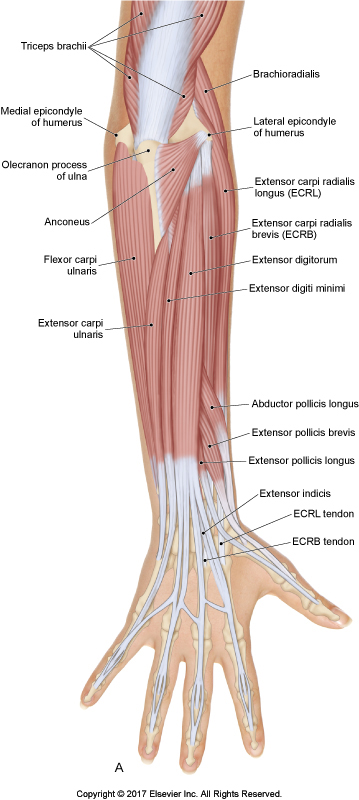
Musculature of the posterior right forearm. Permission Dr. Joe Muscolino – The Muscular System Manual, 5ed.
If we divide up all forearm musculature into anterior and posterior groups, then the ECRL is clearly a muscle of the posterior forearm.
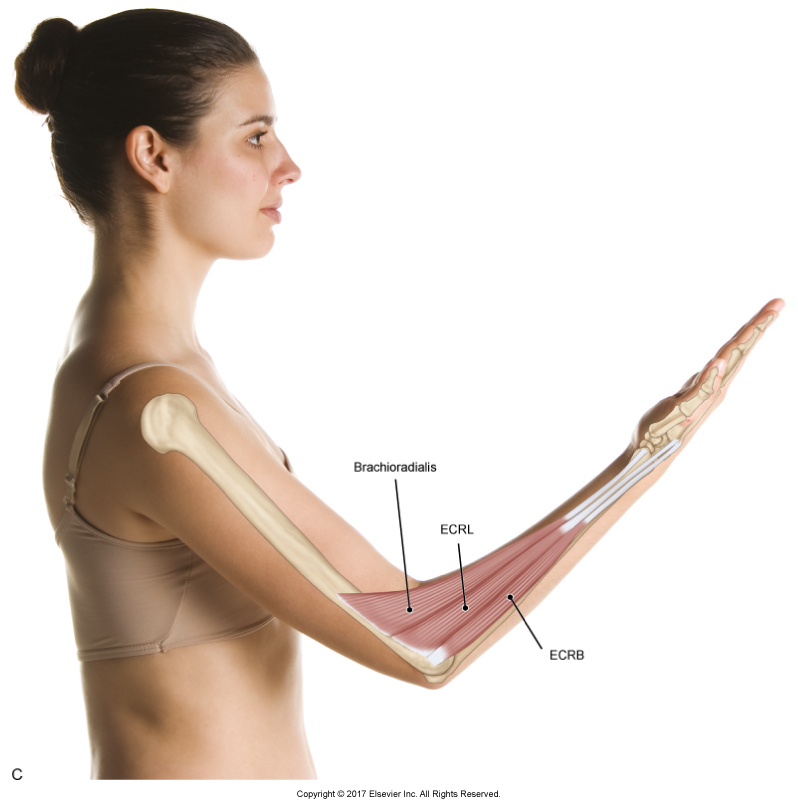
Lateral view of the radial group on the right side of the body. Permission Dr. Joe Muscolino – The Muscular System Manual, 5ed.
But some sources divide up forearm musculature into three groups: anterior, posterior, and radial. In this division, the ECRL is a member of the radial group of muscles (sometimes referred to as the wad of three), along with the brachioradialis and extensor carpi radialis brevis. The brachioradialis lies on the anterior side of the ECRL, and the extensor carpi radialis brevis (ECRB) lies on the posterior side of the ECRL.
Both the ECRL and brachioradialis attach onto the lateral supracondylar ridge of the humerus (directly proximal to the lateral epicondyle of the humerus). All four muscles involved in tennis elbow (more accurately referred to as lateral elbow tendinopathy, as well as lateral epicondylitis or lateral epicondylosis) attach onto the lateral epicondyle of the humerus. The ECRL does not (it attaches more proximally onto the lateral supracondylar ridge), so it is not part of tennis elbow.
The ECRL is also a member of the wrist extensor group of muscles, along with the extensor carpi radialis brevis (ECRB) and the extensor carpi ulnaris.
The musculature of the posterior forearm (as well as the musculature of the anterior compartment of the leg) is held down fairly taut with fascial tissue, often restricting free arterial and venous blood circulation. For this reason, massage to the posterior forearm can be especially beneficial for the client. Unfortunately, the posterior forearm is often not given the attention it deserves.
Palpating the ECRL
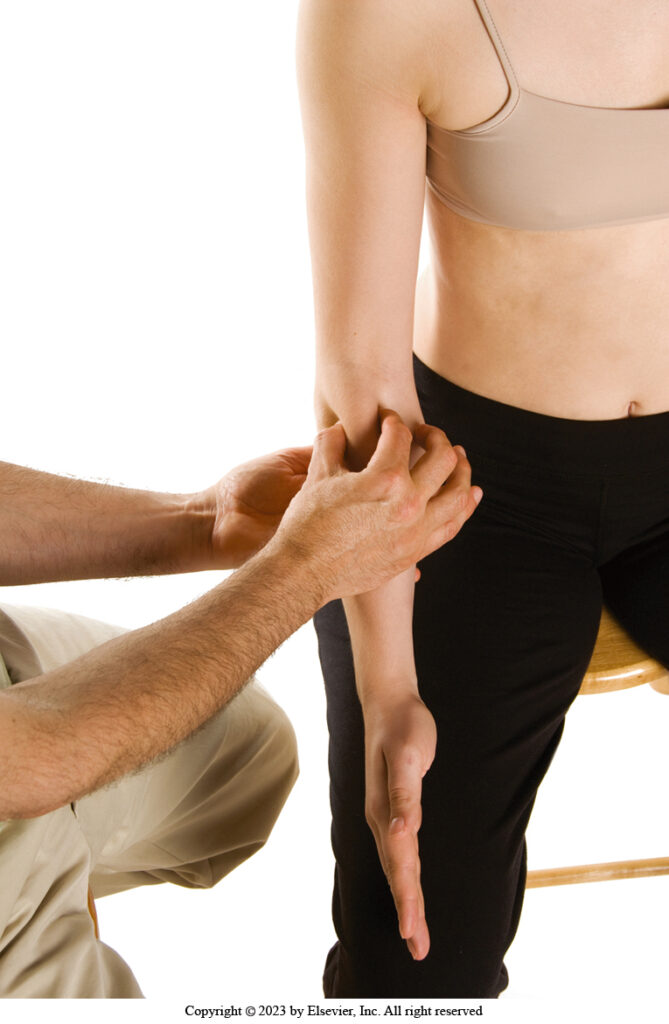
Pinching the radial group away from the forearm. Permission Dr. Joe Muscolino – The Muscle and Bone Palpation Manual, 3ed.
The ECRL can be palpated with the client seated with their forearm flexed at the elbow joint. Pinch the radial group of muscles away from the forearm with your thumb on one side and your index finger (and middle finger) on the other. The ECRL is the middle muscle of this group muscles. The goal is to discern the ECRL within this group by first finding the brachioradialis and the ECRB muscles; then, what is between them will be the ECRL.
Ask the client to extend and/or radially deviate the hand at the wrist joint, and the ECRL and ECRB will engage; the brachioradialis will not.
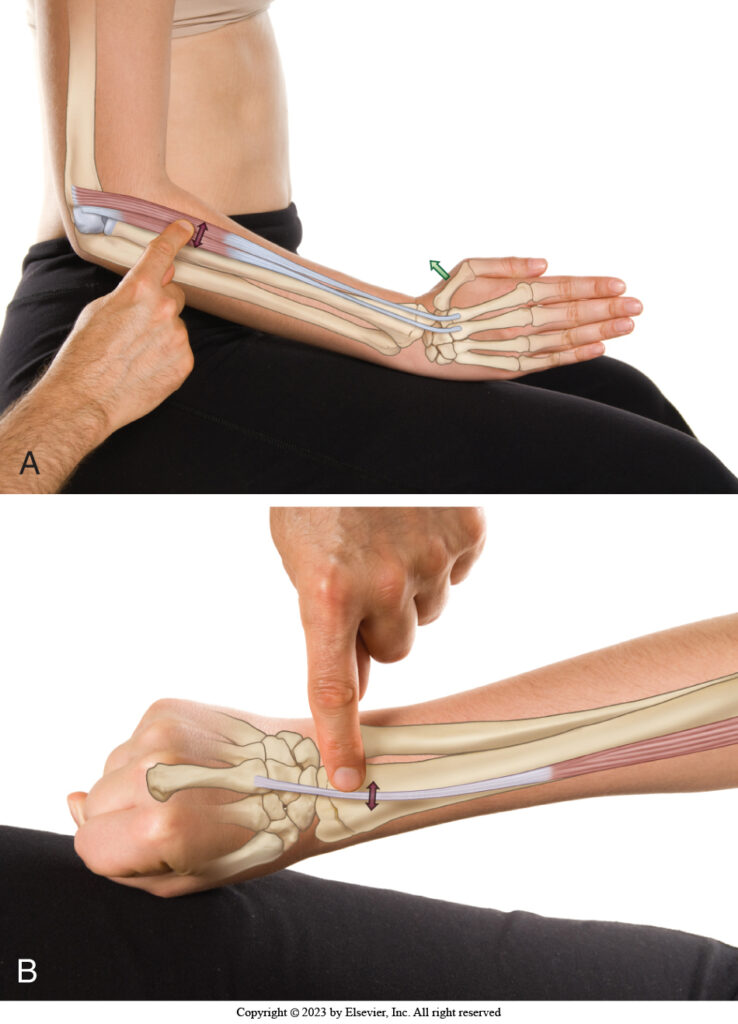
A. Palpation of the ECRL and ECRB with radial deviation of the hand at the wrist joint. B, Palpation of the ECRB distal tendon at the wrist with flexion of the fingers. Permission Dr. Joe Muscolino – The Muscle and Bone Palpation Manual, 3ed.
Now, to find the ECRB, ask the client to flex the hand at the wrist joint (make a fist); this will preferentially engage the ECRB to stabilize the wrist joint against the pull of the two finger flexors (flexors digitorum superficialis and profundus).
Now knowing which fibers are the brachioradialis and which are the ECRB, the ECRL would be the remaining fibers between the other two muscles of the radial group. With the client relaxed, now assess the ECRL for any tissue densification.
Note: Do not add in finger flexion during this protocol because it might cause the extensor digitorum to be stretched taut, thereby stopping the stretch to the ECRL.
Massaging the ECRL
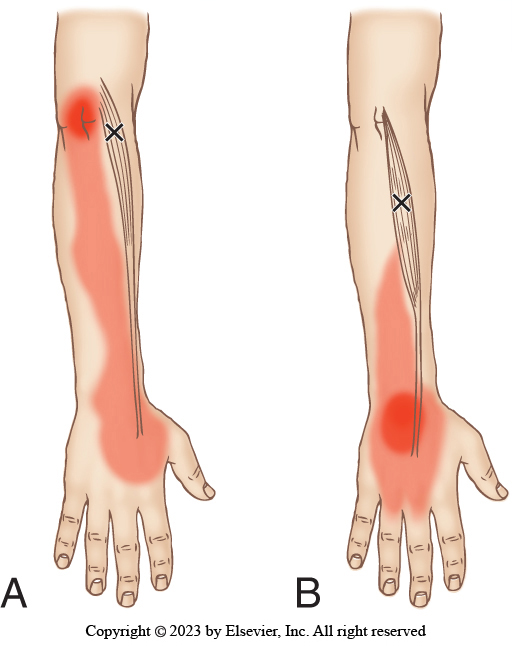
Trigger points of the ECRL and ECRB. Permission Dr. Joe Muscolino – The Muscle and Bone Palpation Manual, 3ed.
Massaging the ECRL follows from the palpation protocol. The ECRL can be worked with long strokes, either proximal-to-distal or distal-to-proximal. It can also be effectively worked with transverse (cross-fiber) strokes.
You can also choose to work it at its resting length, or you can work it on stretch or on slack. Working on stretch is advantageous because you get massage into the tissue plus the stretch; but it often tautens the tissue so that the deeper fibers cannot be accessed. Working on slack is advantageous because it facilitates working into the deeper fibers of the muscle.
Stretching the ECRL
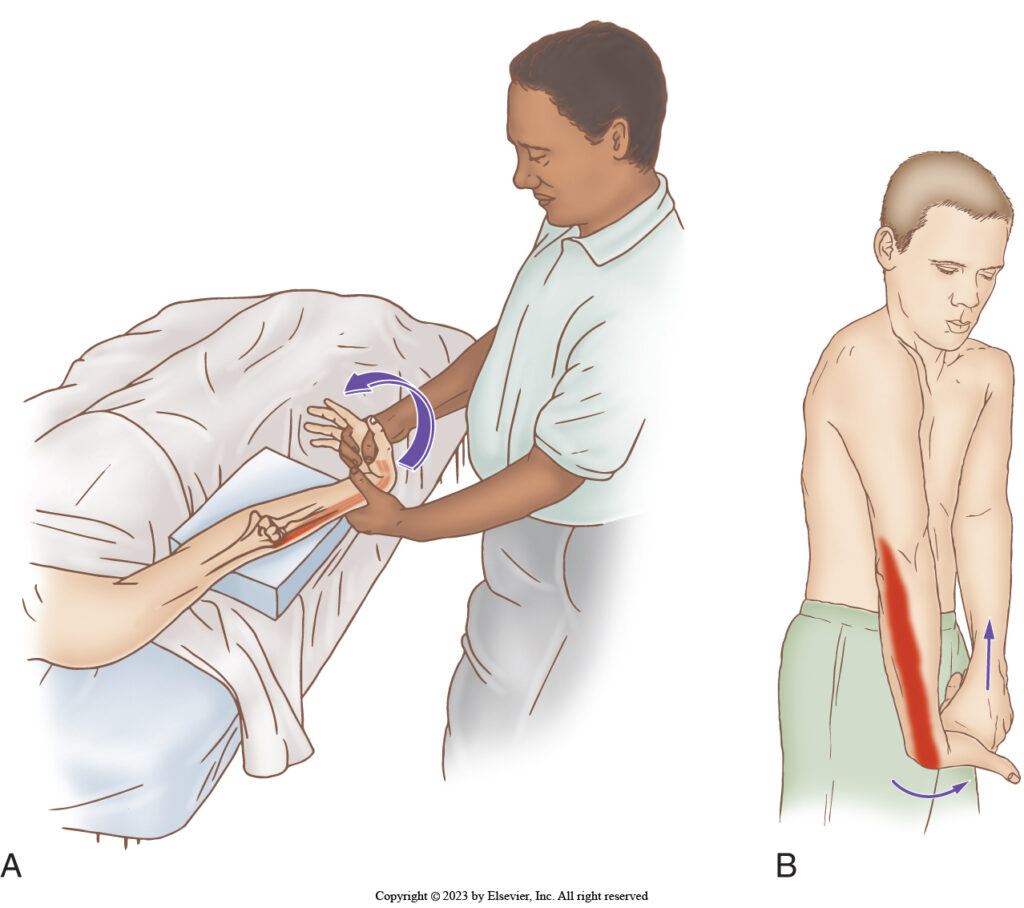
Therapist-assisted and client self-care stretching of the ECRL and ECRB. Permission Dr. Joe Muscolino – The Muscle and Bone Palpation Manual, 3ed.
The ECRL can be stretching be simply doing the opposite of its joint actions. It extends the hand at the wrist joint, so it is stretched with flexion of the hand at the wrist joint. It is a radial deviator of the hand at the wrist joint, so if you can add in some ulnar deviation, it will preferentially stretch the ECRL (and ECRB) compared with other wrist joint extensors. And, because it flexes the forearm at the elbow joint, it is important for the elbow joint to be fully extended. Beyond that, full supination or full pronation will probably increase the efficacy of the stretch, but not likely by very much.
Conclusion
The extensor carpi radialis longus (ECRL) is a muscle of the posterior forearm and part of the radial group as well as the wrist extensor group.
Because of the fascial restriction that is common in the posterior forearm, it can be especially important to learn now to work the ECRL, as well as the other muscles of the posterior forearm compartment.
About the Author

Dr. Joe Muscolino (learnmuscles.com).
Dr. Joseph Muscolino, DC is a soft-tissue oriented chiropractic physician and leading educator in manual and movement therapy. He is the author of eight major textbooks published by Elsevier and LWW, translated into more than 10 languages and used worldwide in core curriculum and clinical practice. A global lecturer and NCBTMB-approved CE provider, he offers COMT (Clinical Orthopedic Manual Therapy) certification workshops across the US and internationally. Visit his website at: LearnMuscles.com.
LearnMuscles Continuing Education (LMCE) is one of his online subscription platforms with over 4,000 video lessons for manual and movement therapy professionals, and more than 320 free NCBTMB-CE hours.
Frequently Asked Questions
Where does the ECRL attach? The ECRL attaches from the distal 1/3 of the lateral supracondylar ridge of the humerus to the posterior side of the base of the second metacarpal.
What joint actions does the ECRL perform? The ECRL extends and radially deviates the hand at the wrist joint, flexes the forearm at the elbow joint, and can pronate or supinate the forearm toward the mid-position at the radioulnar joints depending on the forearm’s starting position.
Is the ECRL involved in tennis elbow? No. Tennis elbow (lateral elbow tendinopathy) involves the four muscles that attach onto the lateral epicondyle of the humerus. The ECRL attaches more proximally, onto the lateral supracondylar ridge, so it is not part of tennis elbow.
Which muscle group is the ECRL part of? The ECRL belongs to two overlapping groups: the radial group (wad of three, with the brachioradialis and extensor carpi radialis brevis), and the wrist extensor group (with the extensor carpi radialis brevis and extensor carpi ulnaris).
How do you palpate and distinguish the ECRL from the brachioradialis and ECRB? With the client’s forearm flexed, pinch the radial group of muscles. The ECRL is the middle muscle. Have the client extend/radially deviate the hand at the wrist joint to engage the ECRL and ECRB (not the brachioradialis), then make a fist to preferentially engage the ECRB — what remains between the two identified muscles is the ECRL.
How do you stretch the ECRL? Flex the hand at the wrist joint, add ulnar deviation, and fully extend the elbow joint — the reverse of the ECRL’s joint actions.