
 Image source: Pexels
Most people describe rhinoplasty in terms of what it looks like from the outside: a smaller tip, a smoother bridge, nostrils that sit differently. That framing makes sense as far as it goes, but it misses most of what’s actually happening. Nose surgery is a structural intervention into one of the most complex regions of the face – bone, cartilage, soft tissue, and airway structures that each play a distinct functional role, all nested within millimeters of each other.
The gap between how rhinoplasty is marketed and what it actually involves is wide. Marketing language emphasizes transformation; anatomy tells a quieter, more technical story about a layered system surgeons must understand before they touch it. For readers drawn to the body’s architecture – manual therapists, healthcare students, and anyone wanting to understand a procedure before committing – what follows covers the nasal structures rhinoplasty works with, why functional and cosmetic goals are often intertwined, what the healing process actually looks like, and how to evaluate a surgeon.
The Anatomy the Surgeon Is Actually Working With
 Image source: Unsplash
The nose has three structural zones. At the top is the bony vault – the nasal bones that form the bridge and anchor to the frontal bone of the skull. Below that sits the cartilaginous vault, built from the upper lateral cartilages and the septal cartilage, which run together as a connected unit. At the base is the lobular unit: the lower lateral cartilages that shape the nasal tip and alar regions.
Each zone responds differently to surgical manipulation. The bony vault is addressed through osteotomy – controlled fractures that allow the surgeon to narrow or reshape the bridge. The cartilaginous vault is more pliable but also structurally critical; disrupting the attachment between the upper lateral cartilages and the septum without adequate reconstruction can cause an inverted-V deformity, where the middle third of the nose collapses inward. The lobular unit is technically the most demanding. According to the rhinoplasty overview published by StatPearls through the National Institutes of Health, the nasal tip is supported by what surgeons call a “tripod structure” – the two lateral crura and the conjoined medial crura of the lower lateral cartilages – and modifying tip projection or rotation means working directly with this architecture.
The nasal septum runs down the center of the nose, dividing the airway into two passages. It’s made of both cartilage and bone; a deviated septum can restrict airflow significantly. The internal nasal valve, the narrowest point of the airway where the upper lateral cartilage meets the septum at roughly 10 to 15 degrees, is a frequent obstruction site. The inferior turbinates – bony shelves that warm and humidify incoming air – are often treated concurrently when enlarged.
All of this is what the rhinoplasty surgeons in Washington DC at practices specializing in combined functional and cosmetic nasal surgery are working with when they plan a procedure. Surgeons who understand nasal anatomy at this level don’t just address what’s visible on the surface; they map how structural changes in one zone will affect adjacent zones before making a single incision. Understanding rhinoplasty surgeons in Washington DC from this anatomical standpoint – rather than purely an aesthetic one – explains why training depth matters so much for outcomes.
Functional vs. Cosmetic Rhinoplasty: Why the Distinction Matters
 Image source: Pexels
Cosmetic rhinoplasty focuses on the exterior proportions of the nose: reducing a dorsal hump, refining the tip’s shape and projection, correcting asymmetry between the left and right sides, or adjusting the alar base width. Functional rhinoplasty targets structural problems that impair breathing – septal deviation, nasal valve collapse, and turbinate hypertrophy are the three most common. The two goals can coexist in a single patient and, critically, in a single operation.
This matters practically. Functional rhinoplasty improves nasal breathing in roughly 82% of patients, according to data from the American Society of Plastic Surgeons (ASPS) and Grand View Research’s 2024 rhinoplasty market analysis. Insurance covers the functional component in approximately 40% of cases when a structural problem is documented, which can meaningfully reduce out-of-pocket costs for patients who would have sought cosmetic refinement anyway. The cosmetic work, however, remains self-pay regardless.
Technique choices follow from these goals. Closed rhinoplasty uses only internal incisions and suits cases requiring limited tip modification. Open rhinoplasty adds a small external incision at the columella, giving direct visualization of the tip’s cartilage framework – standard for complex tip work and revisions. Preservation rhinoplasty, a newer approach, works with the native dorsal anatomy rather than disarticulating it: the “let-down” technique lowers a dorsal hump by removing a wedge from the nasal base rather than rasping from above, reducing recovery swelling.
Because rhinoplasty produces scar tissue inside the nose – between the cartilage and the overlying skin – the healing process shapes the final result as much as the surgery itself. How scar tissue develops and eventually limits or permits tissue movement is something we’ve covered in detail, including how scar tissue can affect mobility after injury – a process that applies directly to post-rhinoplasty tissue behavior.
Recovery: What the Healing Process Actually Looks Like
Recovery from rhinoplasty is longer than most patients expect, because the final result isn’t visible until the tissue has fully remodeled. Initial bruising and swelling peak in the first 48 to 72 hours. A rigid nasal splint is typically worn for 7 to 10 days to protect the osteotomy sites and maintain the reshaped bone position while the fractures stabilize. Most patients look presentable in social settings by weeks 3 to 4, but this is not the same as the final result.
The nasal tip is the last area to settle. Its soft tissue is denser than the bridge or sidewalls, and the tip’s defining contour often remains somewhat swollen for up to 12 months. Patients who assess their results at the 3-month mark are evaluating the nose mid-process. Surgeons who specialize in rhinoplasty consistently warn that the 12-month mark is the earliest point for a meaningful final assessment – and that revision consultations before that point are premature in most cases.
Temporary numbness at the nasal tip is common. The external nasal branch of the anterior ethmoidal nerve is vulnerable during dorsal work, and according to StatPearls’ septoplasty and rhinoplasty coverage, this is a known anatomical consequence of open dissection that resolves spontaneously in most patients within 3 to 6 months.
Internal scar tissue between cartilage and overlying skin shapes the final contour at least as much as the surgery does. Surgeons manage this with precise suturing and, when needed, postoperative steroid injections. Patients with thicker nasal skin see less definition in final results, because the skin itself masks cartilage refinement. That’s anatomy, not a surgical failure – and a surgeon worth choosing will say so during consultation.
Surgical risk management across any operative procedure shares common principles, and rhinoplasty is no exception. Our article on how general surgeons manage surgical risk covers the pre- and post-operative framework that applies to procedures of this complexity. For readers who think about the body in these terms professionally, we’ve also explored how anatomy knowledge translates into clinical careers in nursing and allied health fields.
What to Look for in a Rhinoplasty Surgeon
 Image source: Pexels
Board certification is the starting point, but the board matters. The American Board of Facial Plastic and Reconstructive Surgery (ABFPRS) and the American Board of Plastic Surgery (ABPS) are both recognized by the American Board of Medical Specialties. Certifications from organizations with unofficial-sounding names not recognized by ABMS don’t carry the same training requirements and shouldn’t be treated as equivalent.
Double board certification – in otolaryngology (ear, nose, and throat) and facial plastic surgery – is particularly valuable for rhinoplasty. It means the surgeon trained in internal airway structures through residency and also completed fellowship-level training in external facial aesthetics. That combination is directly relevant to a procedure that can address both the septum and the skin envelope in the same operation.
Volume and specialization signal something important. Rhinoplasty is among the most technically demanding facial surgeries, with a revision rate of up to 15% even at experienced practices, according to ASPS 2024 data. The same data show 96% patient satisfaction overall – but that gap between satisfaction and revision rate reflects how much surgical skill influences outcomes. Surgeons whose practices concentrate heavily on rhinoplasty develop a feel for the tissue response, the structural behavior of cartilage grafts, and the way the nose changes character over the healing arc, in a way that generalists don’t.
Ask about revision rhinoplasty experience directly. Revisions are the most demanding cases – altered anatomy, scar tissue in place of natural tissue planes, and weakened cartilage. Surgeons who handle them regularly know what goes wrong and why, and that knowledge applies directly to primary case planning.
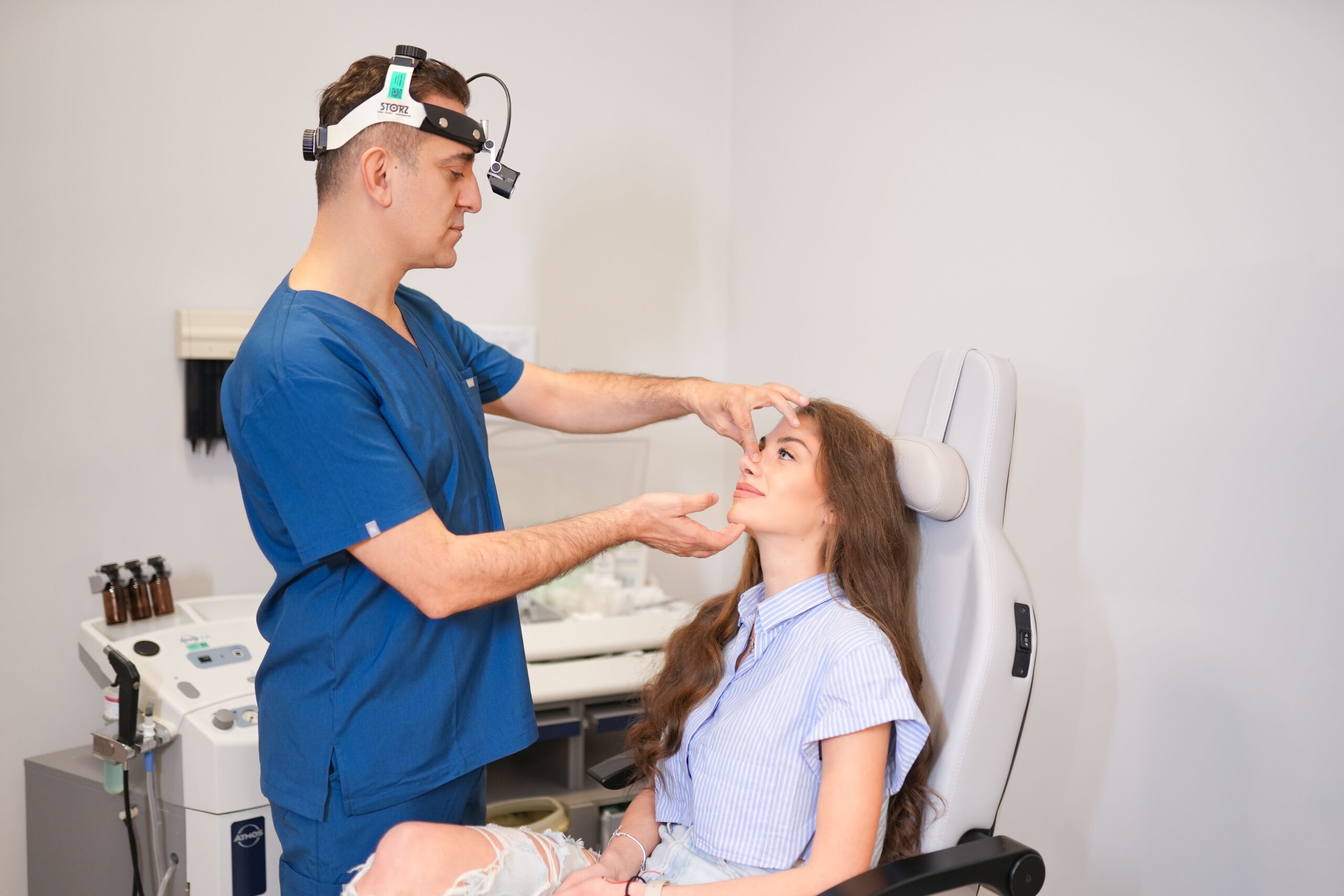
The consultation itself is diagnostic. A good rhinoplasty surgeon listens more than talks in the first meeting, explains the anatomical limits specific to your nose, and uses 3D imaging or simulation software – standard in 85% of leading practices, according to 2025 industry analyses. If a consultation feels like a sales presentation, that tells you something. The American Society of Plastic Surgeons recommends consulting with multiple board-certified surgeons before deciding, and University of Utah Health’s rhinoplasty guidance advises evaluating before-and-after photos for natural-looking outcomes rather than dramatic ones.
There are roughly 350,000 rhinoplasties annually in the United States. Washington DC has a high concentration of double board-certified facial plastic surgeons, partly because of proximity to major academic medical centers and a patient base that expects functional and cosmetic goals addressed in one procedure.
Rhinoplasty as a Structural Decision
Rhinoplasty is fundamentally an anatomical procedure. The nose isn’t a surface to be shaped; it’s a layered system of bone, cartilage, soft tissue, and airway architecture that surgeons must account for in full before the first incision. The best outcomes happen when patients understand what’s actually being changed, choose a surgeon with genuine anatomical depth, and go in with realistic expectations about a healing timeline that extends well past the first months.
For anyone researching rhinoplasty – whether the goal is breathing improvement, cosmetic refinement, or both – the most consequential decision isn’t which technique to choose. It’s which surgeon to trust with a structure that’s doing something every time you breathe.
Written by Denise Smith