
The great majority of muscle imbalances occur without any trauma or pain. Muscle imbalances occur as a result of posture and movement patterns that are maintained over long periods of time such as sitting at a computer, repetitive training programs using the same exercises, and the fact that we are all seated for long periods of time in our daily lives.
It may be subtle at first but as time progresses the imbalance in the joints and muscles begins to manifest itself into distinct changes in the way we move. Tight and weak muscles cause our bodies to adopt inefficient movement patterns to try and make up for the lack of function and mobility in our joints and muscles. The following are some of the most common pairs of imbalances and some tips for how to balance them out.

Correcting Imbalances Before They Get Worse
Over time, the body’s new movement patterns become just as hard to change out as the original problem. Thus, rehabilitating secondary movement patterns may require significant hypertrophy of the involved muscles as well as a careful release of inhibited soft tissue to ensure that the body can move properly and efficiently.
The strength work for this issue is pretty simple. It’s really more about activation than true strength work, but you do need to build some actual strength in your glutes, hamstrings, and back. The larger muscles have gotten all the attention for years, and the smaller muscles that assist them in the movement have gotten none. We just need to make sure that they are turned on. This is more about activating correct movement patterns than about building mass. Where flexibility exercises deal with the other half of the issue. The hip flexors, chest and thoracic spine all have to be stretched out as well because they have become shortened from being in the same position for so long. Where strengthening deals with the other half of the correction needed. If you only stretch them out, you’re only dealing with half of the correction. Unilateral work is also relevant to this discussion. As an example, consider single-leg deadlifts or single arm presses.
The difference between sides becomes clearly apparent when attempting to perform such a lift. During a bilateral exercise the stronger side tends to load up the movement more and the weaker side tends to carry less load. The body can get by with such an imbalance. However, with unilateral work the weaker side now has to do all of the work that was previously being done by the body as a whole.
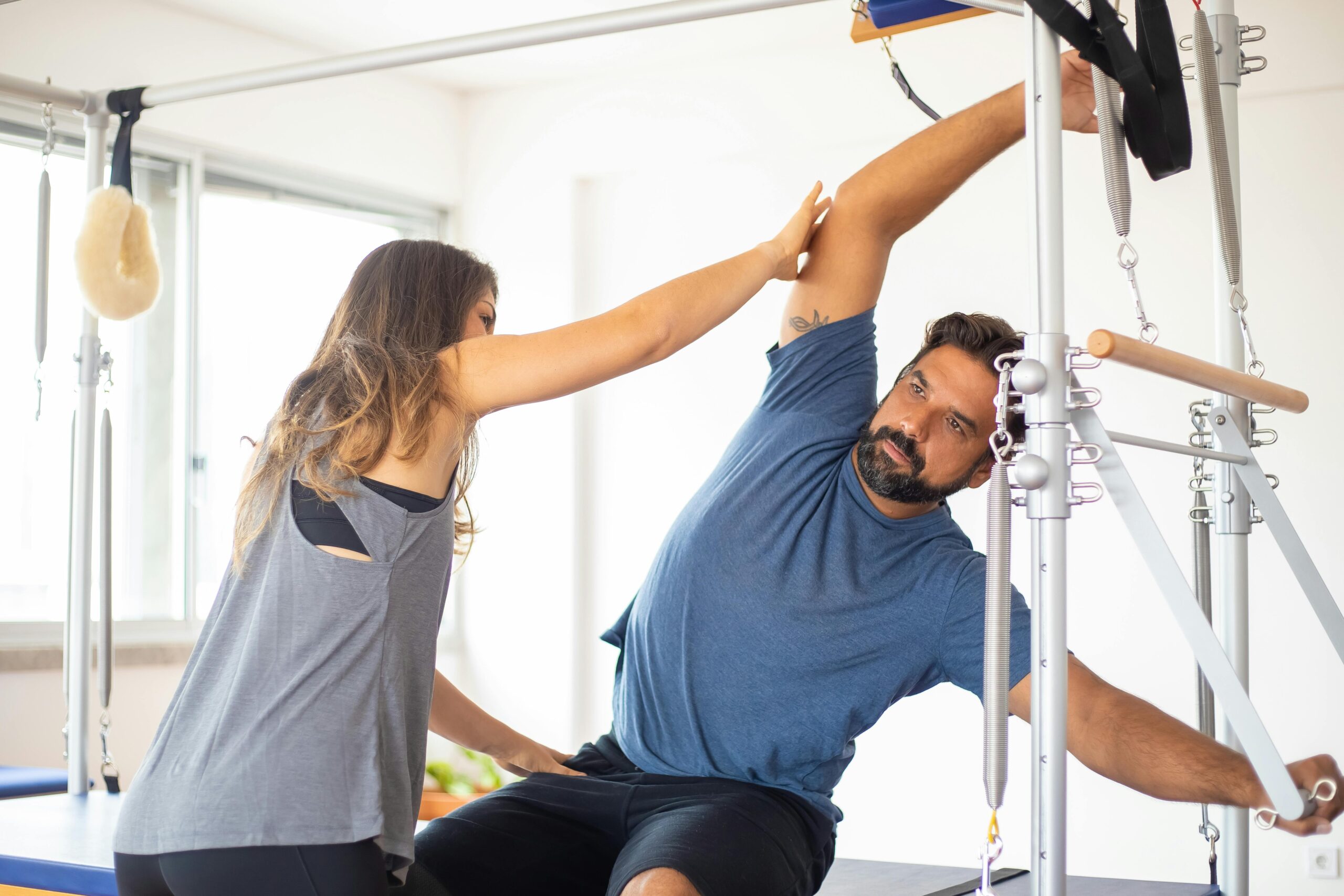
Pilates is another option that may be helpful in treating thoracic kyphosis as Pilates focuses on even muscle activity and controlled movement through a full range of motion. Body awareness is also addressed and by focusing on symmetry and control, it can also help with imbalances.
When self-directed corrective exercise isn’t producing results, or when an imbalance is causing pain, working with a professional changes the equation. Many people eventually seek help from a nearby clinic where trained therapists can evaluate movement patterns in person rather than relying on generalized online advice. In communities like Berkeley Heights, access to specialized care makes that kind of assessment more accessible. A physical therapy Berkeley Heights clinic, for example, can provide the kind of hands-on evaluation that catches dysfunction self-correction often misses. Persistent compensations sometimes involve joint mechanics or neuromuscular timing issues that require trained evaluation.
Corrective exercise programming endorsed by organizations like ACE, NASM, and ISSA provides structured frameworks for tackling these patterns systematically rather than guessing.
The Muscle Pairs Most Likely to Fall Out of Balance
Not all muscle imbalances in the body carry the same consequences. Some pairs are far more prone to dysfunction than others, especially when a sedentary lifestyle is part of the equation.
Hip Flexors and Glutes
When someone sits for most of the day, the hip flexors stay in a shortened position for hours on end. That constant tightness signals the gluteus maximus to dial down its activation, a pattern known as reciprocal inhibition.
The result is a forward pull on the pelvis that contributes to anterior pelvic tilt and, eventually, low-back pain. Because these opposing muscles govern so much of how the lower body moves, even a mild imbalance here can alter gait, reduce hip extension, and limit power output during activities like running or climbing stairs.
Research confirms that adverse health effects of prolonged sedentary behavior extend well beyond stiffness, making this particular pair one worth paying attention to early.
Quadriceps and Hamstrings
The quadriceps tend to be the dominant muscle group for the majority of functional activities of daily living. When we walk, squat, lunge, and climb stairs, the quadriceps are typically working more than the hamstrings and the hamstrings are often not engaging as strongly. This gap is far more important than you realize. If the quadriceps are overpowering the hamstrings, the knee is subjected to an unequal load. This unequal load can increase stress on the ACL and reduce power during activities like running and jumping. The fact that a higher heel in a shoe can cause a more forward foot strike and promote a more powerful quadriceps leads to this potential issue.
Chest and Upper Back
The tight pectorals, the weak rhomboids and mid traps are what create the rounded shoulder posture that we see so often in the desk working population. The chest muscles become short and tight from the reaching forward to type on the key board whilst the upper back muscles become lengthened and ineffective causing the scapulas to no longer sit correctly in the shoulder girdle. This is a discussion that I feel is had way too often. A tight chest in relation to a tight or underdeveloped upper back is one of the most common imbalances that I see.
When an imbalance like this exists it can cause a multitude of problems, including a decrease in scapular mobility and an associated decrease in shoulder range of motion in the overhead position. This can often lead to a person impinging on the top of movements such as the bench press. The solution to this problem is often met with an abundance of chest stretching, but I strongly disagree with this approach and believe that there is a far more beneficial solution.
How These Imbalances Show Up in Movement
Left unaddressed, these compensations reinforce themselves. The body adapts to its own workarounds, layering poor posture on top of existing dysfunction. Restoring optimal movement patterns becomes harder the longer these detours go uncorrected, which is why identifying the signs matters well before pain shows up.

Small Fixes Now Prevent Bigger Problems Later
Muscle imbalance is not a flaw reserved for the injured or the sedentary. It shows up in nearly everyone, and the real risk lies in leaving it unchecked. The corrections outlined above are not dramatic overhauls. Consistent, small adjustments to training habits, daily posture, and movement awareness add up faster than most people expect.
Balanced muscles move better, recover faster, and hold up longer under demand. That payoff starts with paying attention early rather than waiting for pain to force the conversation.
Written by vicheeno@hotmail.com