
What Is the Teres Major? (Quick Answer)
The teres major is a muscle of the posterior shoulder that attaches from the inferior angle of the scapula to the medial humerus. It extends, adducts, and medially rotates the arm at the shoulder joint — the same three actions as the latissimus dorsi. Despite being called the lat’s “little brother,” the teres major is actually larger than the lat in the posterior axillary fold.
Introduction
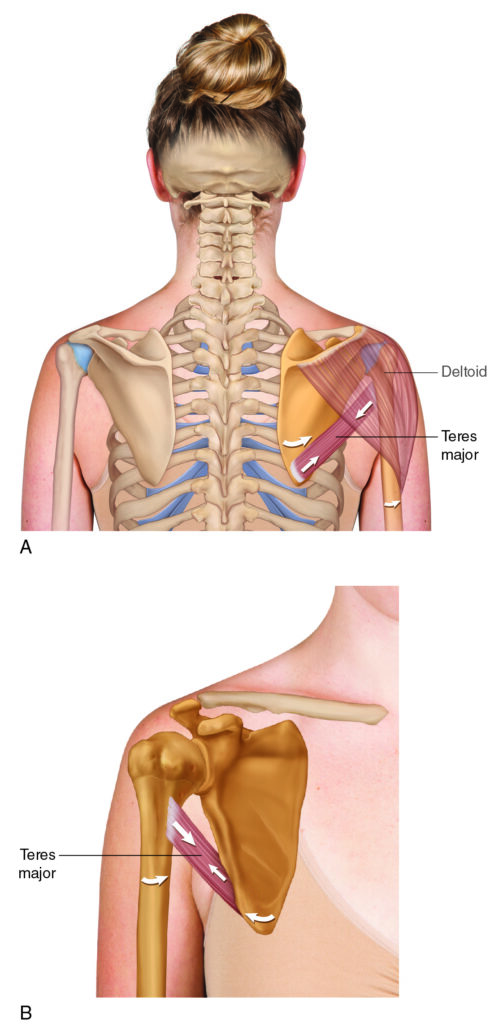
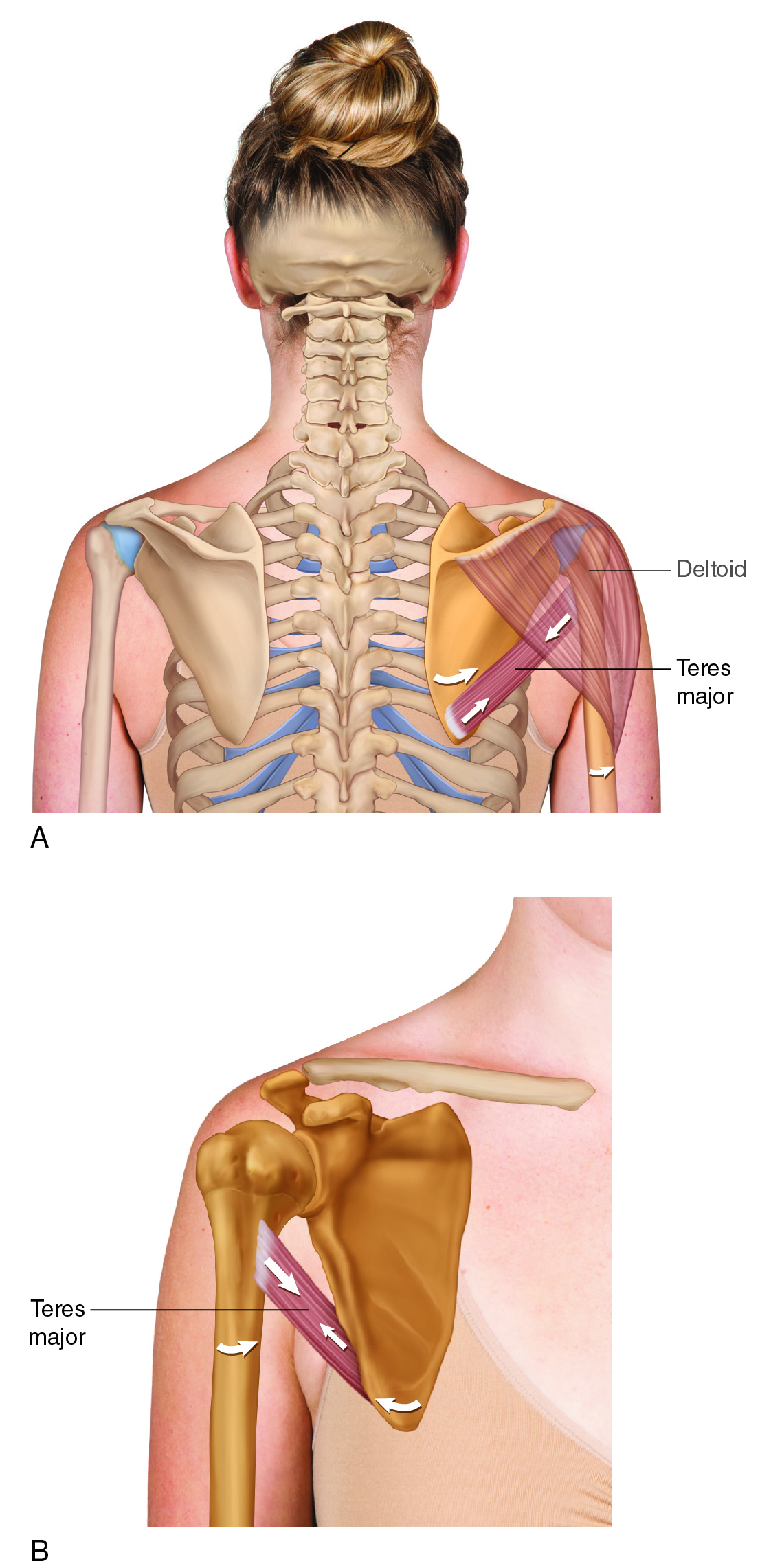
Teres major – posterior and anterior views. Permission Dr. Joe Muscolino (learnmuscles.com).
The teres major is often known as the “little brother” of the latissimus dorsi (lat) because they are found next to each other in the posterior axillary fold of tissue, and they have the same actions upon the arm at the shoulder joint: extension, adduction, and medial rotation. However, I prefer to call the teres major the lat’s big brother because in the posterior axially fold, it is actually quite a bit larger than the lat.
Teres Major Attachments
The teres major attaches from the inferior angle of the scapula (origin) to the medial humerus (insertion).
More specifically, it runs from…
the inferior angle and the inferior 1/3 of the lateral border of the scapula
to the
medial lip of the bicipital groove of the humerus
Teres Major Functions
The teres major crosses the shoulder joint posteriorly with a vertical direction to its line of pull, so it extends the arm at the shoulder joint.
It crosses the shoulder joint medially with a vertical direction to its line of pull, so it adducts the arm at the shoulder joint.
And it crosses the shoulder joint such that it wraps around to the inside of the humerus, therefore it medially rotates the arm at the shoulder joint.
These actions of extension, adduction, and medial rotation of the arm at the shoulder joint are identical to the shoulder joint actions of the latissimus dorsi.
Summary of Teres Major Actions:
- Extends the arm at the shoulder joint
- Adducts the arm at the shoulder joint
- Medially rotates the arm at the shoulder joint
Nearby Anatomy
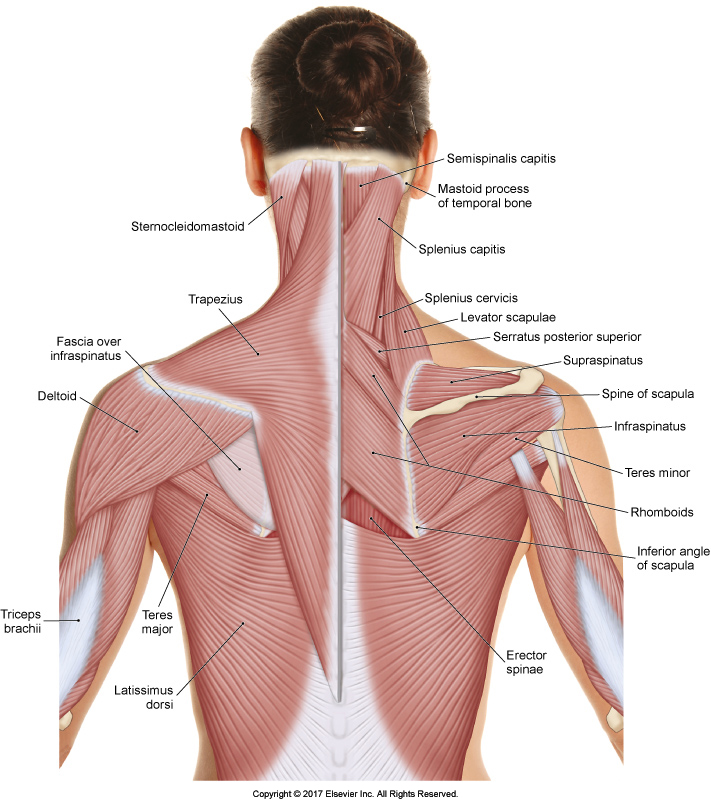
Musculature of the posterior shoulder. Permission Dr. Joe Muscolino – The Muscular System Manual 5ed.
The teres major and latissimus dorsi constitute the posterior axillary fold of tissue. They also both attach onto the medial lip of the bicipital groove of the humerus.
Note: The teres major attaches on the humerus immediately posterior to the latissimus dorsi, and the pectoralis major attaches directly anterior on the humerus. There is an expression that can help us remember their relative positions on the humerus…
the laty between the two majors
The teres minor (of the rotator cuff group) attaches superior to the teres major on the lateral border of the scapula.
The more distal aspect of the teres major runs deep to the posterior deltoid.
Palpating the Teres Major
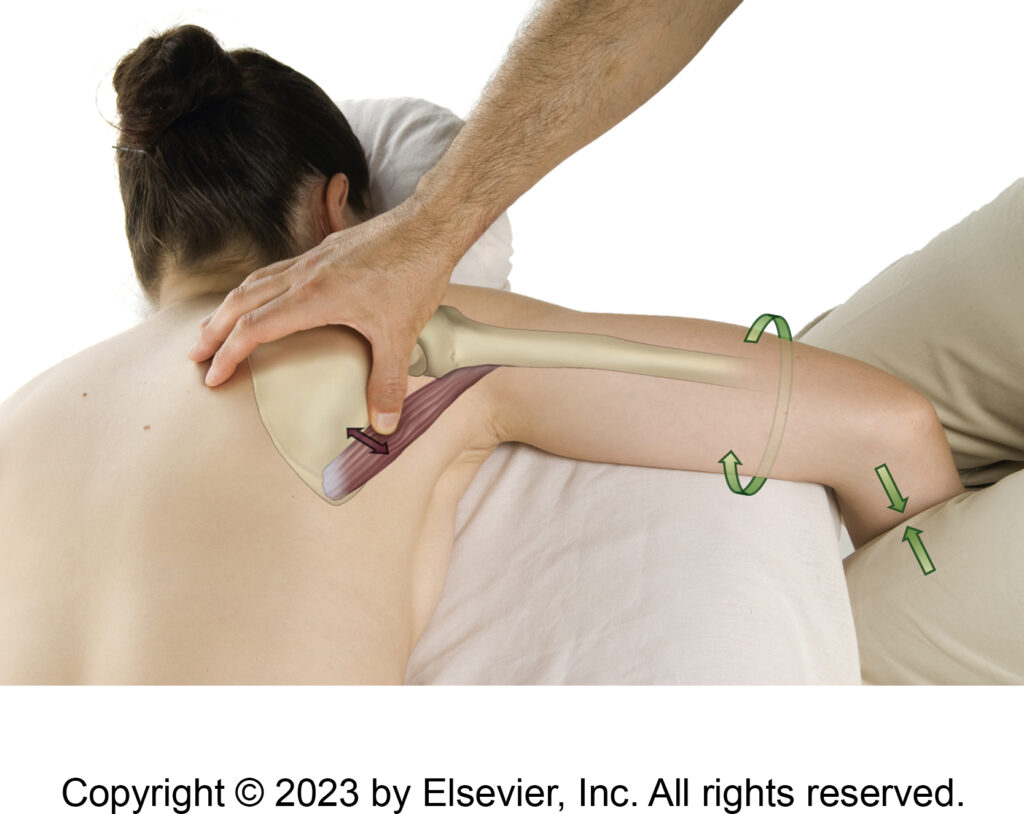
Palpation of the teres major. Permission Dr. Joe Muscolino – The Muscle and Bone Palpation Manual 3ed.
The majority of the teres major is superficial and easy to palpate. Have the client prone with their (upper) arm on the table and their forearm hanging off the side of the table, between your two knees. Find the inferior angle of the scapula; and then palpate just a bit up on the lateral border. You will be on the teres major.
Instruct the client to swing their forearm downward until it contacts the resistance of your knee; this is medial rotation of the arm at the shoulder joint and will make the teres major engage and pop; feel for the teres major to harden. Now ask the client to relax and feel for the teres major to relax and soften.
Once you are sure that you are on the teres major, move a baby step distally toward the humerus and repeat this process of engagement/hardening and relaxing/softening. Continue this protocol as far as possible toward the humeral attachment. It can be challenging to palpate the teres major all the way to the humerus because it runs deep to the posterior deltoid.
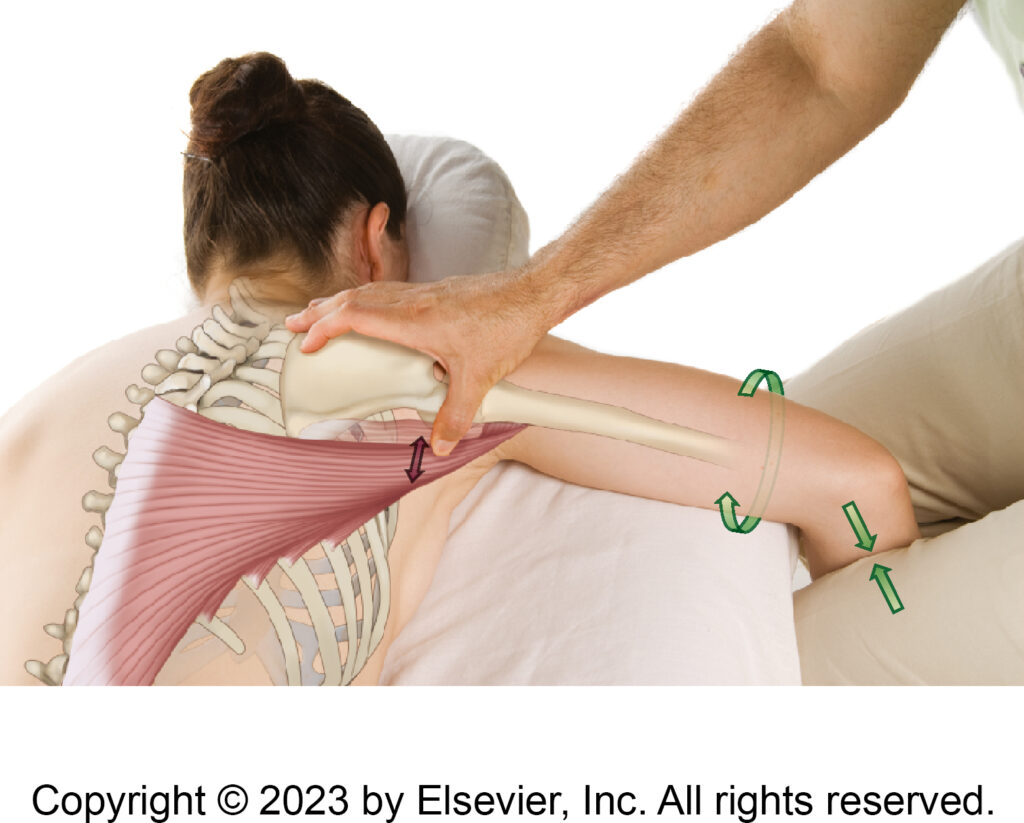
Latissimus dorsi palpation. Permission Dr., Joe Muscolino – The Muscle and Bone Palpation Manual 3ed.
Note the relative location of the latissimus dorsi in the posterior axillary fold.
Stretching the Teres Major
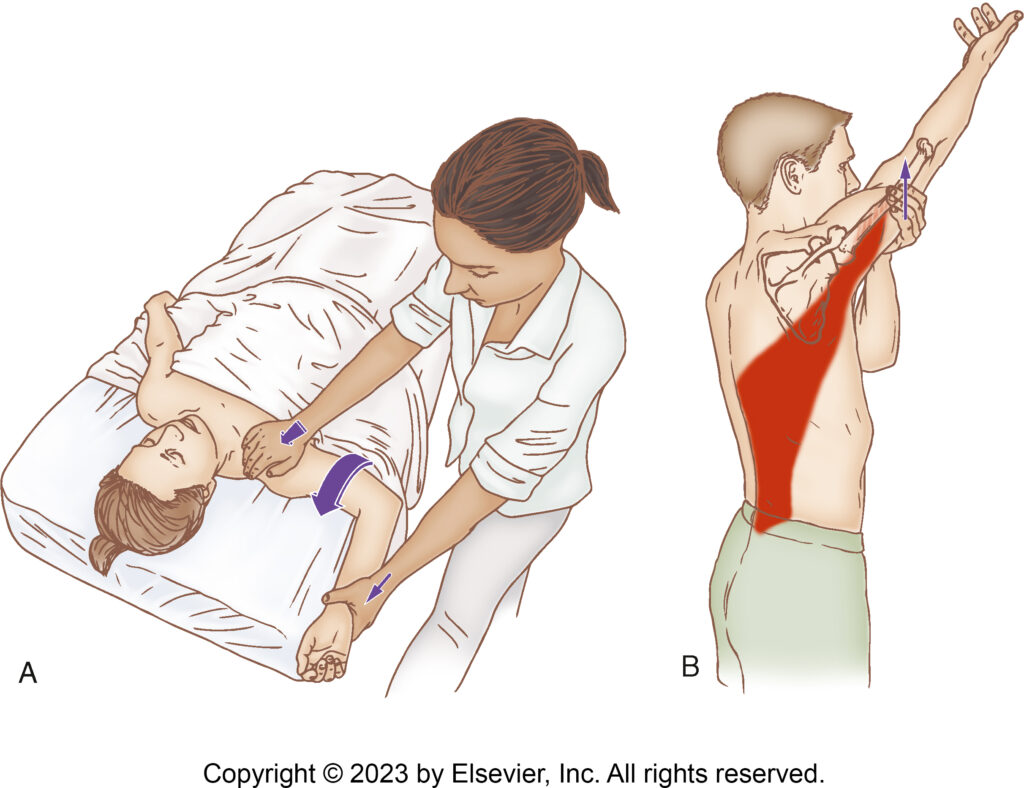
Stretching the teres major. In the therapist-assisted protocol, note the stabilization contact on the scapula. Permission Dr. Joe Muscolino – The Muscle and Bone Palpation Manual 3ed.
Stretching a muscle is making it longer, which is simply doing the opposite of the muscle’s concentric/shortening joint action functions. The teres major is a medial rotator of the arm at the shoulder joint, so it will be stretched with lateral rotation. If flexion and/or abduction can be added, it better targets the teres major given it is also an extensor and adductor.
Massaging the Teres Major
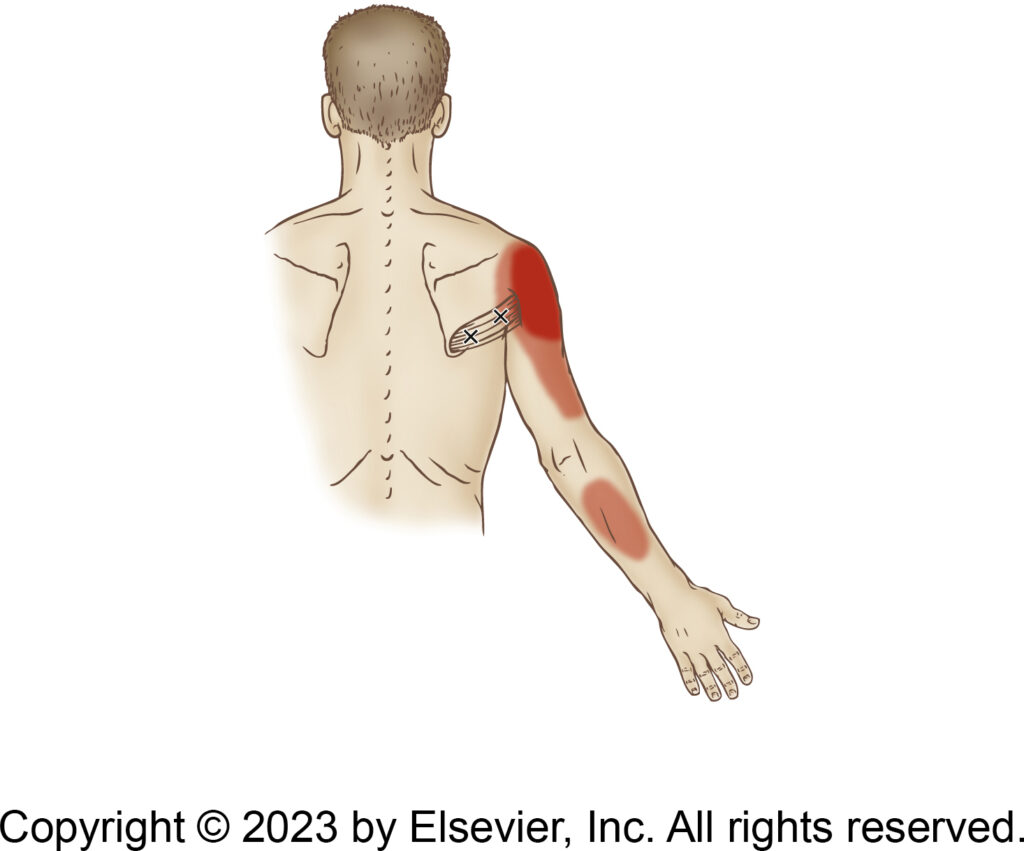
Teres major trigger points and their referral zones. Permission Dr. Joe Muscolino – The Muscle and Bone Palpation Manual 3ed.
The majority of the teres major is superficial so can be easily massaged. Longitudinal strokes can be done from proximal to distal (scapula toward the humerus). Cross-fiber strokes can also be done by strumming across the muscle perpendicularly, usually from inferior to superior.
Frequently Asked Questions About the Teres Major
What does the teres major do? The teres major extends, adducts, and medially rotates the arm at the shoulder joint.
Where does the teres major attach? It attaches proximally onto the inferior angle and inferior 1/3 of the lateral border of the scapula, and attaches distally onto the medial lip of the bicipital groove of the humerus.
What is the difference between teres major and teres minor? The teres minor is part of the rotator cuff and attaches superior to the teres major on the lateral border of the scapula. The teres major is not a rotator cuff muscle.
Is the teres major the same as the lat? No — but they both attach onto the lateral border of the scapula and onto the medial lip of the bicipital groove of the humerus… and share the same shoulder joint actions (extension, adduction, and medial rotation).
Conclusion
The teres major is a muscle that often does not get the respect it deserves because it is next to the more well-known latissimus dorsi (lat). The lat might cover a larger surface area of the body, but in the posterior axillary fold of tissue, the teres major is actually quite a bit larger than the lat. For this reason, I like to call the teres major the lat’s big brother.
Biography

Dr. Joseph Muscolino, DC is a soft-tissue oriented chiropractic physician and leading educator in manual and movement therapy. He is the author of eight major textbooks published by Elsevier and LWW, translated into more than 10 languages and used worldwide in core curriculum and clinical practice. A global lecturer and NCBTMB-approved CE provider, he offers COMT (Clinical Orthopedic Manual Therapy) certification workshops across the US and internationally. Visit his website at: LearnMuscles.com.
LearnMuscles Continuing Education (LMCE) is one of his online subscription platforms with over 4,000 video lessons for manual and movement therapy professionals, and more than 320 free NCBTMB-CE hours.