
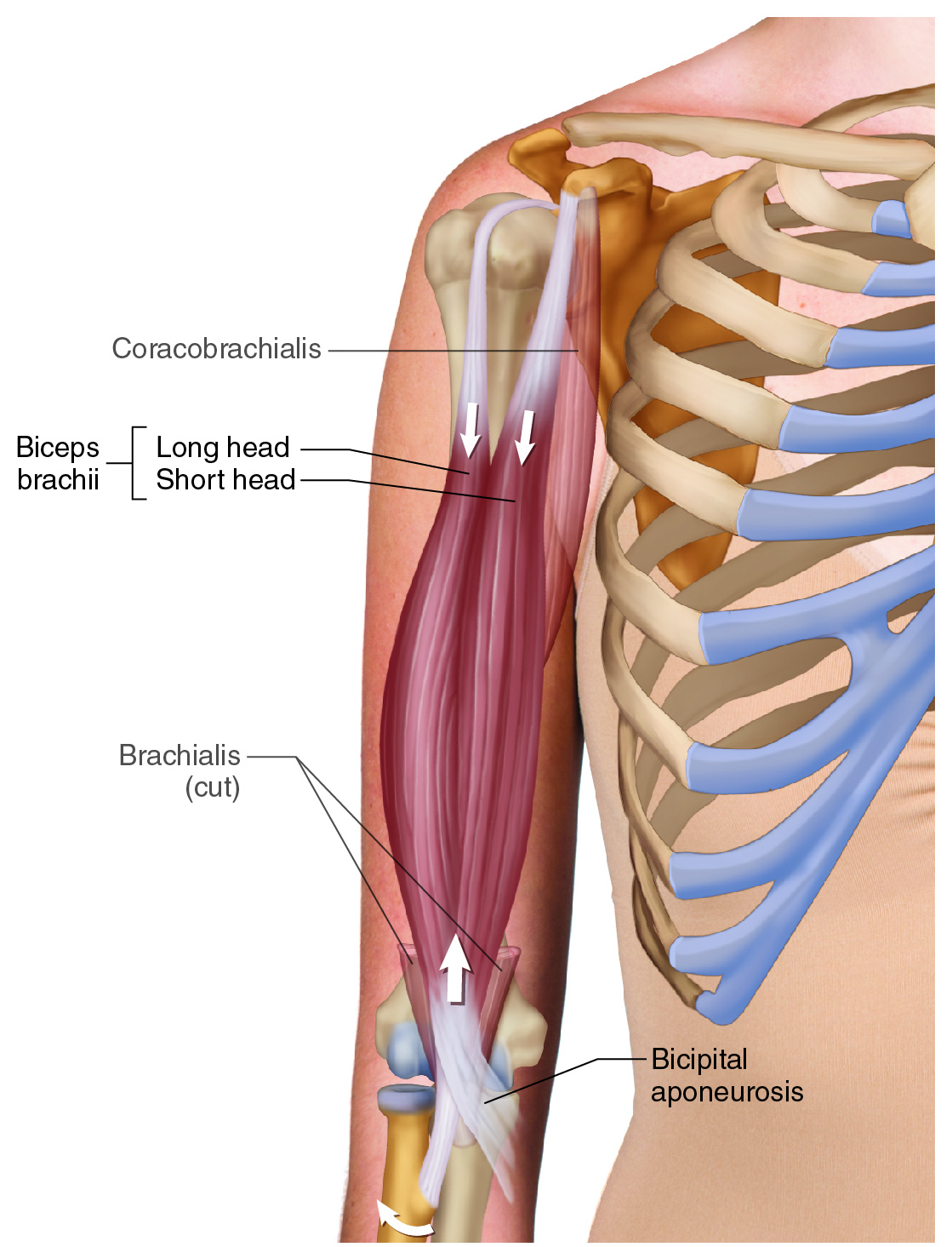
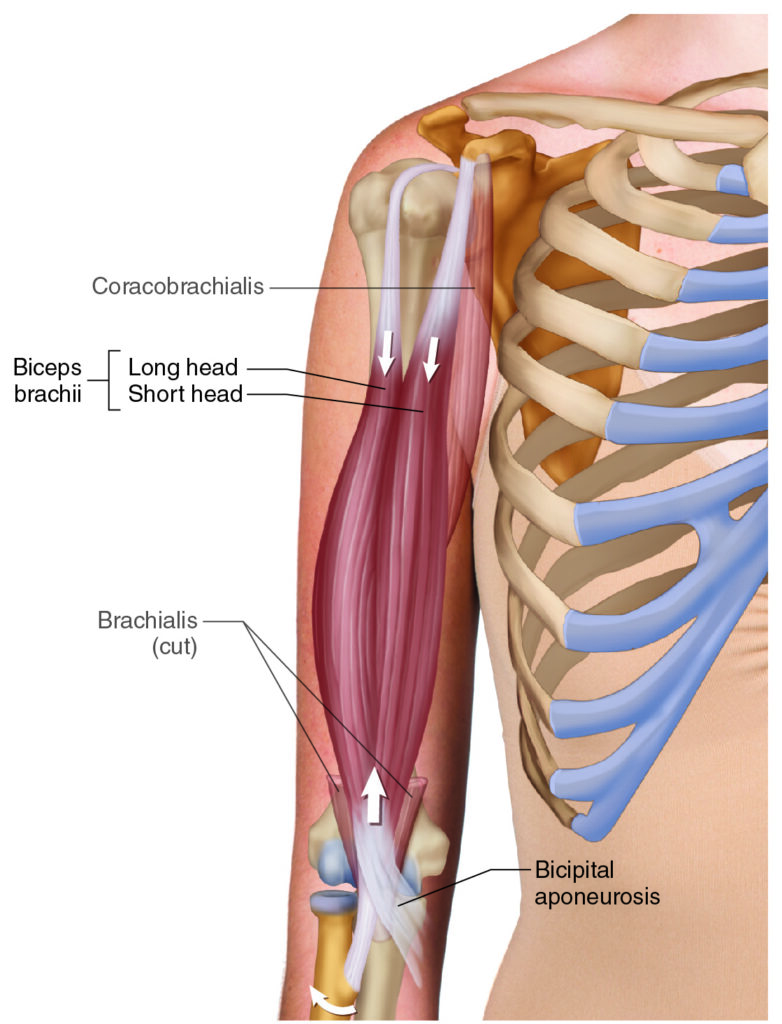
Permission Dr. Joe Muscolino (learnmuscles.com).
Quick Review: The biceps brachii is a two-headed muscle of the (upper) arm that flexes the elbow, supinates the forearm, and assists shoulder flexion. It attaches proximally to the scapula and distally to the radius. Despite its fame, the deeper brachialis muscle is likely the stronger elbow flexor — it pushes the biceps outward, making it appear larger.
Introduction
There is no muscle in the human body more famous than the biceps brachii, the muscle of popeye-fame. When a person wants to show how strong they are, it is the biceps brachii that they contract and show… they show their guns. The irony is that the biceps brachii is likely not even the most powerful muscle at its main joint action function, flexion of the forearm at the elbow joint; that prize falls to the brachialis. The biceps can be big and strong, but it gets so much attention because the large and powerful brachialis that is located deep to it pushes it outward, making it look even larger. I like to say…
Behind every great biceps brachii is a great brachialis.
Biceps Brachii Attachments
The biceps brachii attaches proximally onto the scapula (its origin) and distally onto the radius (its insertion).
More specifically, the biceps brachii attaches from the…
coracoid process (short head) and supraglenoid tubercle (long head) of the scapula
to the
radial tuberosity (and also the bicipital aponeurosis overlying the common flexor belly/tendon)
| Attachment Point | Location |
|---|---|
| Proximal (Origin) – Short Head | Coracoid process of the scapula |
| Proximal (Origin) – Long Head | Supraglenoid tubercle of the scapula |
| Distal (Insertion) | Radial tuberosity; bicipital aponeurosis |
Biceps Brachii Functions
The biceps brachii crosses the elbow joint anteriorly with a vertical direction to its line of pull, so it flexes the elbow joint. Open-chain, it flexes the forearm at the elbow joint.
The biceps brachii attaches onto the radius, so it also exerts a force across the radioulnar joints such that if the forearm is first pronated, the biceps brachii can supinate the forearm at the radioulnar joints.
Both heads of the biceps brachii also cross the shoulder joint, anteriorly with a vertical direction to their line of force, so both heads can flex the arm at the shoulder joint.
But the short head also crosses the shoulder joint medially, so it can adduct the arm at the shoulder joint, whereas the long head also crosses it laterally, so it can abduct the arm at the shoulder joint.
Closed-Chain
When we look at closed-chain mechanics in which the hand is holding onto a stable/fixed object, the distal attachment of the biceps brachii (the forearm) can no longer move, so concentric contraction would cause the proximal attachment to move instead. Across the elbow joint, this would cause the arm to flex at the elbow joint. The quintessential example of this would be performing a pull up. Everyday examples in life would be having someone give you a hand up when you are seated; or using the railing to help pull yourself up the stairs.
Summary of biceps brachii functions:
- Flexion of the forearm at the elbow joint (open-chain)
- Flexion of the arm at the elbow joint (closed-chain)
- Supination of the forearm at the radioulnar joints
- Flexion of the arm at the shoulder joint (both heads)
- Adduction of the arm at the shoulder joint (short head)
- Abduction of the arm at the shoulder joint (long head)
Nearby Anatomy
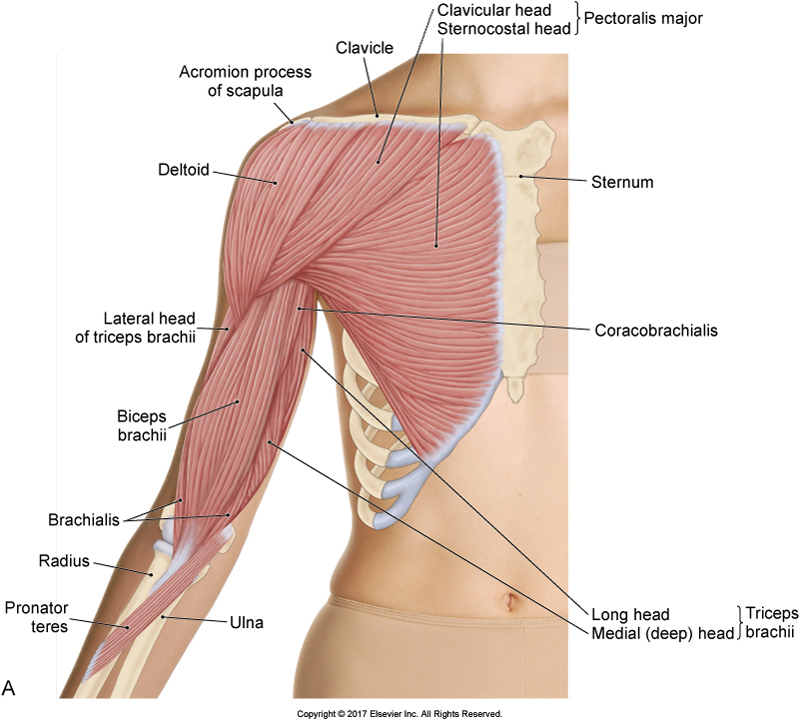
Superficial view. Permission Dr. Joe Muscolino – The Muscular System Manual 5ed.
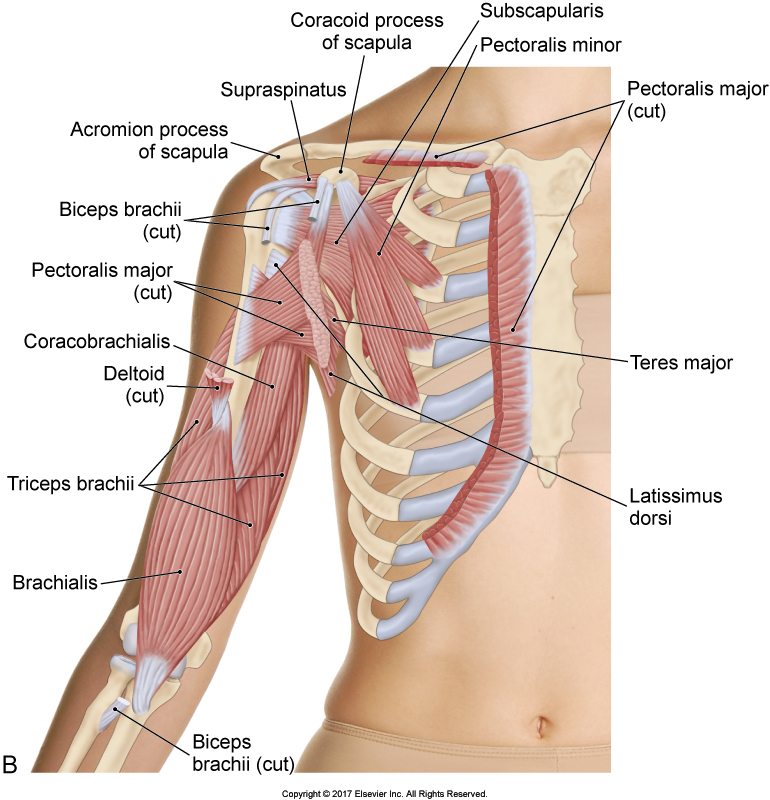
Deep view. Permission Dr. Joe Muscolino – The Muscular System Manual 5ed.
From the anterior perspective, the biceps brachii lies superficial to the brachialis. Its short-head proximal attachment is onto the coracoid process of the scapula along with the coracobrachialis and pectoralis minor; indeed, the belly of the short head always blends with the coracobrachialis muscle. The long head is one of only two muscles in the human body that run intra-articularly; the long head proximal tendon runs within the glenohumeral joint cavity to arrive at the supraglenoid tubercle of the scapula. Distally, the biceps brachii attaches onto the radial tuberosity, whereas the brachialis attaches distally onto the ulnar tuberosity.
Role in Shoulder Impingement Syndrome
The long head of the biceps brachii runs between the head of the humerus and the acromion process of the scapula, along with the distal tendon of the supraspinatus and the subacromial (aka subdeltoid) bursa. Because one or several of these tissues are so often compressed between the two bones, the term shoulder impingement syndrome is used to describe compression of these tissues in this vulnerable space.
Palpating the Biceps Brachii
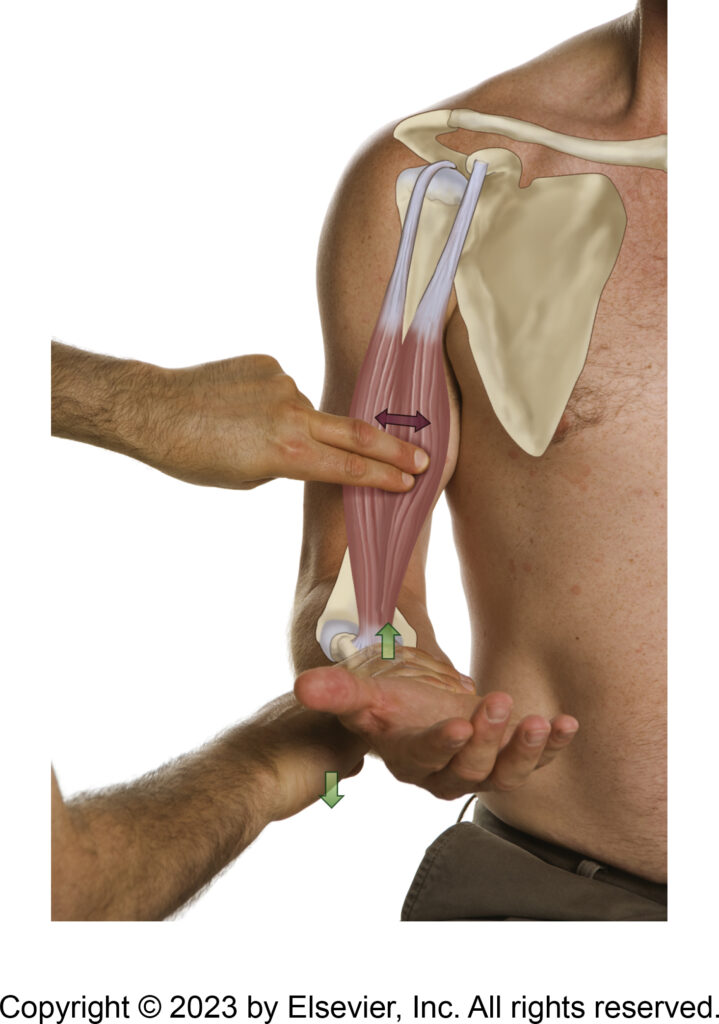
Permission Dr. Joe Muscolino – The Muscle and Bone Palpation Manual 3ed.
The biceps brachii belly and distal tendon are superficial and easy to palpate and discern from adjacent tissue. Begin mid-belly, dead-center anteriorly, on the (upper) arm. Ask the client to flex the fully-supinated forearm at the elbow joint against your resistance (on the distal forearm, not on the hand) and you will feel the biceps brachii engage and harden. Ask the client to relax and feel it relax and soften. Then move a baby step distally and ask them to contract and relax again. Repeat this process until you have reached the attachment on the radius.
Return to the initial starting point and repeat this process proximally. Because the short and long heads go deep to the pectoralis major and deltoid respectively, they are more challenging to palpate and discern; but can be done. Be sure that apart from the elbow joint flexion, the client’s upper extremity is relaxed.
Note: Both the biceps brachii and brachialis are located and palpated with engagement of flexion of the forearm at the elbow joint. But to discern between them, it is best to use forearm supination and pronation. Supination for engagement of the biceps brachii and pronation for engagement of the brachialis.
Stretching the Biceps Brachii
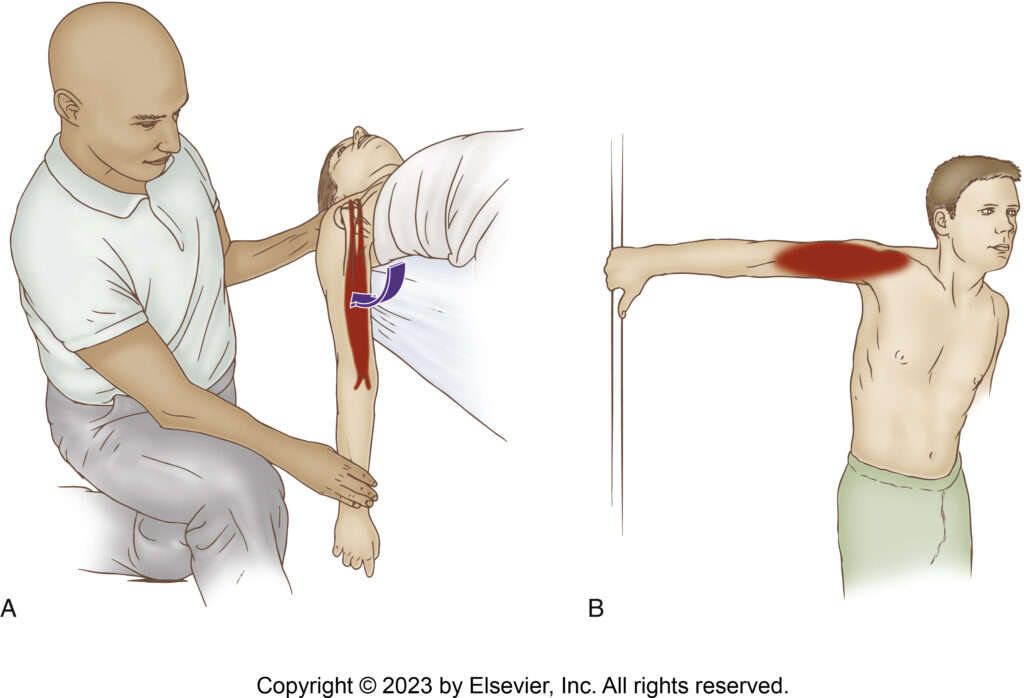
Stretching the biceps brachii. Permission Dr. Joe Muscolino – The Muscle and Bone Palpation Manual 3ed.
Stretching a muscle is performed by doing the opposite of its joint actions because joint actions are concentric shortening functions. So, to stretch the biceps brachii, the client’s elbow joint should be fully extended, with the forearm fully pronated; further, the arm at the shoulder joint should simultaneously be extended. To focus the stretch on the short head, add in abduction of the arm; to focus the stretch on the long head, add in adduction of the arm.
Massaging the Biceps Brachii
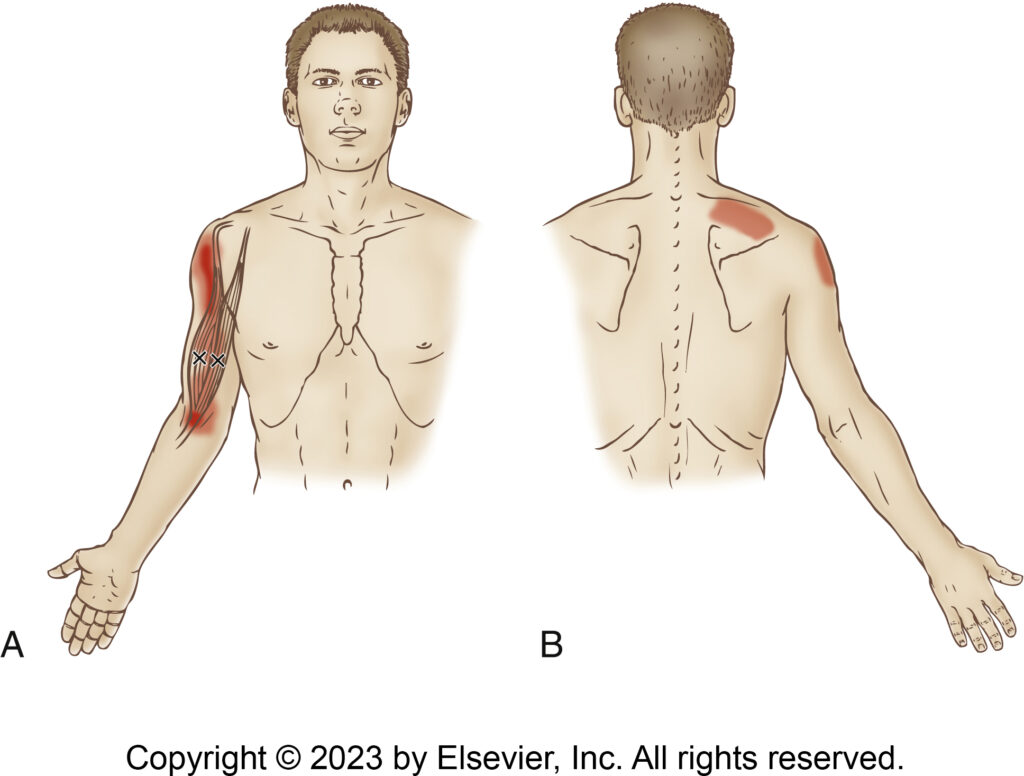
Biceps brachii trigger points and their referral zones. Permission Dr. Joe Muscolino – The Muscle and Bone Palpation Manual 3ed.
Massaging the biceps brachii follows from the palpation protocol. It can be massaged with longitudinal strokes, from proximal-to-distal or distal-to-proximal. Cross fiber work can be done as well; but be aware when you are at its medial border, the median and ulnar nerves as well as the brachial artery are nearby. Working the proximal tendons deep to other musculature is usually best done with short perpendicular cross-fiber strokes.
Conclusion
The biceps brachii is a strong and powerful muscle but often seems larger and more powerful than it really is because the underlying brachialis pushes it outward.
Behind every great biceps brachii is a great brachialis.
Biography

Dr. Joseph Muscolino, DC is a soft-tissue oriented chiropractic physician and leading educator in manual and movement therapy. He is the author of eight major textbooks published by Elsevier and LWW, translated into more than 10 languages and used worldwide in core curriculum and clinical practice. A global lecturer and NCBTMB-approved CE provider, he offers COMT (Clinical Orthopedic Manual Therapy) certification workshops across the US and internationally. Visit his website at: LearnMuscles.com.
LearnMuscles Continuing Education (LMCE) is one of his online subscription platforms with over 4,000 video lessons for manual and movement therapy professionals, and more than 320 free NCBTMB-CE hours.