
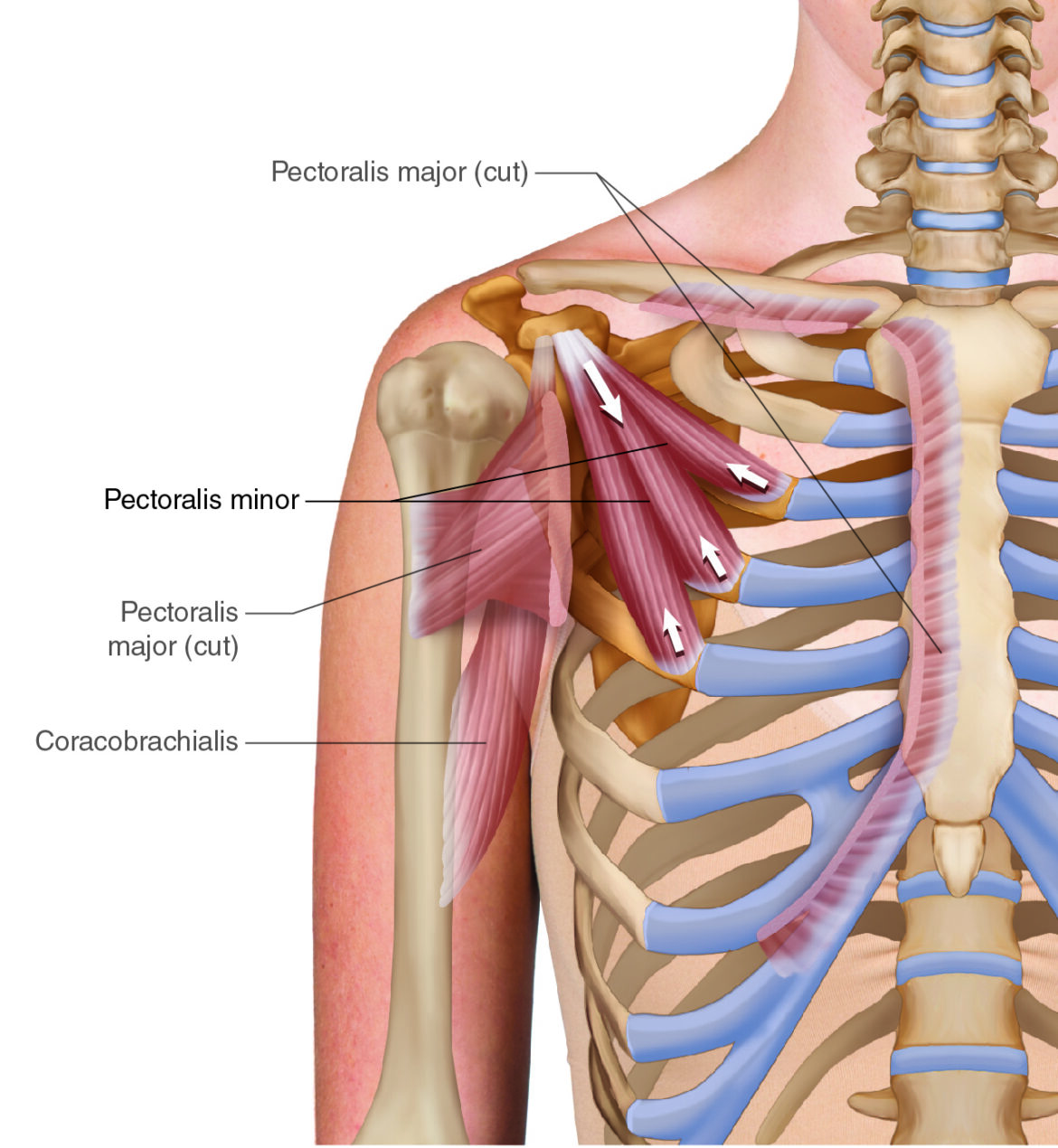
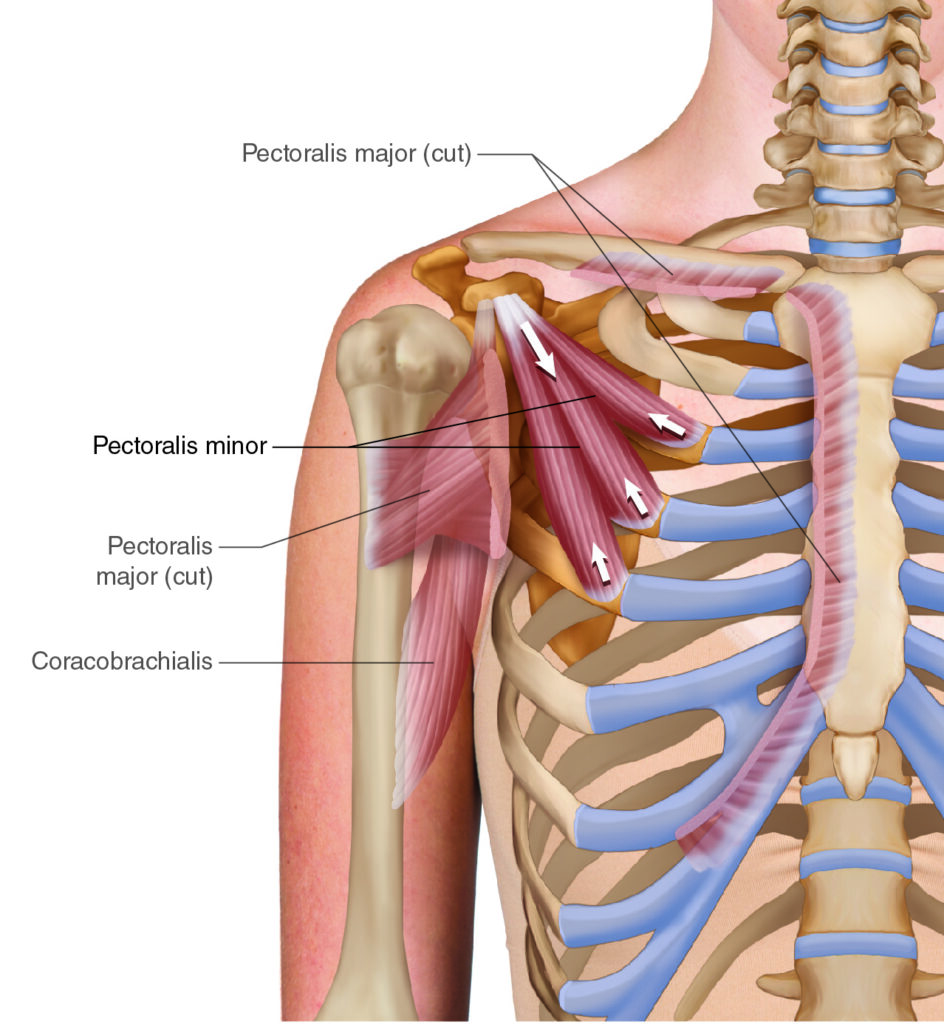
Pectoralis Minor – anterior view
What is the Pectoralis Minor? | Anatomy | Functions | Upper Crossed Syndrome | Thoracic Outlet Syndrome | Palpation | Stretching
Introduction
The pectoralis minor is a fascinating muscle located in the chest, immediately deep to the pectoralis major from an anterior view. One of the reasons it is so fascinating is that it is involved in both upper crossed syndrome postural distortion pattern as well as thoracic outlet syndrome (pectoralis minor syndrome version). But on the positive side, the pec minor is one of the major muscles used when hugging a loved one 🙂
Quick Answer: What does the pectoralis minor do? The pectoralis minor protracts, depresses, and downwardly rotates the scapula — and elevates ribs #3–5 during inspiration when the scapular attachment is fixed.
Pectoralis Minor Attachments
The pec minor attaches distally from the:
- Coracoid process of the scapula (distal attachment / insertion)
- Ribs #3–5 (proximal attachment / origin)
Although there are some variants in which it attaches instead to ribs #2–4 or even #2–5.
For a set of high-res muscle images that can be downloaded, click here.
Pectoralis Minor Functions
For joint actions, assuming the ribcage attachment is stable and the coracoid process/scapular attachment moves…
1. Scapular Protraction The coracoid process would be pulled anteriorly toward the rib attachment, therefore the pec minor protracts (sometimes known as abducts) the scapula at the scapulocostal/ScC (scapulothoracic/ScT) joint.
2. Scapular Depression The coracoid process would be pulled down toward the rib attachment, therefore the pec minor depresses the scapula at the ScC joint.
3. Scapular Downward Rotation Because of the angle of the pull on the coracoid process toward the rib attachment, the pec minor would pull on the scapula such that the inferior angle would lift up and out, which orients the glenoid fossa downward, hence the pec minor downwardly rotates of the scapula at the ScC joint.
So, the pec minor protracts, depresses, and downwardly rotates the scapula.
Now… if the scapular attachments were to be stable instead, the ribcage attachment would have to move instead…
4. Rib Elevation (Respiration) So, the ribcage attachment would lift up toward the coracoid process/scapular attachment, so the pec minor elevates ribs #3–5, which is important during inspiration (breathing in).
Nearby Anatomy
The pectoralis minor is one of three muscles that attach onto the coracoid process of the scapula. The other two are the short head of biceps brachii and the coracobrachialis. The pectoralis major superficially overlies the pec minor. The subclavius is also nearby.
Palpating the Pectoralis Minor
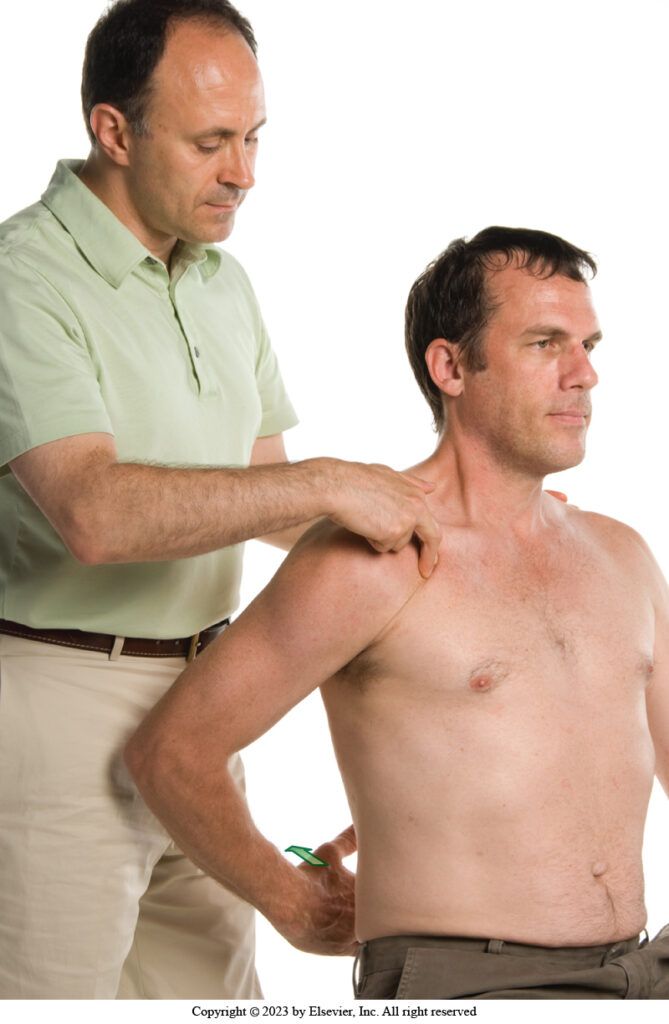
Seated Pec Minor palpation
To palpate the pectoralis minor, the most comfortable and efficient way is to palpate through the pectoralis major. Have the client seated with their hand in the small of their back (so their arm is adducted and extended at the glenohumeral/GH joint); this causes scapular downward rotation via what is called scapulohumeral rhythm. Now, find the concavity at the distal (lateral) end of the clavicle and drop immediately inferior off of it, and press posteriorly and slightly medially, feeling for the coracoid process of the scapula. Now drop immediately inferiorly off of the coracoid process and you will be on the tendon of the pec minor.
Ask the client to lift their hand away from the small of the back, causing active arm extension (while adducted), which will call upon the nervous system to downwardly rotated the scapula (again, via scapulohumeral rhythm), which will engage the pec minor because it is a scapular downward rotator. Strum perpendicularly and feel for the tension/tautness of the pec minor.
Now follow it toward ribs 3–5 in baby steps, at each point along the way, asking the client to first relax, and then actively bring the arm away from the back. Each time, you should feel the pec minor engage/pop. Continue until you reach each of the three rib attachments.
Notes:
- This can be done with the client supine with their hand under the small of their back; just ask them to push their hand down against the table, in effect, asking the arm to try to extend at the GH joint.
- Some therapists like to palpate the pec minor by approaching it laterally and going deep to the pec major. I believe that this protocol is only successful at palpating the lateral aspect of the pec minor, and is also usually uncomfortable for the client, so I do not recommend it.
Pectoralis Minor and Upper Crossed Syndrome
What is Upper Crossed Syndrome? Upper crossed syndrome, originally named by Czech physiologist, Vladimir Janda, describes a postural distortion pattern of the upper body in which…
- the thoracic spine is hyperkyphotic,
- the lower cervical spine is hypolordotic,
- the upper cervical spine (primarily the atlanto-occipital joint) is hyperlordotic (hyperextended),
- there is forward carriage of the head,
- the shoulder girdles are protracted,
- and the humeri are medially/internally rotated.
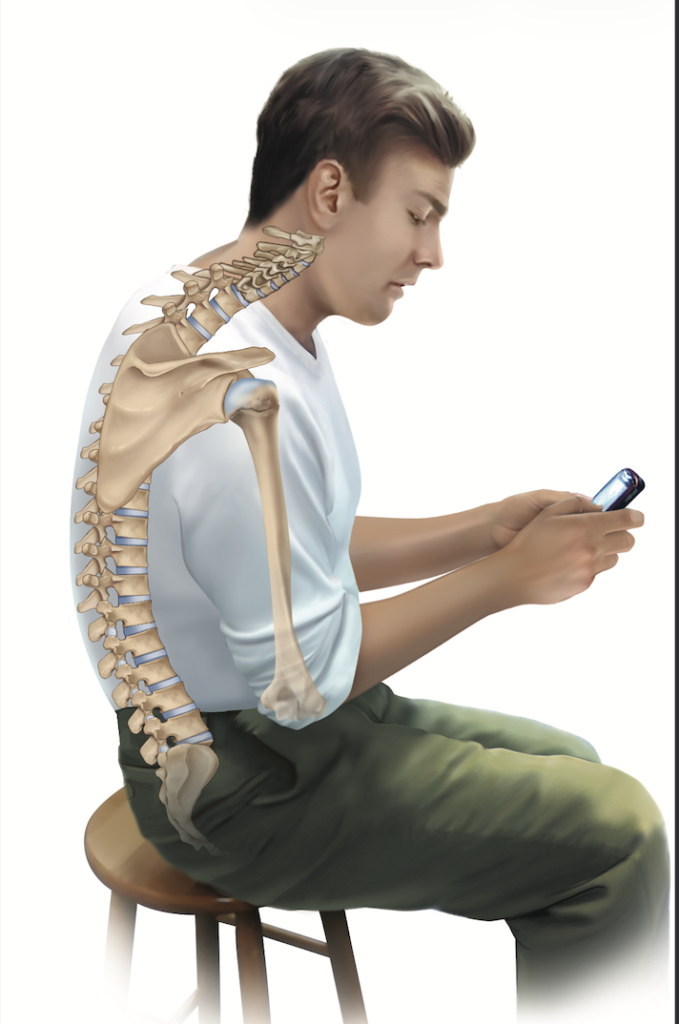
Upper Crossed Syndrome posture
The pec minor is integral to this condition in that it protracts the scapulae. Once upper crossed syndrome becomes entrenched in a person’s posture, the pec minor becomes locked short (hypertonic, overly facilitated, tight, dense). And with upper “crossed” syndrome, the rhomboids and middle trapezius on the other side of the scapula would be locked long. Locked short and locked long muscles are both tight (locked) and weak (by the length-tension relationship curve). But on the whole, because at baseline (resting) tone, the pec minor is tighter than the rhomboids/middle trap, the pec minor is more deserving of massage, heat, and stretching. And the rhomboids/middle trap are more deserving of being strengthened. In other words, address the imbalance by working everything, but focusing on loosening the protractors and strengthening the retractors of the scapula.
Pectoralis Minor and Thoracic Outlet Syndrome
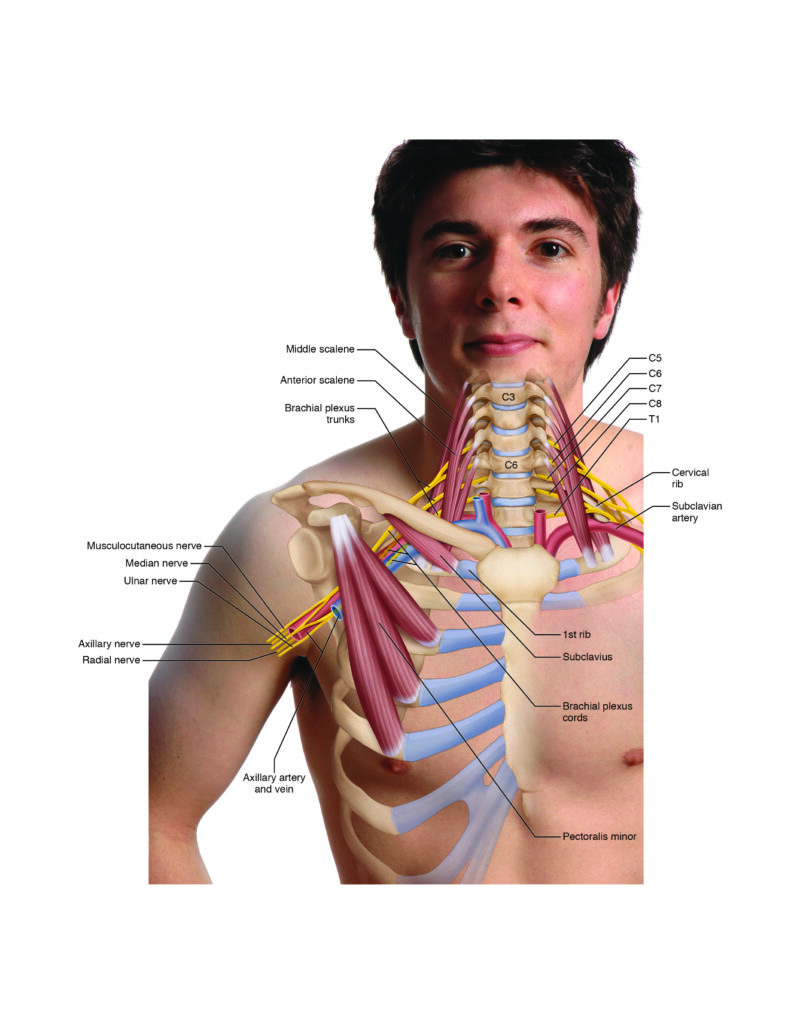
Thoracic Outlet Syndrome – anterior view of the anatomy
What is Pectoralis Minor Syndrome (TOS)? Given that the pec minor, when tight, is involved with the postural distortion pattern of upper crossed syndrome, it makes sense that the forward collapsing of the upper thoracic area (hyperkyphosis of the thoracic spine) would compress the neurovascular bundle that is located between the pec minor and the ribcage, hence thoracic outlet syndrome (TOS); and this particular type of TOS is called pectoralis minor syndrome. This neurovascular bundle is the brachial plexus of nerves, and the subclavian artery and vein. This neurovascular compression occurs both by the natural compression of collapsing forward and closing down on it, as well as by the tightness/hardness of the pec minor squeezing the neurovascular bundle against the ribcage. So, symptoms of TOS can cause sensory and motor signs and symptoms in the upper extremity (which, btw, can mimic a pathologic cervical disc as well as carpal tunnel syndrome in certain cases).
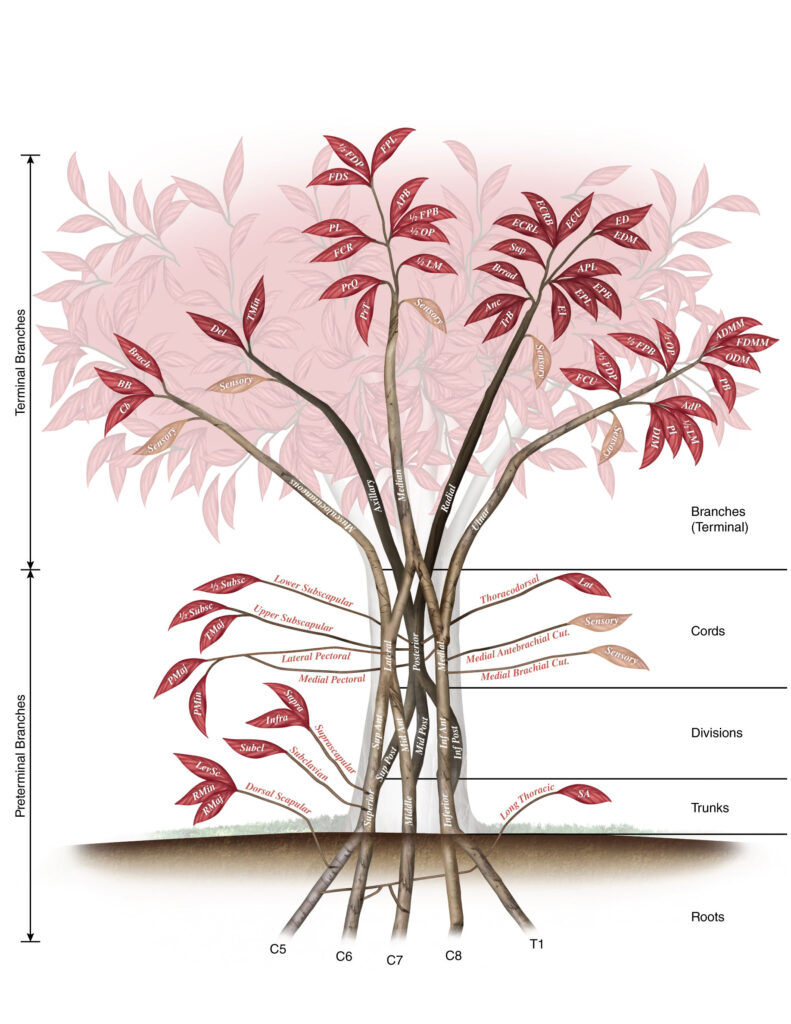
Brachial Plexus of Nerves envisioned as a tree
Assessing TOS Pectoralis Minor Syndrome
To assess for pec minor TOS syndrome, we can use the orthopedic assessment test known as Wright’s test. Have the client seated and find their baseline radial pulse strength (important! strength, not pulse rate/speed). Now slowly lift their arm up and back into extension with abduction. This pulls their scapula back into retraction, elevation, and upward rotation, thereby stretching the pec minor. This makes it more dense/hard and pulls it taut against the ribcage, thereby further squeezing the neurovascular bundle. If the strength of the radial pulse decreases, then we can extrapolate that the subclavian artery is being compressed, and we can further extrapolate that the brachial plexus of nerves, which surround the artery, is also being compressed. Thus, their upper extremity neurologic symptoms could be due to the pec minor.
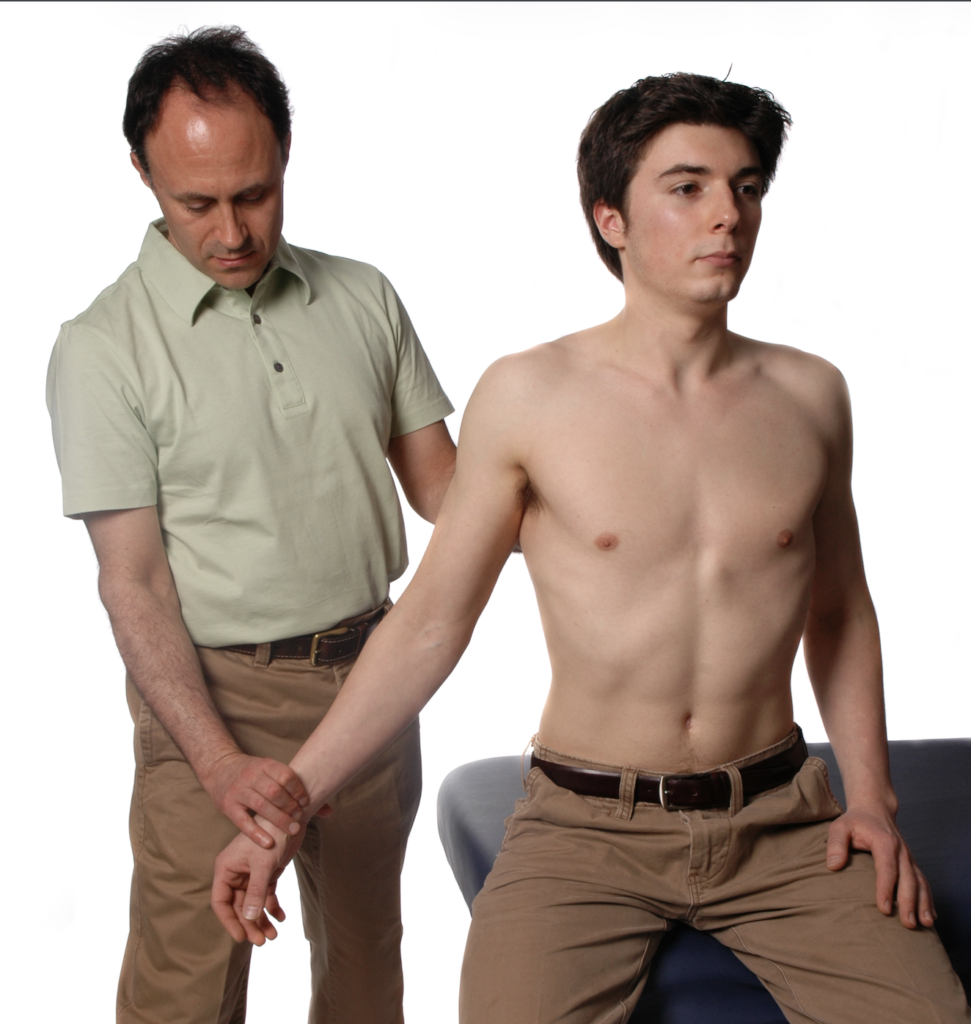
Wright’s Test – assessing baseline radial pulse strength
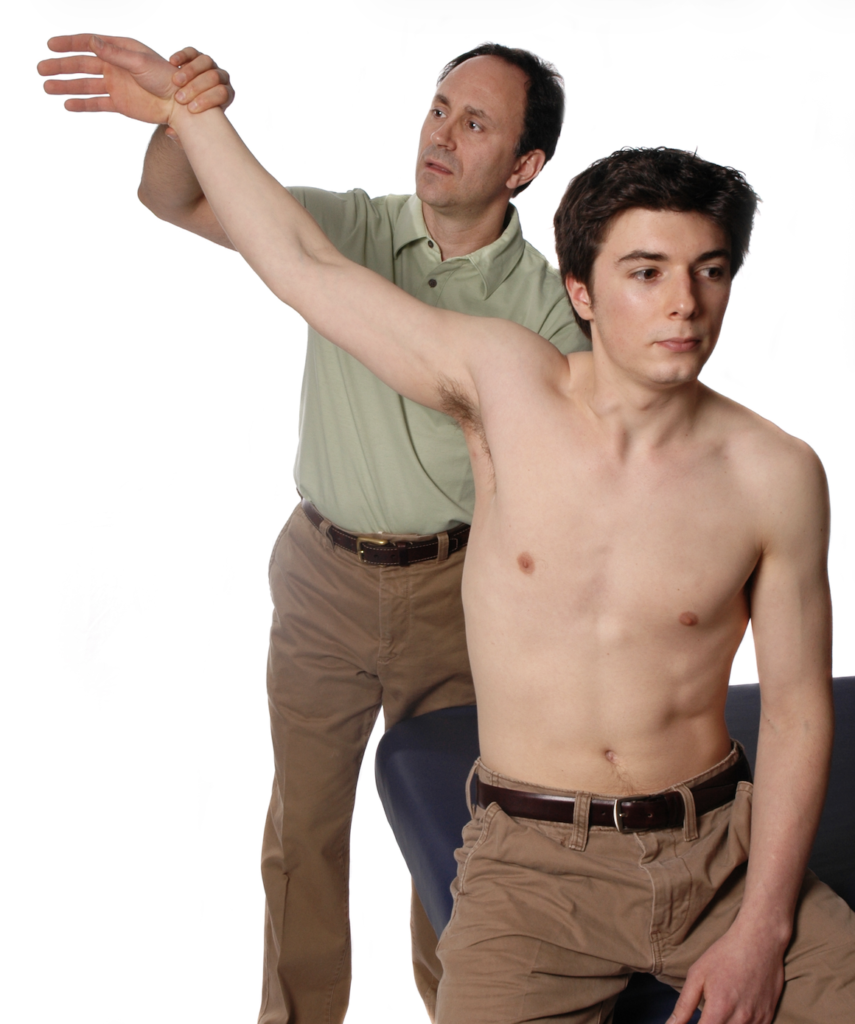
Wright’s Test for Pectoralis Minor Syndrome performed
Stretching the Pectoralis Minor
How do you stretch the pectoralis minor? The pec minor can be effectively stretched by bringing the person’s arm back into extension and abduction, thereby retracting, elevating, and upwardly rotating the scapula (the opposite of the pec minor’s concentric shortening joint-action functions), and making sure to stabilize the client’s trunk to stabilize the ribcage attachment. It is also helpful to bend their elbow joint to knock the biceps brachii out of the stretch so it doesn’t stop the stretch from reaching the pec minor.
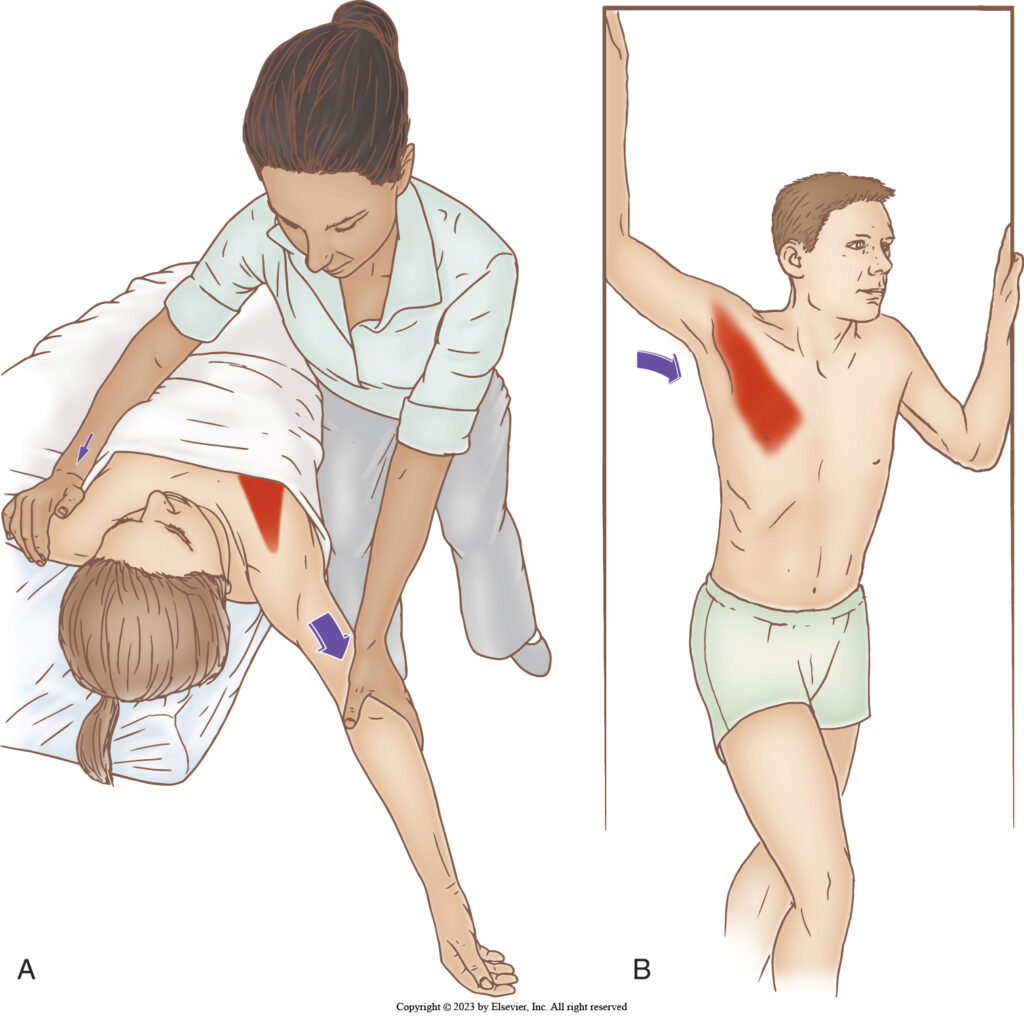
Stretching Pectoralis Minor – therapist-assisted & client self-care
Massage the Pectoralis Minor
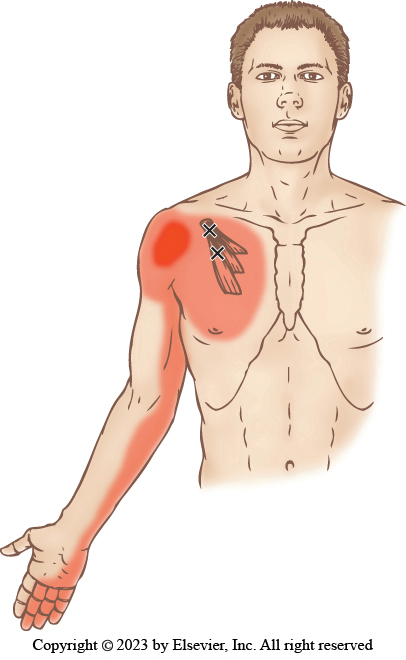
Pectoralis minor TrPs. Permission Dr. Joe Muscolino – Muscle and Bone Palpation Manual)
When palpation the pec minor, assess for tightness and/or myofascial trigger points (TrPs).
It is also extremely helpful to massage and heat the pec minor, especially before stretching it. Stretching is always safer and more effective if the tissue has first been warmed up.
Conclusion
The pec minor is one of the more important muscles to know when working with clinical orthopedic manual therapy (COMT). Its involvement with upper crossed syndrome and thoracic outlet syndrome makes this one of the more clinically-relevant muscles in the human body. But, the pec minor is note always a problem; it is a beautiful muscle in its own right. The next time you hug a friend or family member, remember that the pec minor is helping you do that, expressing your love for that person!

Dr. Joe Muscolino
Dr. Joseph Muscolino, DC is a soft-tissue oriented chiropractic physician and leading educator in manual and movement therapy. He is the author of eight major textbooks published by Elsevier and LWW, translated into more than 10 languages and used worldwide in core curriculum and clinical practice. A global lecturer and NCBTMB-approved CE provider, he offers COMT (Clinical Orthopedic Manual Therapy) certification workshops across the US and internationally. Visit his website at: LearnMuscles.com,
LearnMuscles Continuing Education (LMCE) is one of his online subscription platforms with over 4,000 video lessons for manual and movement therapy professionals, and more than 320 free NCBTMB-CE hours.