
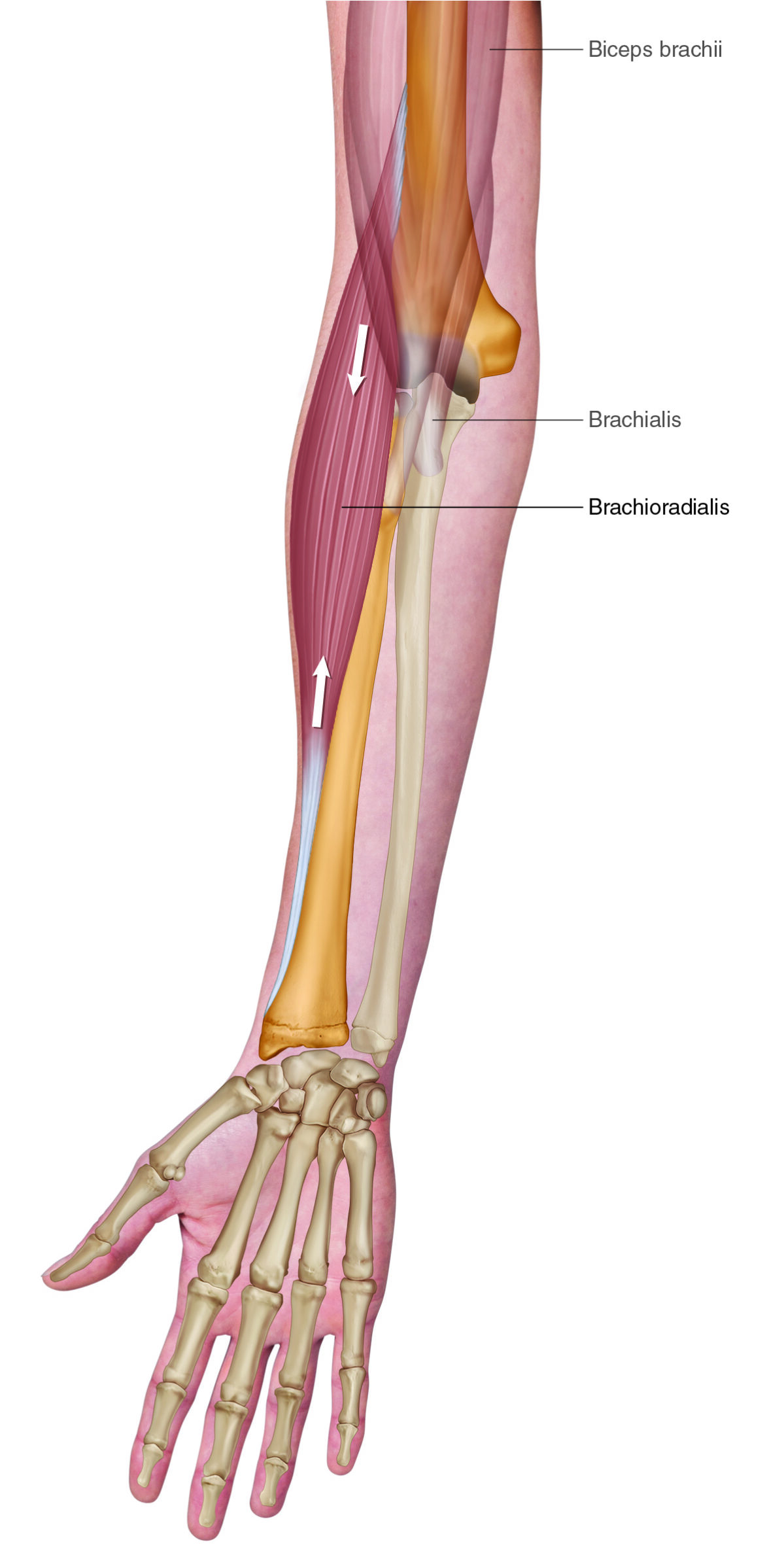
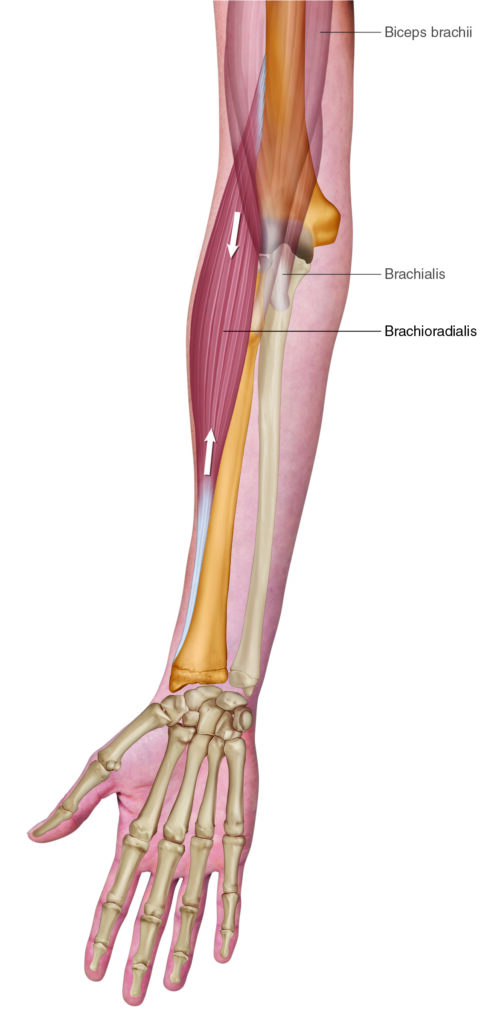
Brachioradialis. Permission Dr. Joe Muscolino (learnmuscles.com)
Introduction
The brachioradialis is a fascinating muscle in a number of ways. First, it is one of the three Bs of elbow joint flexion (biceps brachii, brachialis, brachioradialis). Second, it also crosses the radioulnar (RU) joints of the forearm so it is involved in pronation/supination. But the thing that I love the most about this muscle is that it is the quintessential example of a muscle that can change its joint action with a change in the position of the joint, which opens us up for a wonderful exploration of muscle mechanics (kinesiology)!
Brachioradialis Attachments
The brachioradialis attaches proximally onto the lateral humerus (origin) and distally onto the distal lateral radius (insertion).
More specifically, it runs from the…
Proximal 2/3 of the lateral supracondylar ridge of the humerus
to the
Styloid process of the radius
Brachioradialis Functions
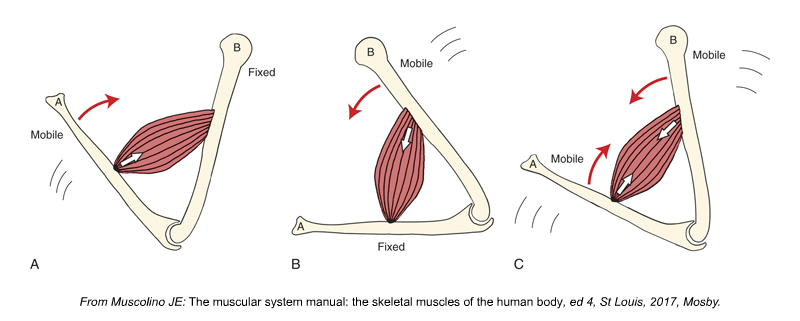
Open-chain and closed-chain (standard and reverse actions) illustrated. Permission Dr. Joe Muscolino – Kinesiology – The Skeletal System and Muscle Function, 4ed.
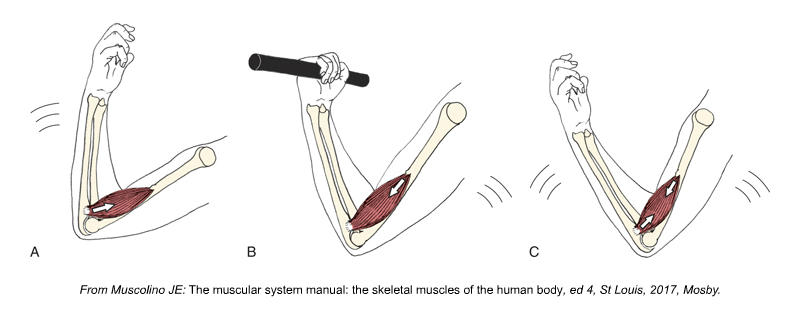
Open-chain and closed-chain elbow joint flexion (with the brachialis as the flexor muscle shown). Permission Dr. Joe Muscolino – Kinesiology – The Skeletal System and Muscle Function, 4ed.
Open-Chain
The brachioradialis crosses the elbow joint anteriorly so it flexes the forearm at the elbow joint.
When in anatomic position (the forearm is fully supinated), the brachioradialis crosses the radioulnar (RU) joints such that it pronates the forearm at the RU joints.
But when the forearm is fully pronated, it supinates the forearm at the RU joints.
Closed-Chain
When the upper extremity is in closed-chain position, i.e., the distal end, the hand, is fixed/stable (usually because it is holding onto an immovable object), the proximal attachment of the brachioradialis moves toward the distal attachment, instead of the distal attachment moving toward the proximal one. In origin/insertion terminology, the origin moves toward the insertion instead of the insertion moving toward the origin, i.e., the humerus moves at the elbow joint toward the radius. It is still elbow joint flexion, but with the arm moving instead of the forearm. This can be called the closed-chain mechanics, or sometimes it is called the reverse action.
So, the brachioradialis flexes the arm at the elbow joint.
This is actually an extremely common movement. For example, when using a handrail to help you up the stairs, you are flexing your arm toward your forearm. Or, if you are sitting in a chair and someone offers a hand for you to grab to help you up, you are similarly flexing your arm at the elbow joint.
A terminology note here. When I teach muscle function, I always require my students to state three things: 1. The direction of motion, i.e., flexion, 2. The body part that is moving, i.e., the arm, and 3. The joint where movement is occurring, i.e., the elbow joint. So we say, flexion of the arm at the elbow joint.
Most often, people state only two of these three things. The direction of motion is always stated, i.e., flexion. But usually, only one of the other two is stated, either the body part or the joint, in other words, flexion of the arm or flexion of the elbow joint. But this can be misleading because saying flexion of the arm could be the typically-thought-of flexion of the arm at the shoulder joint, or it could be the closed-chain reverse action of flexion of the arm at the elbow joint that we are describing here. And saying flexion of the elbow joint could be the typical open-chain flexion of the forearm at the elbow joint, or it could be the closed-chain flexion of the arm at the elbow joint. So, to be fully clear and avoid any chance of miscommunication, I recommend always saying all three components: direction of motion, body part moving, joint where the movement occurs.
Why are we discussing closed-chain joint actions so much? Because they illustrate that a muscle does not pull only on one attachment. Rather, when a muscle contracts, it pulls equally on both attachments. This is also the reason why origin/insertion terminology is not optimal; it tends to bias the student/therapist to think that a muscle only acts open-chain.
A Muscle That Changes Its Joint Action – Kinesiology Exploration
But what I love about the brachioradialis, as we discussed above, is that it can pronate OR it can supinate the forearm.
Huh? The muscle has just one line of pull so how does it do this? It isn’t like the deltoid that has multiple lines of pull; the anterior deltoid can flex the shoulder joint whereas the posterior deltoid can extend it. The brachioradialis has only one line of pull, so how can it have two totally different joints actions?
The answer lies in the concept that a muscle’s joint action is based on its line of pull at the joint, and if the position of the joint changes, the muscle’s line of pull relative to the joint can change, and therefore its joint action can change! Wow!
To be more specific, the joint action is based on the line of pull relative to the axis through the joint in the plane of movement that we are discussing.
To explore how the brachioradialis’ joint action can change, we can start with the fundamental idea that when a muscle contracts and shortens, it pulls its two attachments closer to each other. So, when the forearm is fully supinated (as in anatomic position) and the brachioradialis contracts and shortens, the radial styloid is pulled closer to the lateral supracondylar ridge of the humerus (note: we are looking at this with open-chain mechanics here).
This will not only flex the forearm at the elbow joint, it will also pronate the forearm at the RU joints… but only halfway because that is the position that brings the two attachments the closest to each other that they can be.
BUT… if the forearm starts in a position of full pronation, then the brachioradialis would actually supinate the forearm, but only halfway; again, because this is position of maximal approximation of the two attachments.
What the brachioradialis wants to do at the RU joints (pardon the anthropomorphizing) is get the radius to a position that is halfway between full supination and full pronation. So, it pronates the fully-supinated forearm, but it supinates the fully-pronated forearm.
Terminology… When joint actions are listed in muscle atlases, as a rule, they are what are called anatomic actions, meaning they are the actions that the muscle creates when the body (or at least that region of the body) is in anatomic position.
A note of application… when exercising the elbow joint flexors with free-weight curls, to focus the exercise on the biceps brachii, the forearm should be fully supinated (biceps curl). But to focus the exercise on the brachioradialis, the forearm should be halfway between full supination and full pronation (hammer curl). And to focus the exercise on the brachialis, the forearm should be fully pronated (that explanation will be in the brachialis blog post article when it is written).
Trivia note: Another very well-known muscle that is famous for changing its joint action when the position of the joint changes is the piriformis. In anatomic position, it is a lateral rotator of the thigh at the hip joint. But when the thigh is flexed approximately 60 degrees or more, the piriformis becomes a medial rotator.
Nearby Anatomy
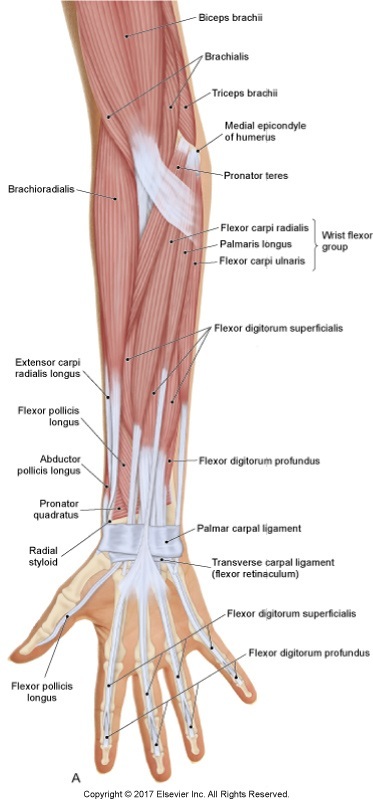
Anterior superficial view of the right forearm. Permission Dr. Joe Muscolino – The Muscular System Manual, 5ed.
The brachioradialis attaches to the proximal 2/3 of the lateral supracondylar ridge of the humerus; the extensor carpi radialis longus attaches to the distal 1/3 of the lateral supracondylar ridge. Posterior to the proximal end of the brachioradialis is the triceps brachii; anterior to the proximal end is the brachialis. In the forearm, the extensor carpi radialis longus lies posterior to the brachioradialis; anterior is the biceps brachii, then pronator teres, flexor digitorum superficialis, and then the flexor pollicis longus.
Palpating the Brachioradialis
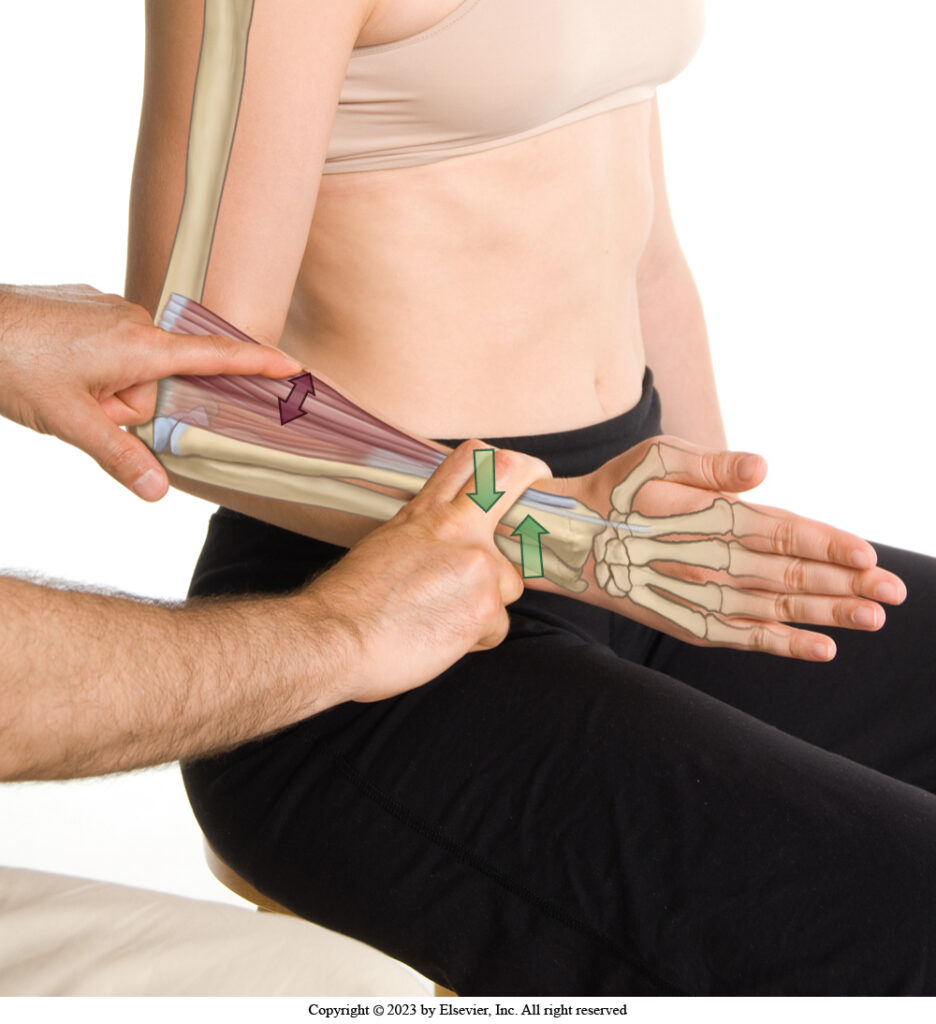
Palpation of the brachioradialis. Permission Dr. Joe Muscolino – The Muscle and Bone Palpation Manual, 3ed.
The brachioradialis is superficial for the entirety of its course and easy to palpate. Have the client’s forearm flexed at the elbow joint and in a position that is halfway between full supination and full pronation. Now contact the client’s distal lateral forearm and ask them to try to flex their forearm against your resistance and look and feel for the engagement of the brachioradialis.
As with the palpation of any structure that has a length to it, strum perpendicularly across the muscle as it is engaged. Then ask the client to relax and move a baby step farther distally along its course. Ask them to engage again, and strum perpendicularly across it again. Continue this process until the styloid process attachment is reached.
Stretching the Brachioradialis
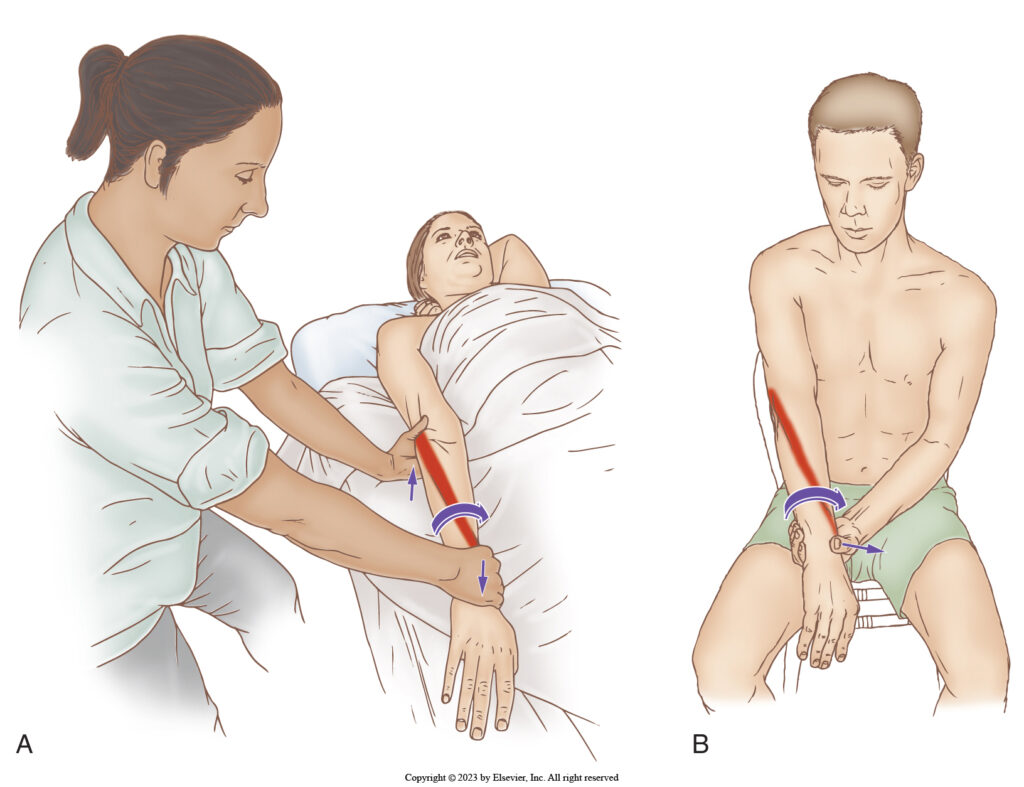
Stretching the brachioradialis. Permission Dr. Joe Muscolino – The Muscle and Bone Palpation Manual, 3ed.
Given that the brachioradialis flexes the elbow joint, it is best stretched with full elbow joint extension. Regarding RU joint supination/pronation, given it is shortest when the forearm is in the halfway position, the question is whether full supination or full pronation would be optimal to maximally lengthen it. Looking at the attachments, it turns out that full pronation would be optimal to best position the attachments as far away from each other as possible.
Massaging the Brachioradialis
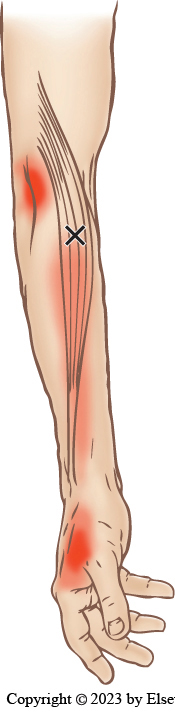
Brachioradialis trigger points and referral zones. Permission Dr. Joe Muscolino – The Muscle and Bone Palpation Manual, 3ed.
Being superficial, the brachioradialis is easy to massage. Strokes can be longitudinal (either proximal-to-distal or distal-to-proximal) or perpendicular, or in any direction you would like. As with any muscle, it can be worked on stretch (using the stretch position shown here), which places both massage and stretching forces into the tissue, but because the stretch pulls the muscle taut, it does not allow for access deeper into the tissue. Or it can be worked when slackened, by working it with the forearm flexed and in the halfway (supination/pronation) position, which does allow for deeper work into the tissue. Or it can be worked anywhere in between these two positions.
Conclusion
The brachioradialis is an important muscle of forearm flexion, working optimally when the forearm is in a position that is halfway between full supination and full pronation. But what makes the exploration of this muscle so fascinating is the opportunity to delve into conversations on muscle mechanics, both the idea of how a muscle can change its joint action with a change in the position of the joint, and the idea of closed-chain reverse actions.
Biography

Dr. Joseph Muscolino, DC is a soft-tissue oriented chiropractic physician and leading educator in manual and movement therapy. He is the author of eight major textbooks published by Elsevier and LWW, translated into more than 10 languages and used worldwide in core curriculum and clinical practice. A global lecturer and NCBTMB-approved CE provider, he offers COMT (Clinical Orthopedic Manual Therapy) certification workshops across the US and internationally. Visit his website at: LearnMuscles.com.
LearnMuscles Continuing Education (LMCE) is one of his online subscription platforms with over 4,000 video lessons for manual and movement therapy professionals, and more than 320 free NCBTMB-CE hours.