
What Is the Brachialis Muscle?
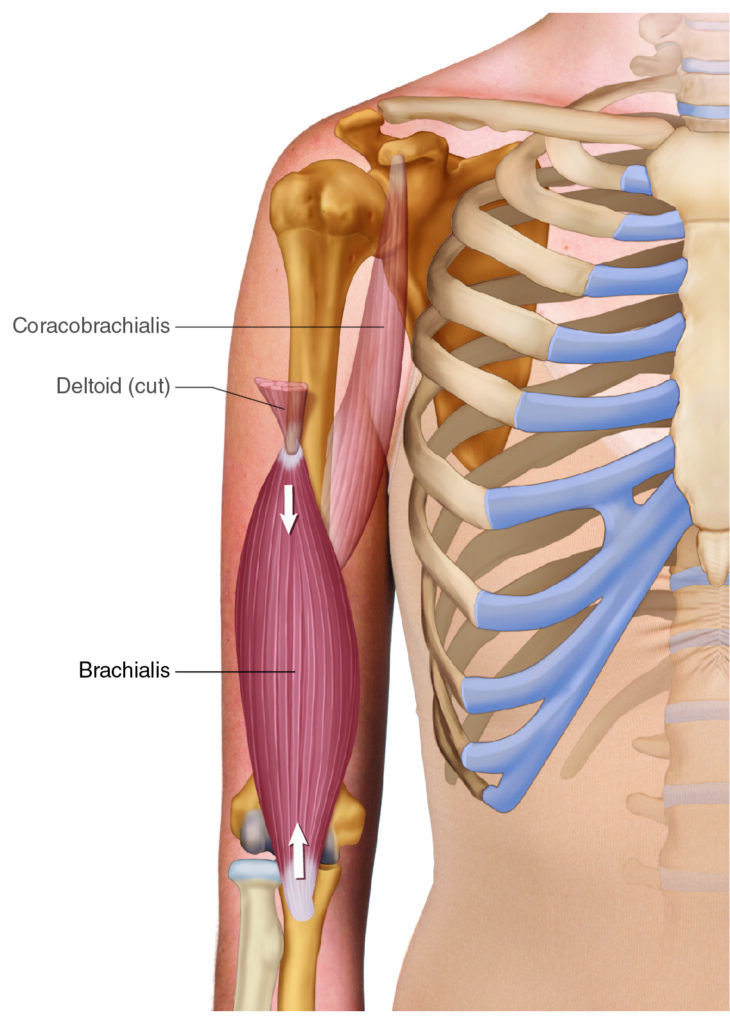
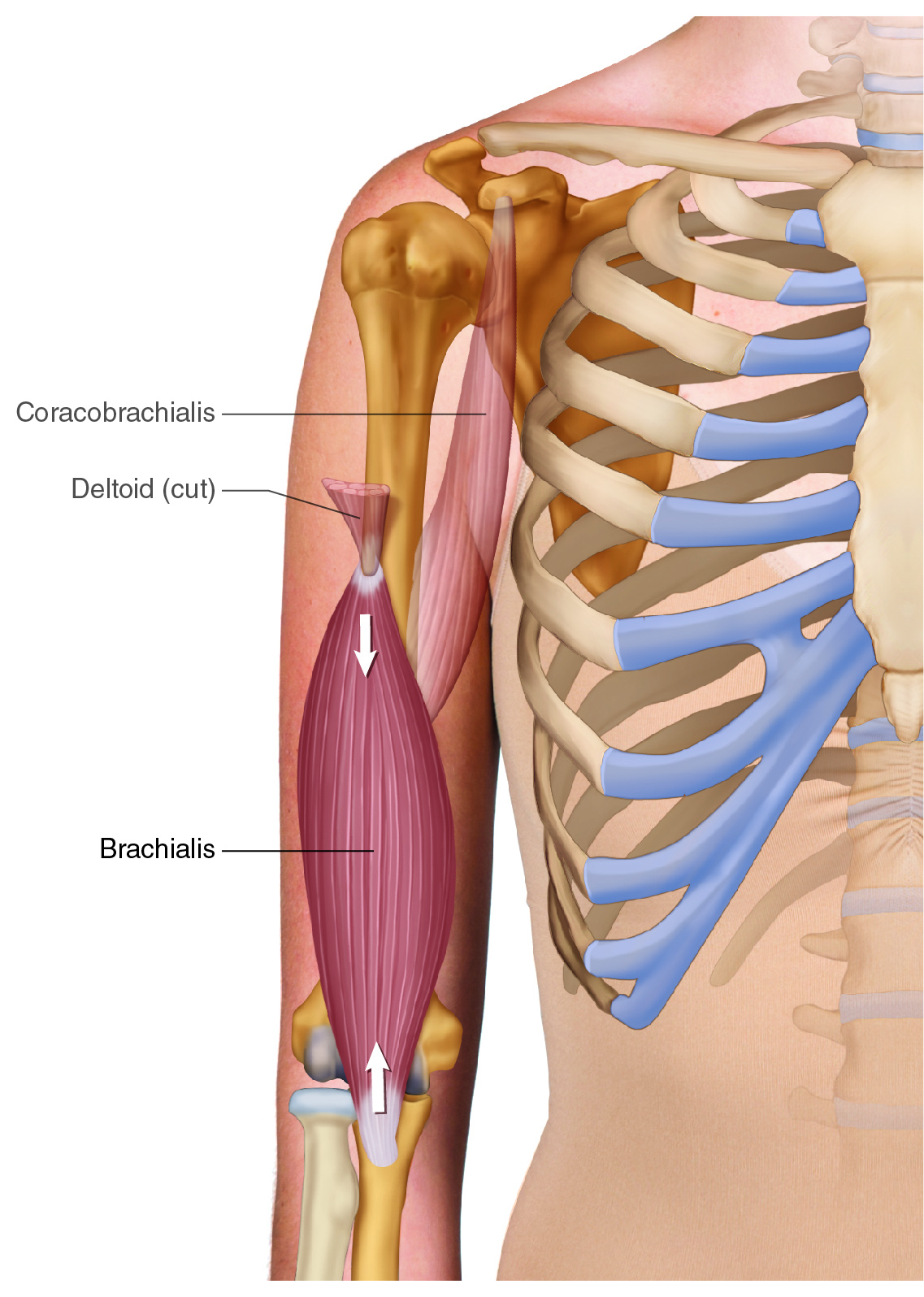
Brachialis. Permission Dr. Joe Muscolino (learnmuscles.com).
The brachialis muscle is in the anterior (upper) arm and one of the three big Bs of elbow joint flexion (biceps brachii, brachialis, brachioradialis). What I love about the brachialis is that it is the quintessential muscle to demonstrate muscle mechanics, in other words, kinesiology biomechanics of muscle function, because it crosses a uniaxial joint with one line of pull. It is also the perfect muscle to demonstrate closed-chain reverse actions. And it is a great muscle to demonstrate the idea that a muscle can be deep to other musculature from one perspective, but superficial from another.
Quick Answer: The brachialis is a muscle in the anterior arm that flexes the elbow joint. It attaches from the distal anterior humerus to the proximal anterior ulna, and is often larger and more powerful than the biceps brachii.
Note: In kinesiology terminology, there is no “upper arm.” The “arm” begins at the shoulder joint and ends at the elbow joint. The “forearm” begins at the elbow joint and ends at the wrist joint. The forearm is not part of the arm; the arm and forearm are entirely separate body parts. This is similar to the lower extremity in which the thigh is not part of the leg; they are entirely separate body parts (think of chicken thighs and legs).
Brachialis Muscle Attachments
The brachialis attaches from the humerus to the ulna.
More specifically from proximally on the distal anterior humerus (origin) and distally on the proximal anterior ulna (insertion).
Even more specifically, it runs from…
- the distal ½ of the anterior shaft of the humerus
to the
- ulnar tuberosity and the coronoid process of the ulna
Summary — Brachialis Attachments:
- Proximal: Distal ½ of the anterior shaft of the humerus
- Distal: Ulnar tuberosity and coronoid process of the ulna
Brachialis Muscle Functions
Open-Chain Function
The brachialis crosses the elbow joint anteriorly with a vertical direction to its line of pull, so it flexes the elbow joint. In open-chain mechanics, it flexes the forearm at the elbow joint by bringing the anterior surface of the forearm closer to the anterior surface of the arm. As mentioned above, because the elbow joint is a uniaxial (hinge) joint, and the brachialis has one line of pull, it is the simplest and purest demonstration of muscle function, and therefore the perfect example to use when first teaching and/or learning muscle function.
The brachialis flexes the forearm at the elbow joint.
Note: Because the brachialis attaches distally onto the ulna, the brachialis does not have any function with regard to forearm (radioulnar joint) pronation/supination. Whereas the other two big Bs of elbow joint flexion (biceps brachii and brachioradialis) attach onto the radius and are involved in forearm pronation/supination. Applying this knowledge allows us to understand how to distinguish between these three muscles when performing palpation assessment, and when performing stretching and strengthening treatment techniques for these muscles.
Closed-Chain Function (Reverse Action)
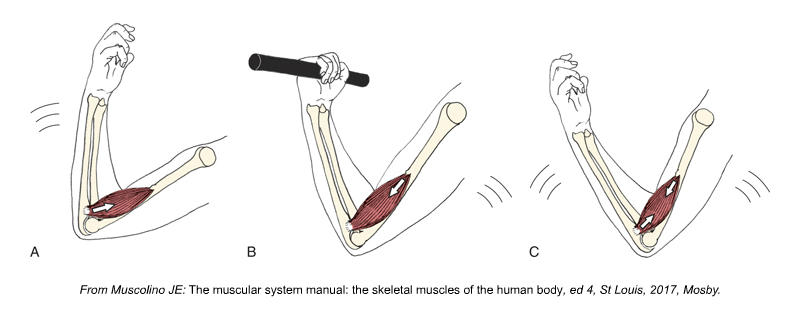
Open-chain and closed-chain elbow joint flexion (with the brachialis as the flexor muscle shown). Permission Dr. Joe Muscolino – Kinesiology textbook, 4ed.
Closed-chain mechanics occur when the distal attachment of a muscle is fixed/stable and therefore, cannot move. In the upper extremity, this usually occurs when the hand is holding onto an immovable object. If the distal attachment of a muscle cannot move when the muscle contracts, then the pulling force of the muscle contraction will play out on the proximal attachment, pulling it toward the distal one. A perfect example of this is when doing a pull-up… or when you are going upstairs and you hold onto and pull yourself up by using a banister.
In the upper extremity example of the brachialis, this means that the humerus (arm) will be pulled toward the ulna (i.e., the forearm). When the proximal attachment (the origin) moves toward the distal attachment (the insertion), we have the reverse of what we typically think of as the attachment that moves, so it can be called a reverse action. To sum up, closed-chain joint actions are reverse actions; these terms are synonymous.
Closed-chain reverse action of the brachialis is flexion of the arm at the elbow joint.
Regarding terminology, this term, reverse action, should not be confused with the term antagonist or antagonist action. The reverse action of brachialis contraction is still elbow joint flexion; what is reversed is the attachment that is moving (arm instead of forearm). Whereas, with an antagonist contraction, it is the motion that is reversed, in other words, the motion is elbow joint extension (instead of flexion).
Quick Answer — Brachialis Closed-Chain Action: When the hand is fixed (e.g., during a pull-up or gripping a banister), the brachialis pulls the humerus toward the ulna. This closed-chain reverse action still produces elbow joint flexion — but the arm moves toward the forearm, rather than the forearm toward the arm.
Nearby Anatomy
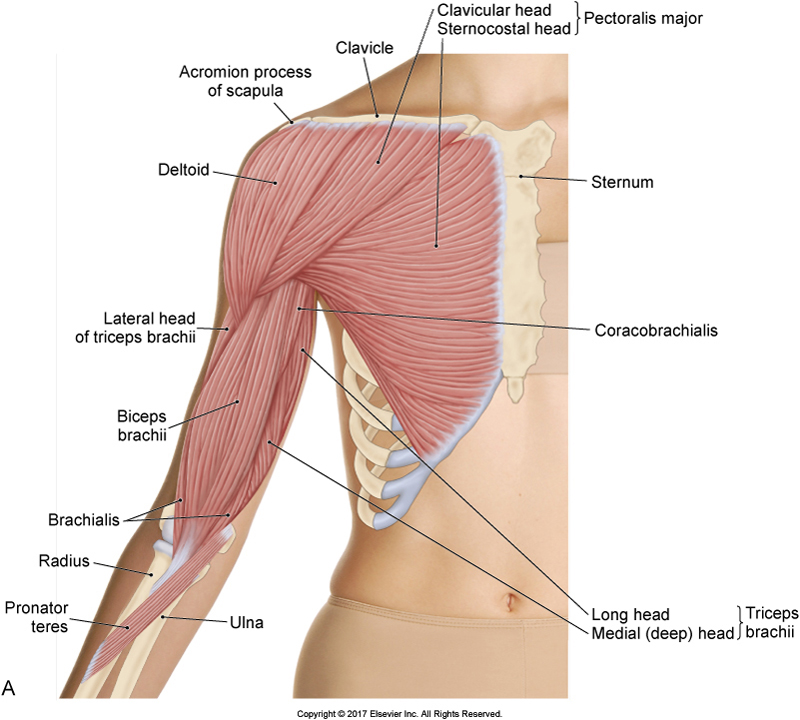
Anterior arm musculature – Superficial view. Permission Dr. Joe Muscolino – The Muscular System Manual 5ed.
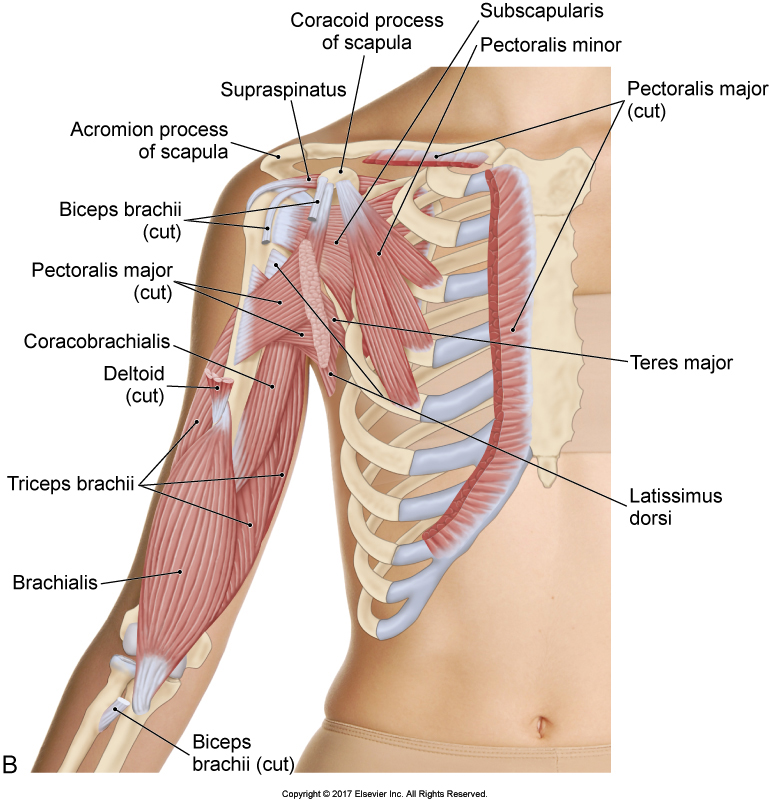
Anterior arm musculature – Deep view. Permission Dr. Joe Muscolino – The Muscular System Manual 5ed.
The brachialis is in the anterior arm along with the biceps brachii, coracobrachialis, anterior deltoid, pectoralis major distal attachment, and the proximal attachment of the brachioradialis (as well as the proximal attachments of a number of other muscles, including the muscles of the wrist flexor group).
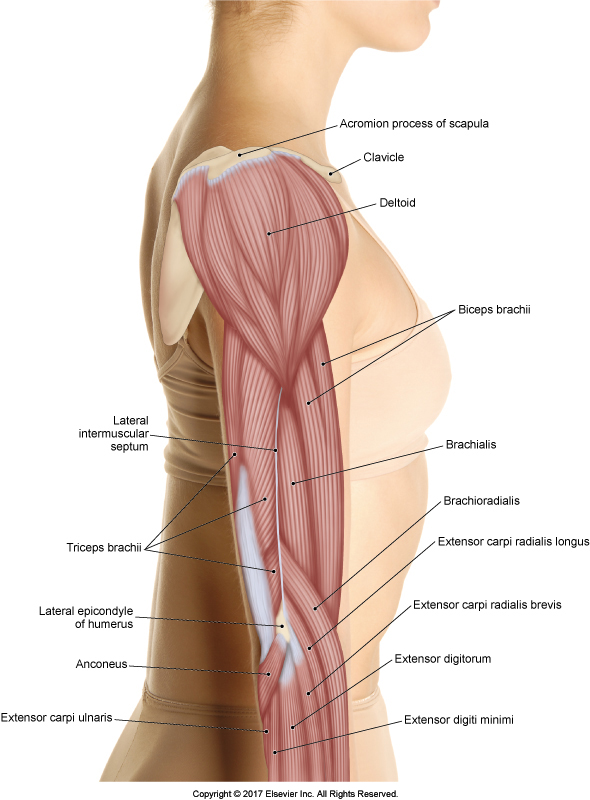
Lateral view of arm musculature. Permission Dr. Joe Muscolino – The Muscular System Manual 5ed.
From the anterior perspective, the brachialis is deep to the biceps brachii. But from the lateral perspective (and bit from the medial perspective as well), the brachialis has superficial exposure. The proximal attachment of the brachialis is directly next to, and slightly surrounds the distal deltoid-tubercle attachment of the deltoid muscle. In the proximal forearm, the brachialis distal attachment on the ulna lies medial to the biceps brachii distal attachment on the radial tuberosity.
Note: We normally think of the biceps brachii as the principal muscle of elbow joint flexion. But the brachialis is often larger and more powerful. We don’t realize this because the biceps brachii is more superficial and therefore more visually apparent. In fact, much of the reason that the biceps brachii is so apparent is that the large brachialis is immediately deep to the brachialis, pushing the biceps outward superficially, making it seem larger than it is.
“Behind every great biceps brachii is a great brachialis.”
This relationship is mirrored in the lower extremity with the more-superficial gastrocnemius and the deeper soleus.
How to Palpate the Brachialis
I like to think of two approaches to brachialis palpation.
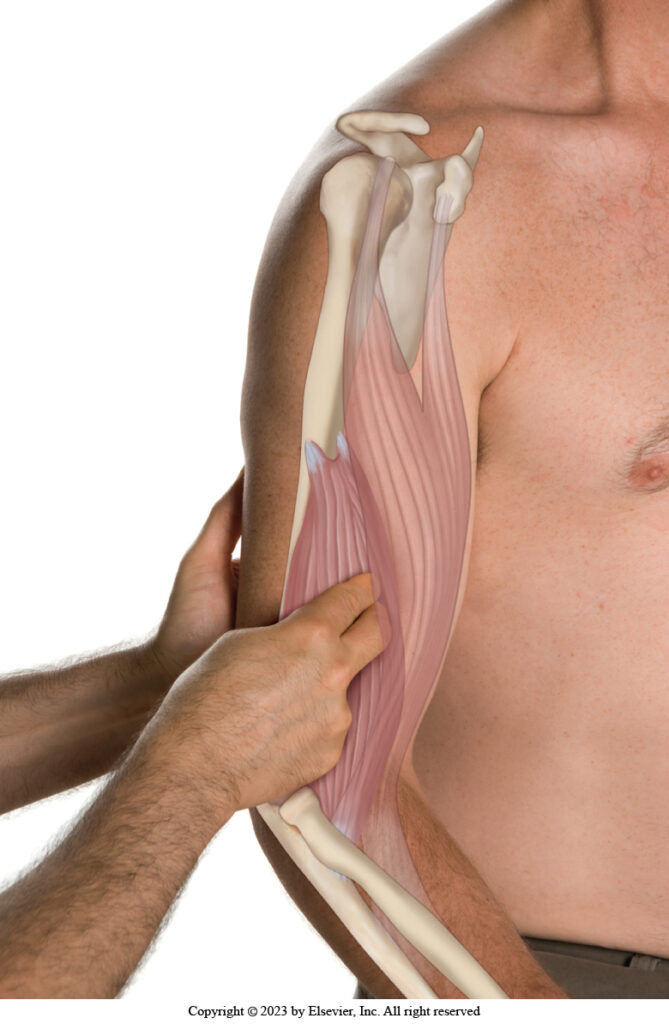
Palpation of the lateral aspect of the brachialis. Permission Dr. Joe Muscolino – The Muscle and Bone Palpation Manual 3ed.
In the lateral distal arm, it is directly superficial and easily palpated.
In the distal anterior arm, it must be palpated through the more-superficial biceps brachii.
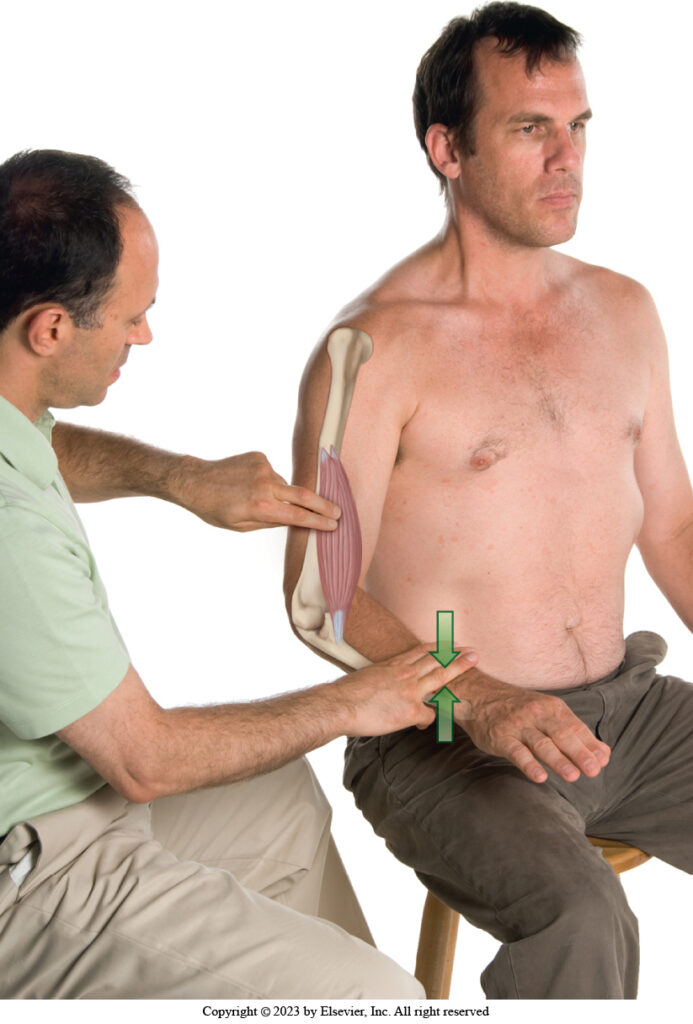
Palpation of the brachialis. Permission Dr. Joe Muscolino – The Muscle and Bone Palpation Manual 3ed.
In both cases, to engage the brachialis, ask the client to try to gently flex the forearm against your resistance on their distal forearm, but do so with the forearm in full pronation; this position will neurally inhibit (relax) the biceps brachii so that we can better palpate through it to feel the brachialis.
As with all palpation protocols, once the target muscle has been located (all borders discerned from adjacent musculature and other soft tissue), palpate it with the client relaxed so that the health of the baseline tone can be assessed.
Quick Answer — How to Palpate the Brachialis: Palpate the lateral distal arm directly, or approach through the biceps brachii anteriorly. Ask the client to flex the forearm against resistance with the forearm in full pronation to neurally inhibit the biceps brachii and isolate the brachialis.
How to Stretch the Brachialis
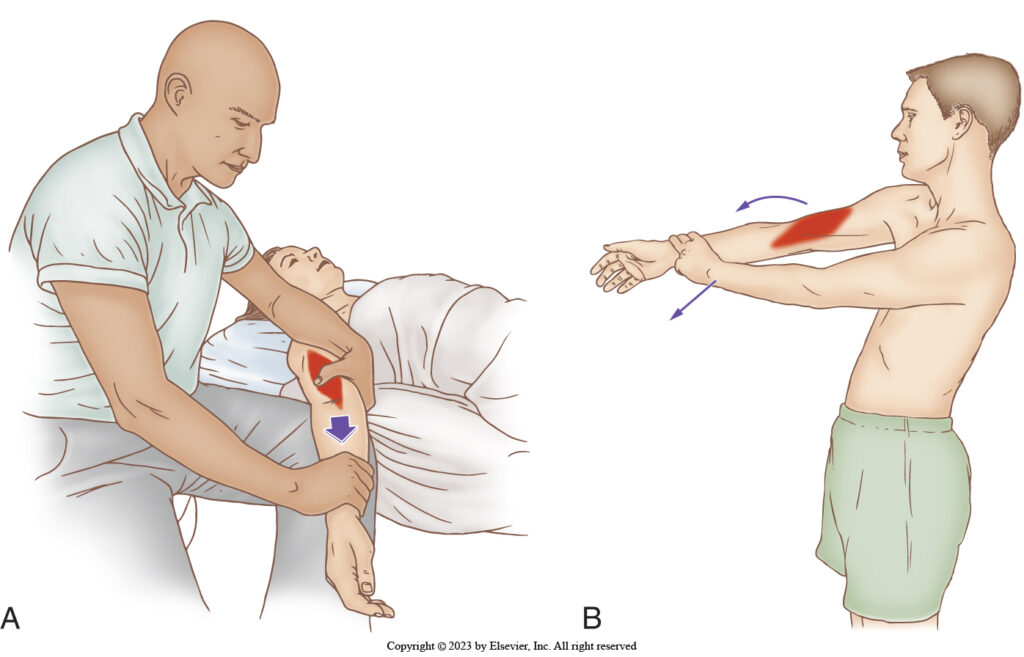
Brachialis stretch: therapist-assisted and client self-care. Permission Dr. Joe Muscolino – The Muscle and Bone Palpation Manual 3ed.
The brachialis flexes the elbow joint, so it is stretched with elbow joint extension.
Given that the brachialis does not have a pronation/supination function, it does not directly matter to the brachialis what position the radius is in, i.e., forearm pronation/supination does not matter. But, when stretching the elbow joint into extension, we do not want other elbow joint flexors to possibly stop the stretch from reaching the brachialis, so it is best to stretch the elbow joint into extension with the forearm in a position that is halfway between full pronation and full supination (this most effectively prevents the biceps brachii and brachioradialis from preventing an effective stretch into the brachialis).
Quick Answer — Brachialis Stretch: Extend the elbow joint with the forearm in a neutral position (halfway between pronation and supination) to most effectively isolate and stretch the brachialis.
How to Massage the Brachialis
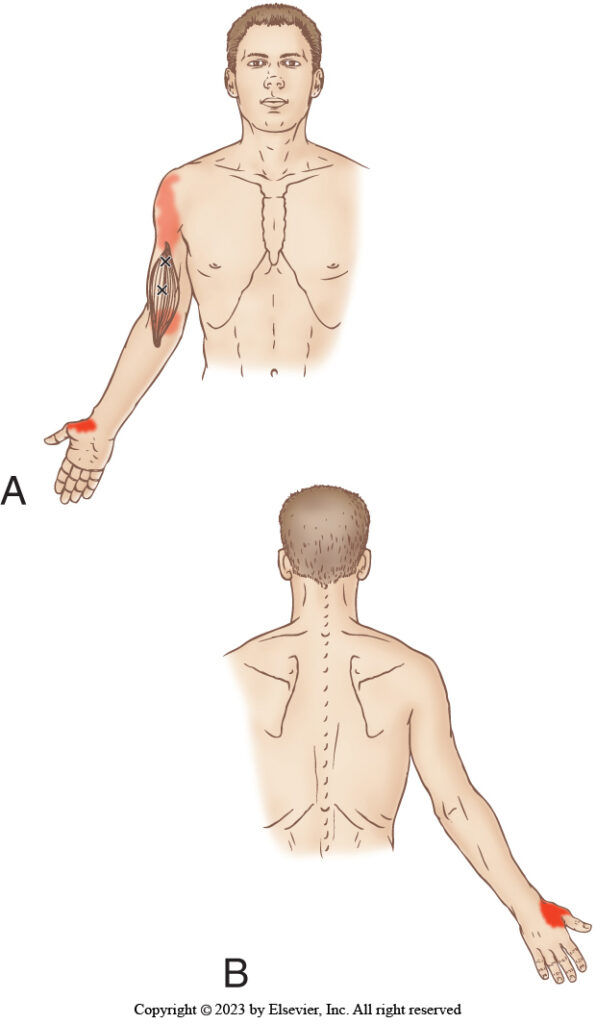
Brachialis trigger points and their referral zones. Permission Dr. Joe Muscolino – The Muscle and Bone Palpation Manual 3ed.
Massaging the lateral aspect of the brachialis in the distal lateral arm can be done any way that the therapist would like. Generally, in the extremities, it is preferred to work distal-to-proximal to work with venous flow; however, long strokes can be performed proximal-to-distal as well. And cross-fiber transverse strokes are also easily performed.
For the bulk of the brachialis that lies anteriorly deep to the biceps brachii, given that it is deeper in the arm, it is usually necessary to slacken the flexor musculature to allow deeper access by having the client’s elbow joint in flexion.
There is also a small portion of the brachialis that is superficial in the distal medial arm. If working here, use precaution because of the presence of the median and ulnar nerves, as well as the brachial artery.
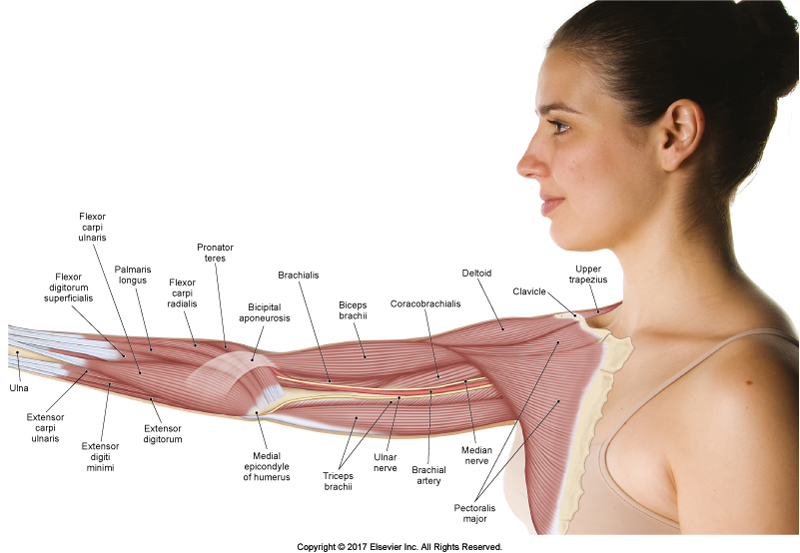
Medial view. Note nerves and artery. Permission Dr. Joe Muscolino – The Muscular System Manual 5ed.
Clinical Note: When massaging the distal medial aspect of the brachialis, exercise caution due to proximity of the median nerve, ulnar nerve, and brachial artery.
Conclusion
The brachialis is an important muscle in its own right. Indeed, it is often larger and more powerful than the more-superficial biceps brachii:
Behind every great biceps brachii is a great brachialis.
But something special about the brachialis is that it is the perfect muscle to teach and learn about classic muscle function. Indeed, in any muscle course curriculum, I recommend that the first muscle taught is the brachialis (followed by the famous and very well-known biceps brachii and triceps brachii, and then the rest of the musculature of the arm).
Frequently Asked Questions About the Brachialis Muscle
What is the brachialis muscle? The brachialis is a muscle in the anterior arm that is one of the three primary elbow joint flexors, along with the biceps brachii and brachioradialis.
What are the brachialis attachments? The brachialis attaches proximally (originates) from the distal ½ of the anterior shaft of the humerus and attaches distally (inserts) onto the ulnar tuberosity and coronoid process of the ulna.
What is the function of the brachialis? The primary function of the brachialis is flexion of the elbow joint. Unlike the biceps brachii and brachioradialis, it has no role in forearm pronation or supination because it attaches to the ulna, not the radius.
Is the brachialis stronger than the biceps? The brachialis is often larger and more powerful than the biceps brachii. The biceps appears larger because the brachialis lies beneath it, pushing it outward superficially.
How do you stretch the brachialis? Stretch the brachialis by extending the elbow joint with the forearm in a neutral position (halfway between pronation and supination) to prevent other flexors from limiting the stretch.
Biography

Dr. Joseph Muscolino, DC is a soft-tissue oriented chiropractic physician and leading educator in manual and movement therapy. He is the author of eight major textbooks published by Elsevier and LWW, translated into more than 10 languages and used worldwide in core curriculum and clinical practice. A global lecturer and NCBTMB-approved CE provider, he offers COMT (Clinical Orthopedic Manual Therapy) certification workshops across the US and internationally. Visit his website at: LearnMuscles.com.
LearnMuscles Continuing Education (LMCE) is one of his online subscription platforms with over 4,000 video lessons for manual and movement therapy professionals, and more than 320 free NCBTMB-CE hours.