
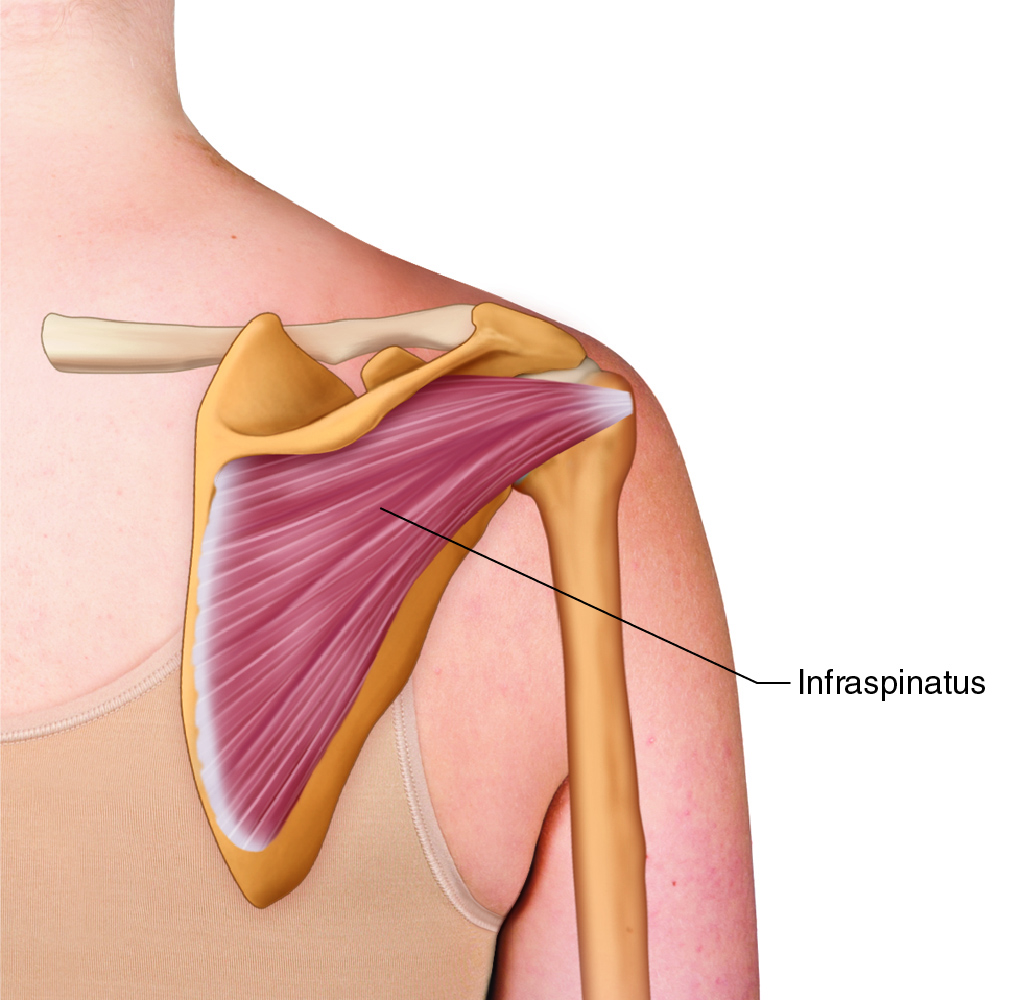
Infraspinatus. Credit Dr. Joe Muscolino (learnmuscles.com).
Quick Answer: The infraspinatus is one of the four rotator cuff muscles, running from the infraspinous fossa of the scapula to the greater tubercle of the humerus. It laterally rotates the arm and stabilizes the shoulder (glenohumeral) joint — making it one of the most commonly injured rotator cuff muscles and a key focus for manual therapy assessment, palpation, massage, and stretching.
Table of Contents
- Introduction
- Infraspinatus Attachments
- Infraspinatus Functions
- Nearby Anatomy
- Palpating the Infraspinatus
- Role in Rotator Cuff Pathology
- Massaging the Infraspinatus
- Stretching the Infraspinatus
- Conclusion
- Frequently Asked Questions
Introduction
The infraspinatus is one of the four rotator cuff muscles and intimately involved in stabilization of the shoulder (glenohumeral/GH) joint. It is often implicated in rotator cuff pathology.
Infraspinatus Attachments
The infraspinatus attaches from the…
infraspinous fossa of the scapula
to the
greater tubercle on the head of the humerus
Infraspinatus Functions
The infraspinatus has a concentric/shortening joint action function and an isometric stabilizing function.
Its shortening function is lateral (external) rotation of the humerus/arm at the GH joint.
Its stabilization function, which is probably its more important function, is to stabilize the head of the humerus into the glenoid fossa of the scapula when the distal end of the humerus is being lifted from anatomic position, in other words, whenever the humerus (arm) is flexed, extended, abducted, or adducted up into the air. This stabilization function is shared with the other muscles of the rotator cuff group (teres minor, subscapularis, supraspinatus).
This means that the infraspinatus is working pretty much with every movement at the GH joint, whether it is isometrically working with flexion, extension, abduction, or adduction, or concentrically working with lateral rotation.
Nearby Anatomy
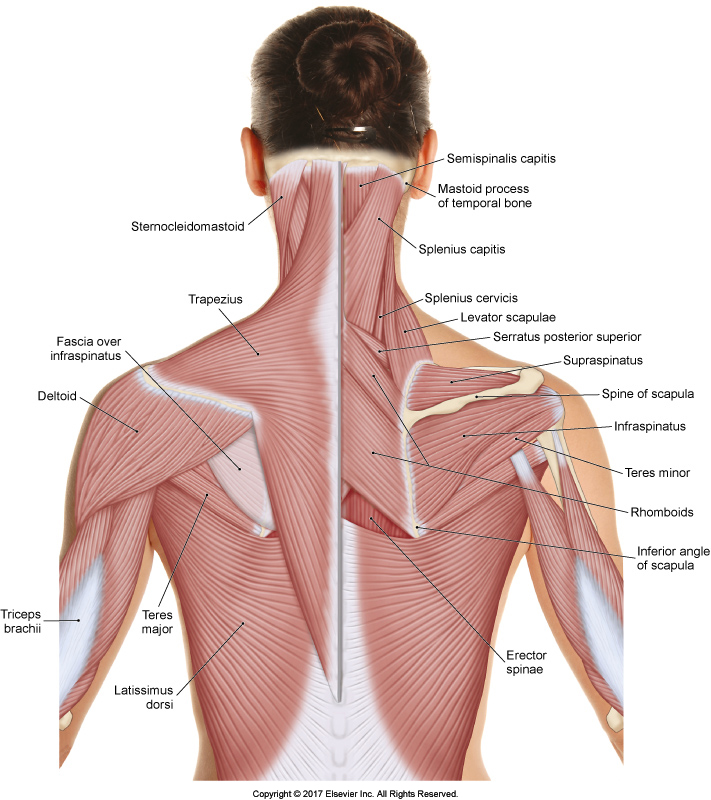
Permission Dr. Joe Muscolino – The Muscular System Manual, 5ed.
The infraspinatus is located directly next to the teres minor, another one of the rotator cuff muscles. In fact, the infraspinatus and teres minor usually blend into each other. Also on the posterior surface of the scapula is the supraspinatus, which is located above the spine of the scapula (“supra”spinatus, whereas the infraspinatus is located below the spine of the scapula; “infra”spinatus). The distal attachment of the infraspinatus is onto the greater tubercle of the humerus, along with the teres minor and supraspinatus.
The posterior deltoid lies superficial to much of the infraspinatus. And the rhomboids are located medial to the infraspinatus.
Palpating the Infraspinatus
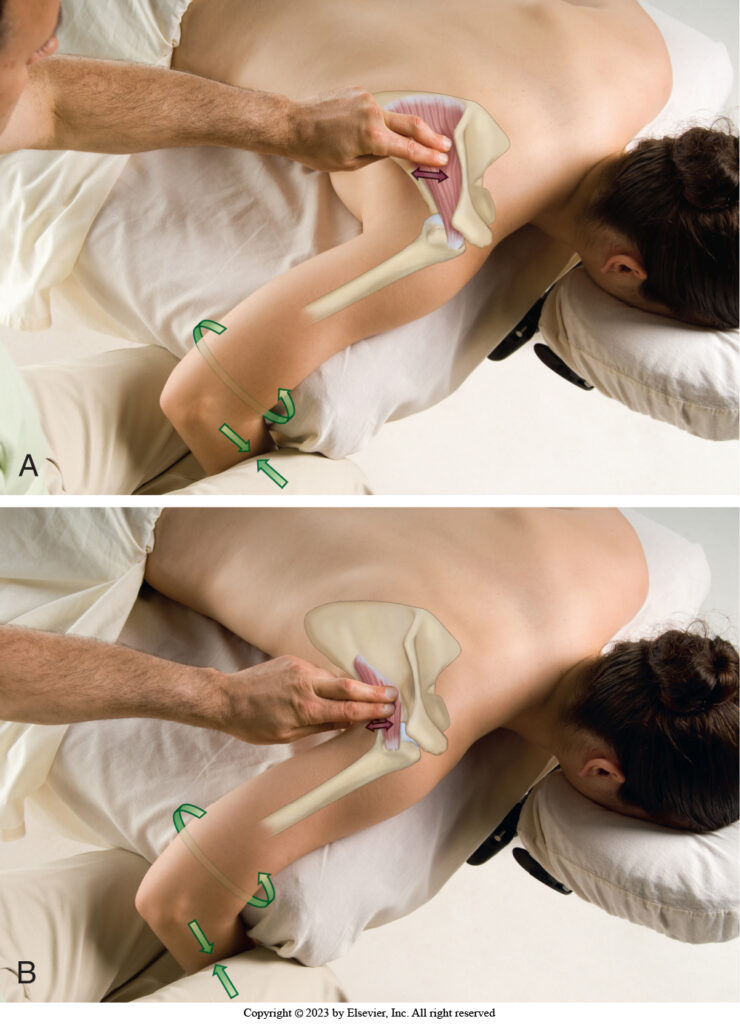
Palpation of the infraspinatus (and teres minor). Permission Dr. Joe Muscolino – The Muscle and Bone Palpation Manual, 3ed.
The infraspinatus is fairly easy to palpate. To palpate its belly, simply locate the spine of the scapula (by strumming vertically, perpendicular to it), and drop immediately inferior to it and you will be on the infraspinatus belly (except the part of it that is deep to the posterior deltoid).
To locate its distal tendon, have the client prone on the table with their (upper) arm resting on the table and their forearm hanging off the table, with their distal forearm/hand between your knees. Instruct the client to laterally rotate their arm at the GH joint by raising their forearm/hand upward (see illustration), and feel for the infraspinatus to engage/pop. Strum perpendicularly across the tendon to strum (“twang”) it. Then move a baby step distally (laterally) toward the humeral attachment and repeat this protocol. Even though the distal tendon is deep to the posterior deltoid, it can usually be easily felt through the deltoid with a gentle lateral rotation engagement on the part of the client. Follow it as far toward the greater tubercle attachment as possible.
Note: The same palpation protocol is used for the teres minor.
Once the infraspinatus has been located, with it relaxed, palpate for density of the tissue.
Role in Rotator Cuff Pathology
The infraspinatus is often implicated in rotator cuff pathology. Because the rotator cuff musculature is so intimately involved in GH joint stabilization, they are often (in the verbiage of Leon Chaitow) used/overused/misused/abused. In other words, they experience repetitive overuse syndrome. Rotator cuff pathology often exhibits initially as tendinitis, but often progresses to degeneration, and then tearing. This can lead to instability of the GH joint, which can then result in muscle spasming as a protective splinting mechanism by the nervous system, which can then sometimes lead to frozen shoulder. Of the four rotator cuff muscles, the supraspinatus and infraspinatus are the two most commonly involved in rotator cuff pathology.
Massaging the Infraspinatus
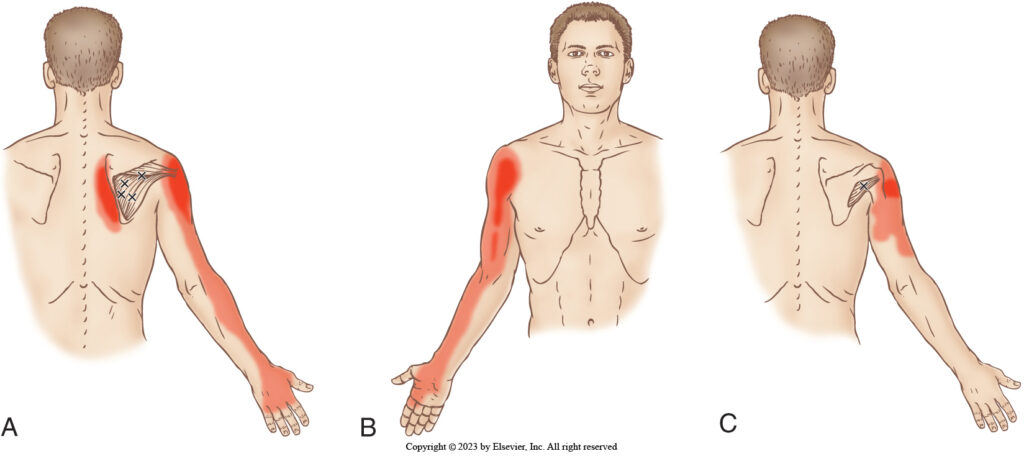
Infraspinatus triggers points and their referral zones. Permission Dr. Joe Muscolino – The Muscle and Bone Palpation Manual, 3ed.
Massaging the infraspinatus follows from its palpation. Once located, it can be worked with any strokes that you like, especially for the belly. Transverse friction strokes across its distal tendon are usually very effective.
Stretching the Infraspinatus
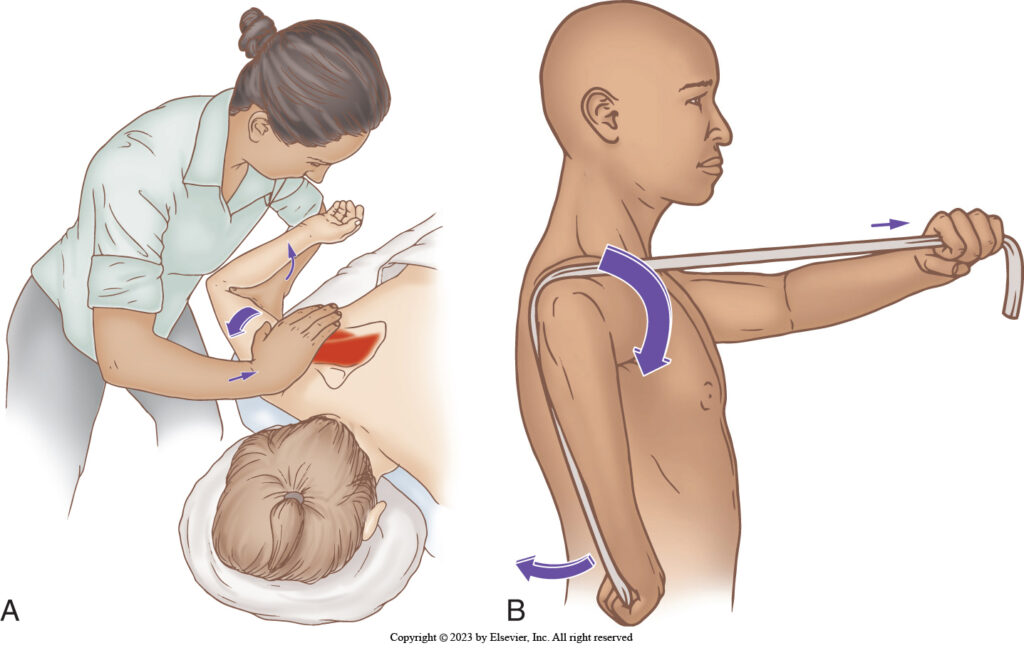
Stretching the infraspinatus (therapist-assisted and client self-care). Permission Dr. Joe Muscolino – The Muscle and Bone Palpation Manual, 3ed.
Given that the infraspinatus is a lateral rotator of the arm at the GH joint, it can be stretched with medial rotation (a muscle’s joint action is its concentric/shortening function, and stretching is making the muscle longer, so simply doing the opposite of its joint action is how to stretch it). Given the challenge of medially rotating the humerus, the stretch protocol can be effectively performed using a rope or band (see illustration).
Caution: The infraspinatus is a fairly delicate muscle, so all the usual stretching precautions apply. Never stretch a muscle unless it has first been warmed up, never stretch it too far, and especially, never stretch a muscle fast. Warm up, stretch slowly and carefully, constantly feeling for the tissue response during the stretching protocol.
Conclusion
Given the tremendous load that is placed on the infraspinatus with everyday activities, and its role in rotator cuff pathology, it is extremely important for the manual therapy practitioner to be competent and effective at working with this muscle.
Biography

Dr. Joe Muscolino (learnmuscles.com).
Dr. Joseph Muscolino, DC is a soft-tissue oriented chiropractic physician and leading educator in manual and movement therapy. He is the author of eight major textbooks published by Elsevier and LWW, translated into more than 10 languages and used worldwide in core curriculum and clinical practice. A global lecturer and NCBTMB-approved CE provider, he offers COMT (Clinical Orthopedic Manual Therapy) certification workshops across the US and internationally. Visit his website at: LearnMuscles.com.
LearnMuscles Continuing Education (LMCE) is one of his online subscription platforms with over 4,000 video lessons for manual and movement therapy professionals, and more than 320 free NCBTMB-CE hours.
Frequently Asked Questions
What is the infraspinatus muscle? The infraspinatus is one of the four rotator cuff muscles, located on the posterior scapula below the spine of the scapula, running from the infraspinous fossa of the scapula to the greater tubercle of the humerus.
What is the main function of the infraspinatus? The infraspinatus laterally (externally) rotates the humerus at the glenohumeral joint, and — along with the other rotator cuff muscles — isometrically stabilizes the head of the humerus in the glenoid fossa during nearly every arm movement.
Where do you palpate the infraspinatus? Locate the spine of the scapula, then drop immediately inferior to it to find the infraspinatus belly. The distal tendon can be found by having the client laterally rotate their arm while prone, feeling for the tendon to engage deep to the posterior deltoid.
Why is the infraspinatus commonly injured? Because it plays such a central role in glenohumeral joint stabilization, the infraspinatus is prone to repetitive overuse, which can progress from tendinitis to degeneration and tearing. Along with the supraspinatus, it is one of the two most commonly involved rotator cuff muscles in rotator cuff pathology.
How do you stretch the infraspinatus? Since the infraspinatus performs lateral rotation, it is stretched using medial rotation of the arm, often assisted with a rope or band — always after a proper warm-up and performed slowly and carefully.
What muscles are located near the infraspinatus? The infraspinatus sits directly next to (and often blends with) the teres minor. The supraspinatus lies nearby above the spine of the scapula, the posterior deltoid lies superficial to the infraspinatus, and the rhomboids lie medial to it.