
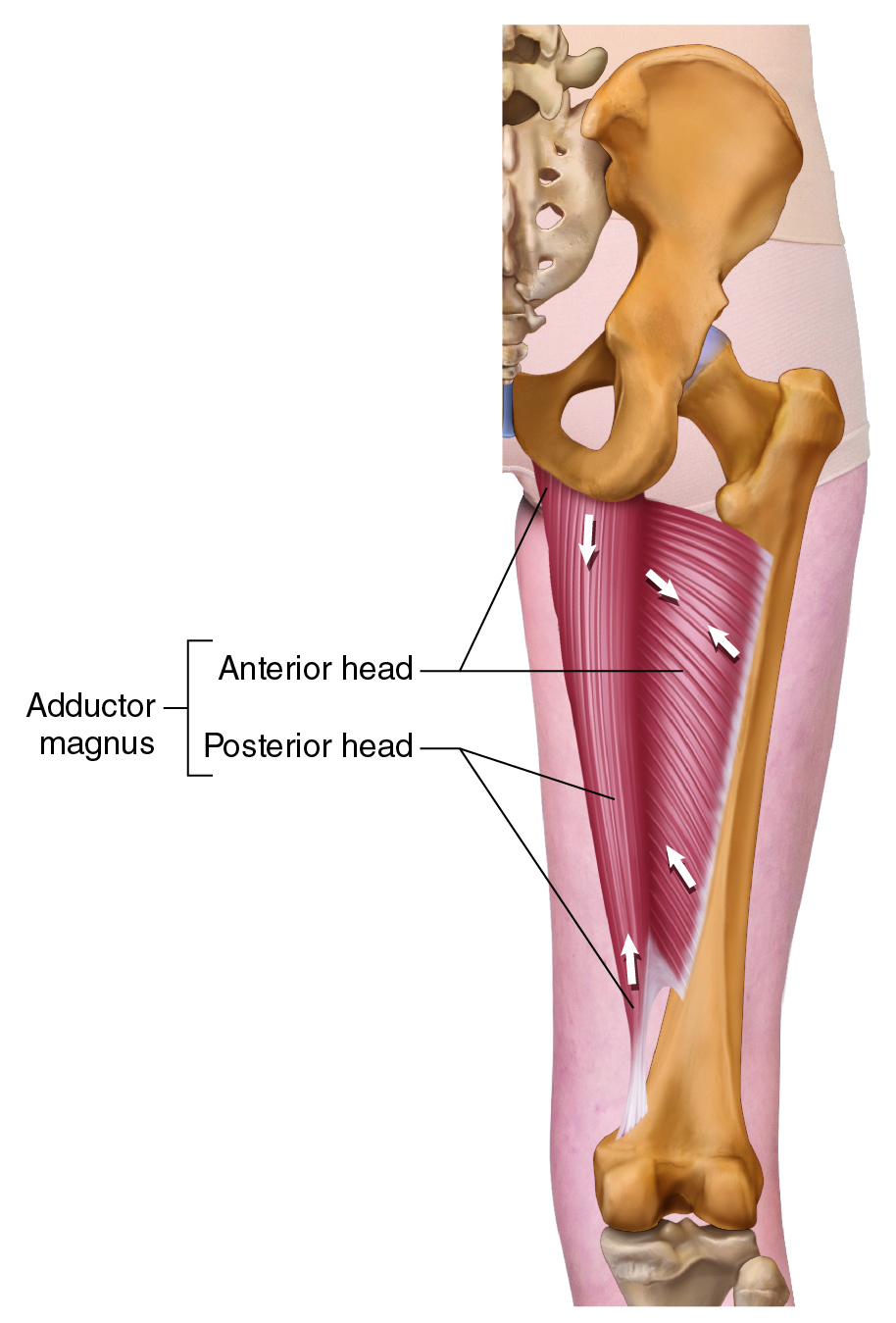
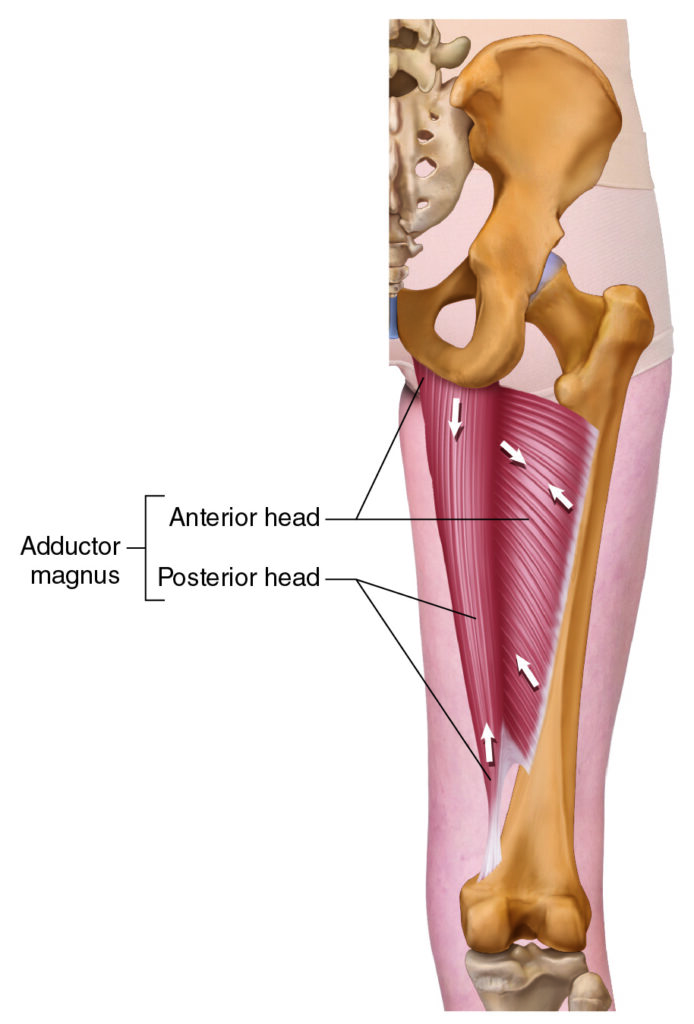
Adductor Magnus – posterior view. Permission Dr. Joe Muscolino (learnmuscles.com).
Introduction
The adductor magnus is one of the most under-appreciated muscles in the human body. I believe this is because it is essentially deep from both the anterior and posterior views. To truly appreciate this grand muscle, it must be viewed from the medial side. To add to the importance of knowing this muscle is that it is often referred to as the 4th hamstring.
Adductor Magnus Attachments
The adductor magnus attaches proximally (origin) onto the pubis and ischium, and attaches distally (insertion) onto the linea aspera of the femur.
More specifically, it has two heads, an anterior head and a posterior head.
The anterior head attaches from the:
- inferior pubic ramus and the ramus of the ischium
to the
- gluteal tuberosity, linea aspera, and the medial supracondylar line of the femur
The posterior head attaches from the:
- ischial tuberosity
to the
- adductor tubercle of the femur
4th Hamstring Status
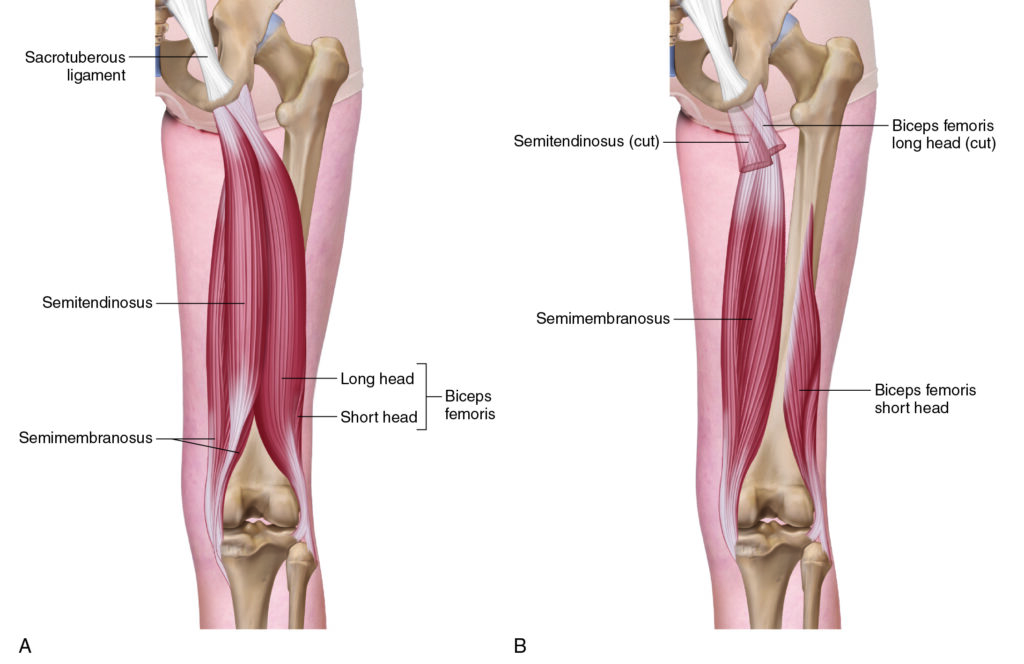
Hamstring Group – superficial and deep views. Permission Dr. Joe Muscolino (learnmuscles.com)
It is because the posterior head attaches onto the ischial tuberosity (like the hamstrings), and therefore, it extends the thigh at the hip joint (like the hamstrings), and is innervated by the sciatic nerve (like the hamstrings), that the adductor magnus, or perhaps to be more precise, the posterior head of the adductor magnus, is often referred to as the 4th hamstring.
Another interesting note regarding naming of the adductor magnus is that some sources describe the anterior head as the adductor minimus.
The Adductor Group
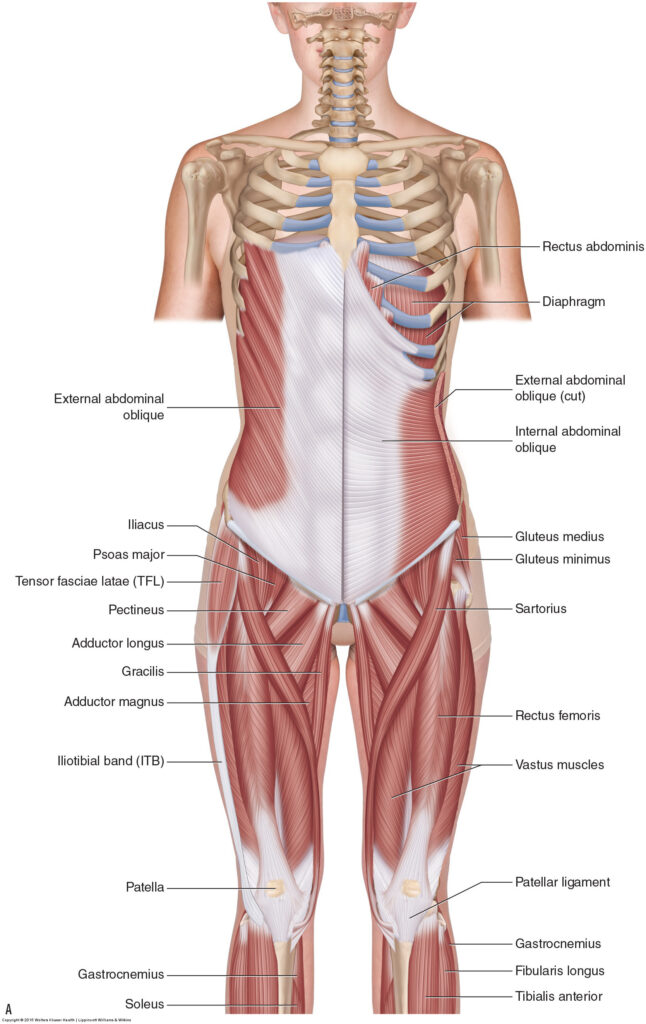
Anterior superficial view of the adductor group. Permission Dr. Joe Muscolino (learnmuscles.com).
The adductor magnus, as its name implies, is a member of the adductor group. It is the largest of the adductor group, hence the designation magnus. There are five members of this group. From anterior to posterior, they are the…
- Pectineus (a transitional hip flexor/adductor, innervated by the femoral nerve like the other hip flexors, but considered to be a member of the adductor group)
- Adductor longus
- Gracilis (sometimes referred to as the adductor gracilis)
- Adductor brevis
- Adductor magnus
Adductor Magnus Functions
Open-Chain Function
The entire adductor magnus crosses the hip joint on the medial side, so it can adduct the thigh at the hip joint (as its name implies). It can also assist with medial rotation of the thigh at the hip joint.
The posterior head crosses the hip joint posteriorly with a vertical direction to its line of pull, so it can extend the thigh at the hip joint.
The anterior head crosses the hip joint anteriorly with a vertical direction to its line of pull, so it can flex the thigh at the hip joint.
Therefore, by the way, the adductor magnus can be its own synergist/antagonist pair, in that the posterior head extends and the anterior head flexes the hip joint. This is not that unusual; for example, the deltoid and the gluteus medius also have this ability. If a muscle has more than one line of pull, and the lines of pull are on opposite sides of the axis of motion of the joint within a plane, then the muscle can create opposite joint actions within itself.
Closed-Chain Function
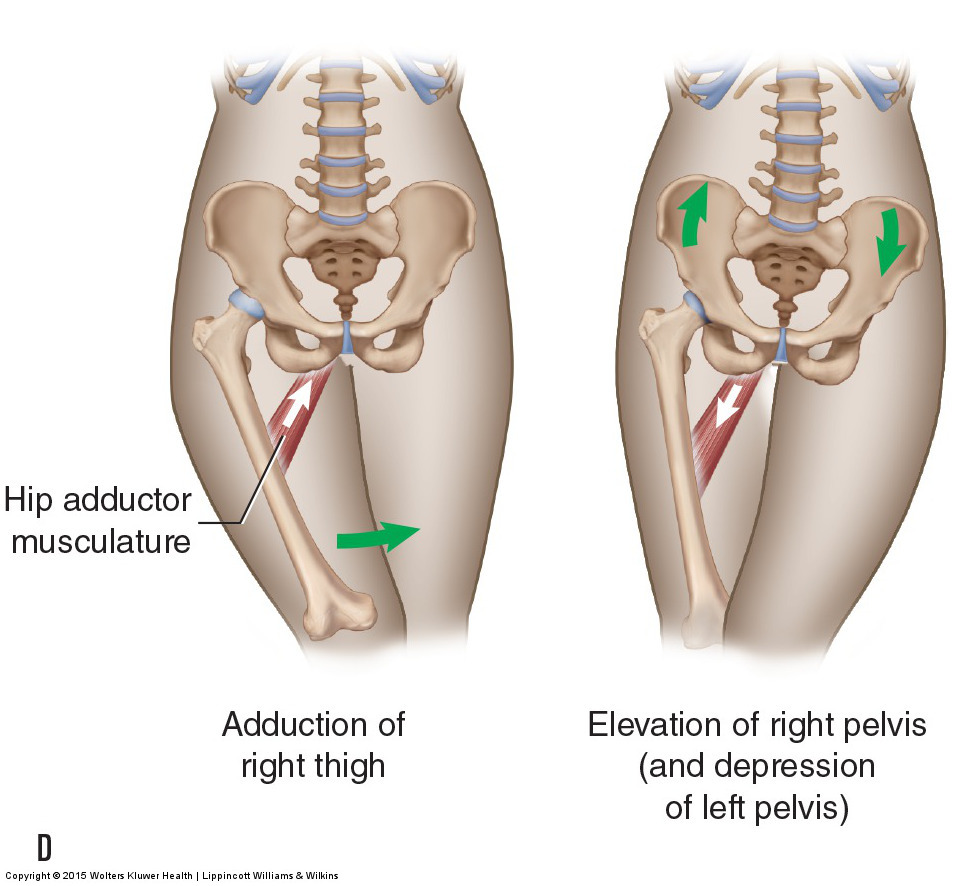
Closed-chain action of hip adductors is elevation of the same-side pelvic bone at the hip joint. Permission Dr. Joe Muscolino (learnmuscles.com).
Because the adductor magnus can adduct the thigh at the hip joint, its reverse closed-chain action is elevation (hiking the hip) of the pelvis at the hip joint.
Because the adductor magnus can medially rotate the thigh at the hip joint, its reverse closed-chain action is ipsilateral (same-side) rotation of the pelvis at the hip joint.
Because the posterior head of the adductor magnus can extend the thigh at the hip joint, its reverse closed-chain action is posterior tilt of the pelvis at the hip joint.
Because the anterior head of the adductor magnus can flex the thigh at the hip joint, its reverse closed-chain action is anterior tilt of the pelvis at the hip joint.
Nearby Anatomy
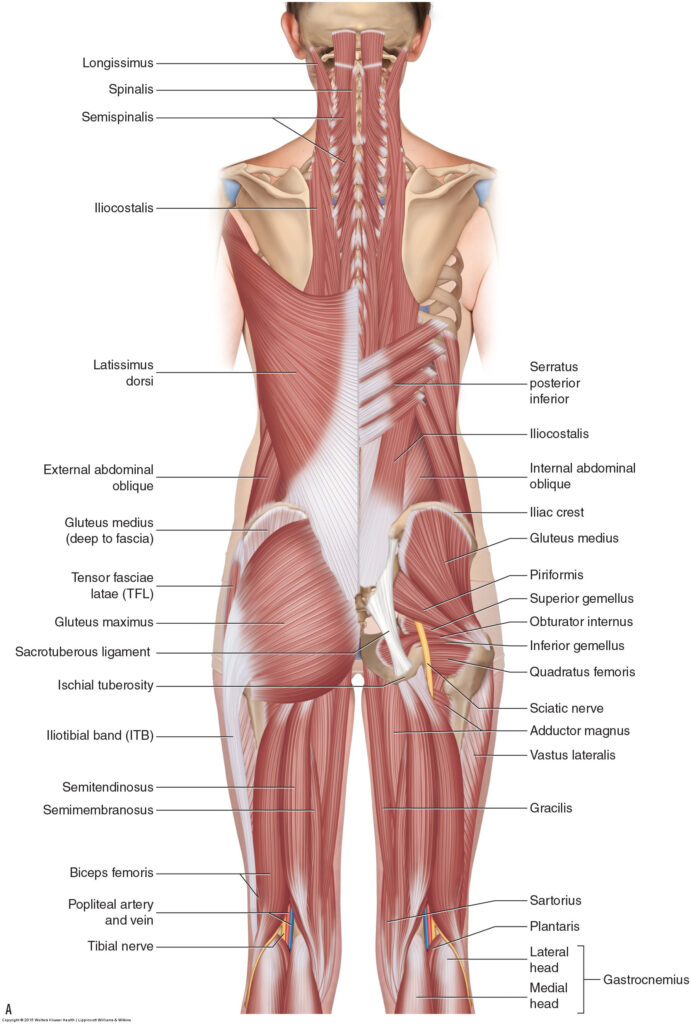
Posterior view of the gluteal and thigh regions – superficial views. Permission Dr. Joe Muscolino (learnmuscles.com)
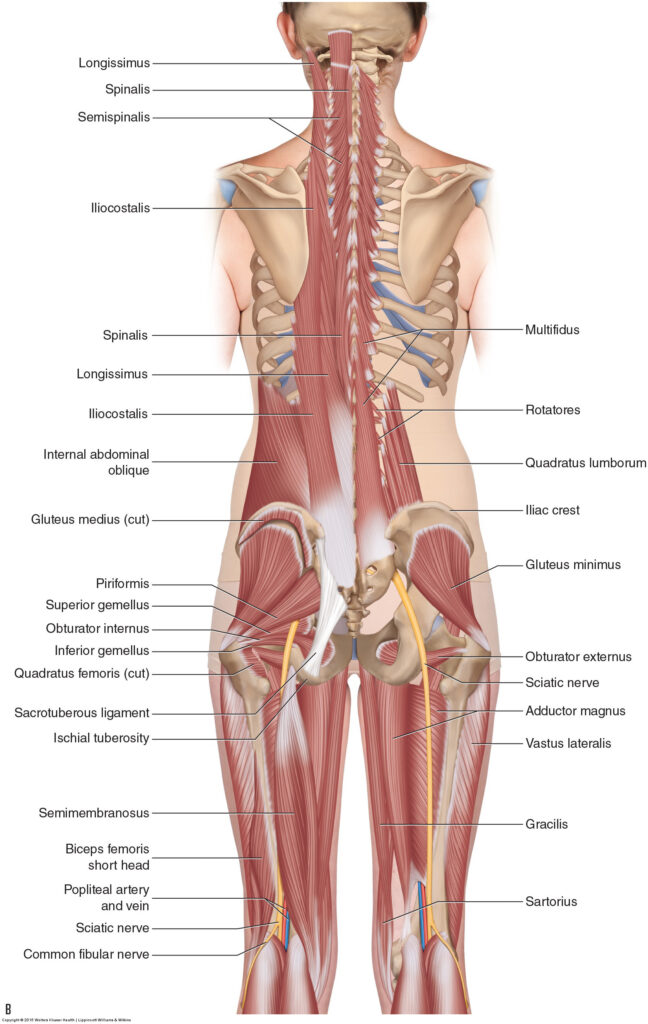
Posterior view of the gluteal and thigh regions – deeper views. Permission Dr. Joe Muscolino (learnmuscles.com)
As mentioned in the introduction above, the adductor magnus is deep from both the anterior and posterior perspectives. The adductors longus and brevis are superficial from the anterior perspective, and the medial hamstrings (semitendinosus and semimembranosus) are superficial from the posterior perspective. I once heard a manual therapy instructor describe the adductor magnus like a shelf that the more anterior adductors in front sit on, and that the medial hamstrings in back sit on.
This is where the under-appreciated status of the adductor magnus emanates. Unfortunately, many people only view muscles from the anterior and posterior perspectives, and usually only from superficial views, so the adductor magnus is not well known/appreciated. There is only a small sliver that is superficial from the superficial anterior perspective and a small sliver superficially from the posterior perspective. To truly appreciate the grandness/magnus aspect of the muscle, we need to view if from the medial perspective. If you ever have the opportunity to attend a cadaver lab, I strongly recommend it; and one of the most awe-inspiring moments in the lab is seeing (and palpating) the adductor magnus muscle!
Palpating the Adductor Magnus
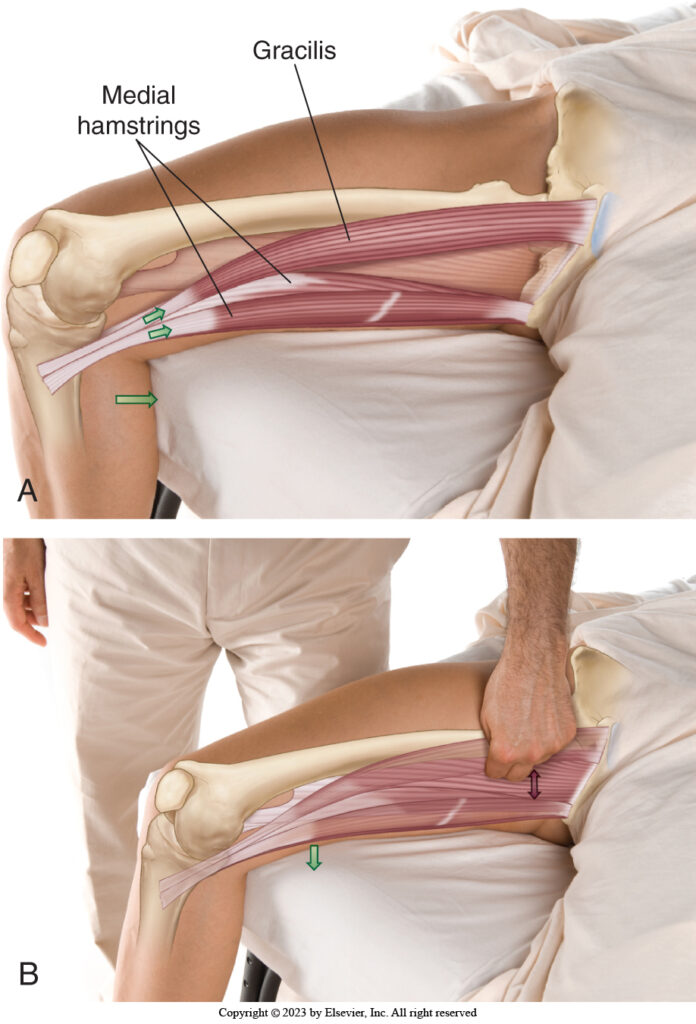
Palpation of the adductor magnus. Permission Dr. Joe Muscolino – The Muscle and Bone Palpation Manual, 3ed.
The best way to initially find the adductor magnus during palpation assessment is to have the client supine and locate the gracilis on the anterior side and the medial hamstring musculature on the posterior side, and then the adductor magnus will be between. The key is to understand that the gracilis and hamstrings both flex the leg at the knee joint, but the adductor magnus does not.
In the accompanying illustration, the client is supine on the table with their thigh on the table, and their (lower) leg off the table. This is the ideal position in which to palpate and locate the adductor magnus because it allows for isolated engagement of knee joint muscles versus hip joint muscles.
Note: If using this position, it is important to have the client’s other hip and knee joints flexed with their foot on the table to help stabilize their pelvis (to prevent excessive anterior tilt, which could cause low back pain). This is not demonstrated in the accompanying illustration so that the view is not obstructed.
In this position, asking the client to press their (lower) leg into the table asks for engagement of knee joint flexors and therefore will engage the gracilis and hamstrings (but not the adductor magnus). Then everything between these muscles will be the adductor magnus! Once the adductor magnus is located, continue palpating it as best possible. The posterior head will engage with resisted extension of the thigh at the hip joint (simply have the client press their thigh into the table).
If instead, you have the client supine with their entire lower extremity on the table, then give them precise instructions so that they are pressing their (lower) leg into the table, and not their thigh.
Once you have located the adductor magnus, have the client fully relax it and palpate for any tightness/tautness, whether it is global hypertonicity, focal myofascial trigger points (TrPs), and/or fascial adhesions.
Stretching the Adductor Magnus
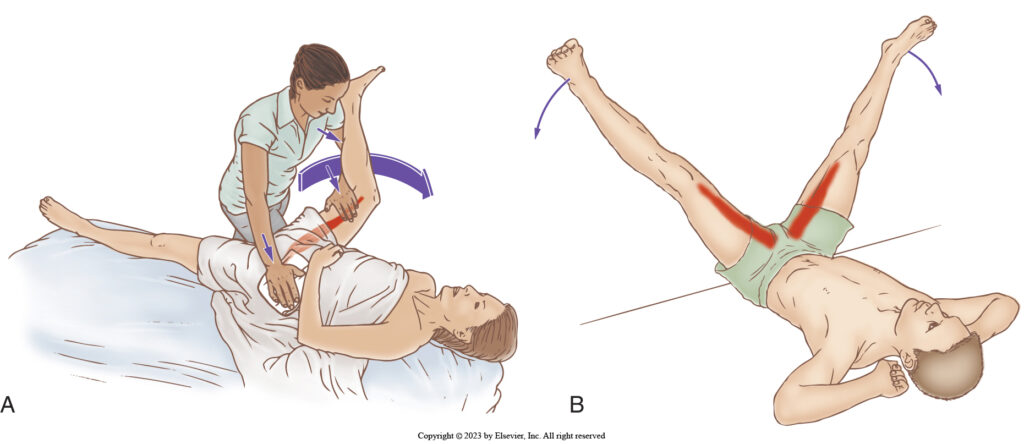
Stretching the adductor magnus. Therapist-assisted and client self-care. Permission Dr. Joe Muscolino – The Muscle and Bone Palpation Manual 3ed.
The adductor magnus is an adductor, so it is best stretched with abduction of the thigh at the hip joint. To preferentially stretch the posterior head, add in flexion of the thigh to the abduction (given that the posterior head does extension). To preferentially stretch the anterior head, add in extension of the thigh to the abduction (given that the anterior head does flexion). It can be helpful to add in knee joint flexion during the stretch protocol because it will slacken and knock the gracilis out of the stretch.
Massaging the Adductor Magnus
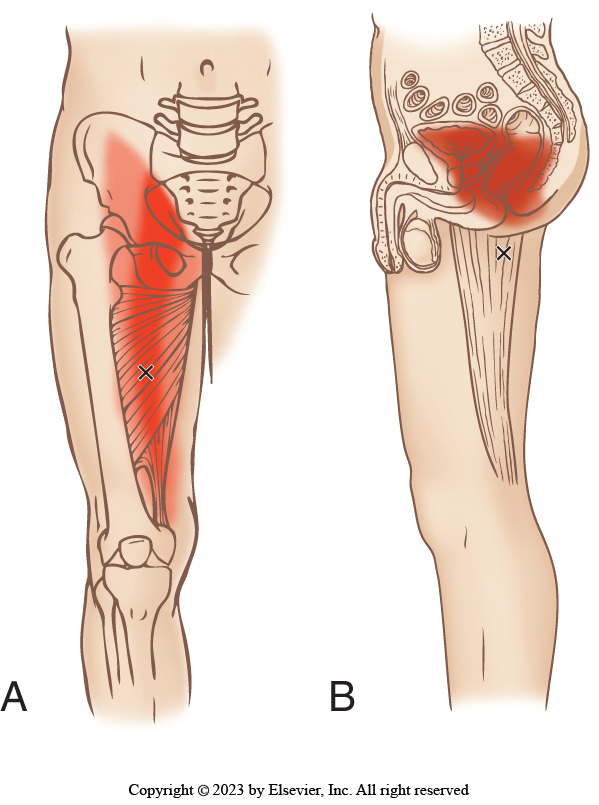
Adductor magnus TrPs and referral zones. Permission Dr. Joe Muscolino – The Muscle and Bone Palpation Manual 3ed.
The adductor magnus responds quite well to heat and massage, followed by stretching. Regarding body mechanics when doing massage, the best way to work into this muscle is to have the client prone and position yourself on the other side of the table (contralaterally). This affords the best angle to reach into the adductor magnus (this is also often the most effective way to work the medial hamstrings).
Note: One reason that the adductor magnus is an important muscle with which to familiarize yourself is that trigger points (TrPs) in the adductor magnus posterior head are often miss-assessed as hamstring TrPs. This can then lead to incorrect treatment, including massage that misses the mark, and stretching that is directed at the wrong musculature.
Conclusion
As mentioned above, the adductor magnus is a truly grand muscle that is not well appreciated. Because it is mostly deep from the anterior and posterior perspectives, it is more challenging to assess and treat, and often mis-assessed, and therefore, incorrectly treated. Hopefully, this article will help you begin to unlock how to work with the adductor magnus, and thereby better help your clients, and enrich your practice!

Dr. Joe Muscolino
Dr. Joseph Muscolino, DC is a soft-tissue oriented chiropractic physician and leading educator in manual and movement therapy. He is the author of eight major textbooks published by Elsevier and LWW, translated into more than 10 languages and used worldwide in core curriculum and clinical practice. A global lecturer and NCBTMB-approved CE provider, he offers COMT (Clinical Orthopedic Manual Therapy) certification workshops across the US and internationally. Visit his website at: LearnMuscles.com.
LearnMuscles Continuing Education (LMCE) is one of his online subscription platforms with over 4,000 video lessons for manual and movement therapy professionals, and more than 320 free NCBTMB-CE hours.