
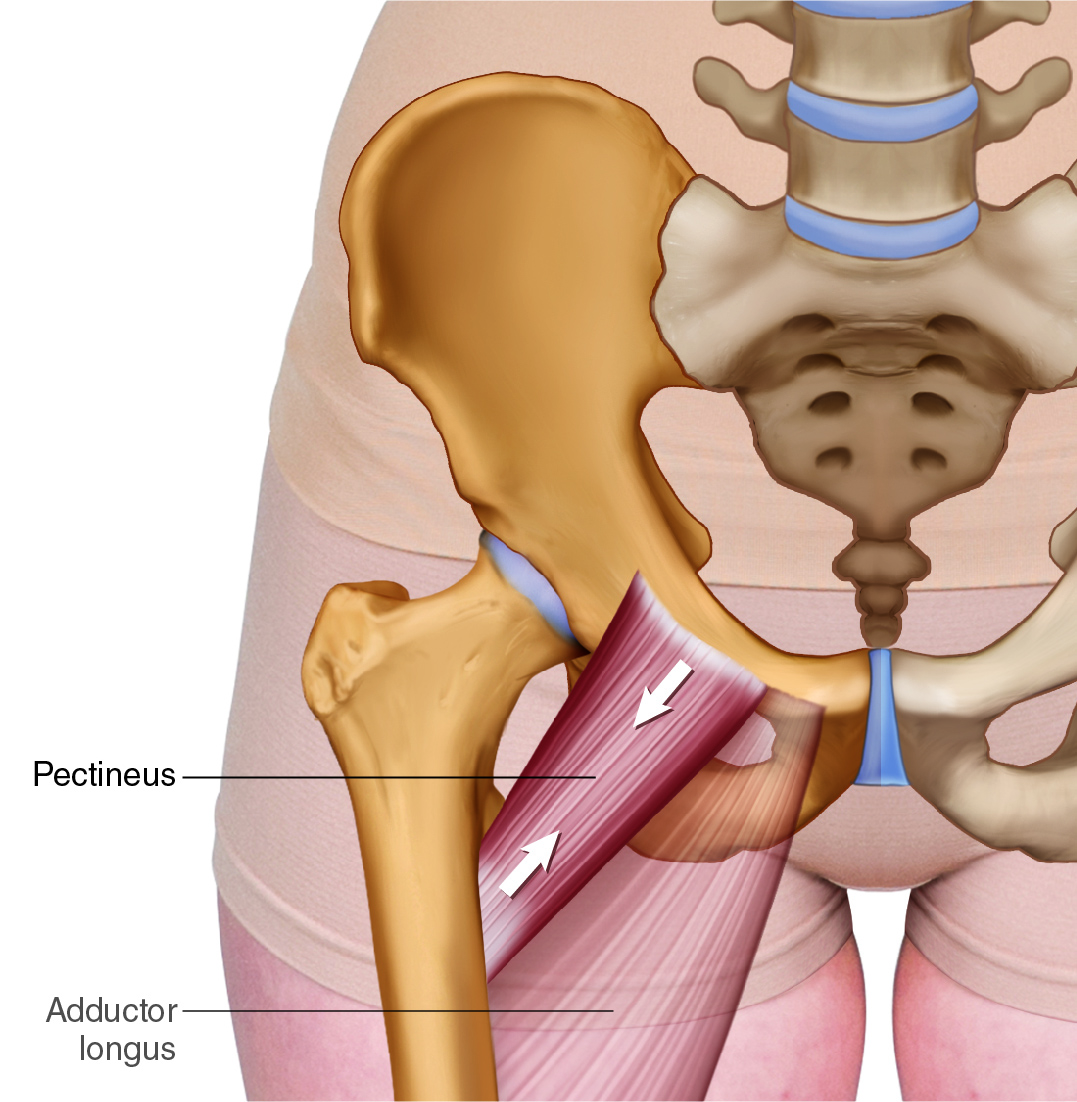
Introduction
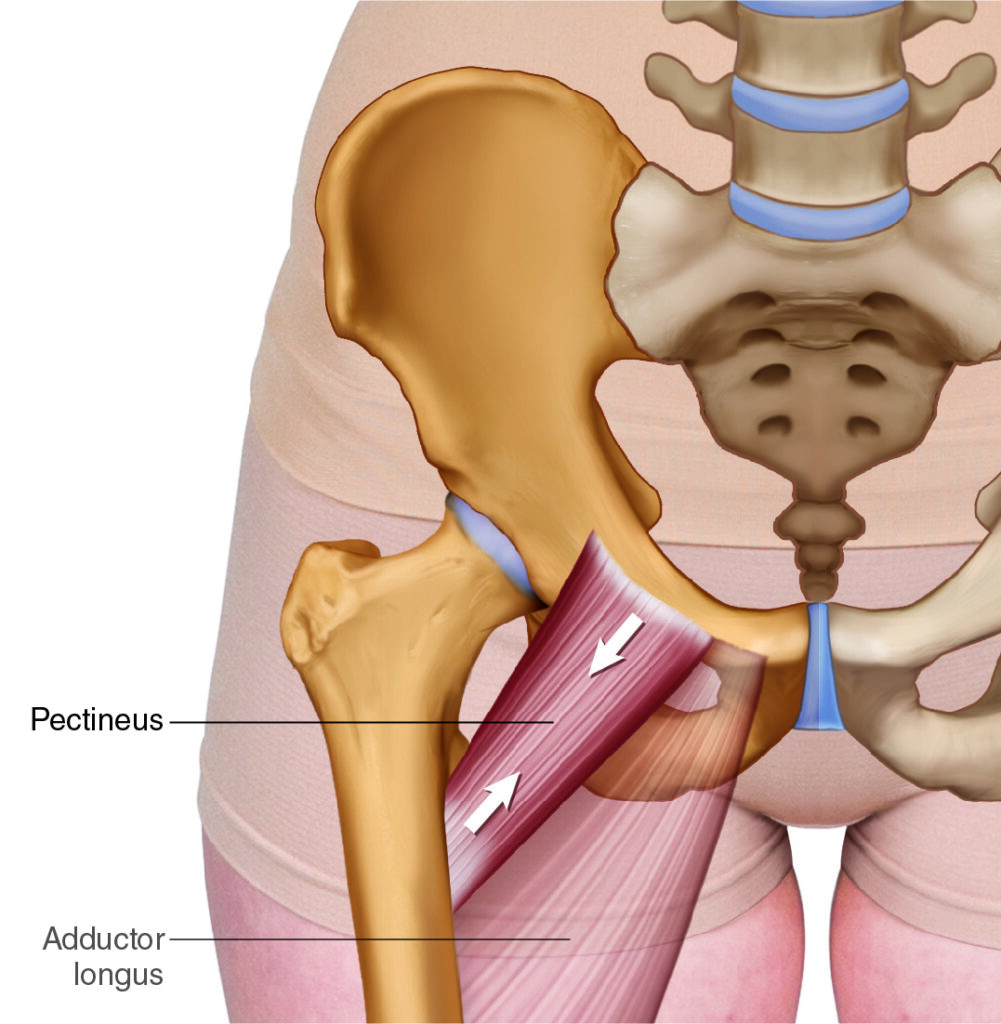
Pectineus. Permission Dr. Joe Muscolino (learnmuscles.com).
Because the pectineus is anteromedial in the thigh, it is a transitional muscle that is located in both the flexor and adductor compartments. It crosses the hip joint anteriorly, so it is considered to be a flexor; it crosses the hip joint medially, so it is considered to be an adductor. Because it straddles both the flexor and adductor compartments, it is described as being a transitional muscle. However, the pectineus is innervated by the femoral nerve, as are (most) all the hip flexors in the anterior compartment, so it is primarily considered to be a hip flexor, but it is far enough medial that it is also considered to be part of the adductor group.
Pectineus Attachments
The pectineus attaches from the pubis of the pelvic bone (origin) to the femur (insertion).
More specifically, it runs from…
the pectineal line of the pubic bone
to the
pectineal line on the posterior femur
Note: The pectineal line on the posterior femur can be thought of as the proximal extension of the linea aspera on the medial side, and it runs proximally toward the lesser trochanter (the gluteal tuberosity can be thought of as the proximal extension of the linea aspera laterally).
Pectineus Functions
Open-Chain
As stated in the Introduction, because the pectineus crosses the hip joint anteriorly with a vertical direction to its line of pull, it flexes the thigh at the hip joint.
Because it also crosses the hip joint medially (with a vertical direction to its line of pull), it is also an adductor of the thigh at the hip joint.
Like the other muscles of the adductor group, it can also weakly assist with medial rotation of the thigh at the hip joint.
But the pectineus has one line of pull across all three cardinal planes, therefore it cannot purely do any one of these cardinal-plane joint actions; rather, it must create one oblique-plane motion pattern that is a combination of all three joint actions, that would be, in effect, “flexo-adducto-medial rotation”.
Closed-Chain
Whenever the lower extremity is in closed-chain mechanics, meaning that the foot is stable on the ground and therefore the distal attachment of the lower extremity muscle is fixed/stable so that the proximal attachment moves instead, we have the closed-chain/reverse action of the muscle; so the pelvis would move toward the femur instead of the femur moving toward the pelvis.
The closed-chain reverse action of thigh flexion is anterior tilt of the pelvis at the hip joint.
The closed-chain reverse action of thigh adduction is elevation of the same-side pelvis at the hip joint.
And the closed-chain reverse action of medial rotation of the thigh is ipsilateral rotation of the pelvis at the hip joint.
And, as with open-chain mechanics, the pectineus has one line of pull across all three cardinal planes, so it would create one oblique-plane motion pattern of the pelvis that would be a combination of all three of these cardinal-plane pelvic joint actions.
Nearby Anatomy
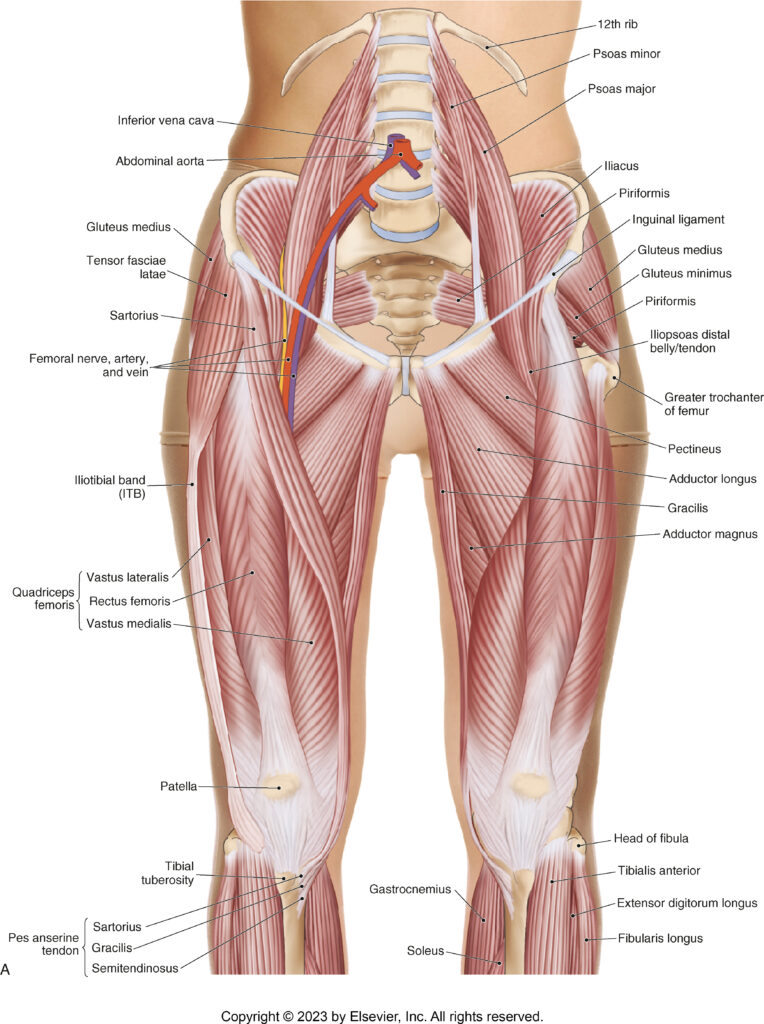
Anterior view of hip joint musculature. Permission Dr. Joe Muscolino – The Muscular System Manual 5ed.
The pectineus is in the anterior proximal thigh, immediately medial to the psoas major and immediately lateral to the adductor longus. As stated, it is considered to be a hip flexor. It is also considered to be a hip adductor, so it is part of the adductor group (pectineus, adductor longus, gracilis, adductor brevis, and adductor magnus). Superior (proximal) to the pelvic bone attachment would be the attachment of the rectus femoris onto the pubic bone (not seen in the above illustration).
Posteriorly, attaching onto the pectineal line of the femur, the pectineus is located proximal to the muscles that attach onto the linea aspera (vastus medialis, intermedius, and lateralis muscles, adductor longus, brevis, and magnus muscles, and the short head of the biceps femoris).
Role in Lower Crossed Syndrome
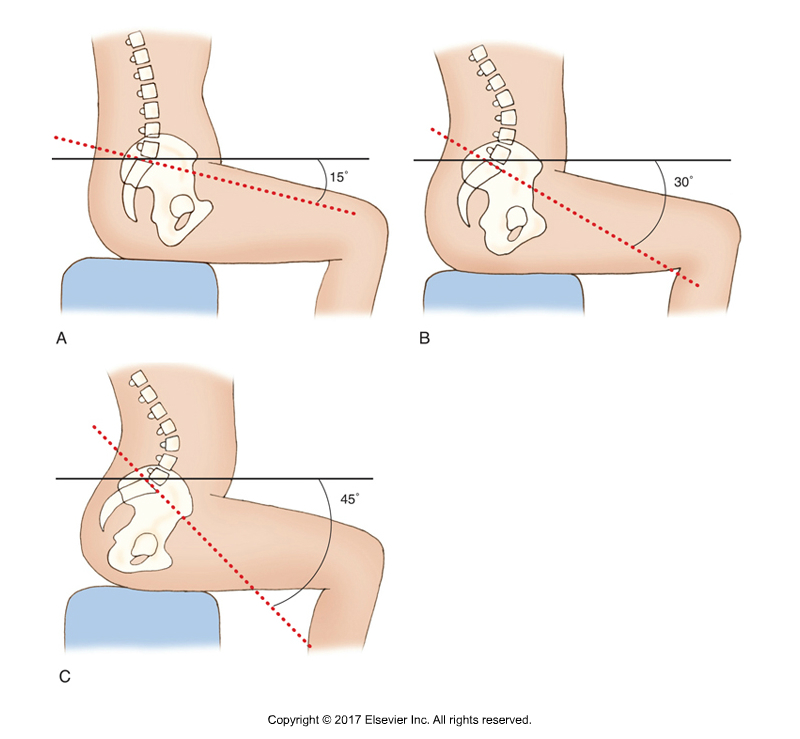
Sacral base angle. Note the relationship between the sacral base angle and the lumbar lordotic curve. Permission Dr. Joe Muscolino – Kinesiology – The Skeletal System and Muscle Function 4ed.
When hip flexors are tight, because we are so often standing and therefore in closed-chain mechanics, these muscles often play out their tension upon the pelvis, resulting in excessive anterior tilt of the pelvis.
When the pelvis is in excessive anterior tilt, the sacral base angle increases, resulting in hyperlordosis (excessive extension) of the lumbar spine. This increases the load upon the facet joints, often causing low back pain, as well as accelerating possible osteoarthrosis (osteoarthritis) in the long run.
Excessive pelvic anterior tilt with concomitant hyperlordosis of the lumbar spine is a postural distortion pattern known as lower crossed syndrome.
Palpating the Pectineus
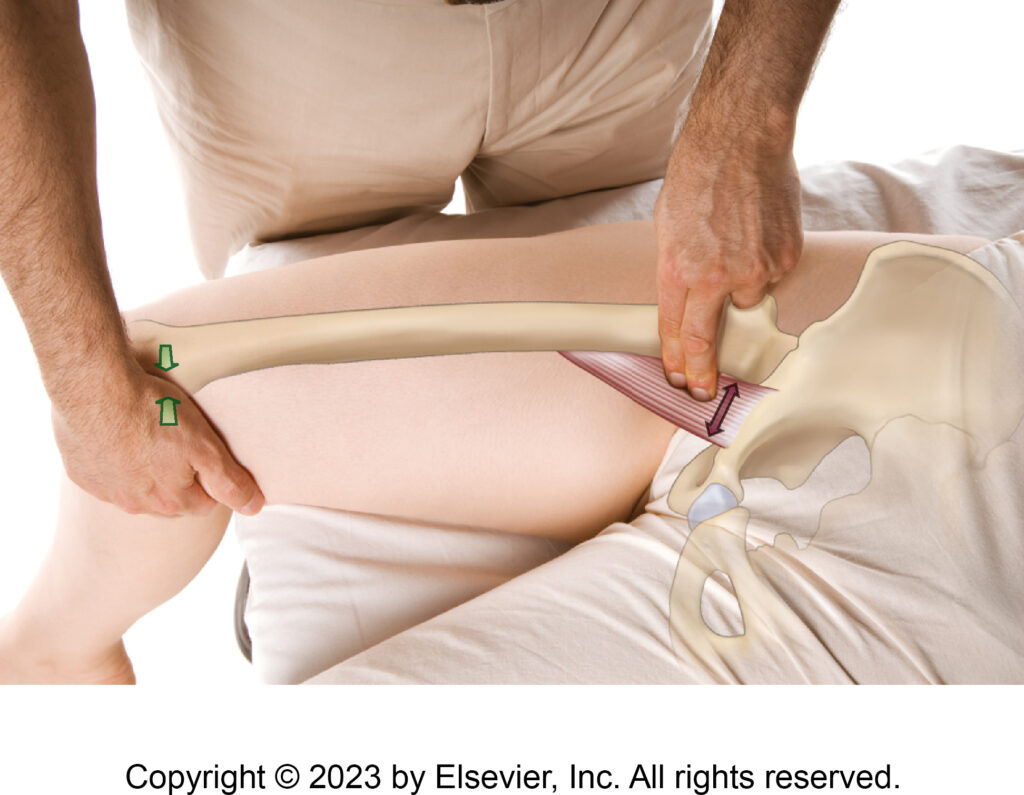
Palpation of the pectineus. Permission Dr. Joe Muscolino – The Muscle and Bone Palpation Manual 3ed.
The pectineus is superficial so it can be easily palpated in the proximal anterior thigh. Either find the psoas major femoral belly and drop off it medially; or find the proximal tendon of the adductor longus and drop off it laterally. The adductor longus tendon is very prominent and easily palpable, even when the muscle it relaxed, so this is usually the easiest landmark to use when palpating the pectineus.
Have the client supine on the table with their thighs on the table and their (lower) legs off the table. If palpating the right-side pectineus, then have the client place their left foot on the table to help stabilize the pelvis (not seen in the illustration above because it would block visualization of the palpation technique). Find the adductor longus proximal tendon and drop off it laterally and you will be on the pectineus (be sure to stay far proximal, close to the inguinal ligament).
Now ask the client to either adduct the thigh at the hip joint against your resistance (or you can ask for flexion or even a combination of flexion with adduction against your resistance) and feel for the pectineus to engage and pop. Move your palpating finger pads a baby step distal along the pectineus and ask the client to engage the muscle again and feel for it to engage and harden again. Repeat this process until you have palpated the entirety of the muscle.
What you are feeling for is the change in tissue texture from soft to hard, to soft to hard, again, etc.
Once you have discerned as much of the pectineus as possible, have the client relax and assess its health at baseline tone.
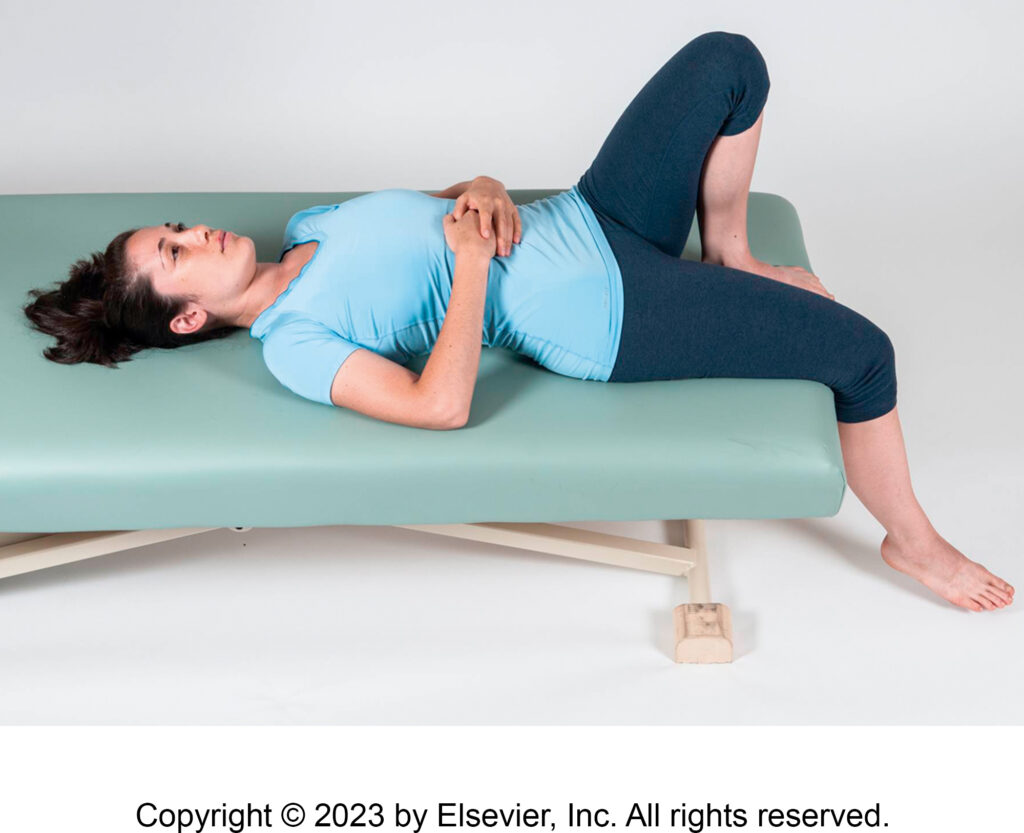
Be sure to have the client’s other foot on the table to help stabilize their pelvis and lumbar spine. Permission Dr. Joe Muscolino – The Muscle and Bone Palpation Manual 3ed.
Note: The position in which the client has both thighs on the table, but one or both (lower) legs off the table can be uncomfortable for their low back. This is because a having a leg hanging off the table tends to pull the pelvic bone on that side into anterior tilt, which can then pull the sacrum with it into anterior tilt (nutation), which then increases the lumbar lordotic curve of extension, loading and jamming the facet joints, likely causing low back discomfort or pain. For these reason, it is important to have the foot of the other lower extremity (the one not being palpated) on the table to at least stabilize that-side pelvic bone. Even with this, it is important to not keep the client in this position for too much time. It is the best and most effective position in which to palpate the hip flexors, but it can be challenging for their low back.
Stretching the Pectineus
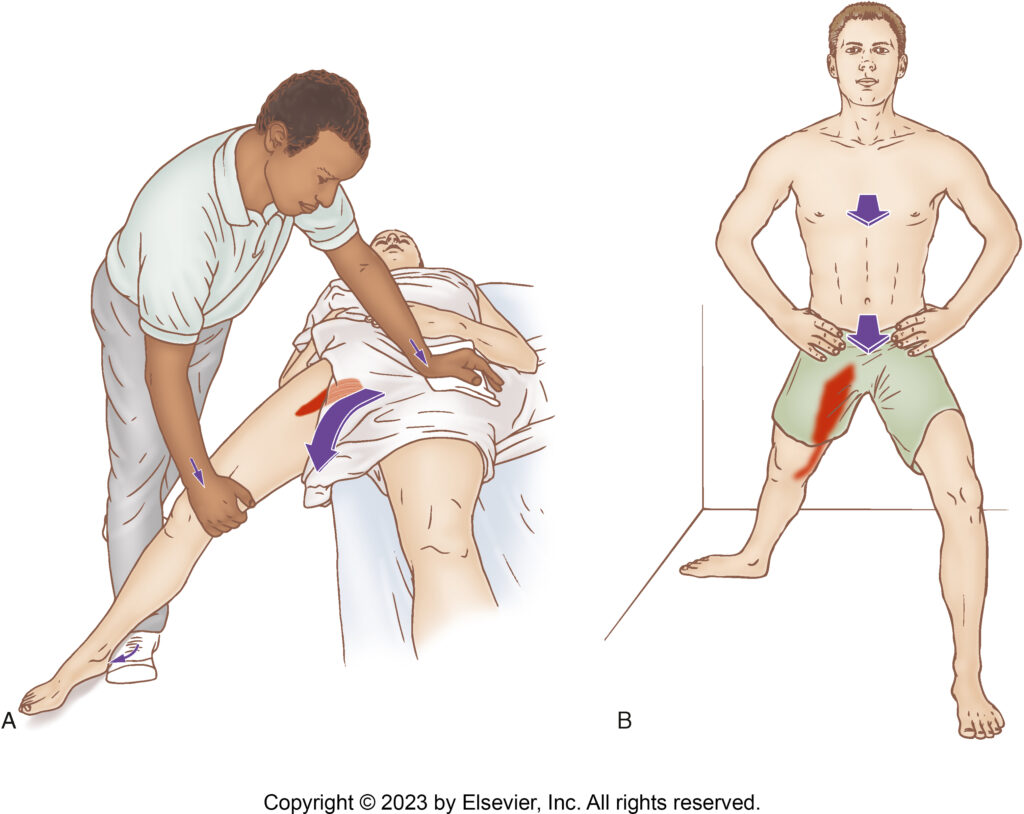
Stretching the pectineus. Permission Dr. Joe Muscolino – The Muscle and Bone Palpation Manual 3ed.
Stretching a muscle is making it longer, which is simply doing the opposite of the muscle’s concentric/shortening joint action functions. The pectineus is a flexor and adductor of the thigh at the hip joint, so it is stretched with extension and abduction.
For the therapist-assisted stretch protocol, this can be done with the client supine on the table with their thigh off the side, dropping it down into extension toward the floor with abduction away from the midline (note the stabilization contact on the opposite-side ASIS with a cushion under the contact for client comfort).
For the client self-care protocol, the hip flexor lunge stretch can be done, but modified with some abduction (and lateral rotation) to preferentially target the pectineus.
Massaging the Pectineus
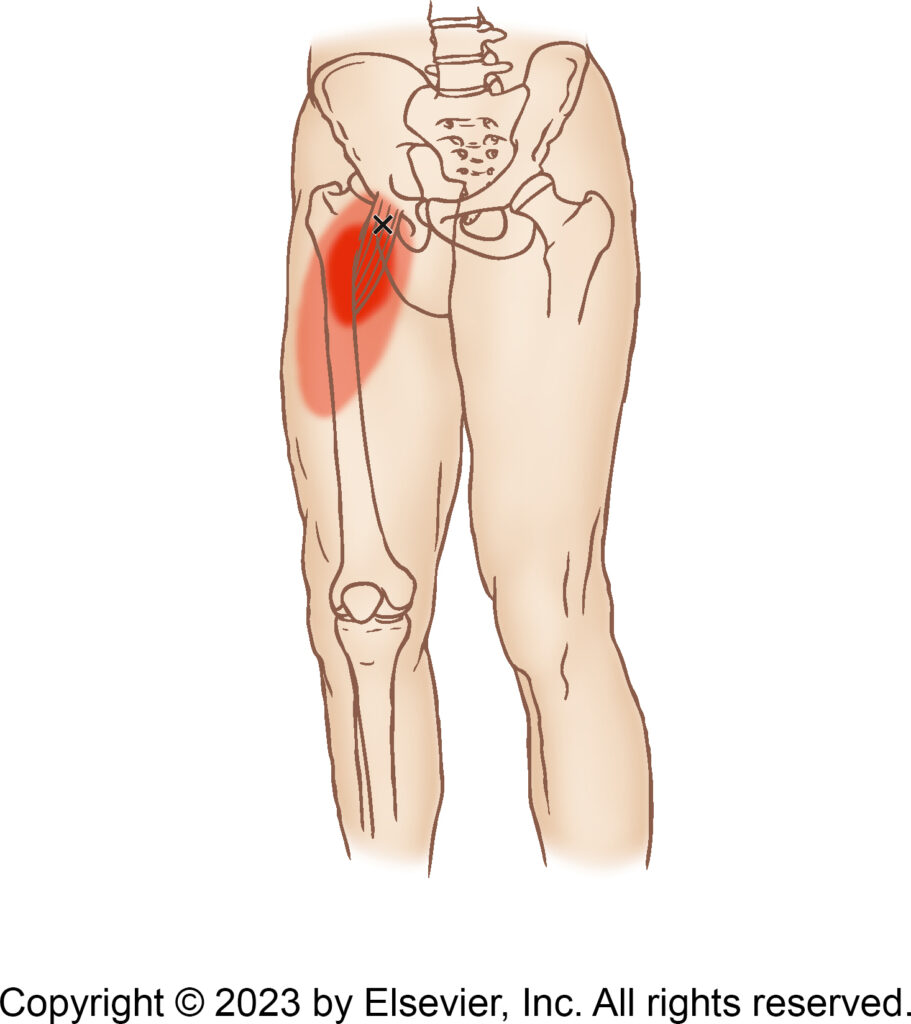
Pectineus trigger points and their referral zones. Permission Dr. Joe Muscolino – The Muscle and Bone Palpation Manual 3ed.
Because the pectineus is superficial, soft tissue manipulation massage is relatively easy. As with the palpation protocol, simply find the proximal tendon of the adductor longus and drop immediately off it laterally, staying close to the inguinal ligament. Once you have located the pectineus, it can be worked with whatever strokes you would like. Longitudinal or transverse strokes, or perhaps circular strokes along its path.
Conclusion
As a hip flexor, the pectineus is an extremely important muscle because of its involvement in the postural distortion pattern known as lower crossed syndrome. Because of the location of the pectineus medially, it is also considered to be part of the adductor group. As such, the pectineus is an excellent example of a transitional muscle, being located within two functional groups.
Biography

Dr. Joseph Muscolino, DC is a soft-tissue oriented chiropractic physician and leading educator in manual and movement therapy. He is the author of eight major textbooks published by Elsevier and LWW, translated into more than 10 languages and used worldwide in core curriculum and clinical practice. A global lecturer and NCBTMB-approved CE provider, he offers COMT (Clinical Orthopedic Manual Therapy) certification workshops across the US and internationally. Visit his website at: LearnMuscles.com.
LearnMuscles Continuing Education (LMCE) is one of his online subscription platforms with over 4,000 video lessons for manual and movement therapy professionals, and more than 320 free NCBTMB-CE hours.
Frequently Asked Questions About the Pectineus Muscle
What is the pectineus muscle? The pectineus is a transitional hip muscle located anteromedially in the thigh. It occupies both the flexor and adductor compartments, making it unique among thigh muscles. It is innervated by the femoral nerve and is primarily classified as a hip flexor, though it also functions as a hip adductor.
Where does the pectineus attach? The pectineus originates from the pectineal line of the pubic bone and inserts onto the pectineal line on the posterior femur. The femoral attachment can be thought of as the proximal extension of the linea aspera on the medial side, running toward the lesser trochanter.
What does the pectineus muscle do? In open-chain mechanics, the pectineus flexes, adducts, and weakly medially rotates the thigh at the hip joint. Because it has one line of pull across all three cardinal planes, it produces an oblique-plane motion combining all three actions (“flexo-adducto-medial rotation”). In closed-chain mechanics, it creates anterior pelvic tilt, ipsilateral pelvic elevation, and ipsilateral pelvic rotation.
What is the role of the pectineus in lower crossed syndrome? As a hip flexor, a tight pectineus can contribute to excessive anterior pelvic tilt in standing (closed-chain) posture. This increases the sacral base angle, causing hyperlordosis of the lumbar spine (lower crossed syndrome), increased facet joint loading, possible low back pain, and potential long-term osteoarthrosis.
How do you palpate the pectineus? To palpate the pectineus, locate the proximal tendon of the adductor longus (a prominent, easily palpable landmark) and move laterally from it, staying close to the inguinal ligament in the proximal anterior thigh. With the client supine, ask them to adduct or flex the thigh against resistance to feel the muscle engage and harden.
How do you stretch the pectineus muscle? Because the pectineus flexes and adducts the thigh, it is stretched by combining hip extension and abduction. A therapist can assist by positioning the client supine with the thigh dropping off the table into extension and abduction. For self-care, a hip flexor lunge stretch modified with abduction and lateral rotation preferentially targets the pectineus.
Is the pectineus part of the adductor group? Yes. The adductor group consists of the pectineus, adductor longus, gracilis, adductor brevis, and adductor magnus. While the pectineus is primarily innervated by the femoral nerve (like the hip flexors), its medial position means it is also classified as a member of the adductor group, making it a true transitional muscle.