
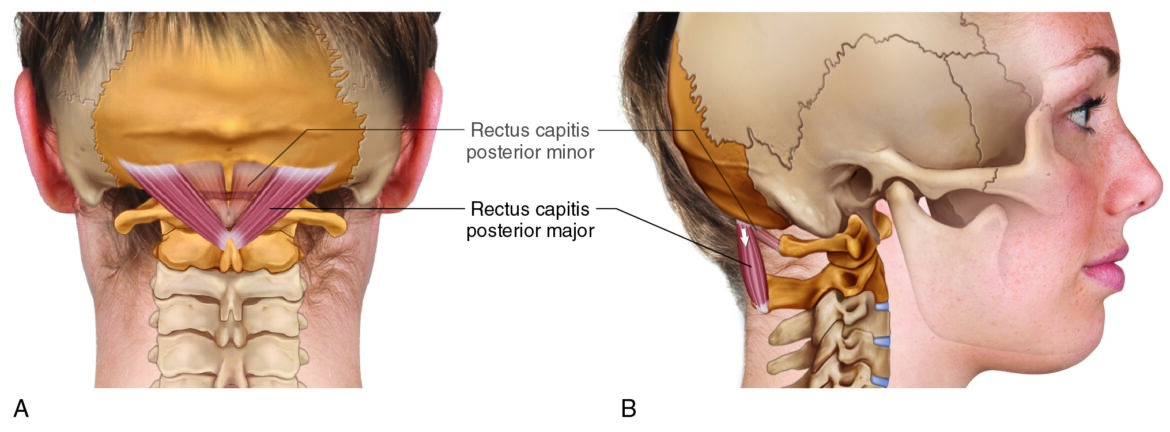
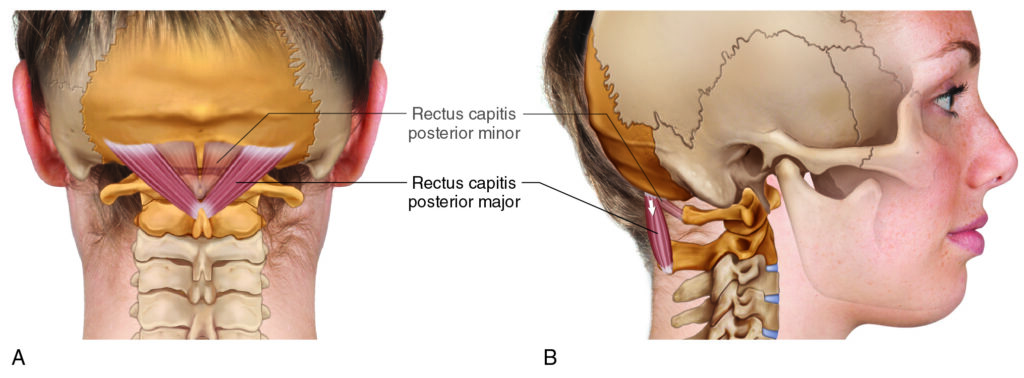
Rectus capitis posterior major. Permission Dr. Joe Muscolino (learnmuscles.com).
Introduction
Rectus Capitis Posterior Major Attachments
The RCPMaj attaches inferiorly on C2 (the axis) to superiorly on the occiput.
More specifically, it runs from…
- the spinous process (SP) of C2 (origin)
to the
- the lateral ½ of the inferior nuchal line of the occiput (insertion)
The Suboccipital Group
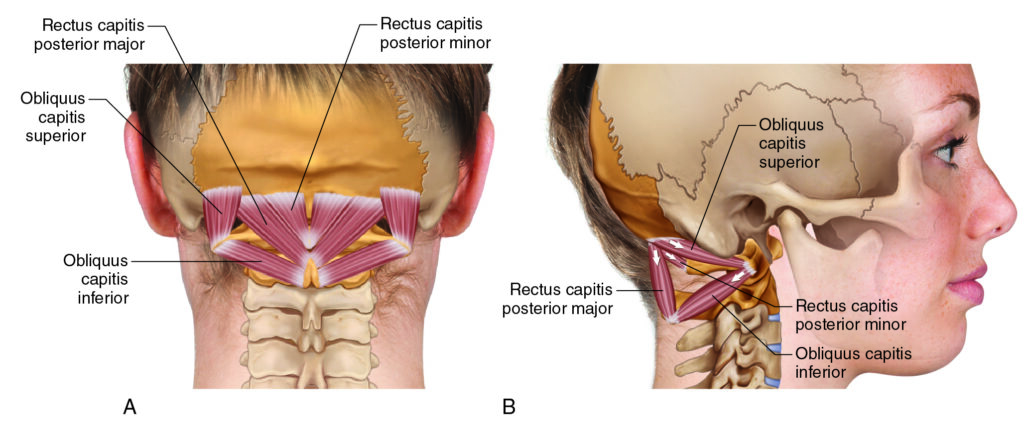
The suboccipital group: posterior and right lateral views. Permission Dr. Joe Muscolino (learnmuscles.com).
The RCPMaj is one of four muscles in the suboccipital group. These four muscles are the
- Rectus capitis posterior major (RCPMaj)
- Rectus capitis posterior minor (RCPMin)
- Obliquus capitis inferior (OCI)
- Obliquus capitis superior (OCS)
Each of the muscles of the suboccipital group has its own joint action (concentric/shortening contraction function), but as a group, these muscles are likely more important for fine stabilization positioning of the head and proprioception (sensing the position and movement of the body in space) because there is a large concentration of proprioceptors located within them.
Rectus Capitis Posterior Major Functions
The RCPMaj crosses the atlanto-occipital joint (AOJ) posteriorly with a vertical direction to its line of pull, therefore it extends the head on the atlas (at the AOJ).
The RCPMaj also can assist with lateral flexion and ipsilateral (same-side) lateral flexion of the head at the AOJ.
However, as mentioned, the RCPMaj also has a proprioceptive function to help nervous system awareness of the posture (and movement) of the head.
Note: The RCPMaj also crosses the atlanto-axial (C1-C2) joint between the atlas and axis. But this joint allows little to no extension, hence the RCPMaj is not usually considered to have an extension motion there.
However, the AOJ does allow a great deal of rotation (it accounts for nearly half of the rotation in the cervicocranial region), therefore, the RCPMaj, via its pull on the head, can transfer that pulling force to the atlas, and therefore the AOJ. For this reason, the RCPMaj can create ipsilateral rotation of the atlas on the axis at the AOJ.
Nearby Anatomy
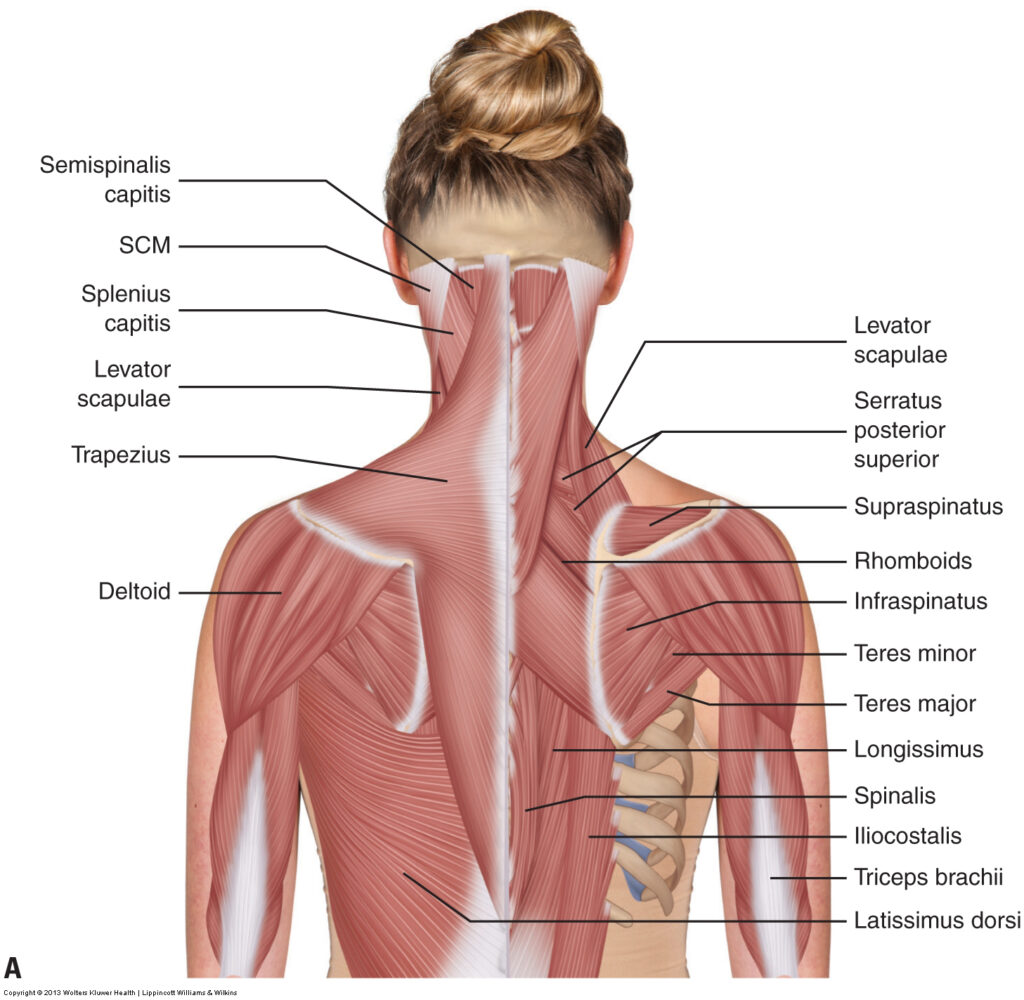
Posterior view of the neck – superficial views. Permission Dr. Joe Muscolino (learnmuscles.com).
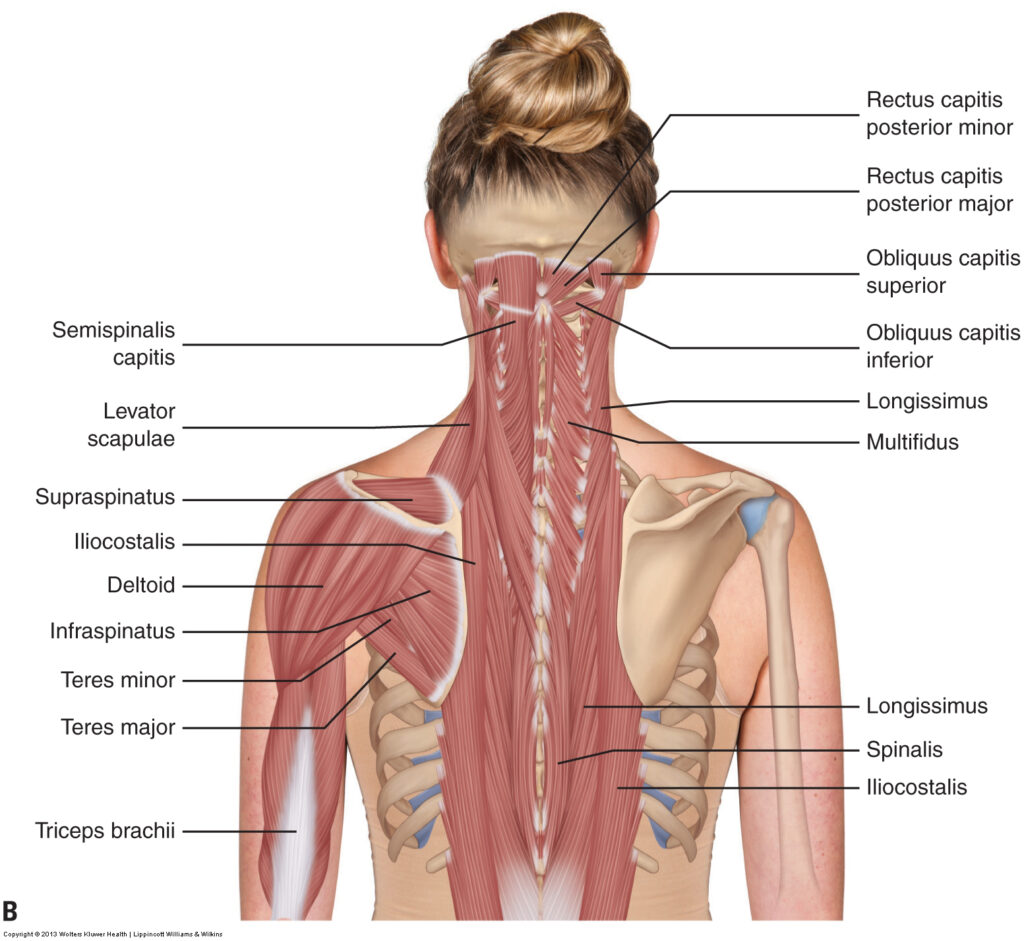
Posterior view of the neck – deeper views. Permission Dr. Joe Muscolino (learnmuscles.com).
As mentioned, the RCPMaj is one of the four muscles of the suboccipital group. Directly medial to the RCPMaj is the RCPMin; directly lateral are the OCI and OCS. The RCPMaj lies deep to the semispinalis capitis (of the transversospinalis group), which in turn, lies deep to the upper trapezius.
For an atlas of high-resolution musculoskeletal anatomy images that you can download and use in your teaching, click here.
Palpating the Rectus Capitis Posterior Major
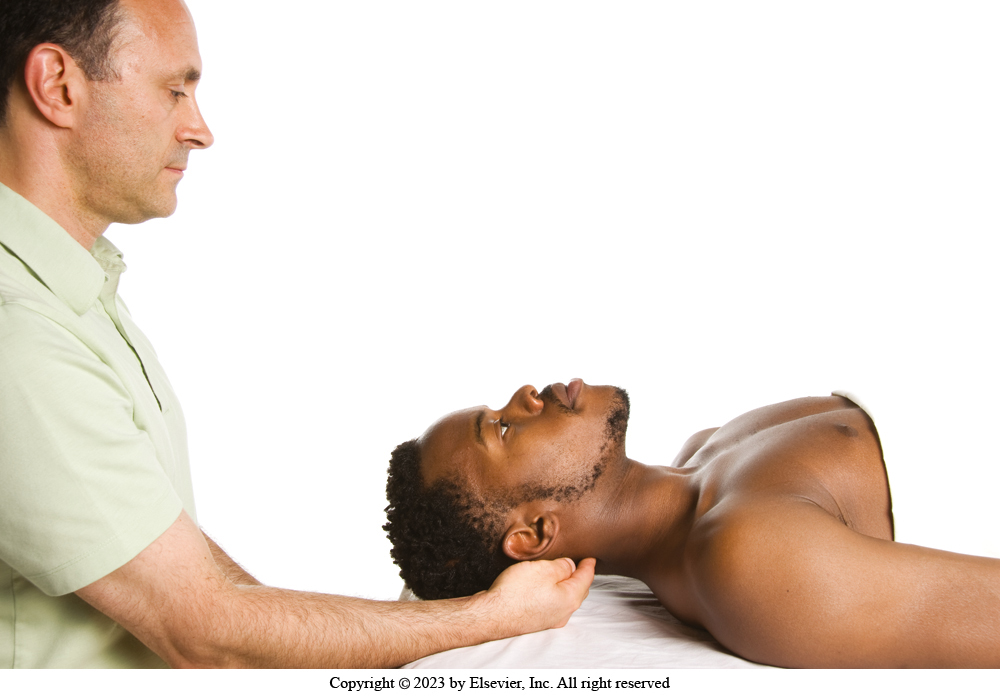
Palpation position for the RCPMaj. Permission Dr. Joe Muscolino – The Muscle and Bone Palpation Manual 3ed.
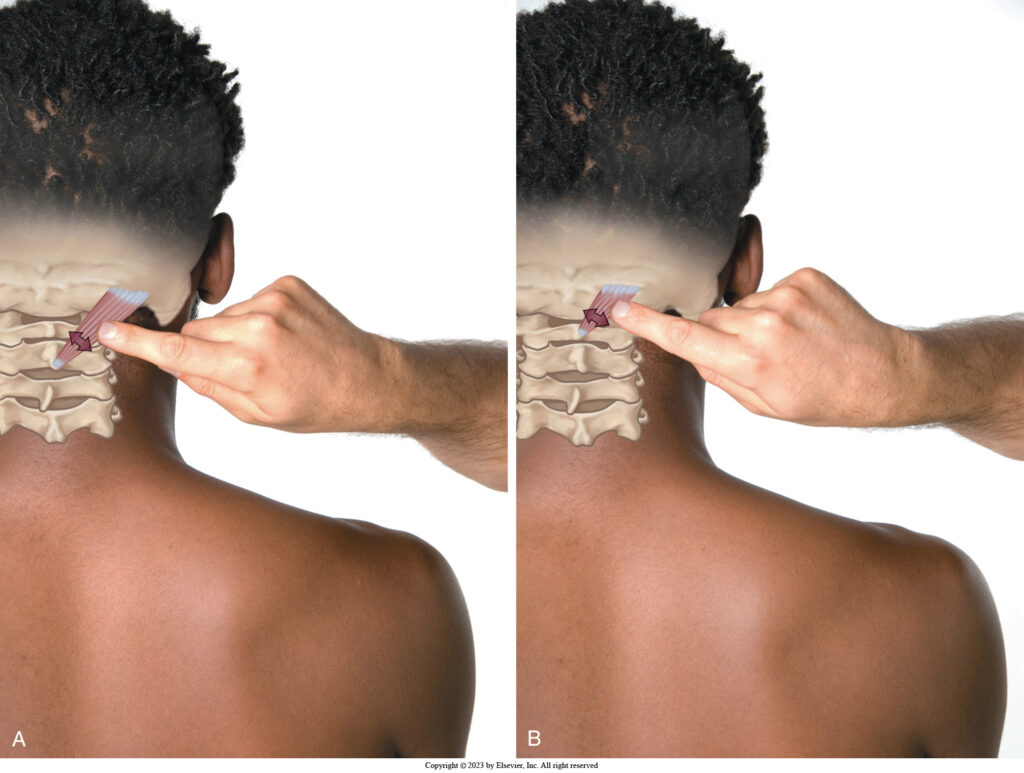
Locating the RCPMaj (and RCPMin). Permission Dr. Joe Muscolino – The Muscle and Bone Palpation Manual 3ed.
To palpate the RCPMaj, we need to first find the SP of the axis/C2. This is usually easy accomplished because the SP of C2 is very large and prominent. With the client supine, palpate perfectly midline on the occiput, then drop directly inferior in the neck. You will feel a space, which is over the recessed posterior tubercle of the atlas/C1. Continue palpating inferiorly until you feel a large bony protuberance; this is the SP of C2.
Now palpate immediately lateral and a bit superior to the SP of C2, and you will be on the RCPMaj. Strum perpendicularly across it (strumming perpendicularly across the target palpation structure is always the optimal way to feel and discern it). Given that the RCPMaj is running diagonally upward at approximately a 45-degree angle (inferomedial to superolateral), strumming perpendicularly will be diagonally in the opposite direction (from superomedial to inferolateral). Once located, palpate the entirety of the muscle from C2 to the occiput.
Your ability to discern the RCPMaj from more superficial musculature (semispinalis capitis and upper trapezius) will depend on that musculature being fairly loose at baseline tone. If the RCPMaj is tight at baseline tone, it will be easier to palpate and discern.
Stretching the Rectus Capitis Posterior Major
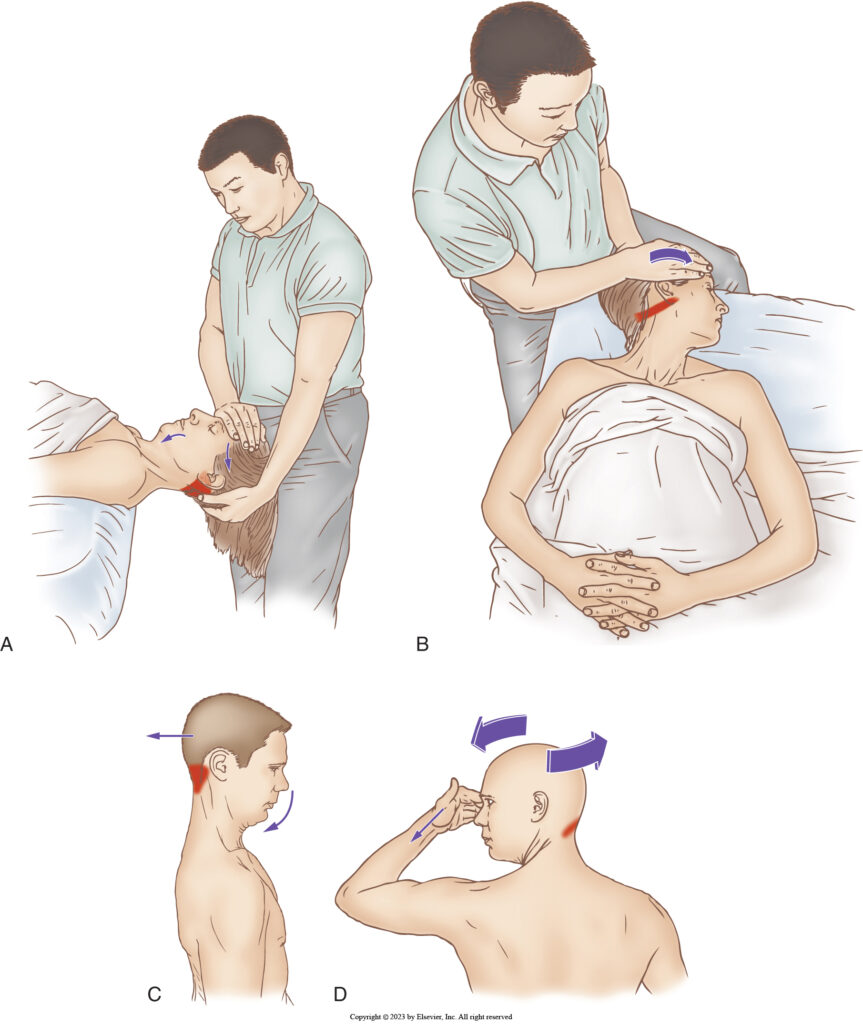
Stretching the suboccipital musculature. A & C, RCPMaj. B & D, OCI. Permission Dr. Joe Muscolino – The Muscle and Bone Palpation Manual 3ed.
Given that the RCPMaj extends the head at the AOJ, we can stretch it by flexing the head upon the atlas at the AOJ; see accompanying figures A (therapist-assisted) and C (client self-care). This movement needs to be precisely oriented at moving the head and not the neck (think of nodding the head forward). If a small amount of lateral flexion is added to the flexion motion, then the stretch will be preferentially focused on the contralateral (opposite-side) RCPMaj.
Note: The stretch protocol shown here for the RCPMaj will also effectively stretch the RCPMin and the OCS. Figures B and D here demonstrate therapist-assisted and client self-care stretch for the right-side OCI.
Massaging the Rectus Capitis Posterior Major
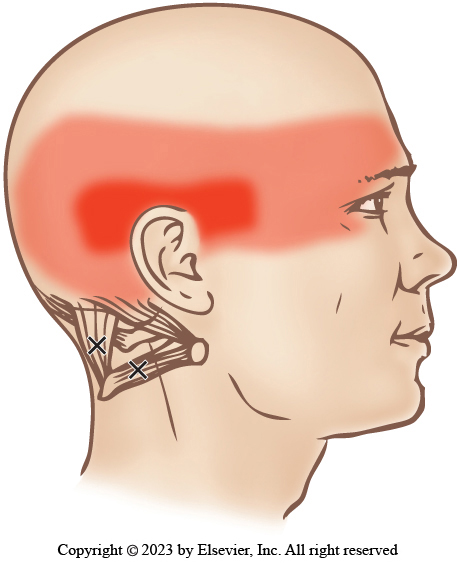
Suboccipital TrPs. Permission Dr. Joe Muscolino – The Muscle and Bone Palpation Manual 3ed.
Because of the pervasiveness of forward head posture with the use of smart phones and other digital devices, the RCPMaj (and indeed all of the suboccipital musculature) is often tight. Indeed, myofascial trigger points (TrPs) located in the RCPMaj are common and usually refer into the head. In other words, hypertonicity of the RCPMaj (and other suboccipital muscles) is often responsible for tension headaches, and therefore should be carefully palpated in clients who experience chronic tension headaches.
For this reason, deep massage (it must be deep to reach the RCPMaj that is deep to the upper trap and semispinalis capitis) can be very beneficial. Remember that deep work is usually well tolerated by the client if you first warm up the area, and then sink in slowly (slowly!), working with the client’s breath.
Conclusion
The rectus capitis posterior major (RCPMaj), as one of the four suboccipital muscles, is an extremely important muscle because it is often tight and implicated with tension headaches. Therefore, it is an extremely important muscles for therapists to able to comfortably and competently assess and treat.

Dr. Joseph Muscolino, DC is a soft-tissue oriented chiropractic physician and leading educator in manual and movement therapy. He is the author of eight major textbooks published by Elsevier and LWW, translated into more than 10 languages and used worldwide in core curriculum and clinical practice. A global lecturer and NCBTMB-approved CE provider, he offers COMT (Clinical Orthopedic Manual Therapy) certification workshops across the US and internationally. Visit his website at: LearnMuscles.com.
LearnMuscles Continuing Education (LMCE) is one of his online subscription platforms with over 4,000 video lessons for manual and movement therapy professionals, and more than 320 free NCBTMB-CE hours.

