
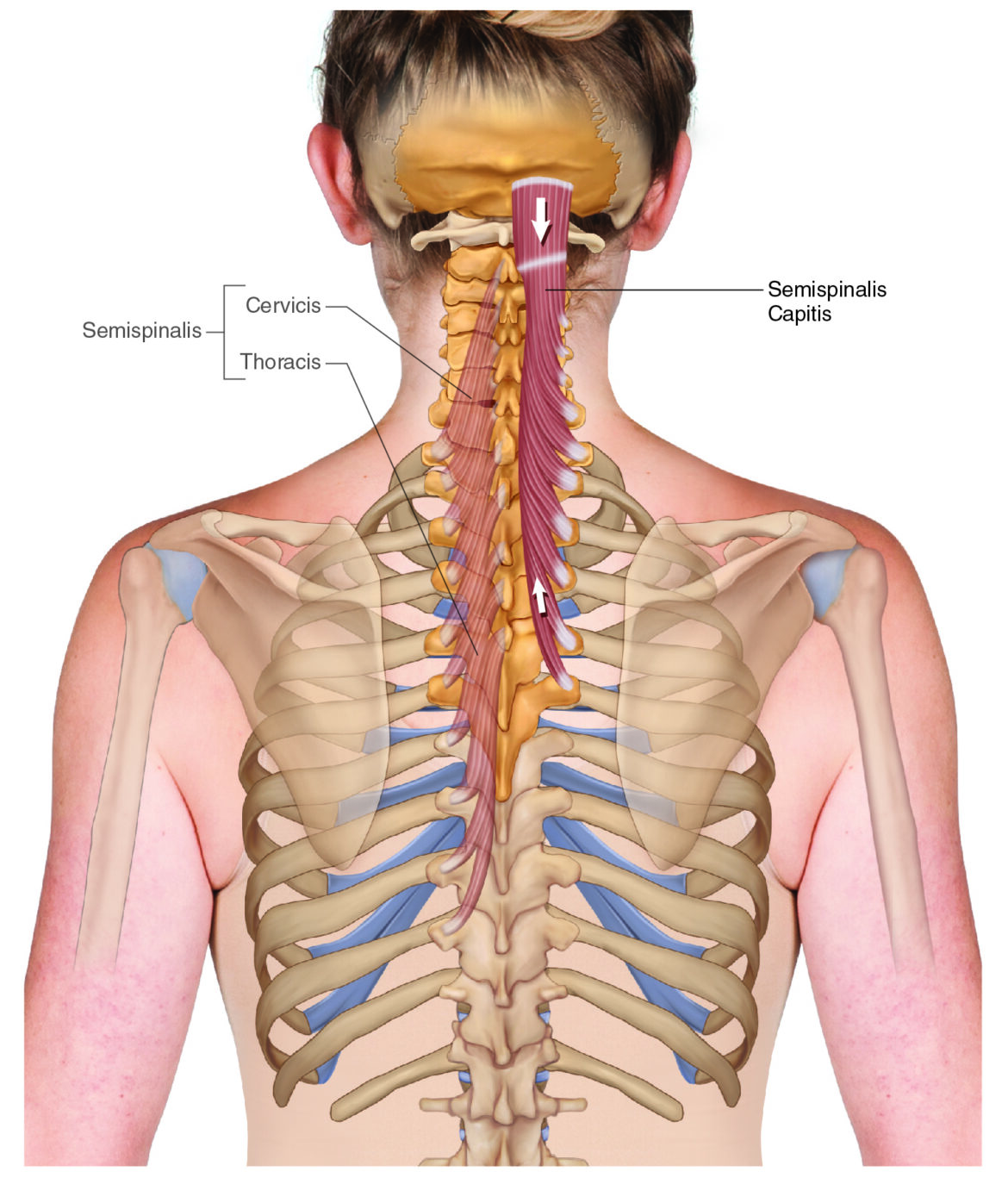
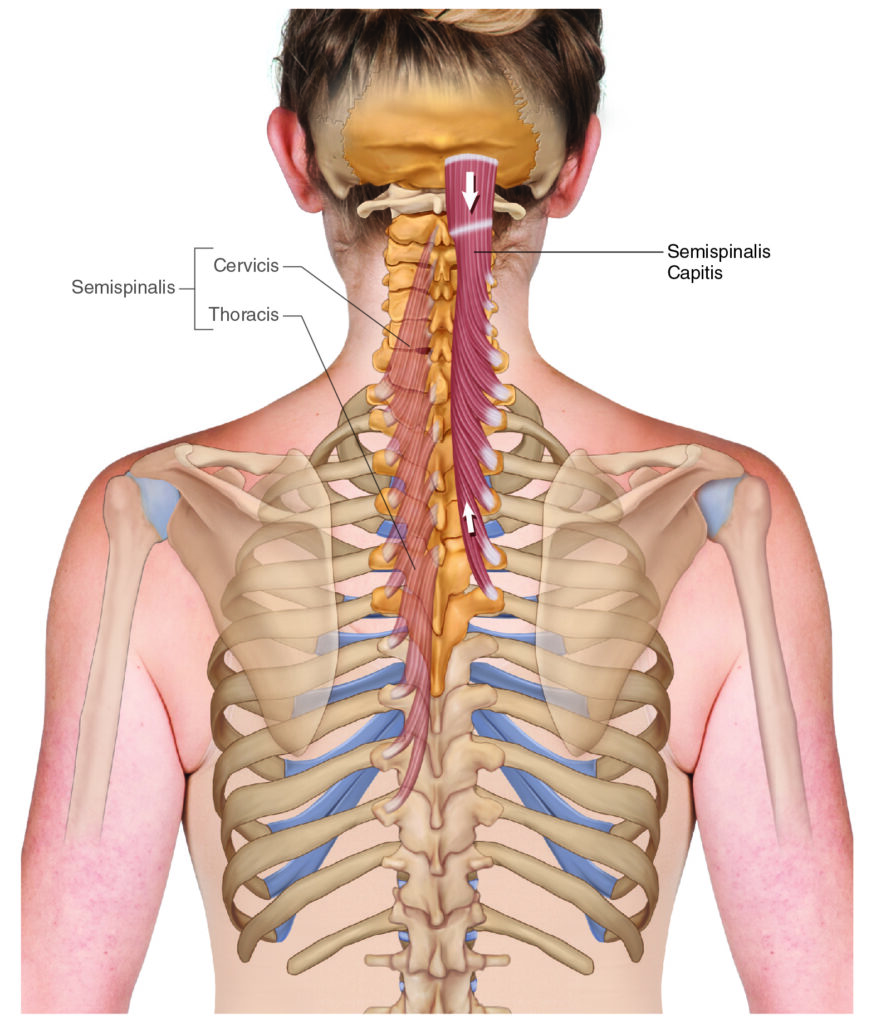
Semispinalis Capitis. Permission Dr. Joe Muscolino (learnmuscles.com).
Quick Answer: The semispinalis capitis is the largest muscle in the posterior neck and a leading — yet frequently missed — cause of neck pain and tightness. It is commonly misattributed to the upper trapezius or erector spinae. Proper palpation, stretching, and massage of the semispinalis capitis is essential for effective neck pain treatment.
Introduction
The semispinalis capitis is one of the three parts of the semispinalis muscle (semispinalis thoracis, cervicis, and capitis) of the transversospinalis group. The transversospinalis group musculature itself (semispinalis, multifidus, and rotatores) lies deep in the laminar groove (between the transverse processes/TPs and spinous processes/SPs), far medial in the neck.
The semispinalis capitis is one of my favorite muscles in the human body because it is so often the cause of pain and tightness in the posterior neck; yet it is rarely recognized as the cause of the pain and tightness, even though it is the largest muscle in the back of the neck!
All too often, therapists look for the usual list of suspects when working with the client’s neck, but all too often, the actual cause is what might be termed the unusual suspect, the semispinalis capitis!
Mistaken Assessment of Semispinalis Capitis
What Causes Posterior Neck Pain? Common Misdiagnoses…
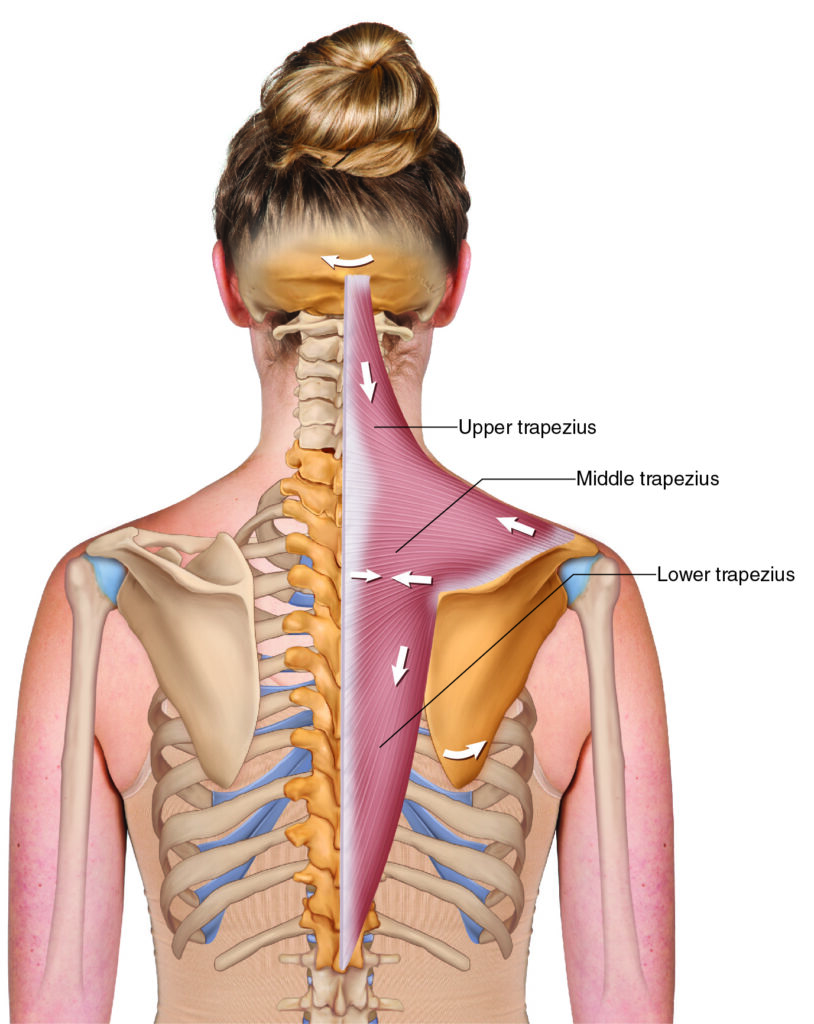
Trapezius. Permission Dr. Joe Muscolino (learnmuscles.com).
Upper Trapezius?
Pain and tightness of the semispinalis capitis is most often blamed on the upper trapezius, which is ironic because it rarely causes pain in the mid to upper neck. The upper trapezius is a very important muscle at the top of the shoulder (cervicothoracic region), indeed at that location, it has the most common trigger point (TrP) in the entire body. But, as the upper trapezius ascends the neck, it thins and narrows tremendously. Indeed, it is rarely of any consequence in the mid to upper neck. But because it overlies the semispinalis capitis in the upper neck, when the semispinalis is tight, it is easy to blame it on the more superficial upper trap.
Erector Spinae?
The other muscle that tight and painful semispinalis capitis is often blamed on is erector spinae.
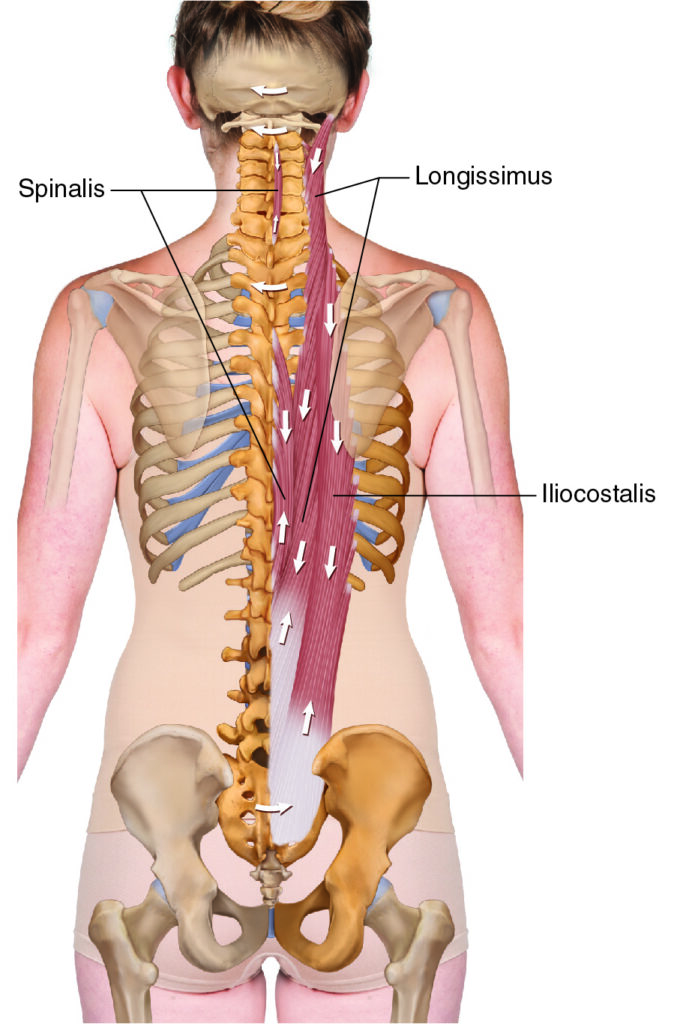
Erector Spinae. Note how little presence it has in the neck. Permission Dr. Joe Muscolino (learnmuscles.com).
This is totally fanciful because there is barely any erector spinae musculature in the neck. The only erector spinae of any consequence in the neck is the longissimus capitis, which is far lateral, attaching way out onto the mastoid process of the temporal bone. Also, texts, mine included, cite there being spinalis capitis of the erector spinae group in the midline of the neck, but if you have ever been to a cadaver lab, you will see that there is rarely any spinalis capitis to be seen. This is more theory than reality (what is seen in the accompanying illustration is rarely found in the body). Any spinalis capitis that exists, is usually blended into the semispinalis capitis. I have spent thousands of hours in the cadaver lab and cannot recall the last time I saw any distinct spinalis capitis musculature as seen in standard anatomy texts.
So, why is the semispinalis capitis not recognized as the causative musculature when the client has a tight and painful neck? One reason might be that the upper trapezius and erector spinae muscles are so important in other areas, that therapists might automatically default to blaming them higher up in the neck. Another reason might be that many therapists do not spend enough time looking at deeper views of musculature to appreciate the deeper semispinalis capitis. Also, even deeper views, unless they are cross-sections, fail to illustrate just how thick and large the semispinalis capitis is.
For whatever reason, I hope that this blog post article will help to give the semispinalis capitis the credit and respect that it deserves.
Semispinalis Capitis Attachments
The semispinalis capitis attaches from the upper thoracic spine, up onto the head.
More specifically, it runs from the …
transverse and/or articular processes from T6 to C4 (origin)
to the
medial occiput, between the superior and inferior nuchal lines (insertion)
Semispinalis Capitis Functions
The semispinalis capitis crosses the cervical spine posteriorly, with a vertical direction to its line of pull, therefore it extends the head and neck at the cervical spinal joints.
It also is located a bit to the side, so it also laterally flexes the head and neck at the cervical spinal joints.
Note: Unlike all the other transversospinalis musculature, it has no rotation capability because it is running directly vertically.
Nearby Anatomy
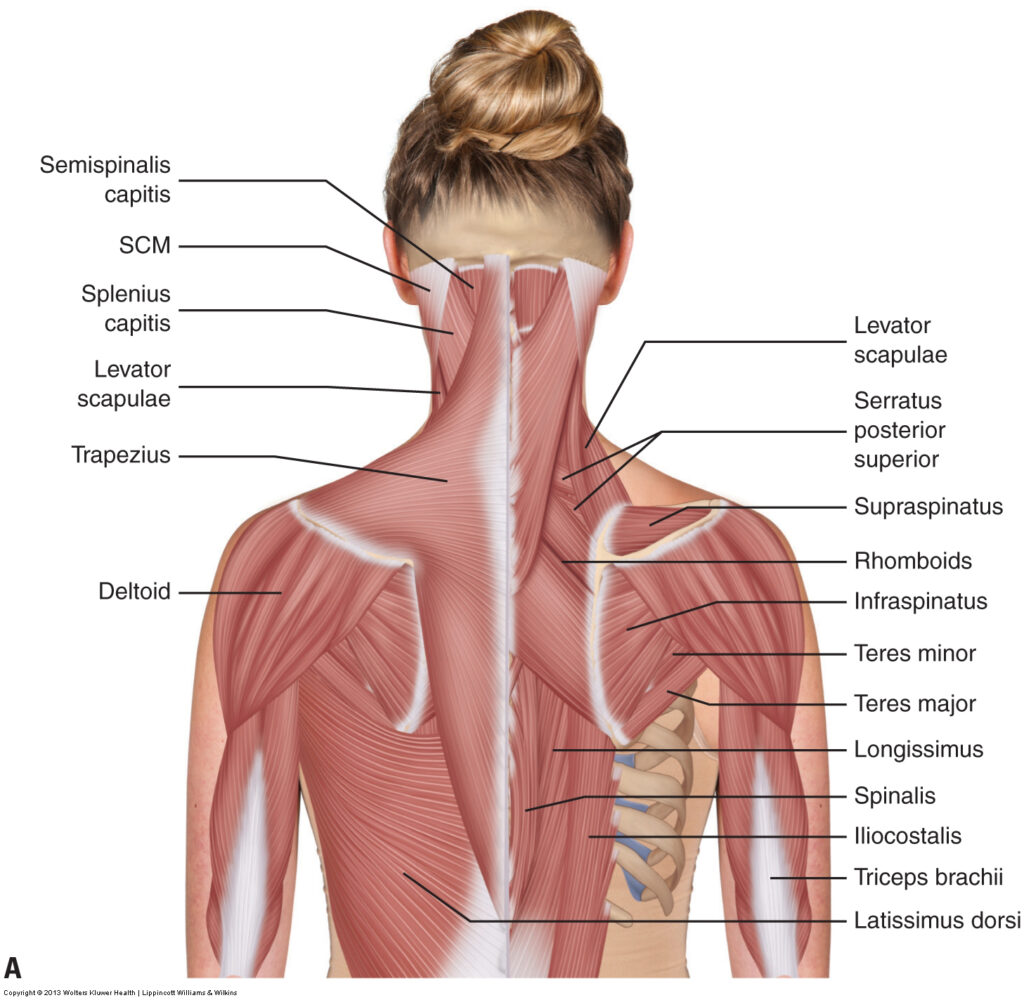
Musculature of the posterior neck – superficial views. Permission Dr. Joe Muscolino (learnmuscles.com).
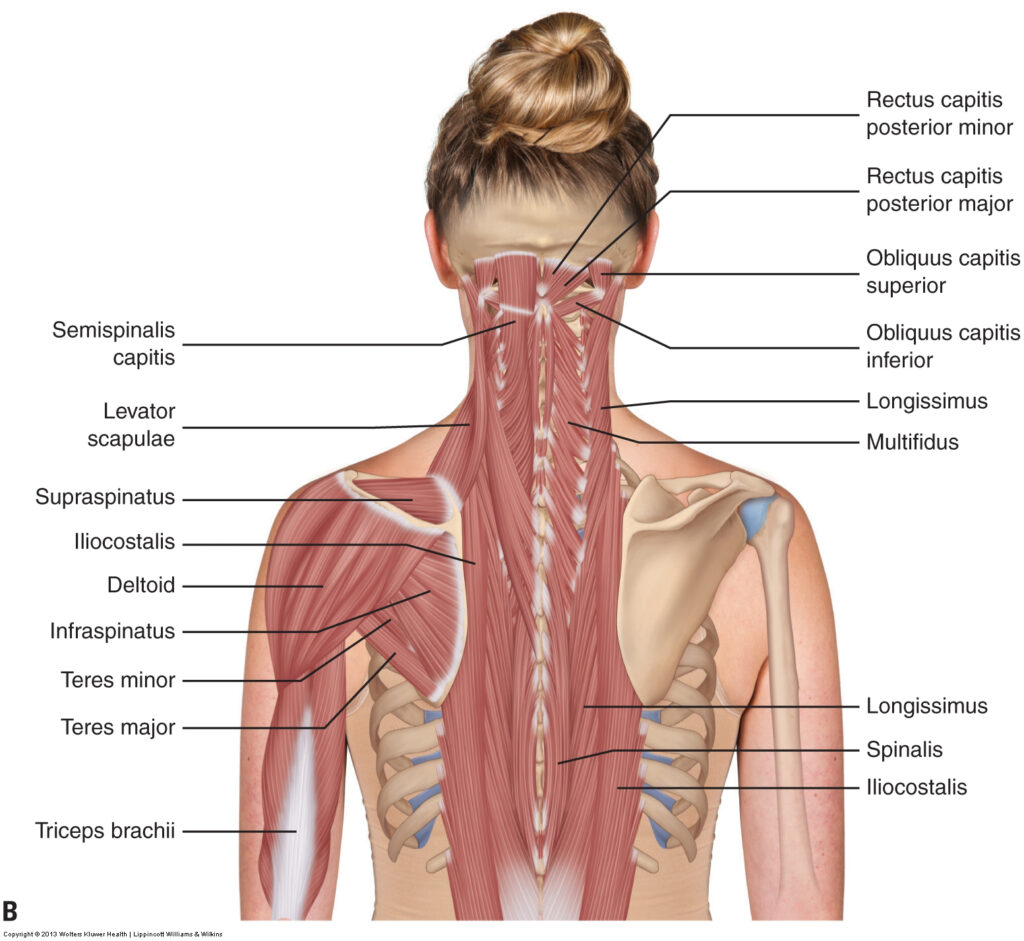
Musculature of the posterior neck – deeper views. Permission Dr. Joe Muscolino (learnmuscles.com).
The semispinalis capitis is directly deep to the upper trapezius in the superior neck, and deep to the splenius capitis and upper trapezius in the mid to lower neck. The semispinalis capitis is superficial to the semispinalis cervicis, as well as the multifidus and rotatores in the mid to lower neck, and superficial to suboccipital musculature in the upper neck/suboccipital region. The obliquus capitis superior lies lateral to the semispinalis capitis.
How to Palpate the Semispinalis Capitis
With the client lying supine, place your palpating fingers immediately inferior to the occiput, far medial over the laminar groove.
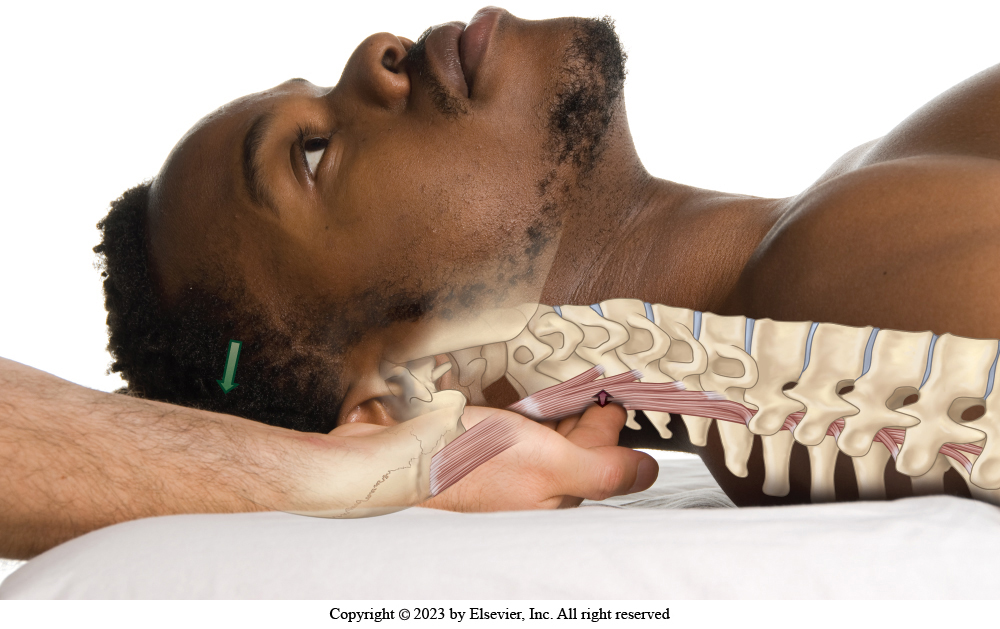
Palpation of the semispinalis capitis. Permission Dr. Joe Muscolino – The Muscle and Bone Palpation Manual 3ed.
I cannot emphasize enough how you need to be as medial next to the spinous processes as possible. Now ask the client to try to extend their head and upper neck by pressing their head down into the table. Feel for the semispinalis to contract and harden. Strum perpendicular horizontally across it (given that it is running vertically) to feel it from its medial border to its lateral border.
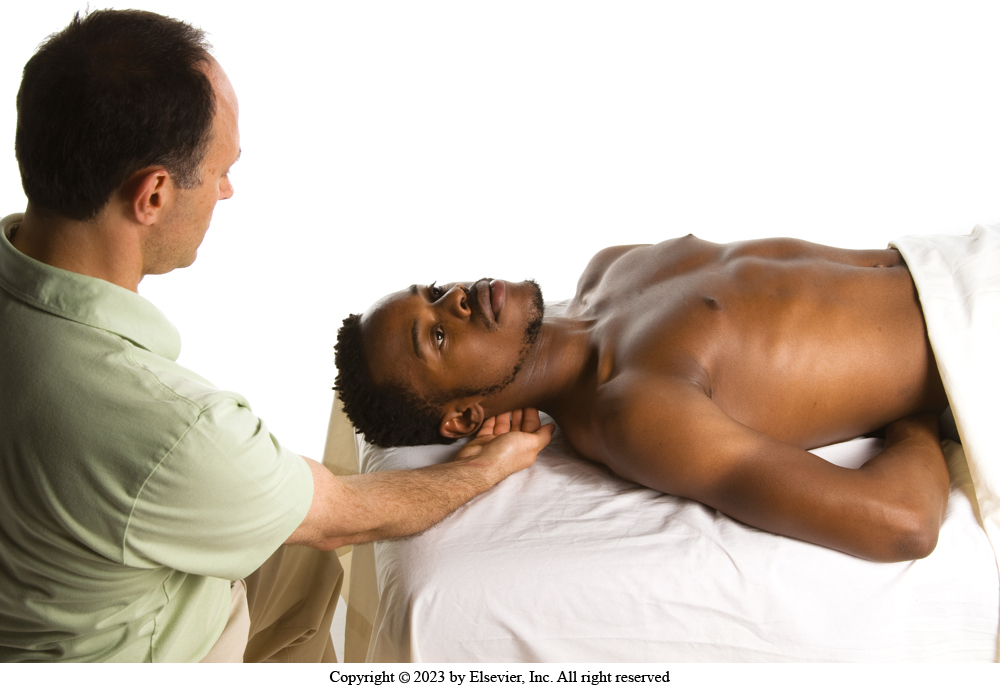
Semispinalis capitis palpation with the client’s hand in the small of the back. Permission Dr. Joe Muscolino – The Muscle and Bone Palpation Manual 3ed.
Asking the client to lie with their hand in the small of their back (see accompanying illustration) can help to inhibit and relax the upper trapezius (via scapulohumeral rhythm) so it is easier to palpate through it.
Once you have located the semispinalis capitis, try to palpate as much of it as possible. If it is tight at baseline tone, as with any deep muscle, it will be easier to palpate and discern it from adjacent musculature. And I will repeat one more time, stay medial. I like to use the SPs as my landmark. I find the SP at any particular level of the neck, and then I drop immediately off it, feeling for the semispinalis capitis.
How to Stretch the Semispinalis Capitis
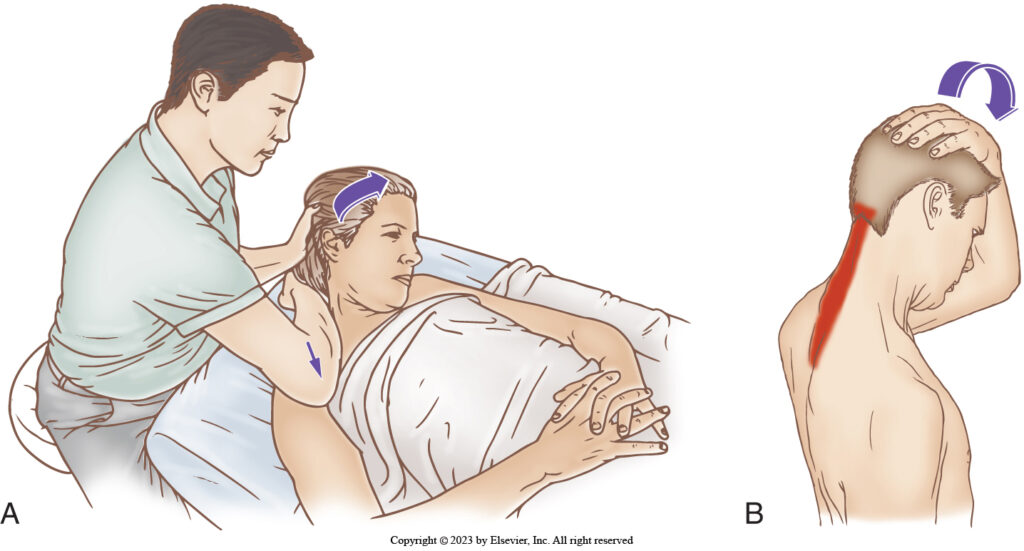
Stretching the right-side semispinalis capitis, therapist-assisted and client self-care. Permission Dr. Joe Muscolino – The Muscle and Bone Palpation Manual 3ed.
Stretching a muscle is making it longer, therefore, all we need to do is the opposite of its joint actions, given that joint actions are concentric shortening functions of the muscle. The semispinalis extends and laterally flexes the head and neck, therefore stretch it with flexion and opposite-side (contralateral) lateral flexion.
How to Massage the Semispinalis Capitis
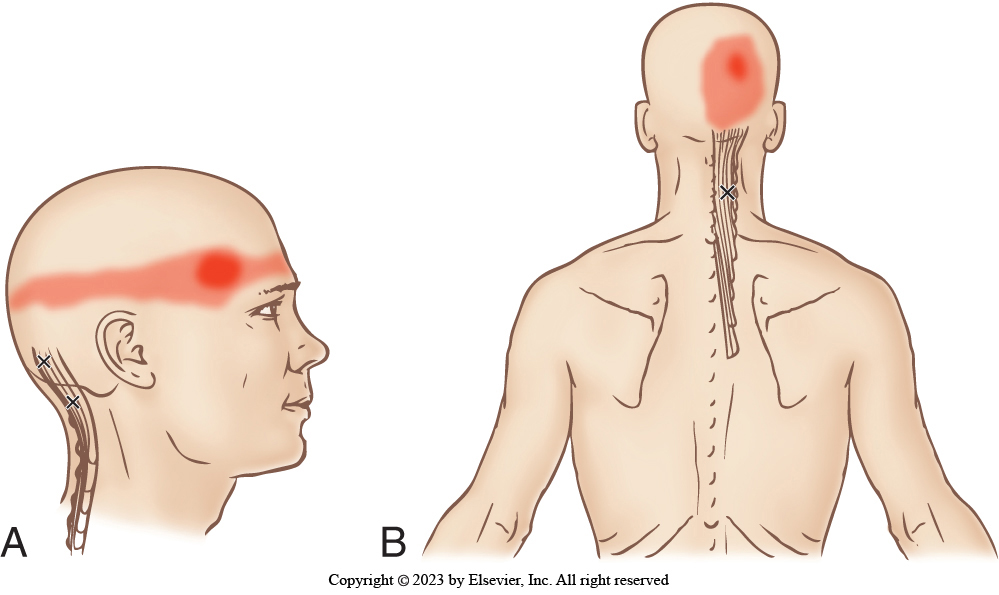
TrPs and their referral zones in the semispinalis capitis. Permission Dr. Joe Muscolino – The Muscle and Bone Palpation Manual 3ed.
There is no one stroke that is right or wrong for any specific muscle. I tend to like to work the semispinalis capitis longitudinally, with vertical strokes, always staying fare medial over the laminar groove of the spine. The semispinalis capitis can be worked with the client supine, in which case the strokes would be from superior to inferior. Or with the client prone, in which case the strokes would be from inferior to superior.
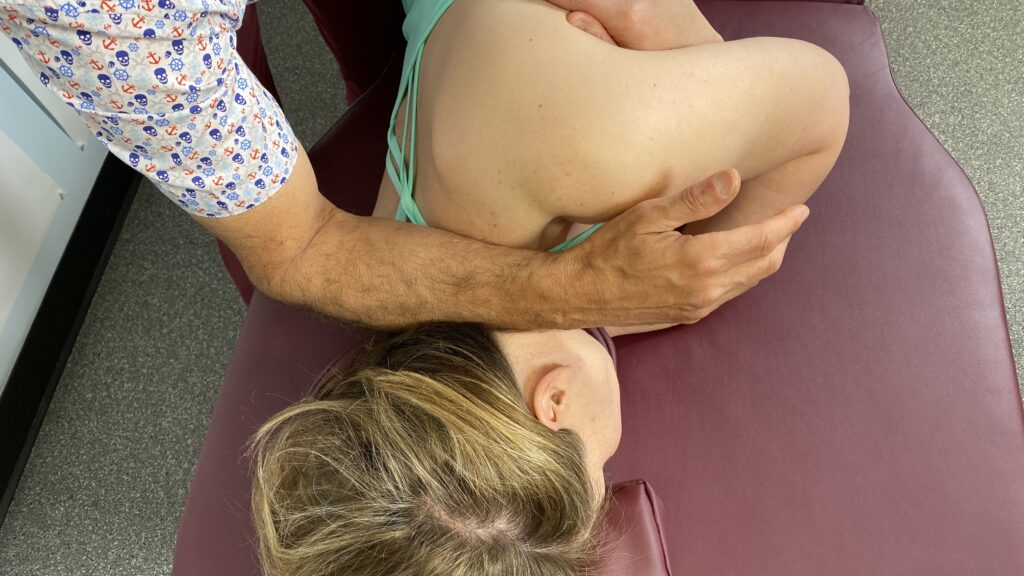
3/4 side-lying massage of the semispinalis capitis. Permission Dr. Joe Muscolino (learnmuscles.com).
But the most efficient and powerful way to work the semispinalis capitis is with the client in the ¾ side-lying position (the client starts side-lying, and then the therapist has them rotate their entire body away from them 45 degrees). This allows the therapist to position their body weight directly above the muscle (picture a plumb line dropping from the sternum onto the semispinalis capitis) and use their body weight and drop down perfectly vertically down into it with a forearm contact, with strokes that are from inferior to superior.
Note: This is an advanced technique and should be practiced and perfected before employing it with clients.
The semispinalis capitis is fairly deep, so the pressure needs to be fairly deep if it will reach the muscle. Whenever working with deep pressure, be sure to first warm up the area with lighter to medium depth work. And always work with the client’s breath, and sink in slowly (slowly!). It is amazing how comfortable a client can be with deep work, if it is done slowly, allowing the tissue time to accommodate and accept the pressure.
Conclusion
I cannot emphasize how important the semispinalis capitis muscle is in the posterior neck. The posterior neck is where Leon Chaitow’s famous expression of use/overuse/misuse/abuse so well applies. With all the forward-head posture that we assume with the use (overuse, etc.) of smart phone and other digital devices, the musculature of the posterior neck is almost always in a state of isometric contraction, trying to maintain the head in this imbalanced forward posture to stop it from falling with gravity all the way into flexion. So, being able to competently and thoroughly palpate and assess, and treat with massage and stretching, is incredibly important.
When the client has pain and/or tightness in the back of the neck, do not just default to what might be the typically thought of usual suspects, instead think of what might have been considered to be an unusual suspect, the semispinalis capitis!
Frequently Asked Questions About the Semispinalis Capitis
What is the semispinalis capitis? The semispinalis capitis is the largest muscle in the posterior neck. It belongs to the transversospinalis group and runs from the transverse and articular processes of T6–C4 up to the medial occiput.
What does the semispinalis capitis do? It extends the head and neck at the cervical spinal joints and contributes to lateral flexion. Unlike other transversospinalis muscles, it does not rotate the head because it runs directly vertically.
Why does the semispinalis capitis cause neck pain? Because it is the largest muscle in the posterior neck and is in near-constant isometric contraction in people with forward-head posture (e.g., from prolonged phone and screen use), it is a very common source of tightness and pain — yet it is frequently misattributed to the upper trapezius or erector spinae.
How do we stretch the semispinalis capitis? It is stretched with cervical flexion combined with contralateral (opposite-side) lateral flexion, since those movements are the opposite of its concentric/shortening actions (extension and same-side lateral flexion).
How do you massage the semispinalis capitis? Work longitudinally with vertical strokes, staying medial over the laminar groove. The most effective position is the ¾ side-lying position, which allows the therapist to use body weight to apply sufficient depth. Always warm up the tissue first and sink in slowly.
Where is the semispinalis capitis located? It lies deep to the upper trapezius in the superior neck, and deep to both the splenius capitis and upper trapezius in the mid to lower neck. It is superficial to the semispinalis cervicis, multifidus, rotatores, and (in the upper neck) the suboccipital muscles.
Biography

Dr. Joseph Muscolino, DC is a soft-tissue oriented chiropractic physician and leading educator in manual and movement therapy. He is the author of eight major textbooks published by Elsevier and LWW, translated into more than 10 languages and used worldwide in core curriculum and clinical practice. A global lecturer and NCBTMB-approved CE provider, he offers COMT (Clinical Orthopedic Manual Therapy) certification workshops across the US and internationally. Visit his website at: LearnMuscles.com.
LearnMuscles Continuing Education (LMCE) is one of his online subscription platforms with over 4,000 video lessons for manual and movement therapy professionals, and more than 320 free NCBTMB-CE hours.

