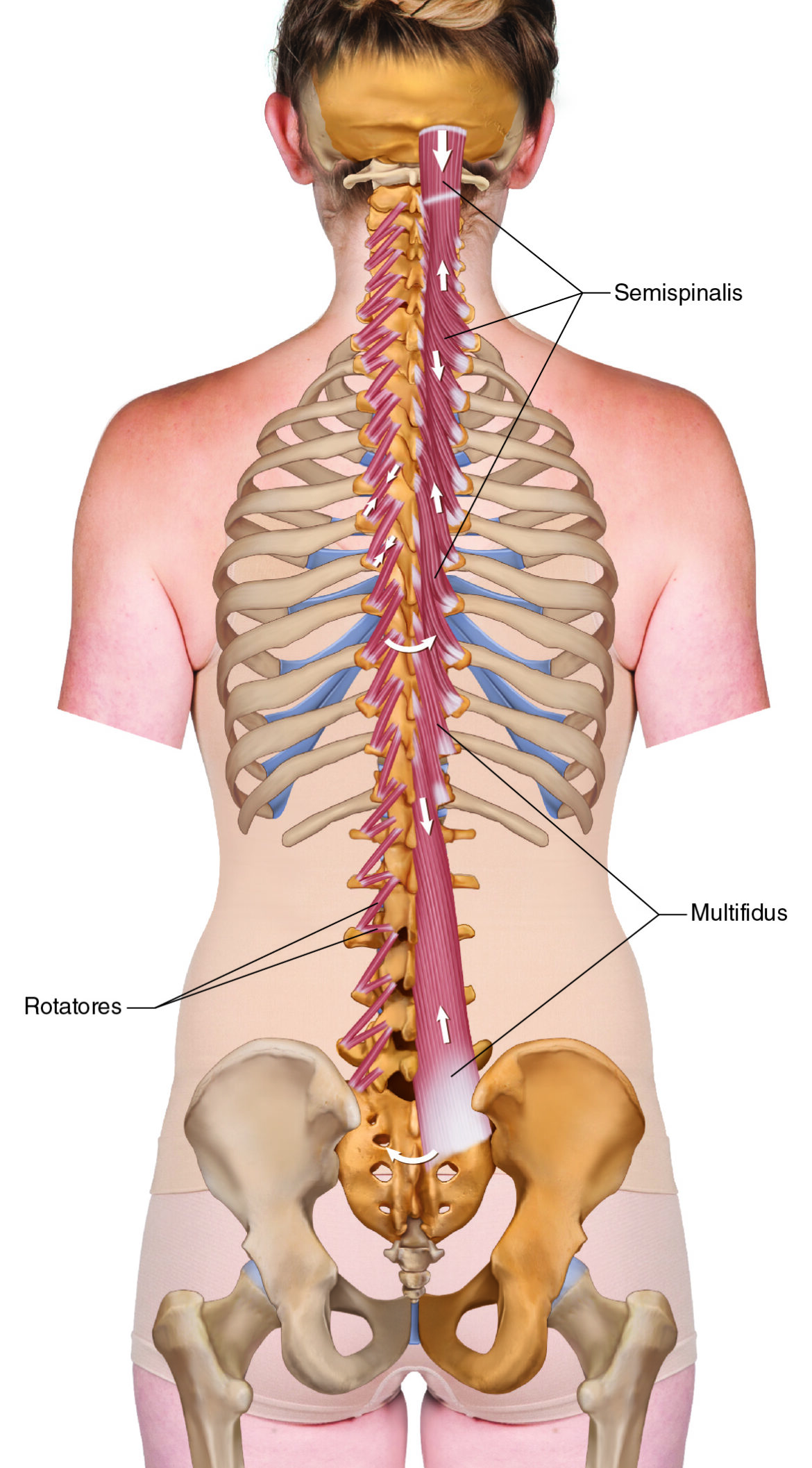
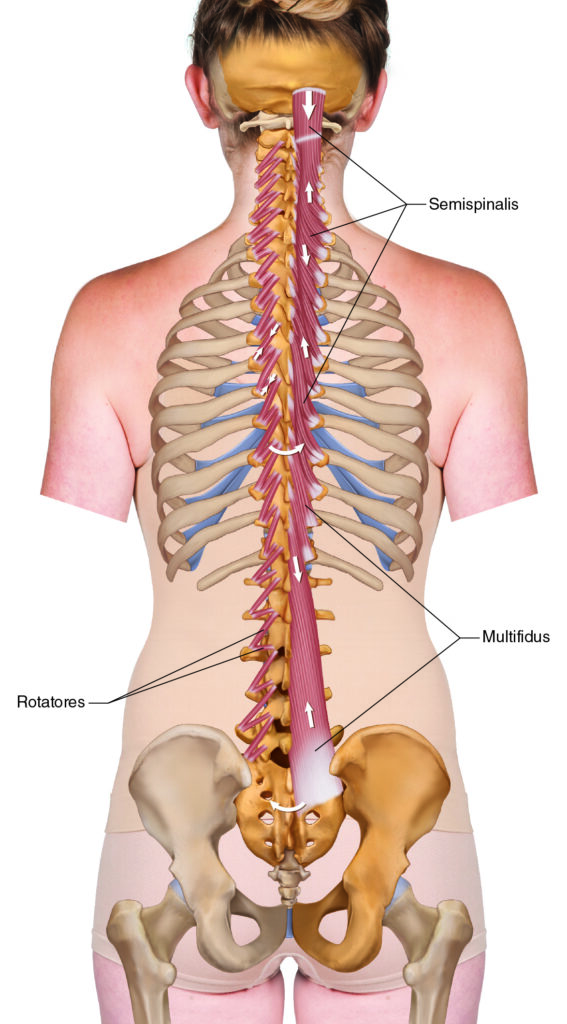
Transversospinalis Group. Permission Dr. Joe Muscolino (learnmuscles.com).
Introduction
The transversospinalis (along with the erector spinae) is one of two groups that comprise the paraspinal musculature. As the name implies, the transversospinalis musculature runs from transverse processes (transverso) to spinous processes (spinalis), therefore, they are located far medial in the laminar groove of the spine.
Transversospinalis Attachments
As a group, the transversospinalis musculature runs essentially from
transverse processes (TPs) inferiorly (origin)
to
spinous processes (SPs) superiorly (insertion)
(from the pelvis to the head).
There are three subgroups of the transversospinalis. Where they overlap, they are, from deep to superficial…
- Rotatores (running from L5 to C2/axis)
- Multifidus (running from the pelvis to as high as C2/axis)
- Semispinalis (running from T10 all the way up onto the head/occiput)
For more detail on the semispinalis capitis of the transversospinalis group, click here.
And, as a rule…
- The rotatores run from a TP inferiorly, to an SP superiorly, one to two levels above.
- The multifidus runs from a TP inferiorly to an SP superiorly, three to four levels above.
- The semispinalis runs from a TP inferiorly to an SP superiorly, five or more levels above.
Transversospinalis Functions
Open Chain
The transversospinales have differing lines of pull.
The semispinalis is more vertical; the rotatores are much more horizontal; and the multifidus are between the other two.
The more vertical the line of pull, the better the muscle is at extension in the sagittal plane and lateral flexion in the frontal plane (both sagittal and frontal planes are vertical).
The more horizontal the line of pull, the better the muscle is at rotation in the transverse plane (the only horizontal plane). Indeed, the name rotatores (the most horizontal of the three groups) indicates that it excels at rotation.
So…
Because the transversospinalis crosses the spine posteriorly with a vertical direction to its line of pull, it does extension of the spine at the spinal joints (in the sagittal plane).
Because each transversospinalis group (left or right) is located to one side, it crosses the spine laterally on that side with a vertical direction to its line of pull, so it does lateral flexion of the spine at the spinal joints (in the frontal plane).
Note: All lateral flexion is same-side lateral flexion, in other words, ipsilateral lateral flexion.
Because the transversospinalis crosses the spine somewhat horizontally, it pulls horizontally to create rotation. When pulling the more-superior SP toward the more-inferior TP, it pulls the SP toward the side of the TP, which creates rotation of the spine to the opposite side of the body (in the transverse plane).
Note: Remember, rotation is always named for where the anterior aspect of the bone (in this case, the body of the vertebra) comes to orient.
So, the transversospinalis does…
Extension, lateral flexion, and contralateral rotation of the spine.
Closed Chain
All of the foregoing conversation was with open-chain mechanics. With closed-chain mechanics, for example, if a person is lying down in bed and decides to move their lower spine (or even pelvis) relative to the upper body, then we would have the following joint actions.
There would still be sagittal-plane extension of the spine. And for the transversospinalis multifidus, because it crosses the lumbosacral (L5-S1/LS) joint posteriorly, it also does sagittal-plane anterior tilt of the pelvis at the LS joint.
There would still be frontal-plane lateral flexion of the spine (or frontal-plane elevation of the same-side pelvis).
There would still be transverse-plane rotation, but now it would be ipsilateral rotation of the lower spine (or pelvis) relative to the upper spine.
Stabilization…
Muscle function is not only important for open-chain or closed-chain movement… it is also important for isometric-contraction stabilization. In this regard, the multifidus is extremely important for core (lumbosacral region) stabilization of the body.
Nearby Anatomy
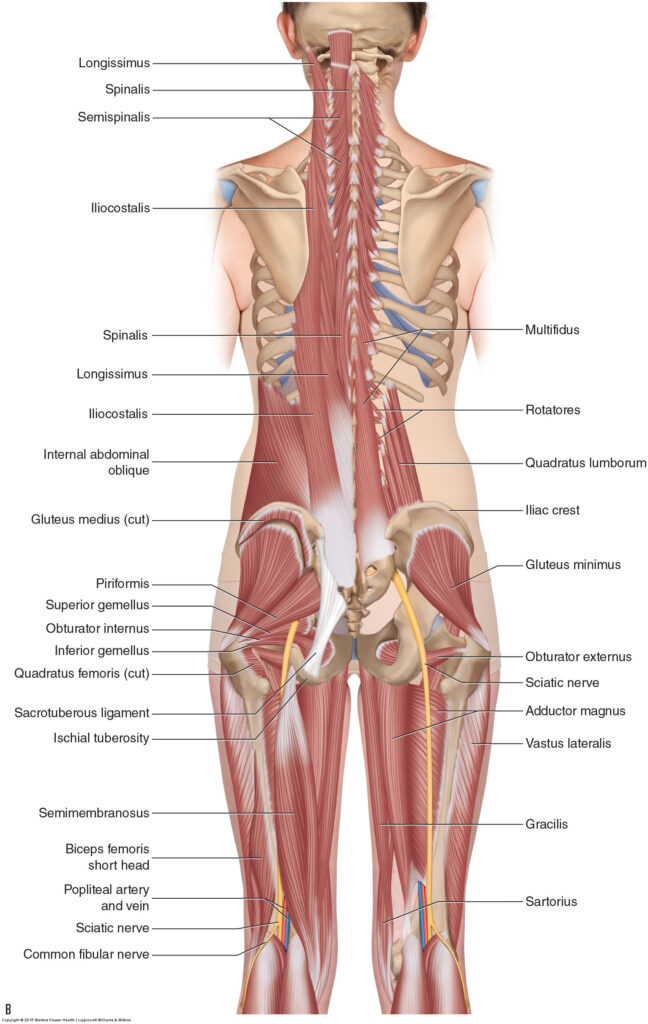
Deep posterior view of trunk musculature. Permission Dr. Joe Muscolino (learnmuscles.com).
There is no musculature deep to the deepest transversospinalis musculature, the rotatores.
Where the erector spinae and transversospinalis musculature overlap, the transversospinalis is deep to the erector spinae. In the lower back, the transversospinalis is also deep to the latissimus dorsi. In the middle to upper back, the transversospinalis is also deep to the rhomboids and middle trapezius. In the cervical spine, the transversospinalis is deep to the splenius capitis and upper trapezius.
Palpating the Transversospinalis
The transversospinalis is generally deep, but can usually be fairly easily palpated, assuming the more superficial musculature is not so tight that it blocks sinking in through it to reach the deeper transversospinalis.
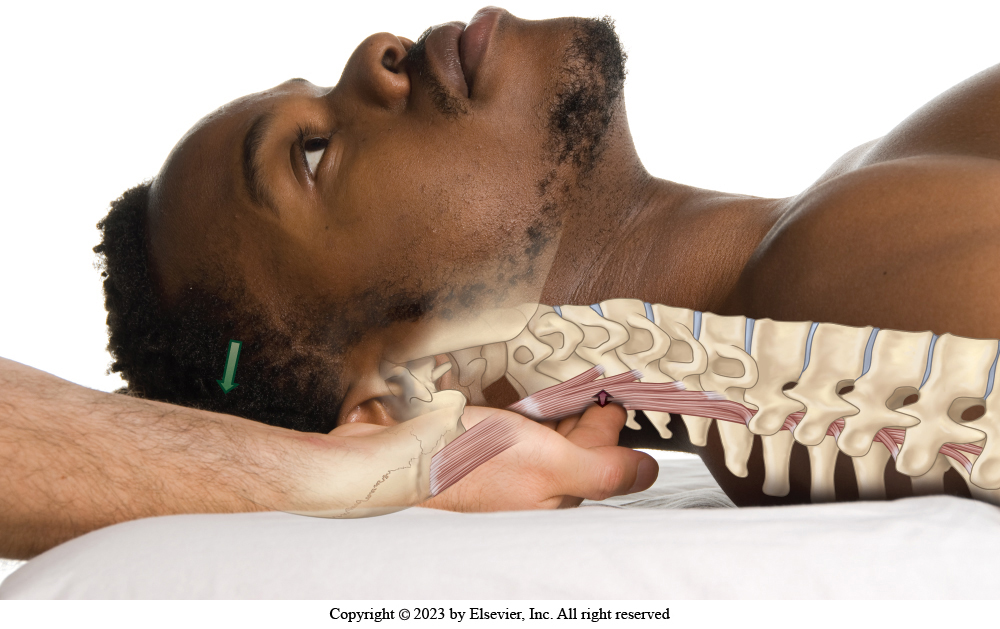
Palpation of the semispinalis capitis. Permission Dr. Joe Muscolino – The Muscle and Bone Palpation Manual 3ed.
The semispinalis capitis is the thickest muscle in the back of the neck, so it is also easily palpable and easy to work with soft-tissue manipulation massage.
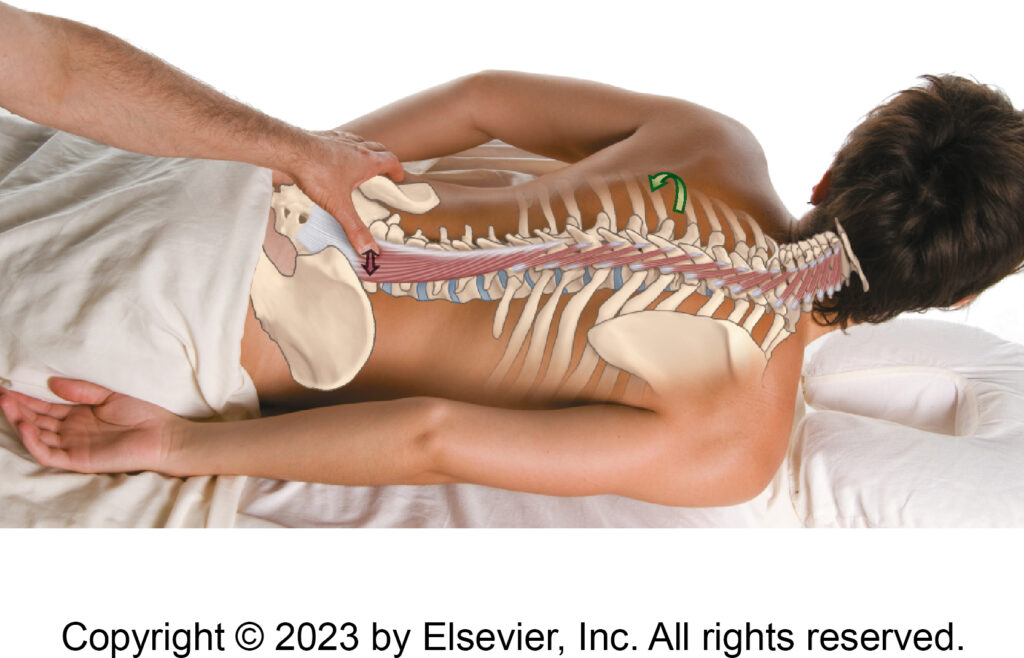
Palpation of the multifidus. Permission Dr. Joe Muscolino – The Muscle and Bone Palpation Manual 3ed.
And it is worth noting that the multifidus is the thickest muscle in the low back, so it is usually easy to palpate; sometimes, a very tight longissimus of the erector spinae group can make it challenging to palpate and discern the deeper multifidus in the lumbar region. But, even in these cases, it is certainly easy to translate pressure into the multifidus.
Stretching the Transversospinalis
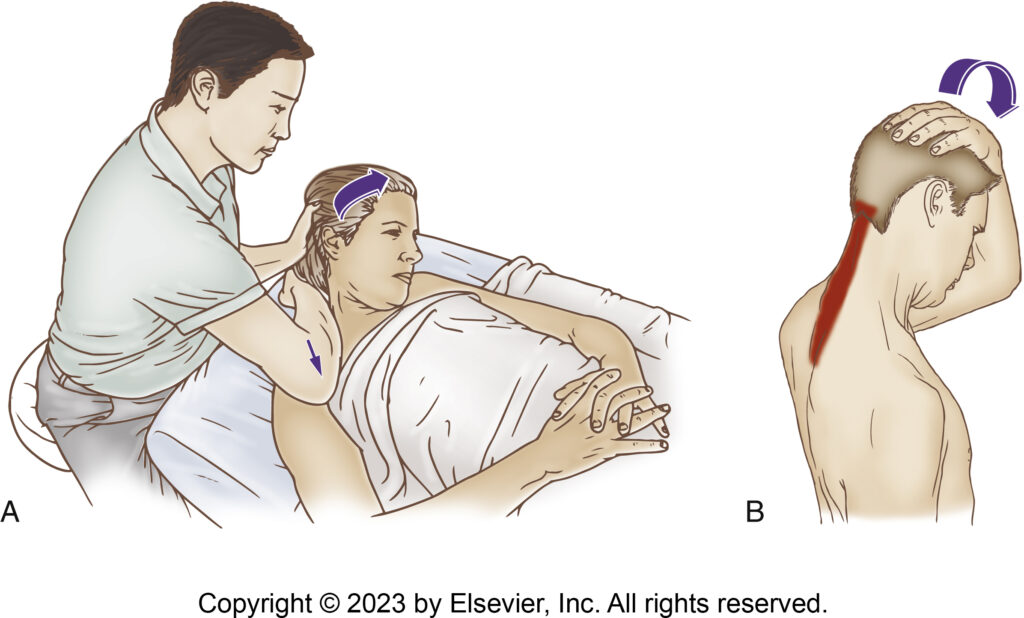
Stretching the right-side semispinalis capitis. Permission Dr. Joe Muscolino – The Muscle and Bone Palpation Manual 3ed.
The transversospinalis can be stretched with flexion and contralateral lateral flexion (lateral flexion to the opposite side) of the spine.
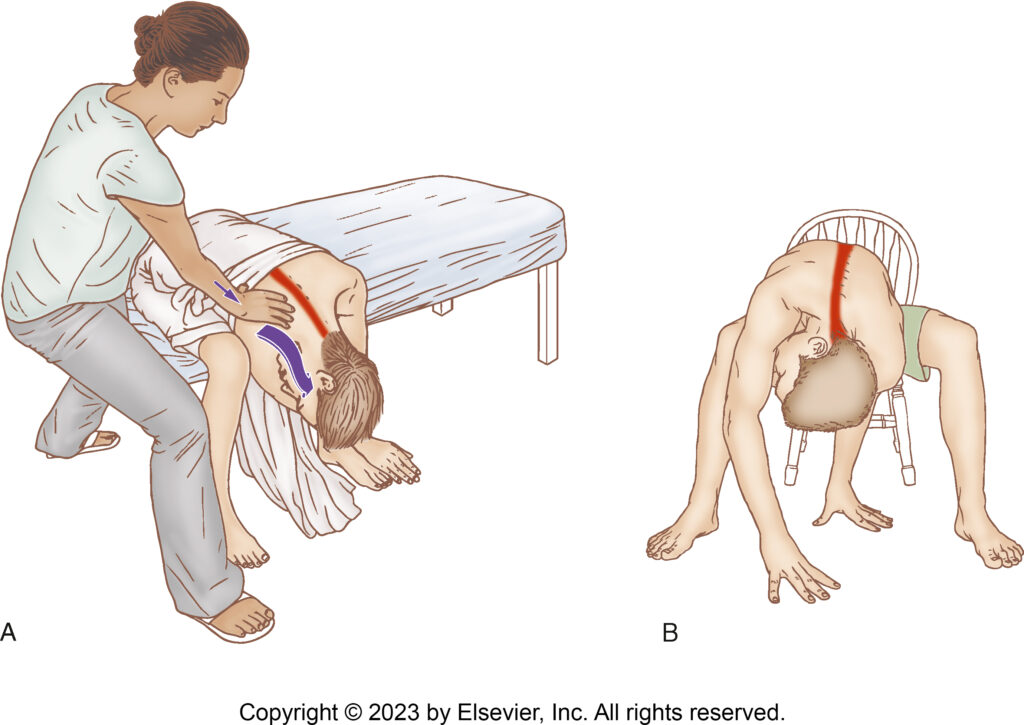
Stretching the right-side trunk transversospinalis. Permission Dr. Joe Muscolino – The Muscle and Bone Palpation Manual 3ed.
This will also stretch the nearby erector spinae, so if you can add in some rotation to the same side for the low back multifidus stretch, then the protocol will preferentially stretch the transversospinalis.
Massaging the Transversospinalis
It is likely that the transversospinalis is some of the most important musculature that needs to be treated with massage and stretching.
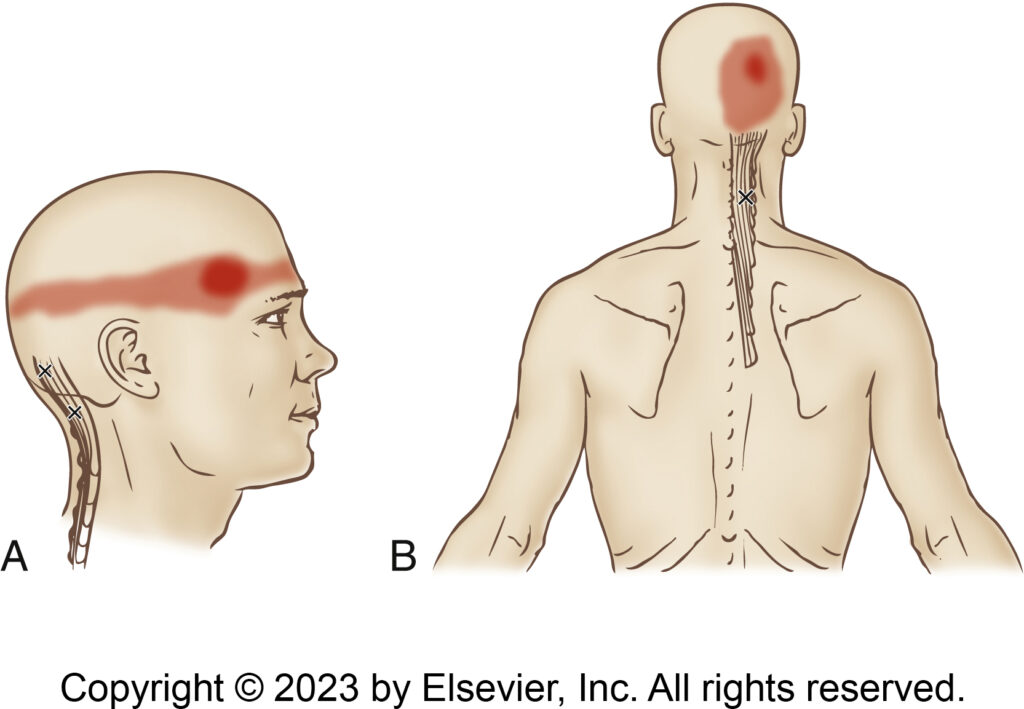
Semispinalis capitis trigger points and their referral zones. Permission Dr. Joe Muscolino – The Muscle and Bone Palpation Manual 3ed.
The semispinalis capitis is likely the most important muscle in the back of the neck, it is often tight and painful. And interestingly, its tightness and pain are often mistakenly attributed to the upper trapezius and/or erector spinae (which, btw, are rarely the cause of pain and dysfunction in the middle to upper cervical spine).
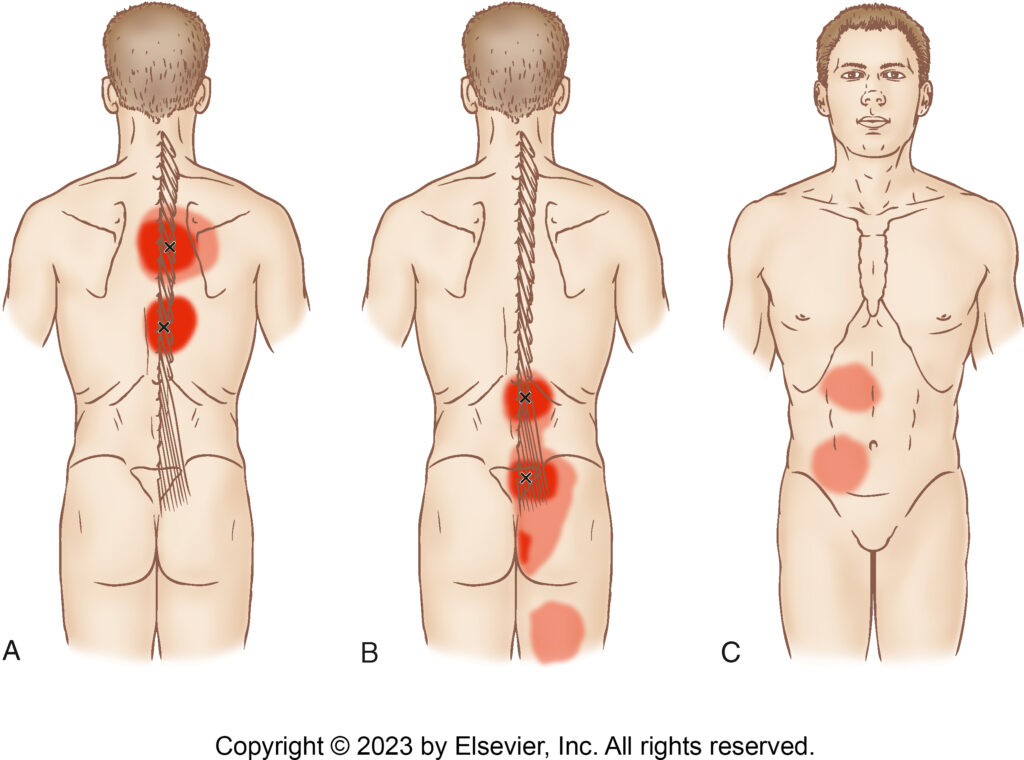
Thoracolumbar transversospinalis trigger points and their referral zones. Permission Dr. Joe Muscolino – The Muscle and Bone Palpation Manual 3ed.
And the multifidus is the thickest musculature in the lumbosacral region, it is extremely valuable to work, especially with clients who have lower crossed syndrome (a postural distortion pattern involving excessive anterior pelvic tilt with hyperlordosis (excessive extension) of the lumbar spine.
When working the transversospinalis, it is incredibly important to work very far medially. Most therapists have a tendency to work too far laterally, both in the trunk, and especially in the neck.
You must work into the laminar groove.
The best protocol is to first find the spinous process at whatever level you are working and then drop immediately laterally off it so that you are sure to be over the laminar groove, and therefore over the transversospinalis musculature.
Conclusion
The transversospinalis musculature is extremely important functionally, and important with pain and dysfunction. It includes the multifidus, the thickest muscle of the low back; and the semispinalis capitis, the thickest muscle in the back of the neck. When working this musculature, it is extremely important to work very far medially, over the laminar groove of the spine.
Biography
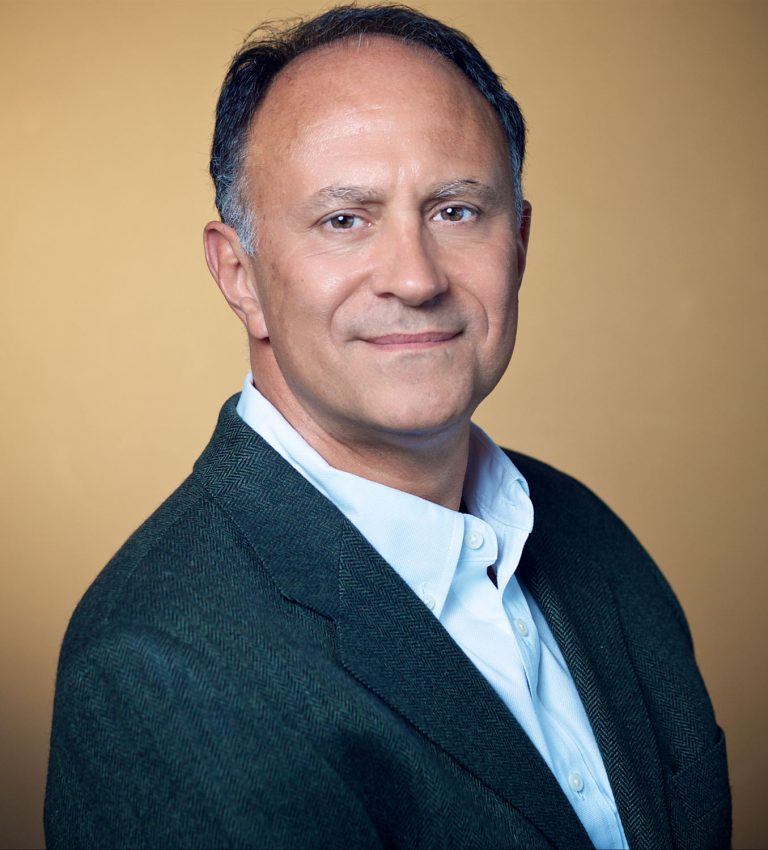
Dr. Joseph Muscolino, DC is a soft-tissue oriented chiropractic physician and leading educator in manual and movement therapy. He is the author of eight major textbooks published by Elsevier and LWW, translated into more than 10 languages and used worldwide in core curriculum and clinical practice. A global lecturer and NCBTMB-approved CE provider, he offers COMT (Clinical Orthopedic Manual Therapy) certification workshops across the US and internationally. Visit his website at: LearnMuscles.com.
LearnMuscles Continuing Education (LMCE) is one of his online subscription platforms with over 4,000 video lessons for manual and movement therapy professionals, and more than 320 free NCBTMB-CE hours.