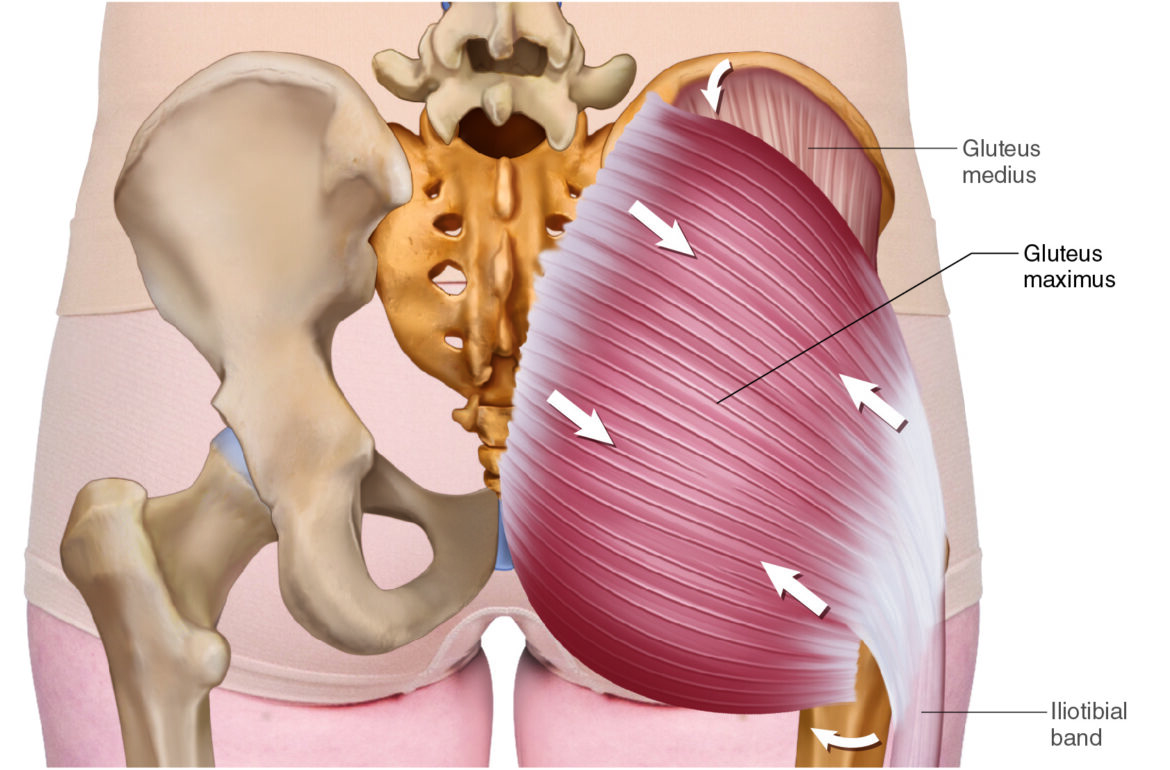
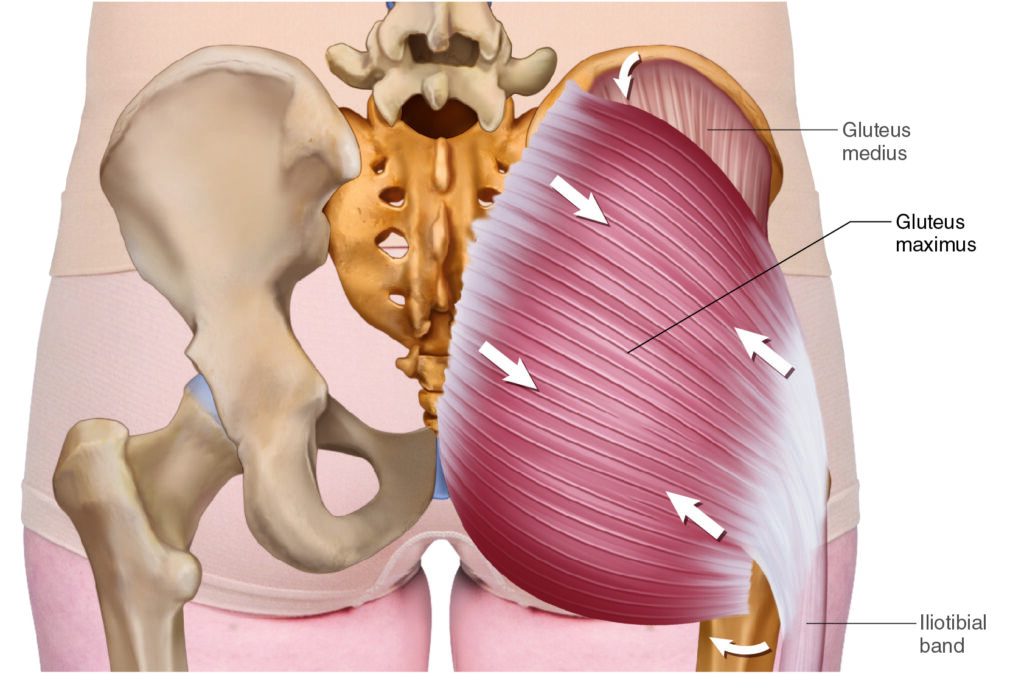
Gluteus maximus. Permission Dr. Joe Muscolino (learnmuscles.com).
Quick Answer: The gluteus maximus is the largest muscle in the human body. It attaches from the posterior iliac crest, posterolateral sacrum, and coccyx to the iliotibial band (ITB) and the gluteal tuberosity of the femur. Its primary open-chain actions are hip extension, lateral rotation, and (depending on fiber orientation) abduction or adduction of the thigh. In closed-chain function, it posteriorly tilts the pelvis, contralaterally rotates the pelvis, and elevates or depresses the same-side pelvis — making it a key muscle for core/powerhouse stability and sacroiliac joint stabilization.
Introduction
The gluteus maximus is the largest muscle in the human body. It is superficial in the posterior pelvis, crossing the hip joint to move both the thigh and the pelvis at the hip joint in all three planes.
Gluteus Maximus Attachments
The gluteus maximus attaches from the pelvic bone to the femur
More specifically, the gluteus maximus attaches from the…
posterior iliac crest, posterolateral sacrum, and the coccyx
to the
iliotibial band (ITB) and the gluteal tuberosity of the femur
However, it should be emphasized that there are superior deep fibers of the gluteus maximus (located directly lateral to the PSIS) that attach from the sacrum directly onto the ilium of the pelvic bone, therefore they directly cross the sacroiliac joint.
Notes:
- The ITB can be thought of as a distal tendinous attachment of the superior fibers of the gluteus maximus.
- The gluteal tuberosity of the femur can be thought of as a proximal lateral extension of the linea aspera.
Gluteus Maximus Functions
Open-Chain Actions:
In open chain kinematics, the distal attachment of the gluteus maximus, in other words the femur, is free to move, so the thigh/femur moves at the hip joint relative to a fixed/stable pelvis. The open-chain joint actions of the gluteus maximus are…
Extension of the thigh at the hip joint in the sagittal plane
Lateral rotation of the thigh at the hip joint in the transverse plane
Both abduction and adduction of the thigh at the hip joint in the frontal plane…
- The upper 1/3 of the gluteus maximus fibers cross above the axis of motion, so they abduct the thigh at the hip joint.
- The lower 2/3 of the gluteus maximus fibers cross below the axis of motion, so they adduct the thigh at the hip joint.
Closed-Chain Actions:
In closed-chain kinematics, the distal attachment is fixed/stable, so the proximal attachment moves instead. Therefore, the pelvis moves at the hip joint relative to the fixed/stable femur.
The gluteus maximus posteriorly tilts the pelvis at the hip joint in the sagittal plane.
The gluteus maximus contralaterally rotates the pelvis at the hip joint in the transverse plane.
The gluteus maximus can both elevate and depress the same-side pelvis at the hip joint in the frontal plane.
- The upper fibers, being abductors of the thigh, are depressors of the same-side pelvis at the hip joint.
- The lower fibers, being adductors of the thigh, are elevators of the same-side pelvis at the hip joint.
Stabilizing Function:
Because the superior deep fibers of the gluteus maximus cross from sacrum to ilium, they cross the sacroiliac joint and can, therefore, perform a stabilizing function at the sacroiliac joint.
Nearby Anatomy
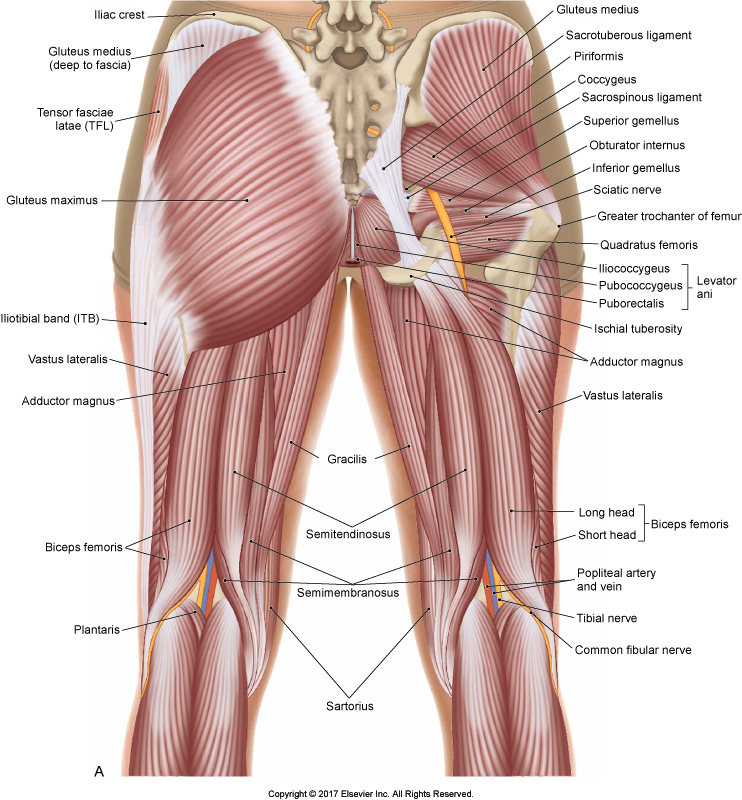
Posterior view of the musculature of the pelvis. Permission Dr. Joe Muscolino – The Muscular System Manual, 5ed.
The gluteus maximus, being superficial in the posterior pelvis is superficial to the posterior fibers of the gluteus medius (and gluteus minimus), as well as all six deep lateral rotators of the thigh at the hip joint (from superior to inferior: piriformis, superior gemellus, obturator internus, inferior gemellus, obturator externus, quadratus femoris).
The gluteus maximus is also superficial to the proximal aspect of the hamstring muscles.
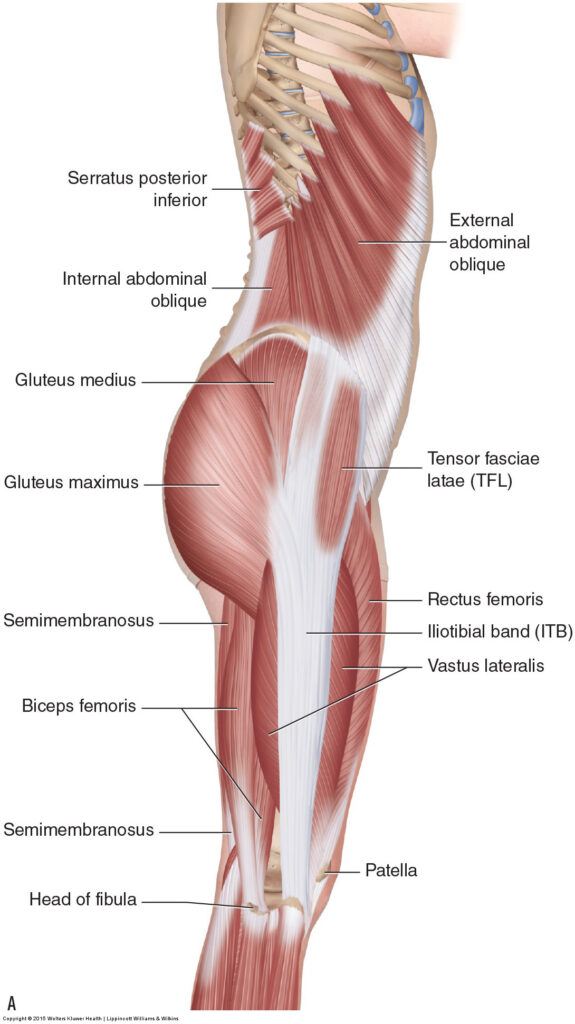
Lateral view of the musculature of the pelvis. Permission Dr. Joe Muscolino (learnmuscles.com).
Both the gluteus maximus and the tensor fasciae latae (TFL) attach into the ITB.
Gluteus Maximus as part of the Core/Powerhouse
Because of its closed-chain action of posterior tilt of the pelvis at the hip joint, the gluteus maximus is an important muscle for core stability/strength of the powerhouse. Generally, a weak core leads to weak/overly inhibited posterior pelvic tilters (anterior abdominal wall musculature and hip extensor musculature) and tight/overly facilitated anterior pelvic tilters (low back extensor musculature and hip flexor musculature). This leads to an excessively anteriorly tilted pelvis, which then leads to a hyperlordotic lumbar spine, which then leads to excessive weight bearing / jamming of the facet joints, and possible low back pain.
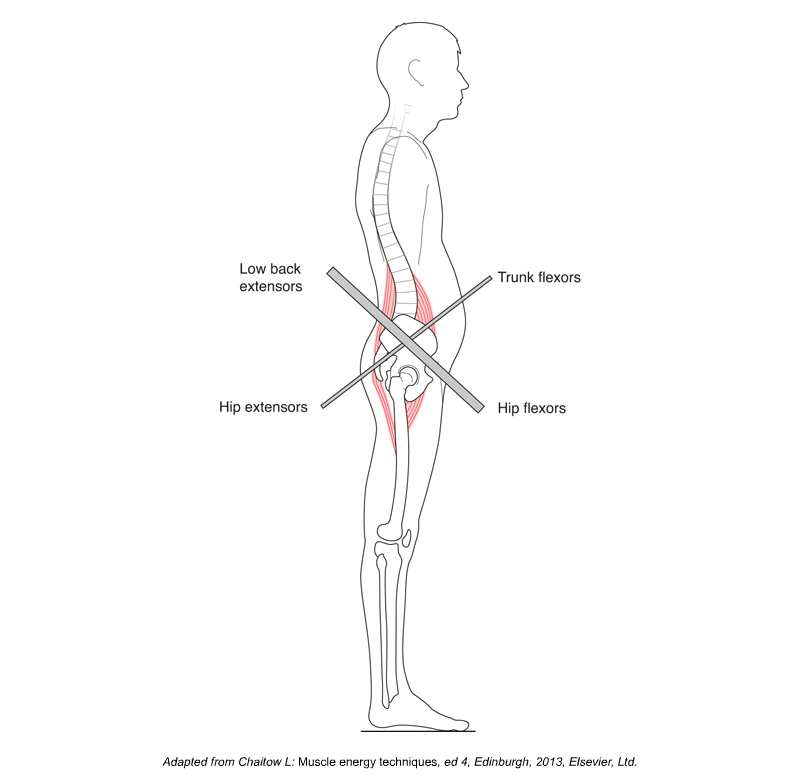
Lower crossed syndrome. Permission Dr. Joe Muscolino – Kinesiology, the Skeletal System and Muscle Function, 4ed.
This pattern is central to Vladimir Janda’s “lower crossed syndrome” postural distortion pattern. Therefore, it is a key part of core/powerhouse strength training to strengthen the gluteus maximus.
Gluteus Maximus Trigger Points
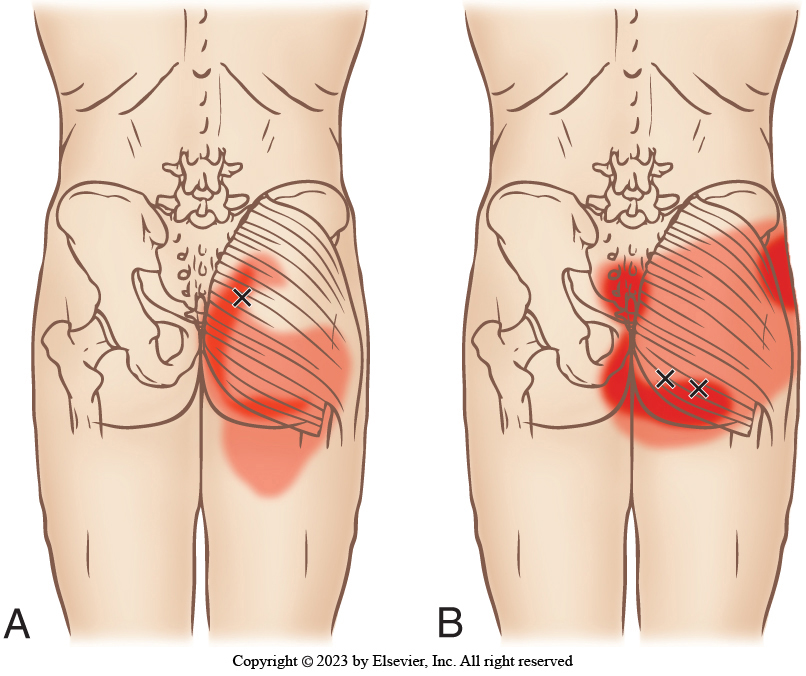
Gluteus maximus trigger points. Permission Dr. Joe Muscolino – The Muscle and Bone Palpation Manual, 3ed.
Even though the gluteus maximus is generally a weak/overly inhibited muscle, there are deep superior fibers of the gluteus maximus that attach directly from the sacrum to ilium, thereby crossing the sacroiliac joint. As such, when isometrically contracting, they can help to stabilize the sacroiliac joint. For this reason, it is common for there to be myofascial trigger points in these fibers whenever there are issues with the sacroiliac joint. They can be palpated directly lateral to the PSIS.
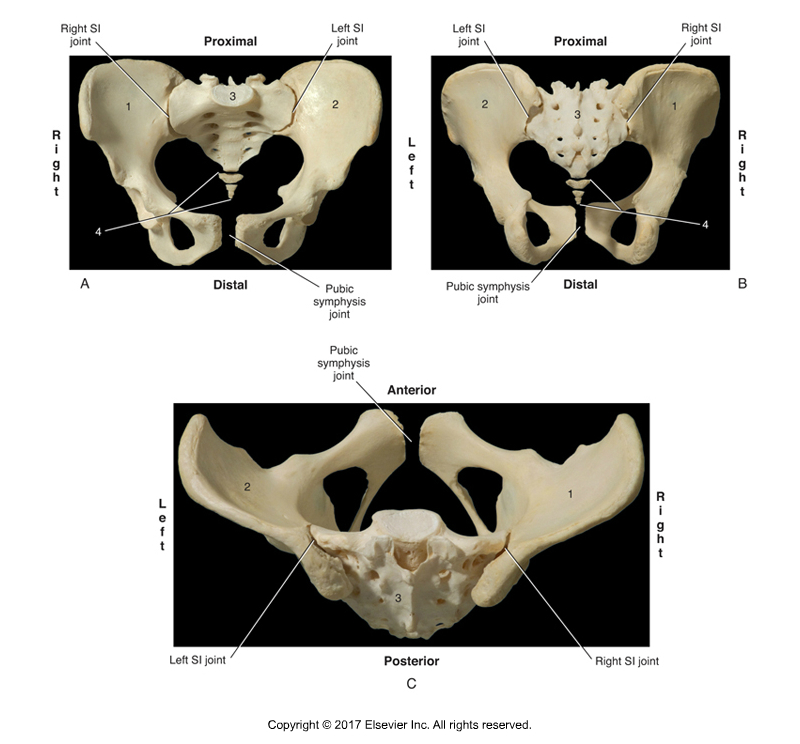
The sacroiliac joint (SIJ). Permission Dr. Joe Muscolino (learnmuscles.com).
The problem is that when these fibers guard/protect the sacroiliac joint, they develop trigger points that can then become the cause of the client’s low back/hip pain syndrome.
Palpating the Gluteus Maximus
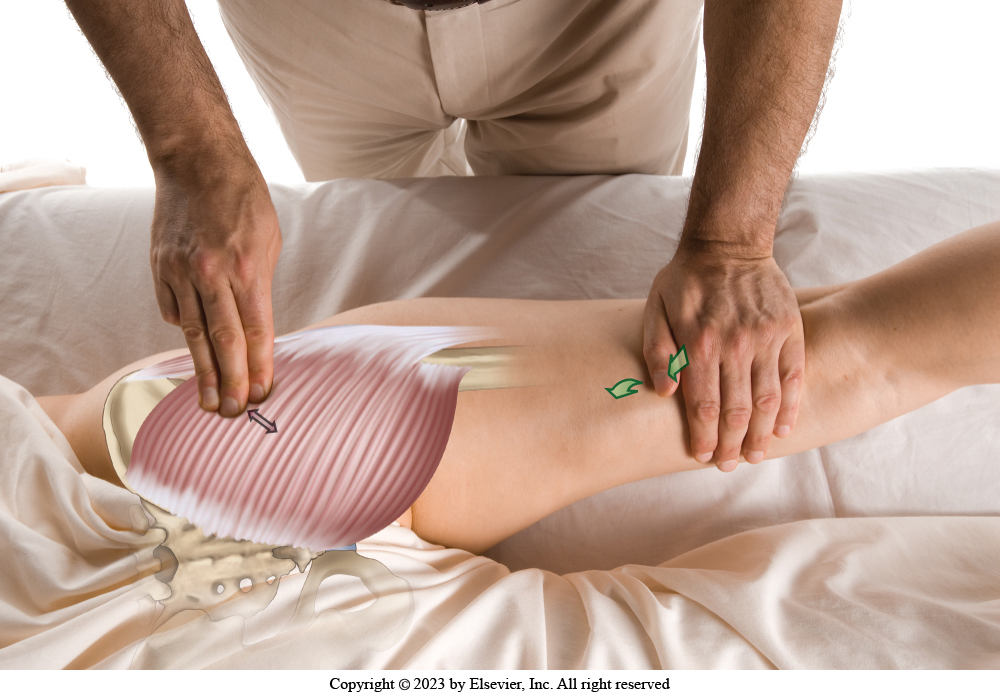
Palpating the gluteus maximus. Permission Dr. Joe Muscolino – The Muscle and Bone Palpation Manual, 3ed.
Because the gluteus maximus is superficial, it can be easily palpated. Have the client prone and ask them to laterally rotate their thigh, and then extend it up into the air. The gluteus maximus will engage and harden. Once the borders are located, with the client relaxed, palpate the entirety of the gluteus maximus. Be especially mindful to assess the superior fibers immediately lateral to the PSIS.
Massaging the Gluteus Maximus
Massaging the gluteus maximus follows from palpation. Static pressure can be applied ipsilaterally, i.e., standing on the same side that you are working. Because of the contour of the muscle, if strokes will be performed (with appropriate draping), then it is easier to work contralaterally (standing on the opposite side from the side you are working).
Stretching the Gluteus Maximus
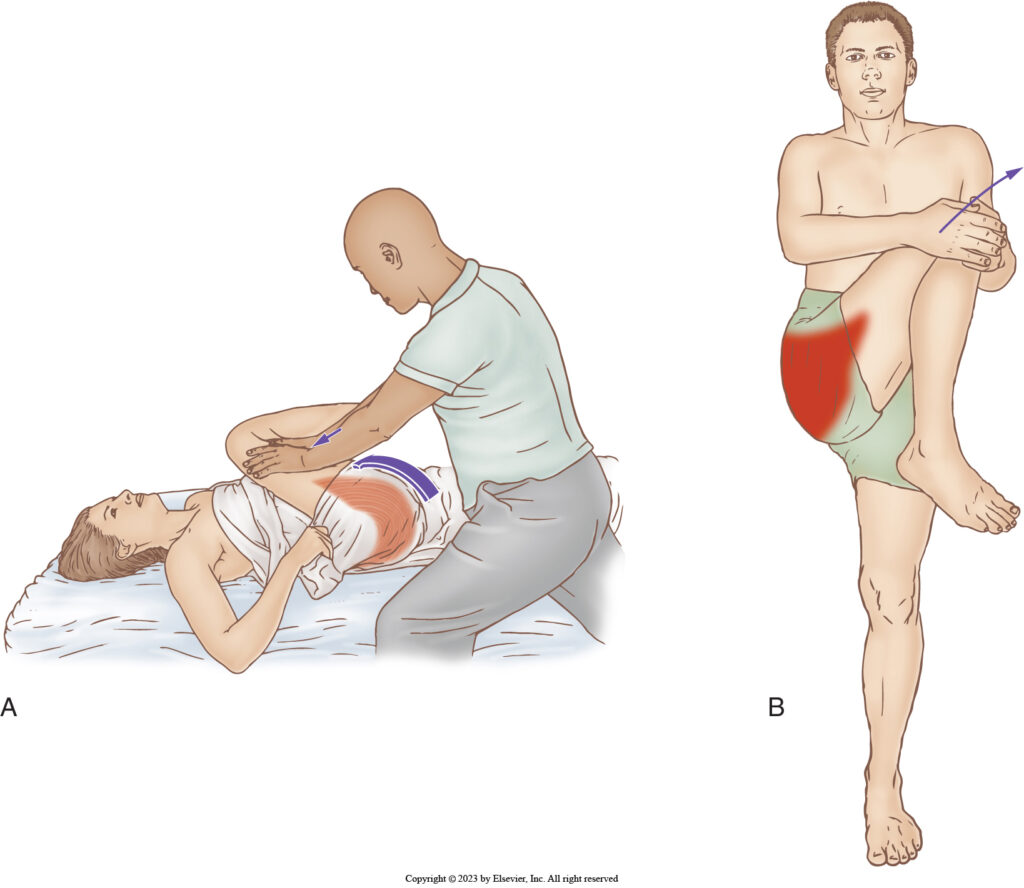
Stretching the gluteus maximus. Permission Dr. Joe Muscolino – The Muscle and Bone Palpation Manual, 3ed.
The gluteus maximus can be stretched with knee to chest stretch in which the supine client’s thigh is brought up toward the same-side shoulder. This preferentially stretches the lower fibers. To best stretch the upper fibers, the thigh should be brought up toward the opposite-side shoulder (this is essentially the same stretch as is done for the deep lateral rotator group musculature (including the piriformis).
Conclusion
Functionally, the gluteus maximus is an important muscle primarily because of its pelvic posterior tilt concentric contraction function, and because of its isometric stabilization function to armor/protect the sacroiliac joint. Manual therapists should be mindful to especially assess the superior fibers lateral to the PSIS.
About the Author

Dr. Joe Muscolino (learnmuscles.com).
Dr. Joseph Muscolino, DC is a soft-tissue oriented chiropractic physician and leading educator in manual and movement therapy. He is the author of eight major textbooks published by Elsevier and LWW, translated into more than 10 languages and used worldwide in core curriculum and clinical practice. A global lecturer and NCBTMB-approved CE provider, he offers COMT (Clinical Orthopedic Manual Therapy) certification workshops across the US and internationally. Visit his website at: LearnMuscles.com.
LearnMuscles Continuing Education (LMCE) is one of his online subscription platforms with over 4,000 video lessons for manual and movement therapy professionals, and more than 320 free NCBTMB-CE hours.
Frequently Asked Questions
What is the largest muscle in the human body?
The gluteus maximus is the largest muscle in the human body. It is superficial in the posterior pelvis and crosses the hip joint to move the thigh and pelvis in all three planes.
Where does the gluteus maximus attach?
The gluteus maximus attaches from the posterior iliac crest, posterolateral sacrum, and coccyx to the iliotibial band (ITB) and the gluteal tuberosity of the femur. Its superior deep fibers also attach directly from the sacrum onto the ilium, crossing the sacroiliac joint.
What are the open-chain actions of the gluteus maximus?
In open-chain kinematics, the gluteus maximus extends the thigh at the hip joint, laterally rotates the thigh, and either abducts (upper 1/3 of fibers) or adducts (lower 2/3 of fibers) the thigh at the hip joint.
What are the closed-chain actions of the gluteus maximus?
In closed-chain kinematics, the gluteus maximus posteriorly tilts the pelvis, contralaterally rotates the pelvis, and either elevates (lower fibers) or depresses (upper fibers) the same-side pelvis at the hip joint.
Why is the gluteus maximus important for core/powerhouse stability?
Because of its closed-chain posterior pelvic tilt action, the gluteus maximus is a key posterior pelvic tilter. Weakness here contributes to an excessively anteriorly tilted pelvis and hyperlordotic lumbar spine — a pattern central to Vladimir Janda’s “lower crossed syndrome.”
Where are gluteus maximus trigger points commonly found?
Myofascial trigger points are commonly found in the deep superior fibers of the gluteus maximus, directly lateral to the PSIS, especially when there are issues with the sacroiliac joint.
How do you stretch the gluteus maximus?
The lower fibers are stretched with a knee-to-chest stretch bringing the supine client’s thigh toward the same-side shoulder. The upper fibers are best stretched by bringing the thigh toward the opposite-side shoulder — the same stretch used for the deep lateral rotator group, including the piriformis.